Timber

Western wildfires endanger beloved sites at national parks

Wildfires burning in the Western U.S. are threatening some of America’s most treasured national parks – and in some areas, the damage has already been done.

Last week in Montana, a 20-square-mile blaze burned the historic Sperry Chalet, a hotel and dining room built in 1914 and only reachable by trail.

“We are saddened to inform you that Sperry Chalet has been lost,” the chalet’s operator writes in a post to the chalet’s website. “The Sprague Fire reached the chalet around 6:00pm on Thursday, August 31. The hotel building was rapidly engulfed by fire.”

“This event marks a significant moment in the history of Sperry Chalet and for Glacier National Park,” it adds. “We are deeply grateful for the support we are hearing from all our friends and guests. Sperry is a loved place for a great many people. It has been a great privilege to share the special charms of Sperry Chalet with so many people, we are grateful to be able to share the grief from the loss. Thank you for your support.”

“It’s hard to think about the magnitude of what’s happened,” Glacier National Park Conservancy executive director Doug Mitchell told the Kalispell Daily Inter Lake. “This was an iconic part of the park … our role is to preserve and protect for future generations.”

“This puts all hands on deck,” he added. “We will marshal the troops and do what we can to help. Our mission is to be here for the long run.”

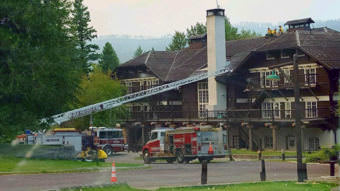
Other beloved buildings remain endangered. Glacier shared photos on Monday of firetrucks outside its Lake McDonald Lodge, built in 1913. “Fire has not reached the lodge, but every precaution is being taken,” it says in a Facebook post.

On Monday, wind gusts were blowing the fire toward the shores of the lake and endangering the lodge.

Mark Hufstetler, a historian who spent several years working at the lodge in the 1970s and 80s told The Associated Press it would be “unimaginably devastating” if the lodge were lost—especially given the destruction of Sperry Chalet.

“These are some of the most remarkable buildings anywhere in the United States and they are an integral part of the Glacier experience and the Glacier tradition,” Hufstetler told the news service.

And then there are the trees.

Near California’s Yosemite National Park, the Railroad Fire is burning in Sierra National Forest. On Monday, the fire swept through an area called Nelder Grove, which is home to 2,700-year-old giant sequoia trees. Among the hundred or so giant sequoias there is one of the world’s largest: the Bull Buck Tree: 246 feet high and 99 feet in circumference at its base.

Giant sequoias have thick, fire-resistant bark — which served them well when the fire swept through.

The trees were left with scorch marks, but they all survived, fire information officer Cheryl Chipman told the AP.

And in Oregon’s Columbia River Gorge, a blaze known as the Eagle Creek Fire has jumped the river into Washington, creating dramatic and dangerous scenes.


Earlier, wildfires had spurred hundreds of homes evacuated in the Los Angeles area, but cooler, wetter weather over the weekend helped firefighters’ efforts to contain it. A fire that burned four homes is no longer actively blazing, the AP reports.

Of course, where there’s fire, there’s smoke. A blanket of smoke from numerous wildfires converged over the weekend, sending Spokane residents indoors. And far from the flames, as the National Weather Service reports, a cold front moving through the Eastern U.S. is carrying smoke from the Western fires: “Most smoke is aloft but makes for hazy skies & red sunsets.”

Copyright 2017 NPR. To see more, visit http://www.npr.org/.

Walker signs SB 88, Mental Health Trust land exchange

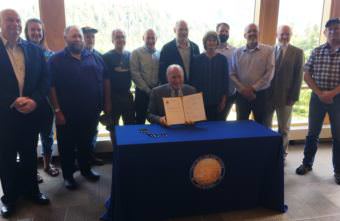
Gov. Bill Walker hold up a signed Senate Bill 88, the Alaska Mental Health Trust land exchange. (Photo by Leila Kheiry/KRBD)

Alaska Gov. Bill Walker was joined in Ketchikan on Thursday by U.S. Sen. Lisa Murkowski, state Sen. Bert Stedman and state Rep. Dan Ortiz to sign a bill accepting a land trade between the U.S. Forest Service and Alaska Mental Health Trust.

The trade puts parcels of Trust land close to communities in Ketchikan and Petersburg into Forest Service ownership, in exchange for federal land that the Trust plans to log.

The Ketchikan Public Library has a huge picture window in its large activities room. The view is Deer Mountain – the iconic backdrop to Alaska’s First City.

Walker pointed to the mountain, clear against a bright blue sky, noting to the small audience gathered for the signing that they picked this spot on purpose.

“This couldn’t be a better location,” he said. “You’re really looking out at the fruits of your labor.”

Until Walker penned his name to Senate Bill 88, a large chunk of that mountain belonged to Alaska Mental Health Trust, which uses its land to make money for mental health services.

In Southeast, the easiest way to make money from the land is resource extraction. Logging.

But, nobody wants Deer Mountain logged.

The Trust and the U.S. Forest Service have been working on a plan for about 10 years to get Deer Mountain and other sensitive parcels close to Southeast neighborhoods exchanged for more remote Forest Service sites.

That was moving slowly, though. And so, following threats last summer from Mental Health Trust officials that they would log Deer Mountain, lawmakers sped the process up.

Walker noted that the exchange required action from the House and Senate in Washington, D.C., and Juneau.

“It took all four bodies to make this happen,” he said. “It’s one of those things that, everybody knew it was the right thing to do, but it just took a while to get there.”

Murkowski was on hand for the signing. She said the land trade will benefit all the stakeholders.

Mental Health Trust will be able to make money off its land; the timber industry will get a source of trees to keep them in business; and the communities of Ketchikan and Petersburg will not be harmed by logging activity close to homes.

“It’s really one of those win-win-win situations,” she said.

Stedman represents much of Southeast Alaska. He thanked Walker for his work on this bill, and other efforts for the region.

“He’s been very dogmatic in helping us create and maintain jobs in Southeast,” Stedman said. “I really appreciate that. It’s definitely made a difference. We see it all across Southeast, and we’re particularly going to see it on Prince of Wales coming up here.”

Viking Lumber on Prince of Wales will be a big beneficiary of the logging activity that the Trust now can move forward with.

The federal land that now belongs to the Trust includes parcels on Prince of Wales and in the Shelter Cove area of Revilla Island.

Ortiz noted the hard work that legislative staff members put in to getting the various bills passed, and local efforts organized by residents of Ketchikan and Petersburg.

A Ketchikan group called Save Deer Mountain was founded by Ray Troll and Bob Weinstein. Both were there to witness the successful end to their efforts.

“This is an example of how local communities, local governments, state governments and federal governments can all work together on an issue and agree,” Weinstein said. “When they do, it’s a success.”

He said it’s nice to know that the beautiful view out the library window will be preserved for future generations.

Also on Thursday, Walker signed another bill at the Ketchikan shipyard.

On the deck of the not-yet-finished state ferry Tazlina, surrounded by shipyard employees, Walker signed a bill officially naming the ferry and its sister ship, the Hubbard, which will be built by Vigor Alaska after the Tazlina is complete.

Gov. Bill Walker visits Ketchikan for Blueberry Arts Festival

Alaska Gov. Bill Walker helps judge the Blueberry Arts Festival pie-eating contest in Ketchikan on Saturday. (Photo by Leila Kheiry/KRBD)

Gov. Bill Walker came to Alaska’s First City on Saturday to experience this year’s sun-filled Blueberry Arts Festival.

He is attending fairs and festivals around Alaska in place of scheduling the governor’s picnics that have been traditional for the past few years.
“What an honor to be back. I had never seen a slug race before I came here. I think that’s unique to Ketchikan,” Walker told the crowd from the main stage during Blueberry Arts Festival.

Walker also lent a hand judging the blueberry pie-eating contest, and walked around various art- and food-vendor booths, meeting with local residents.

Taking a break for a short interview with reporters inside the First United Methodist Church, Walker skirted the topic of whether he and Lt. Gov. Byron Mallott would seek re-election in 2018.

Walker said their intention is to seek another term, but that’s not their focus now.

“We have a lot of work to do to fix Alaska, and we are remaining focused on that,” he said.

Walker said other state lawmakers have work left, too.

He said while the Legislature has made some accomplishments, they still need to find a solution to Alaska’s fiscal challenges.

“They have a tough job to do and they’re doing it. They’re getting it done,” he said. “Not as quickly as they would like, not as quickly as I would like, but we’re not done yet. We still haven’t figured out how to pay for the services we provide. Until we get that figure out, it’s not going to be done.”

Walker said he expects there will be another special session this fall for the Legislature to find a way to fund government. But, he said, his office will work with lawmakers in the interim to find out what options are most likely to pass.

The ongoing national debate over health care, and whether to repeal the Affordable Care Act is something Walker said he has paid close attention to.

Walker said he’s part of a coalition of governors trying to help provide options and input to federal representatives. He said he doesn’t want what happens in Washington, D.C., to hurt Alaskans.

“I expanded Medicaid – accepted Medicaid expansion – that’s now provided health care for 35,000 Alaskans who didn’t have health care before that,” he said. “We don’t want to lose that kind of coverage. We don’t want those folks to go uninsured as a result of what happens in Washington. So, we’re very involved in that process.”

While President Donald Trump has been pushing for the repeal of the Affordable Care Act, with or without a replacement, Walker said that, overall, he believes Alaska will fare well under the Trump administration.

Walker said he looks at the president’s appointees, especially Secretary of the Interior Ryan Zinke.

“I think that Secretary Zinke is someone who understands the opportunities we have in Alaska with responsible resource development… There are many areas of development in Alaska that we’ve been wanting to do responsibly, but we haven’t had access under federal land to do that. I think we’re going to see a difference in that,” he said.

Asked whether he would return next year to enter the blueberry pie-eating contest, Walker said he’s not sure he’s up for that kind of competition.

Walker is scheduled to return to Ketchikan on Thursday to sign Senate Bill 88, which approves a land transfer between the U.S. Forest Service and Alaska Mental Health Trust.

Ketchikan’s Deer Mountain was one of the parcels that the trust had said it would log if the transfer didn’t take place.

The transfer will put that parcel, and other sensitive sites in Southeast, into Forest Service ownership.

Caterpillars spike around lakes and rivers near Aleknagik and Dillingham for second year

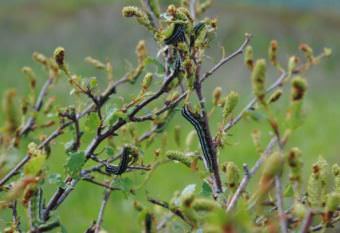
Noctuid caterpillars munch on plants in Wood Tikchik State Park. (Photo courtesy Daniel Schindler/University of Washington)
Noctuid caterpillars munch on plants in Wood-Tikchik State Park.
(Photo courtesy Daniel Schindler/University of Washington)

Visitors to Wood-Tikchick State Park were greeted by an unusual sight this summer.

Alders that are normally dense, green and leafy were bare.
“It looks almost like fall came early, so everything’s kind of brown and without any leaves on it,” said Daniel Schindler, a professor from the University of Washington. Schindler is an aquatic and fisheries science researcher in the park.

It is the second year in a row that people around Dillingham, Aleknagik, Wood-Tikchik State Park and the Togiak National Wildlife Refuge are reporting a massive outbreak of caterpillars.

Schindler is seeing at least two species, one bright green and one brown with dark stripes. They likely belong to the family Noctuidea.

In the state park, the caterpillars’ appetites left their mark along the entire chain of five lakes.

Up to the second lake, Schindler said the alders were completely defoliated up to 1,000 feet in elevation.

It is the most damage to alders and willows from caterpillars he has seen in roughly 20 years working in the region.

As the summer draws to a close, caterpillars are dropping off plants to burrow into the soil where they will winter over in their pupa form.

In the spring they will emerge as moths.

Before the caterpillars hunkered down for winter, gulls, fish and bears had a heyday.

“Usually just before the salmon show up, the rainbow trout are pretty skinny, and this year they have big extended bellies on them,” Schindler said. “When we sample what they’re eating, it’s mostly caterpillars. Even the bears are eating them. The bear scat is full of caterpillar remains.”

Now that the very hungry caterpillars are disappearing, the alders are quickly regrowing their leaves.

That’s something Schindler notes that they did last year as well.

“By middle of September when most of the vegetation was starting to go yellow and brown,” he said. “The stuff that resprouted was still going gangbusters and was bright green. It’s pretty clear that the plants have some sort of evolutionary history with them. My wonder is whether the plants can handle two, three years of this in a row. That’s where there may be some long-term damage to the vegetation.”

Still, it is unlikely that this huge caterpillar population will remain at its current size in the years ahead.

Noctuid moths tend to go through a boom-bust cycle.

“In Scandinavia where people have studied them a long time, it’s often a decade between major outbreaks,” Schindler said. “They’ll explode for a year or two and then disappear for a long time,” says Schindler.

When the population will hit its peak and decline is unclear, but it does seem that the area will see another spring full of moths.

Afognak Island elk study looks at balancing logging with game management

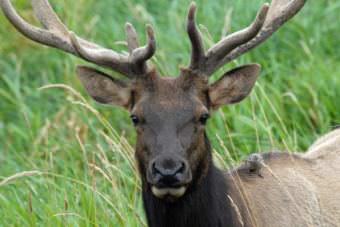
Roosevelt elk, the type of elk found on Afognak Island. (Creative Commons photo by Dan Dzurisin/Flickr

A study of elk and bears on an island in the Kodiak Archipelago will try to help balance game management and logging.
The Alaska Department of Fish and Game and its partners, including Kodiak area Native corporations, are at the beginning of a two-and-a-half year, $1.8 million study on Afognak Island.

Researchers hope it will lead to a long-term forest management strategy they can work on with Native corporations that harvest the island’s trees.

A varied terrain covers Afognak, said Fish and Game area wildlife biologist Nate Svoboda, everything from old growth forests to clear-cut areas from logging.

“It’s kind of a patchwork of units across the island, and so what we’re interested in looking at is how does that impact animal movements and resources?”

He said they’ll look at how the elk use the landscape through the seasons.

“In the winter time, there’s been some research that some of these animals, elk in particular, need wind-firm stands, so in these harsh winters that we have where we get a lot of snowfall or high winds there’s been some research that suggests that elk need these wind-firm stands so they can go to get thermal covering, be in these warmer areas out of the elements.”

Elk may also graze in clear-cut areas because plants can grow better in those spots, Svoboda said, and researchers will take a look at elk droppings to find out more about their diets.

He said researchers are interested in similar information when it comes to bears.

“What resources are they using at different times of year? What habitats are they using? What are their movements throughout the year – different seasons and on an annual basis? But then also we’re looking at what impact if any are bears having on the elk population? So, are bears eating elk calves for instance?”

At one point they’d radio-collared about 50 elk and 40 bears, but the numbers are still working themselves out.

Many of the collars fall off, especially when it comes to the male bears, which have thick necks and small heads, Svoboda said.

“It’s like putting a collar on a funnel. They can get it off pretty easy. And so, after we put 40 collars out, we went back and looked at the data, and about 15 of those collars had already slipped off in a matter of two weeks.”

Collars are more likely to stay put on the female bears and the elk, but Svoboda said researchers were careful to make sure an animal can remove the collar if it really tries.

In addition to tracking the location of the elk and bears, researchers will take hair and blood samples and weigh the animals.

By the end of the study, they hope to have a better idea of how the elk interact with the resources around them.

Chiniak’s burn area is looking pretty green after replanting

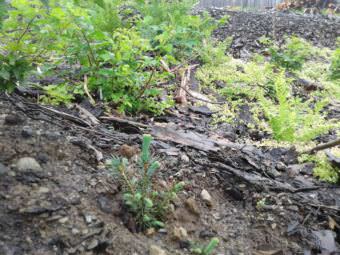
A Sitka spruce seedling emerges from the ground where the Chiniak fire left a burn area in 2015. (Photo courtesy Maggie Slife)

Kodiak Island Borough resource manager and officer Maggie Slife was part of a group that went out on a rainy day to inspect the completed replanting of the burn area the Chiniak fire left behind in 2015.

Recently, crews planted 200,000 Sitka spruce seedlings in the area. Slife said things looked good, but it’ll take some time before the burn area fully grows back.

“It’s starting its cycle over again,” she said. “This is how the world goes. In circles, but it looks pretty good for what it is.”

They inspected the planting frequency of the seedling, debris cleanup and general restoration of the landscape. Slife and company also kept their eyes peeled for any sign of rabbits, because the foresters planting the seedlings said they had seen a ton, which could spell danger for the young trees.

“As any gardener will tell you, rabbits are always a threat to small plants so we were looking for signs of rabbit damage to the seedlings, and we didn’t see any.”

Slife thinks they didn’t see any damage because there’s plenty of other things for the rabbits to chow down on.

“Because it’s a burn area it’s all new growth,” she said. “There are just hundreds and thousands of little shoots of all kinds coming up. Salmonberries and ferns and your natural first growth plants in Kodiak are starting to dig back into the landscape. So there are a lot of things for them to eat.”

She says the next inspection of the Chiniak burn area will be in two years.

The goal is to have a 95 percent success rate among the seedlings, according to Slife.

The Kodiak Island Borough is hoping to open the area to the public in the near future.

Site notifications
Update notification options
Subscribe to notifications