Tourism

NTSB begins investigation of Era helicopter crash

Era Helicopters has identified its pilot who was critically injured in Thursday’s crash at Norris Glacier near Juneau as Jiri Hanis.

Hanis, 39, was medevaced to Harborview Medical Center in Seattle on Thursday with critical injuries. A hospital spokeswoman Friday afternoon said he’s in serious condition in intensive care.

Era spokesman Tim O’Leary said Era’s operations in Juneau have been suspended temporarily. He said the start date of the seasonal heli-mush tour on Norris Glacier has also been pushed back from May 12 to May 16.

The pilot was headed up to the glacier at the time of the accident to supply the dog camp, O’Leary said. The helicopter itself is in “pretty rough shape.”

“So, it will be part of the investigation to see if it can – what – can be salvaged,” he said.

Mike Hodges is the investigator in charge on this crash for the National Transportation Safety Board.

“This’ll be a full investigation done by the NTSB,” Hodges said. “And as of right now, we’re waiting on weather conditions to cooperate for recovery operations. So we’re just kind of on standby right now.”

A preliminary report is expected to be published in five to 10 days.

It’s not unusual for weather to limit access to the site. Independent videographer Paul Hemann got stuck on the glacier for three days once because of weather.

“You’d hear the helicopters on the other side just trying to get over and they can’t get over. And they, you know, you’ve got your bags ready to jump on and get out of there, and sat there for three days cause the weather changes, the ceiling changes around those mountains so fast that once they come in, sometimes you don’t got a window to get out.”

Hemann has spent several weeks on Norris Glacier in recent years following the dog sled operation. He said the sled dog camp is sited in a pretty flat basin, but there are some risks. Besides weather, the ice itself can be hazardous. He said workers use long poles to regularly check for hidden ice bridges and crevasses.

“There’ll be … nothing one day, and then the next day, there’ll be a ton of stuff there,” Hemann said. “You know, there might be a big ol’ crack that opened up that’s bottomless.”

Alaska Heli-Mush partners with Era Helicopters for its dog sledding tours on the Norris Glacier. On their website, they describe Era is the “oldest and safest helicopter company in Alaska.”

Coast Guard: Pilot injured in Era helicopter crash at Norris Glacier

Update | 9:05 p.m.

In a written statement about the crash, company President and CEO Chris Bradshaw expresses appreciation to the people involved in the rescue operation and addresses safety.

“Safety is always our highest priority, and we deeply regret these injuries to one of our team members,” Bradshaw is quoted saying. “Our investigation will continue in cooperation with the National Transportation Safety Board and other relevant authorities.”

Update | 8:18 p.m.

The patient was medevaced to Harborview Medical Center in Seattle at about 7:20 p.m., said Bartlett Regional Hospital spokesman Jim Strader. He remained in critical condition.

Update | 5:38 p.m.

(Photo by Mikko Wilson / KTOO)
A TEMSCO helicopter leaves Bartlett Regional Hospital after dropping off a patient on Thursday. (Photo by Mikko Wilson/KTOO)

A TEMSCO helicopter dropped the injured helicopter pilot off at Bartlett Regional Hospital around 4:20 p.m. As of 5:20 p.m., hospital spokesman Jim Strader said the patient was in the emergency department with life-threatening injuries.

A woman who answered the phone at Era Helicopters  declined to comment or identify herself.

The National Weather Service’s aviation forecast showed the Juneau area, including the Norris Glacier, under marginal visual flight rules. Heavy rains were forecast with 25 mph winds.

Original story | 3:36 p.m.

(Map courtesy Google Earth)

The Coast Guard is reporting that a helicopter has crashed near the Norris Glacier and the pilot, who was the only person on board, is injured.

Coast Guard Chief Petty Officer Joshua Ryan of District 17 Command said a distress beacon was detected at 2:14 p.m.

era helicopter norris glacier
An Era helicopter on the Norris Glacier near Juneau in July 2013. (Creative Commons photo by brad.)

He said Era Helicopters confirmed it was one of theirs that had crashed. Authorities have been in radio contact with dog sled tour operators on the glacier near the crash site. Ryan said those workers got the pilot out of the helicopter.

Ryan said Capital City Fire/Rescue personnel and TEMSCO Helicopters are en route to retrieve the injured pilot. An MH-60 from the Coast Guard’s Air Station Sitka is also en route.

Ryan said the pilot has not been identified. He said the initial reports are that the pilot is responsive, but has chest pains.

This is a developing story. Check back for updates. 

TSA Boosts Number Of Security Staff, Aiming At Airport Bottlenecks

Faced with the prospect of long wait times at airports this summer, Homeland Security is boosting its checkpoint staffing. In this photo from December, passengers line up to go through security at the Fort Lauderdale-Hollywood International Airport. Wilfredo Lee/AP
Faced with the prospect of long wait times at airports this summer, Homeland Security is boosting its checkpoint staffing. In this photo from December, passengers line up to go through security at the Fort Lauderdale-Hollywood International Airport.
Wilfredo Lee/AP

Homeland Security Secretary Jeh Johnson says he’s “acutely aware” of longer wait times at airports, and now he’s boosting staffing at checkpoints, hoping to avoid even longer wait times that had been projected for this summer.

The move comes after officials predicted “long waits in epic lines,” as NPR’s Marilyn Geewax reported in March.

And in a video chat today on NPR’s Facebook page, Marilyn explains that airport bottlenecks are due in part to a sharp increase in the number of people traveling. Also, she says, the TSA may have overestimated the popularity of its PreCheck program, which allows some travelers to go through security without taking time-consuming steps such as taking off their shoes and pulling items from their carry-on luggage.

Here’s that video; Marilyn appears around the 6-minute mark:

As Marilyn says, some travelers are reluctant to sign up for the program, because of either its cost ($85 per person for five years) or a hope that the lines won’t be long enough to worry about.

Johnson’s strategy is to target airports that are likely to have the highest passenger volume, giving them more transportation security officers and also “increasing the number of canine teams as an additional measure to help them expedite the screening process.”

Johnson announced his plan Wednesday morning; along with the staffing changes, he says the TSA will work to streamline the use of bins at screening stations — and that he’s asking Congress to approve funding changes that would pay for overtime and expand screening officers’ work hours to cover peak travel periods.

The TSA’s move was quickly applauded by the U.S. Travel Association, with the industry group’s president and CEO Roger Dow saying the”travel community is grateful that the well-documented problems with TSA security lane resourcing have the full attention of the Obama administration and Congress.”

The travel association also says it agrees with Johnson’s goal of increasing the use of the TSA’s PreCheck program to reduce wait times.

Copyright 2016 NPR. To see more, visit http://www.npr.org/.

CBJ defends itself in cruise ship tax lawsuit using this one weird trick

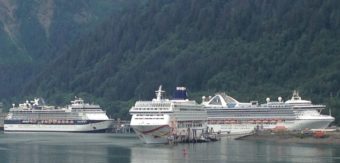
Tourists walk toward the cruise ship Radiance of the Seas, docked at Juneau's waterfront. (Photo by Ed Schoenfeld,/CoastAlaska News)
Tourists walk toward the cruise ship Radiance of the Seas, docked at Juneau’s waterfront. (Photo by Ed Schoenfeld/CoastAlaska News)

Cruise Lines International hit Juneau with a lawsuit last month, alleging that the city misused marine passenger fees. Now the city has come up with a way to pay for legal counsel: marine passenger fees.

Mila Cosgrove, deputy city manager, said $50,000 is being transferred over.

“They’re coming out of the waterfront acquisition fund and the majority of the money in that fund are marine passenger fees or have come through that source,” Cosgrove said.

The city has its own legal team but Cosgrove said it doesn’t have the capacity to defend the case.

An estimated $8 million comes into Juneau every year through marine passenger fees. That money is supposed to be used to benefit cruise ships and passengers. The filing asks the court to permanently stop “the assessment, collection and improper use” of the fees.

And it argues a park being built — about a mile from the port — is a misuse of the funds.

But Cosgrove said a recent legislative audit of the state marine passenger fees found the city to be in the clear.

“Regarding the fees for legal defense, again, because it’s directly related to how those funds are used, we thought it was an appropriate expenditure of funds,” Cosgrove said.

Hoffman and Blasco are defending the city with another law firm, Latham & Watkins. A Cruise Line International rep could not be reached for comment.

Panamax cruise ship dock almost ready for the season

An artist rendering of the art installation. (Provided by Juneau Docks and Harbors)
An artist rendering of the art installation. (Image courtesy Juneau Docks and Harbors)

The first cruise ship of the season arrives in Juneau on Saturday. And next week, large ships will be able to use a new, floating dock.

They’re called Panamax ships because they’re the biggest thing that can fit through the Panama Canal.

The nearly $54 million project is paid for by marine passenger fees. In the past, some Panamax ships have had to anchor offshore and tender passengers over in small boats. Carl Uchytil , the port director for Juneau Docks and Harbors, said this deters tourists from leaving the ship.

“And so we really want that ability for the vessels to tie up at our float, walk ashore, go on excursions, go to shops and frequent the restaurants,” Uchytil said.

Now more passengers will be able to walk down a ramp to the wharf. Uchytil said he’s seen an uptick in Panamax ships with the popularity of Alaska’s cruise industry.

Phase 2 of the project is slated to be completed next May.

“Then in Southeast Alaska you’ll have the three major cruise ship ports: Skagway, Juneau and Ketchikan, all capable of accommodating four Panamax-sized cruise ships,” Uchytil said.

The status quo has been three in Juneau.

A $500,000 light-up art installation is also in the plans. It features several abstract columns along the waterfront. It was designed by a Los Angeles artist, inspired by whale flukes and the span of eagle wings.

Uchytil expects the art to go in sometime in the late summer of 2017.

Audit: Skagway misspent cruise head tax on playground equipment

Broadway in Skagway
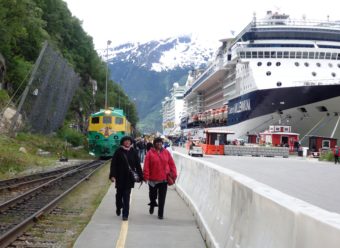
Skagway’s main drag, Broadway, Sept. 5, 2007. (Creative Commons photo by Pat Groves)

Alaska charges cruise ships that stay three or more days in state waters a $34.50 tax per traveler. It’s called the Commercial Passenger Vessel Tax. The tax brings in millions of dollars each year, much of which the state distributes to cruise ship port communities. An audit of the CPV program found some towns need to tighten standards for how they spend the money. And, it alleges that Skagway misspent some CPV funds on school playground equipment.

The research was conducted by the state Division of the Legislative Audit after a request from Eagle River Sen. Anna MacKinnon. MacKinnon wanted to get to the bottom of assertions that some communities stockpile CPV funds or use them on inappropriate projects.

While the audit didn’t find rampant abuse of CPV dollars, it did find one instance of misspent money and a couple cases where municipalities should do a better job justifying CPV expenditures.

The audit shows that Skagway receives more shared CPV funds from the state than any other town. From 2007 to 2015, the Gateway to the Klondike got more than $30 million. (That doesn’t include $10 million Skagway received in state CPV grant allocations.) Skagway and the other communities can’t just spend that money however they want. There are three things it can be used for: port facilities, harbor infrastructure or other services that provide for the cruise ships and their passengers.

“The audit found that shared tax revenue spent for port facilities and harbor infrastructure was allowable,” said Legislative Auditor Kris Curtis. “It was just the area where expenditures for other CPV services to vessels and passengers where they need to improve documentation.”

In Skagway’s case, Curtis says, one of those ‘other services’ purchases did not follow regulations.

“The municipality of Skagway borough management used CPV funds to purchase playground equipment for the Skagway elementary school at a cost of $114,450,” Curtis said. “The audit concluded that the playground equipment primarily used for the elementary school does not qualify as an allowable purpose under the state or federal law.”

“I wasn’t too sure about that,” said Skagway Borough Manager Scott Hahn. He was not at the helm when the playground purchase was made in 2013, but he says there is a justification for it.

“Skagway, unlike a lot of the larger communities, is very much different,” Hahn said. “Because you go to Juneau…when you add the cruise ship population it’s only a little bit of a dent in what’s going on there. But here it’s completely consumed by the cruise ship activity.”

Hahn’s argument is that in a town of less than 1,000 permanent residents, the up to 10,000 cruise ship passengers that pour into Skagway daily put a demand on resources that outweighs what other port towns experience. He says the school is a primary emergency shelter for cruise ship passengers. There’s also a huge influx of children in the summer with the arrival of seasonal workers and families of cruise ships.

“To me, if they weren’t here and you didn’t have families, it’s somewhat directly connected. But it all depends on how tightly you want to consider the impact,” Hahn said. “And in Skagway, the impact is overwhelming and all-consuming.”

Borough Treasurer Heather Rodig says records are unclear about why CPV funds were used on the playground equipment. She says it was a ‘prior management decision’ that was made before she or manager Hahn were in their current jobs. Borough Clerk Emily Deach says the playground supplies, were purchased for two parks – one at the school and one in downtown Skagway. It was the portion used for the school park that the audit found improper, Deach says.

Allowable expenditures by Skagway included improvements to the small boat harbor, which involved the construction of a seawalk and wave barrier to enhance cruise visitor safety.

The other recommendations in the report have to do with Ketchikan and Sitka. Both places use CPV money for general municipal services. Curtis says the justifications to use CPV funds are vague.

“These communities where cruise ships are visiting, they certainly do encounter a great deal of increase in costs to services because of all the folks that offload onto communities,” Curtis said. “Our audit found that two specific communities were not doing an adequate job in supporting the degree to which cruise ship passengers increased general municipal costs as evidence to support using CPV taxes to pay for operations.”

Skagway also uses CPV funds for things like water, sewer and garbage costs. But the municipality was protected from admonishment on that front because of a survey conducted in 2008 that shows the cruise ship impact on municipal operations. The audit says that survey justifies the expenditures, although it would be more reliable if it was up-to-date.

Hahn says the borough assembly will discuss the CPV audit at a meeting this week.

“I think this is maybe just kind of a wake-up call to make sure everybody is doing the right thing,” Hahn said.

He says the audit will help Skagway’s government in future decisions to leverage CPV funds.

Site notifications
Update notification options
Subscribe to notifications