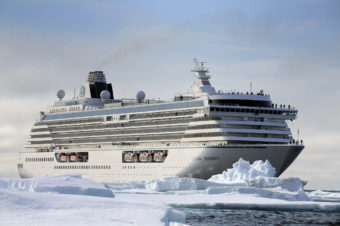
A cruise ship is docked at Ketchikan’s downtown Berth 2. About 1 million cruise passengers visited Southeast in 2015. (Photo by Leila Kheiry/KRBD)
Cruise Lines International Association sued the City and Borough of Juneau over how it uses cruise head taxes. While Juneau is the only community named, the implications of the lawsuit could affect other Alaska communities that levy their own head taxes. Like Ketchikan.
The City of Ketchikan is keeping a close eye on what happens with the head-tax lawsuit, says City Manager Karl Amylon, who declined to be recorded for this report.
One area that could have a broad-reaching effect is that the lawsuit objects not only to Juneau’s use of its own head tax funds but to that city’s use of state-issued cruise head tax money. Amylon says it’s not clear whether the industry is objecting to the state head tax overall, in addition to Juneau’s use of it.
The City of Ketchikan receives state head tax funds and levies its own head taxes. Amylon says the city keeps the cruise industry in the loop when it comes to what those funds pay for, and there have been no objections so far from the industry.
Locally collected head tax money goes directly to port improvement projects. Amylon says state head tax money initially went to pay off city debt for construction of Berths 3 and 4 of the downtown cruise dock. State head taxes also have paid for the Thomas Basin seawall project, and some port operating and maintenance costs.
Amylon says future head tax funds likely would be used in Ketchikan to continue upgrading the port to accommodate larger cruise ships.
He says Juneau has approached the City of Ketchikan and the Ketchikan Gateway Borough to sign on as friends of the court. The Borough Assembly likely will talk about that Monday, and the City Council will take up the issue Thursday.
A scale model of the humpback whale sculpture at the University of Alaska Southeast campus, Aug. 14, 2015. A life-size version is destined for a waterfront park in downtown Juneau. (Photo by Jeremy Hsieh/KTOO)
On Tuesday, Cruise Lines International Association hit Juneau with a lawsuit filed in federal court. It alleges the city misused a combination of marine passenger fees, port development fees and state excise taxes.
The association represents major cruise lines, like Celebrity, Disney and Holland America.
When it comes to how the city allegedly misused the funds, the lawsuit names a life-size bronze whale statue. The whale itself was paid for by private donors. But a $10 million park under construction — featuring an artificial island — will be paid for by tourists.
The president of the association, John Binkley, said he doesn’t think the whale benefits cruise ships and passengers. It’s located near the Douglas Bridge — about a mile from the port.
“And so while we’re not opposed to paying taxes, we feel that proposed island and the foundation for the whale sculpture is beyond what those funds should be used for. We’re just trying to get guidance from the court,” Binkley said.
Actually, the filing also asks the court to permanently stop “the assessment, collection and improper use” of the fees.
Binkley estimates, every year, up to $8 million is collected from passengers that arrive in Juneau. He said the association sent letters to the city about the whale park, but their concerns weren’t addressed.
In a press release, the municipality stated it was expending the fees in a “responsible” way. Kim Kiefer, the city manager, said she thought the city was doing its best.
“We’re trying to use those fees to facilitate the safe and effective movement of those passengers throughout community, and I think we do that quite well,” Kiefer said.
The association said it would not be targeting other cruise ship ports with similar fees — like Ketchikan.
Institute of Social and Economic Research Director Gunnar Knapp presented possible economic effects of state budget proposals earlier this year. (Photo by Skip Gray/360 North)
What the legislature does in response to the state government’s $4 billion deficit could have big effects on Alaska’s economy, according to a leading economist.
Gunnar Knapp, director of the University of Alaska Institute of Social and Economic Research, told the Senate Finance Committee on Wednesday that uncertainty over the budget is a concern for the economy.
Knapp said closing the budget gap in one year could be too much, too fast. But it’s important for the state to have a plan, he said.
“If you can, in fact, reduce the uncertainty, then it makes more sense to implement … things over time,” Knapp said. “But there’s all the difference in the world between that and saying, ‘OK, we fixed 30 percent of the problem and we’ll, we’ll get back to you on what comes next.’”
Knapp said the state isn’t in recession yet, but appears to be heading into one. Job losses in the oil and gas industry, construction and state government have been offset by gains in health care and hospitality.
“I would say that regardless of what you do, I think it’s very unlikely that the recession we will be facing would be as severe or damaging as the 1980s recession,” he said.
Knapp said that’s because the economy is bigger, more diverse and less over-extended with borrowing and construction than it was in the 1980s.
Knapp urged lawmakers to focus on major issues, like making changes to Permanent Fund earnings and new revenue:
“My own instincts are that you can’t get there without new revenues,” Knapp said.
Gov. Bill Walker has proposed a personal income tax. Legislative leaders have so far resisted the proposal.
Fairbanks Republican Sen. Pete Kelly said he doesn’t want to raise taxes until the legislature has done more to cut the size of government.
“If we’re getting into the discussion of the things that begin to affect the flat-rate mechanic in my district, about whether he or she should pay taxes and start giving up the fruits of their labor,” Kelly said, “that has to be done later, after we have made sure everything else about government is on the table. Then we’ll start talking about the things that are on their table.”
Kelly questioned whether Knapp’s emphasis on having a state fiscal plan to reduce uncertainty was influenced by Gov. Bill Walker. In response, Knapp said he realizes lawmakers face difficult decisions, but he’s trying to stay out of the politics on either side of the issue.
A 2012 Canadian loonie. (Creative Commons photo by Jackman Chiu)
The Canadian dollar continues to hover around $0.72 U.S. That means locals in Haines and Skagway might not see as many Yukon license plates this summer, and the loss of Canadian business for local shops and tour operators.
Haines and Skagway are already feeling the effects of our friendly neighbor’s lagging loonie, and the summer tourist season is still months away.
The Canadian dollar has been in a steady decline for years. It reached its lowest point in more than a 12 years last month, and, depending on who you ask, it’s going to get worse before it gets better.
Mountain Market in Haines has been serving Canadian guests for 25 years. Owner Mary Jean Sebens says the business from Yukoners is a large part of the market’s income.
“I guess I would say that we didn’t have a bad year last year, we had a good year, but if the Canadian dollar had been stronger, we would have had that much more of a good year,” she said.
Sebens said she thinks the big holiday weekends, and events like the Chilkat Kluane International Bike Relay and BeerFest, will still lure Canadians, but when the dollar was stronger, Haines and Skagway saw an influx of visitors almost every weekend, all year long.
Mountain Market, which sells food and groceries, might have a slight advantage as the loonie threatens to bottom out at around 60 cents. People need to eat, after all. Elective activities like tours might feel the pinch more.
A Yukon license plate. (Creative Commons photo by Jerry “Woody”)
“It’s going to be noticed a lot in Haines and Skagway this summer, the downturn in them visiting,” says Alison Jacobson, the CEO of Alaska Fjordlines. The tour business offers scenic boat rides between Juneau, Haines and Skagway and has been on the water for 25 years. It’s one of many tour businesses and shops in the upper Lynn Canal that relies heavily on summer Canucks. Jacobson said she’s still considering the business’s tradition of taking Canadian money at par during the slower times of the season.
“But we probably won’t do it for as long because it’s really hard for us to take that hit. I think it’s still possible for us to get those folks in Haines and Skagway if we run some specials,” she said.
Jacobson said her bookings are filling up at a good rate, though there are noticeably fewer Canadian customers.
Haines Borough Tourism Director Leslie Ross said a lot of people take the Canadian contingent for granted. Until they stop coming.
“With the cruise ships, we kind of know those numbers and we can anticipate what’s going to happen. With the Yukon tourism, we kind of just expect it to be there,” Ross said. “It is something that people are watching now. Just the few businesses that I’ve spoken to, they’ve seen a significant loss already.”
Last week, the Tourism Industry Association of the Yukon canceled its annual convention slated to be held in Haines. That event lasts a few days and brings in around 150 visitors in April, typically a slower month. Ross said it’s a huge disappointment.
“We won the bid this year for hosting and just in the last two weeks, they’ve called and canceled that. Mainly due to the low Canadian dollar and a push for them to spend locally, which is very understandable,” Ross said.
Blake Rogers is the director of the association in Whitehorse. He says they just couldn’t take the risk of the dollar sinking even lower. He said Canadians are being encouraged to stick closer to home.
“Canadian destinations are seeing a bit more of an opportunity to try and encourage more Canadians to do domestic travel and visit places in Canada that they may not have visited before, but also opportunities to try and encourage Americans to come to Canada,” Rogers said.
Rogers said despite having to cancel the event in April, he’s looking forward to continuing the symbiotic relationship with Haines and Skagway.
“It was disappointing for all of us, but we haven’t seen the last of Haines, let’s just say that. We will come in full force in the years to come,” Rogers said.
Haines tourism director Ross said she’s hearing from tour operators that bookings are down overall while Canadians wait to see if the dollar will rebound. The weak Canadian dollar is attributed to several factors including plummeting oil prices. But, Ross said it’s not all bad news. Low fuel prices are likely to bring in more Alaskans on road trips, and more RV travelers from the Lower 48.
Fjordlines’ Jacobson also tries to look on the bright side. She said offering cash at par or other discounts will solidify the strong relationship between Haines, Skagway and Whitehorse.
“I know that it will be so popular that the word will spread fast up in Whitehorse if you can offer any kind of a special rate,” Jacobson said.
The National Bank of Canada’s long term outlook says its currency is supposed to hold steady before creeping up in the fall. However, a forecaster at the global investment bank Macquarie told the CBC last month he expects the loonie to reach an all-time low of 59 cents by the end of the year.
Delta Airlines is temporarily cutting two weekly flights to Juneau.
Anthony Black, a Delta spokesperson, says effective immediately Delta will no longer fly to Juneau on Tuesday or Saturday. There will be no southbound flights on Sundays or Wednesdays. Sometime in March, Sundays will be added back to the schedule. In May, Delta will revert back to offering seven flights per week in May.
The company started flying year-round to the capital city in the summer of 2015. The airlines scaled up to a Boeing 737 during the summer, which can accommodate 160 passengers, but demand slowed as tourist season ended.
Black said Delta passengers who have already scheduled flights can be reimbursed or rerouted through Alaska Airlines.
The Alaska Railroad brings a load of tourists into Whittier in July 2008. (Creative Commons photo by Frank Kovalchek)
The Alaska Railroad has a lot riding on a highway bill pending in Congress. The railroad CEO says he hopes it will fix a technical mistake in a 2012 law that has shortchanged the railroad $3 million a year.
When you’re up against a deadline and all bleary-eyed from working way too long, you’re prone to make mistakes. It’s the same with Congress, only on a larger scale. Three years ago, when Congress passed a highway bill, the House and Senate lawmakers negotiating the final version agreed the Alaska Railroad should get $31 million a year in formula funds. It was a cut from years past, but that was the deal. And then somebody made a mistake in calculating the formula.
“Due to the math error, by the time it was all said and done — one of these 11th-and-a-half-hour deals — we only received $28 million annually,” says Alaska Railroad CEO Bill O’Leary.
The railroad attributes the mistake to the Federal Transit Administration, which provided technical assistance to the congressional conference committee. O’Leary says it appears to be just an honest mistake, a late night math goof that has cost the railroad $3 million for each of the past three years.
Alaska Congressman Don Young convinced his colleagues on the House Transportation and Infrastructure Committee to fix that math mistake this year. The House passed a new highway bill this month that would bring the formula funding for the Alaska Railroad back to the intended amount.
The Alaska Railroad gets about half its revenue from hauling freight, and about 25 percent from government sources.
Young’s spokesman, Matt Shuckerow, also attributes the math mistake to agency personnel and said he doesn’t know if it affected any other railroads. In 2012, some lawmakers wanted to drastically cut the Alaska Railroad’s funds. Young was one of the conference committee members then, and Shuckerow said he got his fellow negotiators to agree the Alaska Railroad should get $31 million, only to see $3 million lost to technical error.
“That’s part of the reason why it was such a top priority for him to rework this issue,” Shuckerow said.
The Senate version of the bill does not include the Alaska Railroad fix, but Sen. Lisa Murkowski was appointed to the conference committee this time and it’s a priority for her.
Close
Update notification options
Subscribe to notifications
Subscribe
Get notifications about news related to the topics you care about. You can unsubscribe anytime.