Tourism

Tourists spent more in Southeast this season

Mendenhall Glacier Visitor Center Director John Neary oversees a destination that attracted about 500,000 tourists this season. That's half of the season's cruise ship passengers. (Photo by Ed Schoenfeld/CoastAlaska News)
Mendenhall Glacier Visitor Center Director John Neary oversees a destination that attracted about half of Southeast’s 1 million cruise-ship passengers this season. (Photo by Ed Schoenfeld/CoastAlaska News)

About a million cruise ship passengers from around the world sailed through Southeast’s Inside Passage this season. Some ships continued on to Whittier, Kodiak and even Unalaska.

The overall numbers are around the same as the previous two years. But destinations and businesses saw visitors willing to spend more, due to the improving national economy.

If you want to see tourists in action, Juneau’s Mendenhall Glacier is the place to go. About half the state’s million cruise ship visitors came to view the rock-strewn ice this season, more than the previous year.

All those people presented a challenge when glacial outburst floods, called jökulhlaups, raised the level of Mendenhall Lake. Jökulhlaups happen when ice dams float or break, allowing a rapid escape of water.

They’ve usually happened only once per season.

“Last year for the first time we had two of them in one year. And then this year they turned out to be weekly. And it just caught us all by surprise,” says John Neary, director of the U.S. Forest Service’s Mendenhall Glacier Visitor Center.

Visitors walk a trail around Mendenhall Lake to view Nuggett Falls. Glacial floods closed that trail for part of this season. (Photo by Ed Schoenfeld/CoastAlaska News)
Visitors walk a trail around Mendenhall Lake to view Nugget Falls. Glacial floods closed that trail for part of this season. (Photo by Ed Schoenfeld/CoastAlaska News)

He says the floods hit the area’s most popular trail, which follows the lake’s shoreline to the base of a large, dramatic waterfall.

“As soon as the water level goes up, which it did about weekly, we had to close the trail. Not just to prevent wet feet, but actually to prevent people who are going around making side trails,” he says.

He says those side trails can damage the shore and disrupt nesting seabirds.

It was also a good year for a Ketchikan attraction that puts tourists on a modified “Deadliest Catch” crabber.

“This season was a lot busier than it was last year. There were a lot more cruise ship passengers coming up, so we had a lot more guests with the potential to sell to,” says Shauna Lee, executive director of the Bering Sea Crab Fishermen’s Tour.

She says unusually good weather helped draw customers … until the back end of the season.

“We’ve had some really horrific days. But the beginning of the season put everybody in a good mood and a lot more guests coming into town certainly helped a lot as well,” she says.

Lee says the summer’s tours sold out months in advance. In fact, it was the best season in the company’s history.

Bering Sea Crab Fishermen’s Tour
The Aleutian Ballad, a former “Deadliest Catch” vessel, hosts Ketchikan’s Bering Sea Crab Fishermen’s Tour. (Photo courtesy Alaska Crab Tour)

“I felt like people had money to spend. They were happy to spend it. They were happy to be on vacation and not stressing,” she says.

“We had more customers. And probably more importantly, we had more customers wanting to do longer, more expensive tours,” says John Dunlap, vice president of Allen Marine Tours.

The Sitka-based company runs sightseeing and wildlife-watching catamarans in Ketchikan and Juneau, as well as its hometown.

He says people were willing to spend more money this season because the nation’s economy has improved. Fewer tourists sailed north from 2010 through 2012, and those who did spent less.

Dunlap’s also seen a shift in the type of passenger served in recent years.

“So people are just in general more knowledgeable. They tend to study about where they’re going and that’s a lot of fun. They really stretch you to have more information for them – good information for them,” he says.

He says customers these days also want to know their excursions have minimal impact on the environment.

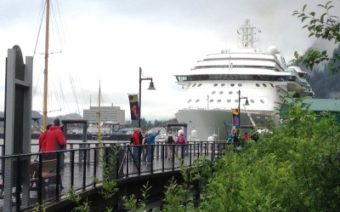
Tourists walk toward the cruise ship Radiance of the Seas, docked at Juneau's waterfront. (Photo by Ed Schoenfeld,/CoastAlaska News)
Tourists walk toward the cruise ship Radiance of the Seas, docked at Juneau’s waterfront. (Photo by Ed Schoenfeld,/CoastAlaska News)

That’s also the case in Petersburg, where retired troller Grant Trask shows visitors around the docks.

He introduces them to commercial fishermen and talks about gear groups, seasons and species caught. He says some ask about sustainability. A few want to argue about it.

“I can tell them that we have a lot of fish in Alaska. And that when they are going to be eating an Alaska fish, wherever they live, it’s not going to be the last one because we have such good management of our resources,” he says.

Trask and his wife also run Das Hagedorn Haus bed and breakfast. Like others we talked to, his business picked up this season, as well as last.

He says he’s noticed another trend, the growing diversity of Alaska tourists.

“We’re used to American and Canadians, Australians and New Zealanders. But we have folks from Europe quite a bit more in our little town. So my last group just a couple weeks ago was mainly folks from Belgium,” he says.

That’s also the case back at Juneau’s Mendenhall Glacier.

Walking up the rock steps to the visitor center, Director John Neary says far more cruise ship passengers are visiting from Europe, Asia and India.

“Also more kids this year. That’s pretty exciting for us. It used to be just Disney Fridays. But now, we’ve got a lot of kids on other days. I think the demographics are changing, maybe with rising incomes. More families are able to afford to get on the ships,” he says.

Sen. Murkowski challenges Mendenhall Glacier Visitor Center fee bump

Mendenhall Visitor Center (Photo by Reywas92/Wikimedia Commons)

Sen. Lisa Murkowski on Thursday challenged National Park and Forest Service officials about the fees they collect from visitors.

At a Senate hearing, Murkowski said she “generally” supports the law allowing the agencies to collect fees.  The 10-year-old law requires that most of the revenue is spent on things like visitor services, maintenance and public safety. But then Murkowski homed in on the Mendenhall Glacier Visitor Center.

The Forest Service is raising the entrance fee at the visitor center from $3 to $5 starting in May. Murkowski said the increase is reasonable, but was leery of plans to expand the fee area beyond the visitor center.

“If you want to bypass the visitors center, you don’t want to go to the restroom, you don’t even want to park your car, if you just want to go to – and I’m just reading the article from the Juneau Empire here – if you just want to go to the Photo Point Trail, we’re going to charge the $5,” she said.

The senator says she worries the agencies are making public lands “uninviting.”

“I don’t want to go to my Mendenhall visitors center and go hiking on the great trails that we have out there and feel like I’m going to have somebody from Forest Service who’s going to chase me down the trail to pull up my multiple rain jackets to see if I’ve got a wristband on,” she said.

“Um, yeah, not only are we not going to chase them down trails but our real focus is going to be on trying to get our community to support us more in the future, by delivering things for this fee that they’ll support,” said John Neary, director of the visitor center.

Neary wasn’t at the hearing, but he says he’s concerned about preserving the visitor experience, too. He says 90 percent of the 500,000 visitors the park expects next year will have already paid their fee through a commercial tour operator. For those who arrive on their own, enforcement will be sporadic and Neary doesn’t envision asking hikers to roll up their sleeves.

“In the past we’ve used wristbands. We’d like to get away from that, for a variety of reasons … and I think a lot of people find them annoying,” Neary said.

Neary says visitors won’t be charged to use most trails, only those the Forest Service has invested money in, like Photo Point Trail, which is paved. User fees help maintain those improvements, and the center director says it needs more amenities.

“Right now, women that come out on a cruise and take a bus out here on a Monday afternoon typically have to wait 15 or 20 minutes on line to use the restroom block. And that’s unacceptable.”

Neary says the visitor fees will help pay for new bathrooms, since they can’t rely solely on funds from Congress.

Cruise ship nearly doubles Unalaska’s population (for a day)

The Celebrity Millennium and another smaller cruise ship doubled Unalaska's population for a day when about 3,800 people disembarked from the vessels. (Photo by John Ryan/KUCB)
The Celebrity Millennium and another smaller cruise ship doubled Unalaska’s population for a day when about 3,800 people disembarked from the vessels. (Photo by John Ryan/KUCB)

The biggest cruise ship ever to visit the Aleutian Islands pulled into Unalaska’s Dutch Harbor Tuesday morning. The floating city known as the Celebrity Millennium disgorged about 2,500 passengers and 1,000 crew. In tandem with nearly 300 passengers in town from the much smaller Le Boreal, the two cruise ships nearly doubled the population of Unalaska for the day.

For many towns in southern Alaska, the arrival of a mega cruise ship would make for an ordinary or even a slow day for tourism. Juneau can handle five big cruise ships at once. But those towns along the main cruise corridors have the infrastructure for a deluge of wandering pedestrians seeking entertainment. Unalaska does not.

Starting about 10 a.m., passengers walked down the ramp from the Millennium onto an industrial dock.

The floating city’s P.A. system blared a welcome to Dutch Harbor and safety messages at its passengers. They learned, as they prepared to walk off the ship for the first time in three days, that Dutch Harbor isn’t really set up for pedestrians, let alone large numbers of them.

“When leaving the dock and heading away from the airport, there is no paved walk area. Please be very mindful of industrial traffic,” the announcer advised.

A small number of passengers started a long and windy walk into the center of town despite the lack of sidewalks. Many more hopped on board the buses, taxis and rental cars lined up at the dock.

Unalaska Fire chief Zac Schasteen said there were no problems with tourists wandering into the wrong areas of the nation’s busiest commercial fishing port.

The arrival of the supersize ship sent town officials and many volunteers into a flurry of activity, especially in the past month, after officials learned there would be hundreds more passengers than they’d first been told.

“We’ve been kind of sounding the alarm, so to speak, for at least a year,” Cathy Jordan with the Unalaska Convention and Visitors’ Bureau said. Despite an “overwhelming” number of visitors, Jordan said the day went smoothly.

“I am just thrilled with the outpouring of support from the community,” she said.

An estimated 200-300 of the passengers showed up at a crafts and souvenirs market set up inside the town gym. Local artist Carolyn Reed said she sold enough postcards and jewelry to be worth her time, but it wasn’t a huge boost to her business.

Across the street, the Unalaska School District charged $10 a head for a program of traditional Unangan, or Aleut, culture. Patty Gregory-Lekanoff showed off bentwood visors and other traditional clothing to the dozens of visitors sitting on bleachers in the high school gym.

“What I’m wearing feels like wax paper, but this is the intestine of a walrus,” she said. Unangan dancers performed, and young athletes performed high kicks and other Native Youth Olympics events.

Electronic Limits

Unalaska’s physical and electronic infrastructure wasn’t built to handle many hundreds of tourists showing up at once.

The Millennium started in Vancouver and is headed to Shanghai by way of Japan.

Unlike Unalaska, the giant ship has its own movie theater, a spa and an internet café.

Unalaska officials asked the ship to have its passengers put their phones in airplane mode while they’re here. Otherwise, their quest for connection might overwhelm Unalaska’s phone system.

Passenger Bob Knobbe from Saskatchewan said word did trickle down to the passengers. He showed a reporter that his phone was indeed in airplane mode.

Other passengers could be seen in walking through town, tapping and staring at their phones.

Parts of Unalaska had internet service outages in the afternoon, but it’s hard to know if that was because of the large number of visitors, or just another day in Unalaska, where cell service is often unpredictable.

A warming Arctic could lead to more ships passing through the Aleutians for business and pleasure. If so, Unalaska will face choices about what kinds of ships it wants to welcome and whether to embrace industrial-scale tourism as well as industrial-scale fishing.

Searchers respond to hikers lost near Mendenhall Glacier

Emergency responders were called out to two separate incidents of hikers lost in the Juneau area over the last several days.

Tuesday evening’s incident involved a couple that became disoriented off of West Glacier Trail. Alaska State Troopers and Capital City Fire/Rescue found the couple in good condition and transported them by boat to the trailhead. They were identified as Eric Wheeler, 32, and Helen Tegg, 30, of Orlando, Florida.

Saturday night’s incident involved two hikers who got lost coming down from Mount McGinnis in the dark.

Brennon Oakley, 24, of Texas, and Ryan Rigsby, 36, of Idaho, lost the trail at about the 1,200-foot level above Mendenhall Glacier. They were able to provide their GPS coordinates and describe their location, which included dense brush surrounded by cliffs. Troopers were called out just before 10:30 p.m. Saturday night and two SEADOGS teams responded just before midnight. The hikers were found and escorted down to the trailhead after 4 o’clock Sunday morning. There were no injuries reported.

Alaska State Troopers say hikers should always carry a fully charged cell phone and familiarize themselves with mapping programs in case they have to report their position to rescuers.

Mendenhall Glacier ice caves on Smithsonian Magazine’s “bucket list”

Mendenhall Glacier ice cave
The Mendenhall Glacier ice cave in March 2014. This view shows daylight streaming in from the moulin. (Photo by Matt Miller/KTOO)

Smithsonian Magazine has listed Juneau’s Mendenhall Glacier ice caves on a list of “25 Great New Places to See.”

It’s number six on the “life list” or “bucket list,” beaten out by the largest cave located in Vietnam, gorilla trekking in East Africa and the Alma Telescope in Chile.

Because the Mendenhall Glacier is melting, the magazine says there’s “less time to see one of the most breathtaking visions available.”

It says the melting also “reveals astonishing ice caves where blue water runs over blue rocks, creating surreal lava-lampish images.”

Director of the glacier’s visitor center John Neary says images of the ice caves have gotten a lot of media attention in the past few years causing more and more visitors to seek them out.

“People are drawn to the beauty of those photos and they want to experience that. The only disappointment is that 99 percent of them can’t. It’s not feasible in the time frame or the skill or the athletic ability needed,” Neary says.

Hiking to and from the ice caves can be an all-day affair and Neary recommends going with a guide.

The ice caves were heavily photographed in the earlier part of 2014. That particular one has since collapsed and is a remnant of what it was, but other smaller ones have formed.

How to voice a story at 60 mph, 300 feet off the ground

For the first time last month, Hoonah hosted an 8.3-mile footrace called J’eet’s Challenge. The course begins near sea level, runs through town and then up a mountain to the finish line.

The race winners lit mountaintop signal fires, echoing events from a Tlingit story. From there, runners hopped into harnesses and ziplined back down to Icy Strait Point, which is Huna Totem Corp.’s salmon cannery turned tourist attraction.

The winner's of the 2015 J'eet's Challenge race in Hoonah light signal fires near the finish line, Aug. 29, 2015. (Photo courtesy Icy Strait Point)
The winner’s of the 2015 J’eet’s Challenge race in Hoonah light signal fires near the finish line. (Photo courtesy Icy Strait Point)

The run and zipline ride were part of Icy Strait Point’s annual neighbor’s day event, a package daytrip out of Juneau that I took part in.

“One, two, three, enjoy the ride, bye-bye.”

That, followed by the clanging of mechanical metal gates swinging away where I just had my feet propped was the last thing I heard before the whoosh of speed and air drowned out most sound.

I was ziplining — and attempting to voice a story — on one of six parallel lines running down a mountain in Hoonah. They’re among the longest continuous spans of zipline in the world, taking riders 1,300 vertical feet down over about a mile of galvanized steel. Cruising down at about 60 mph, the ride back to sea level is over in about 90 seconds.

The view from the Icy Strait Point ZipRider. (Photo by Jeremy Hsieh/KTOO)
The view from the Icy Strait Point ZipRider. (Video still by Jeremy Hsieh/KTOO)

What does voicing a story at 60 mph, 300 feet off the ground look like? Find out in this video.

In 2014, about 13,000 people rode the Icy Strait Point ZipRider, generating an estimated $1.6 million in revenue. That’s according to Terra-Nova LLC of Utah, which built it in 2007.

Until 2014, it was the longest zipline in the world. That’s when another Terra-Nova-built zipline opened that’s a mile and half long in Mexico’s Copper Canyon.

A Icy Strait Point sign still claims the zipline to be the longest in the world. (Photo by Jeremy Hsieh/KTOO)
An Icy Strait Point sign still claims the zipline is the longest in the world. (Photo by Jeremy Hsieh/KTOO)

Nowadays, there’s still some Icy Strait Point advertising and signage around calling it the “longest” zipline in the world, but it’s being phased out and replaced with the world’s “largest” zipline.

Tyler Hickman, vice president of operations at Icy Strait Point, explained the distinction.

“We have six cables that are side by side. And each cable is 5,330 feet, each. So each cable is over a mile long. … The one claim that is absolute is we have the most rideable cable in the world. Six miles of cable, nobody even comes close to that.”

Hickman was one of 89 runners to take J’eet’s Challenge. He says 187 people rode over from Juneau for neighbor’s day, their biggest turnout ever.

The runners just before starting the inaugural J'eet's Challenge race at Icy Strait Point. (Photo courtesy Icy Strait Point</a?)
The runners just before starting the inaugural J’eet’s Challenge race at Icy Strait Point.
(Photo courtesy Icy Strait Point)

Hickman says he’s probably zipped down more than 100 times, and every time is still awesome.

At the end of my first ride, a series of springs on the line cushion the abrupt impact. Metal twangs, my harnessed legs swing up toward the sky for a moment, then gravity reclaims them.

As I hop out of my harness and put my feet back on terra firma, the other riders and I cheer in a flurry of satisfaction.

The end of the Icy Strait Point ZipRider. (Photo by Jeremy Hsieh/KTOO)
The end of the line. (Video still by Jeremy Hsieh/KTOO)
Site notifications
Update notification options
Subscribe to notifications