The bidding process for construction of an estimated $11 million seawalk, island and park near the Douglas bridge could begin in the next few weeks–creating a home for a major Juneau landmark.
New York City has the Statue of Liberty. Seattle has the Space Needle.
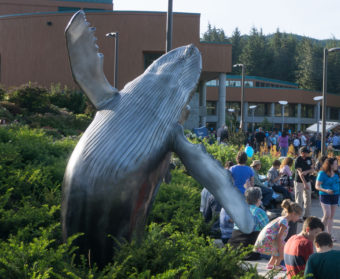
“A lifesize breaching humpback whale will become iconic to Juneau,” says former mayor Bruce Botelho. He’s the vice president of The Whale Project, a nonprofit dedicated to the completion of the nearly $1.5 million bronze sculpture, designed by Skip Wallen.
Most of the money has been raised through private donors and grants, but the organization is still asking for funds. In 2012, the statue was gifted to the city of Juneau with the understanding it would find a place for it; now it seems it has.
“Oh, it’s exciting. I’ll feel a lot better once it’s actually in place but we’re moving quickly towards that,” Botelho says.
Site plans for the Bridge Park from the Juneau Planning Commission agenda.
The statue will be part of a new waterfront park and seawalk that will eventually connect all the way to the cruise ship docks about a mile away. It will cross over to an artificial island, lush with native plants.
Skye Stekoll, an engineer with the city of Juneau, says the island will mitigate some of the ecological damage done to Gold Creek and its delta. The Army Corps of Engineers has already signed off.
The bronze, life-size whale statue at a workshop. (Photo courtesy City and Borough of Juneau)
“So a habitat island is trying to replace some of the riparian habitat that may have been there in a natural state,” Stekoll says.
In June, the Assembly gave its final approval to move ahead. Cruise ship passenger fees and sales tax will fund the construction. A mixed-use plaza is in the plans and Juneau Docks and Harbors is considered opening a fish market on the other side of the bridge.
After more than a decade of discussion, disagreements about where the park should be built and concerns over funding, the only thing left to do is open the bidding process, which Stekoll says could happen in the next few weeks.
“Yeah, for the most part we are now ready to go.”
Bids then go before the assembly for final approval. Construction could start as early as October and be completed next fall.
Editor’s note: A reference to the Juneau-Douglas Bridge has been corrected. It’s the Douglas Bridge.
Seven major cruise lines face penalties for polluting the air while sailing Alaska waters. The state Department of Environmental Conservation issued 18 notices of violation involving 48 instances of excessive air emissions since 2010.
Smoke pours out of the smokestack of the Carnival Spirit cruise ship as it fires up its engines. Carnival is one of seven lines allegedly violating pollution rules. But exceptions are made for engine startups. (Photo courtesy Ground Truth Trekking)
Environmental Program Specialist Jason Olds says they were measured in Ketchikan, Juneau, Haines, Skagway and Anchorage. Others were spotted while sailing between ports.
He says government or contract monitors measured the density of ship smoke. They’re part of the department’s Cruise Ship Program.
“The layman’s explanation is that we look at the contrasting background and how much of that is obscured by the plume,” he says.
Details of the notices are not yet public because the alleged violations and penalties are being negotiated with cruise lines. Olds says they could be resolved within six months, though it could take longer.
He says the penalty for a current violation is $37,500 per incident. Earlier violations could cost less, since the amount is linked to inflation.
Olds says violations were issued to almost all of the major cruise lines serving Alaska.
“We have Carnival, Holland America, Princess, Royal Caribbean, Norwegian, Celebrity and one to Silver Seas,” Olds says.
The industry says it’s already reducing air pollution.
“All the ships are equipped with opacity monitors that actually measure the opacity as the smoke comes out of the stack,” says John Binkley, who heads up Alaska’s chapter of the Cruise Lines International Association.
He says the ships self-report when their monitors detect excessive emissions. But sometimes, that equipment comes up with different measurements than human observers.
“And so, that’s one thing they may be discussing in these alleged violations is, which do you give more weight to: The actual instrumentation or the person’s interpretation of what the smoke looks like?” he says.
A Celebrity Cruise Line ship sails into Juneau in 2012 with emissions coming out of its stack. Celebrity is one of seven lines alleged to have exceeding emissions limits. (Ed Schoenfeld/CoastAlaska News)
A number of cruise lines have installed or are in the process of installing stronger pollution-control equipment called scrubbers. They mostly target sulfur emissions, but also remove particulates that reduce opacity.
In addition to cruise ships, the ferry Columbia was found in violation while it was in Auke Bay, home to Juneau’s ferry terminal.
Alaska Marine Highway spokesman Jeremy Woodrow says that happened two winters ago, after new engines were installed.
“The department worked with DEC, tested the quality of the air coming out of the exhaust stacks and sure enough, it wasn’t in compliance,” he says.
Further adjustments were made and the Columbia met emission standards. Olds says his department took no further action.
The cruise ship Norwegian Pearl sails south through Chatham Strait on its final voyage of 2013. (Photo by Ed Schoenfeld/CoastAlaska News)
The Alaska Department of Labor and Workforce Development released a report this week that puts tourism’s impact in Southeast Alaska into numbers. The report calls the region the “epicenter” of cruise ship traffic in the state – and that’s the main driver of the visitor industry.
“Tourism’s one of the big parts of Southeast’s economy,” says Department of Labor Economist Conor Bell, who authored the recent report using statistics from 2014. “I don’t think there’s enough real analysis of what impact tourism really has to our region.”
He found that there were about 4,600 tourism-related jobs in Southeast, making up about 11 percent of the region’s summer economy.
The report says Southeast’s economy is ‘highly seasonal,’ and most of that increase is tied to tourism. From May to September of 2014, there was an average of about 7,000 more jobs each month than the rest of the year. More than half were in visitor-related industries.
Tour guides are the most common of those jobs, followed by waiters and waitresses and then retail salespeople.
The highest paying of visitor-related jobs are captains, mates and pilots of water vessels — earning an average of about $17,000 a summer. Tour guides earned an average of about $6,000 in a summer.
Visitor-related jobs are especially concentrated in three Southeast towns: Juneau, Ketchikan and Skagway. Bell found that in 2014, Juneau had about 1,700 jobs directly related to summer tourism, Ketchikan had about 1,000 and Skagway had around 800. Of those three, Skagway stands out.
“The impact of tourism should be apparent to any Skagway resident. For one thing, the summer employment for tourism exceeds the year-round population. And so there’s a huge influx of people. And over half the jobs of summer are in tourism industries. And that’s only counting direct tourism jobs.
More than 50 percent of Skagway’s summer jobs are directly visitor-related. Compare that to 12 percent in Ketchikan and 9 percent in Juneau.
Some of the ports that have less steady or no cruise ship traffic see much less of an economic impact from tourism. For example, last summer Sitka had 340 visitor-related jobs, Haines had about 200, Petersburg 50, Wrangell 40, Prince of Wales Island 150 and Yakutat fewer than 10. The Hoonah-Angoon census area, which includes Gustavus and Glacier Bay, added 250 summer tourism jobs.
Bell says some communities are looking to increase those numbers.
“Yakutat had their first few ships this year and they’re evaluating whether they want to expand that in the future, Hoonah build a dock in recent years,” Bell says. “More and more Southeast communities are going to enter the market and it’s going to make the market more competitive but also more exciting for travelers and it could lead to more economic development.”
In Haines, the borough assembly voted to offer 50 percent- discounted docking fee waivers to cruise ships in summer of 2017. The goal of the waivers is to draw more ships to Haines.
Bell says tourism jobs and cruise ship visitor numbers took a hit during the nationwide recession. But since then, numbers have been building back up.
And as long as visitors keep cruising, Southeast summer tourism employment will continue to climb.
RSVP patrons enjoy the drag performances during Monday night’s event. (Photo by Lakeidra Chavis/KTOO)
On Monday afternoon, nearly 2,000 people arrived in Juneau for their first stop on the 30th anniversary RSVP Vacations cruise. The cruise line caters exclusively to gay and lesbian people.
The Southeast Alaska LGBTQ+ Alliance, also known as SEAGLA, hosted an event for cruise patrons at the Imperial Saloon downtown. Nearly 200 patrons mingled, drank and played billiards during the 2-hour event.
SEAGLA decorated the outside of the Imperial with various gradient flags from the LGBT community, including the pride, bisexual, transgender, leather, bear flags. (Photo by Lakeidra Chavis/KTOO)
“It’s just important to remember that we are in the community, that we’re neighbors, but also to welcome people who are traveling, who might be looking for community,” says Lauren Tibbitts-Travis, SEAGLA outreach coordinator.
She helped organize the event.
“It’s one thing to go somewhere that you’ve never been and see the sights, but if you’re going there [and you] immediately identify with [the place], that makes it a much better experience. That’s what we’re trying to do at these events,” Tibbitts-Travis says.
This week’s cruise will take tourists to Glacier Bay, Sitka, Ketchikan and Victoria, British Columbia. Although the passengers are predominantly male, the cruise caters both to gay and lesbian people.
Ticket prices ranged from $900 to almost $3,000. Joe Fallon and his husband David Rodes says the cruise was worth it.
“We’d never been to Alaska and we’d always wanted to do an Alaska cruise, but a straight cruise never seemed like that much because we figured we’d be with a lot of old people,” Fallon says.
Fallon and Rodes, who are both in their late 50s, decided to take the cruise to celebrate paying off their mortgage.
“We met working in the same shopping center when we were like 17 and 18 years old.” Fallon says.
They’ve been together for 39 years, says Rodes.
Both men says they’re most excited to see Glacier Bay.
Sam Wilson, 47, sits in the Imperial with his best friend and travel partner. (Photo by Lakeidra Chavis/KTOO)
For 47-year old Sam Wilson, he decided to go on the cruise because it’s something his best friend has always wanted to do.
“He actually wanted to go for a very long time, and we finally found time to go. We travel a lot, this is like my fourth cruise. I did a couple in the Caribbean and a Mediterranean one, so this was like on the bucket list — definitely one to come and see,” Wilson says.
Wilson and his friend have traveled everywhere from Egypt to Greece. He says the cruise is like a party every night and there’s always a chance to meet new people.
Halfway through the event, four local drag performers took the dance floor to entertain the crowd. Performer Vanessa LaVoce-Kellie — who preferred to be identified by her stage name — was one of them.
For her the event symbolized a larger effort to create a more inclusive community.
“I performed tonight because there’s not very many opportunities to do drag here in Juneau; it’s been getting a lot better. We’ve been having more exposure, but any chance that I get to step out inface and give somebody a show, I’ll take it,” La-Voce-Kellie says.
For LaVoce-Kellie, the bigger the drag queen presence in Juneau, the better.
“These events give people that safe place, and help us to build the conversation for more acceptance and tolerance. The more you can do for love the better,” LaVoce-Kellie says.
The cruise left late Monday night to travel to its next destination, Sitka, before making a stop in Glacier Bay.
The location of the new dock at Icy Strait Point. (Photo by Elizabeth Jenkins/KTOO)
The final pilings for a new cruise ship dock are being driven at a Hoonah tourist attraction, marking an end to the nearly decade-long saga that divided the community. The publicly financed dock is being built where it serves a local Native corporation’s interests, only indirectly benefiting residents — although many are also shareholders.
On the grounds, tourists wander in and out of a historic salmon cannery turned museum. They skim the treetops on more than a mile of zipline and bask in front of a crackling wood fire that an employee keeps going.
Tyler Hickman is the vice president of Icy Strait Point, owned by the Huna Totem Corp. He says it’s important to maintain the cannery’s off-beat charm.
“It just starts feeling fake when you overdo something,” he says. “We try to make sure that everything we do is authentic.”
Tender boats drop off passengers from the ship. (Photo by Elizabeth Jenkins/KTOO)
Part of that is making sure visitors feel comfortable when they arrive and leave. About 150,000 cruise ship passengers travel to Hoonah each year. To get to Icy Strait Point, they have to schlep over on a small tender boat. There’s no place for the big ships to dock.
Hickman points to 60 people on a cruise ship waiting for a tender to transport them to shore. In the future, he says, those passengers will be able to grab their raincoat and wander off the boat on their own.
From there, they could walk through second-growth forest. Not everyone is as enchanted with the location of what Hickman estimates is a $22 million dock, paid for primarily by a grant from the state.
Ken Skaflestad is a shareholder in the Native corporation. He says before the cruise ships started arriving back in 2004, the village felt like a different place. Its population was around 750.
“I remember a day when somebody might wear their pajamas down to pick up the newspaper or groceries on a Saturday morning. If a cruise ship’s in town, that’s changed now,” he says.
An employee in uniform answers tourists questions about a real halibut carted around the boardwalk. (Photo by Elizabeth Jenkins/KTOO)
A mile past Icy Strait Point’s traffic gate is the city of Hoonah. Tourists shuttle through for bear watching tours and to ride the zipline.
Back in the mid-2000s, the city proposed a multi-use dock located closer to the city center.
“This commercial dock that was going to help with barging, that was going to help with freighting, was going to be a place for fishing boats to tie up to,” he says.
Cruise ships weren’t the main focus, but Skaflestad says the conversation shifted after the success of Icy Strait Point as a tourist destination. A public-private partnership was created. The state put in $14 million to build the dock; the corporation put in $8 million. Although the inclusion of cruise ships was decided, the location of the dock wasn’t.
Skaflestad says the Icy Strait Point developers disagreed with where the community wanted the dock, which was about 800 feet toward town from their existing facility.
The city selected Shaman Point. He says the argument became not only about where it should be, but also what: a multipurpose dock close to downtown or a cruise ship dock on private land.
“I can say that I was one … that adamantly took opposition to that whole initiative.”
And the town, he says, was split down the middle.
“I refer to it as World War III. It was horrible,” he says.
A Royal Caribbean executive sent a letter to the city stating that if the dock was built at Shaman Point, cruise lines might not moor there. Skaflestad says the cruise ship passenger experience outweighed the community’s interests in the dock.
“The opinion of the customer’s experience was touted to far outweigh the community’s need to all of the other uses other than a cruise ship dock,” Skaflestad says.
Tourists explore the grounds of Icy Strait Point. (Photo by Elizabeth Jenkins/KTOO)
Eventually, the city council turned over. A new mayor was elected and it was decided the dock would be built at Icy Strait Point. Skaflestad says he never did agree with how everything went down. But when he became mayor in 2014, he wanted to make the best of it.
“I had to really work to be open minded about this and listen to the other points of view. The other opinions were that right now the important thing is the development of this industry and that those other uses are really relatively small uses. They’re not going to be big booms to our economy or anything,” he says. “Truthfully, this dock, it’s primarily income that’s going to come through the cruise ships.”
As the final pilings go in, Tyler Hickman says there’s no need to discuss what happened in the past.
“To me, it’s about today. When you go and walk around the corner, it’s being installed where it is and it’s in the right place,” Hickman says. “The experience the cruise ship guest is going to have is going to be the best in the world.”
The new dock could attract more cruise lines such as Disney, which would mean more visitors to Icy Strait Point and Hoonah.
Skaflestad says he’s trying to be welcoming. He leads the bear watching tours when they get overbooked. He says before, the locals just wanted the tourists to pass right through.
“This metamorphosis has happened and the town is saying ‘I can make a buck here,’ ‘Hey, I’m finding a little niche over here,’ or ‘I’m just going to sit here like I used to sit and watch the birds on the beach and now I’m going to watch tourists,'” Skaflestad says. “There’s this significant change that the presence of these visitors has brought to Hoonah.”
The dock is expected to be completed in October just as Icy Strait Point closes for the season.
Twenty-something seasonal tourism workers have been tentatively identified as those who climbed the Alaska Capitol and stole the U.S. and Alaska flags on July 31.
After stills from video surveillance were circulated in the local media, two of the three men caught on tape walked into the Juneau Police Department on Tuesday and talked with an investigator. They admitted to grabbing the flags after hitting the bars downtown. After the theft, the flags were apparently discarded somewhere in the downtown area. The flags and rope have an estimated value of $434.
A 26-year-old man and a 24-year-old man face potential trespass and larceny charges. Police have yet to name or arrest them.
Police say they know who the third man is, but he hasn’t been interviewed yet.
Close
Update notification options
Subscribe to notifications
Subscribe
Get notifications about news related to the topics you care about. You can unsubscribe anytime.