Tourism

Juneau Assembly approves funding to boost staffing at Mendenhall Glacier this summer

Mendenhall Glacier Visitor Center in July, 2023. (Photo by Clarise Larson/KTOO)

The Juneau Assembly has approved spending up to $200,000 to hire support staff for Mendenhall Glacier Recreation Area after federal firings left few U.S. Forest Service staff on duty

The heavily trafficked attraction saw about a million visitors last year and has a higher volume of tourists — and bears — on the horizon. 

The funding would go to organizations that already operate at the glacier so they can hire more staff. Those include education nonprofit Discovery Southeast and the Central Council of the Tlingit and Haida Indian Tribes of Alaska, which has a co-stewardship agreement with the Forest Service.

Shawn Eisele directs Discovery Southeast, which brings nature and science education programs to Juneau schools and camps. He said setting the funding aside is a common sense move.

“I think it gives us a lot more tools,” Eisele said. “I see Discovery Southeast and Tlingit and Haida both being in a position where we can bring on some folks that can ensure some of the basic stuff that people expect to see out there, particularly related to safety.”

The worker shortage is a result of national policy changes. In February, the Trump administration cut thousands of workers in the U.S. Forest Service, including most of the staff at Mendenhall Glacier. Some were rehired after courts challenged the firings, but some have taken a resignation option since.

The Forest Service has not responded to multiple inquiries about how many original glacier staff took the resignation option, and how many remain.

The agency released a plan in April that reduced the Mendenhall Glacier Visitor Center’s hours and said a handful of Forest Service employees from other offices and departments would staff the recreation area. 

Now it is staffed from 10 a.m. to 5 p.m. each day but Saturday. When six ships docked in Juneau last Saturday, there were at least two Forest Service staff present at the glacier, but the agency doesn’t guarantee that will continue.

Góos’k’ Ralph Wolfe directs Tlingit and Haida’s cultural ambassadors program. Cultural ambassadors are tribal members who staff the recreation area to teach visitors about Indigenous history, language and culture. 

Wolfe said between the reassigned Forest Service staff, Discovery Southeast employees and the six cultural ambassadors, things at the glacier haven’t been out of control, yet. But he’s expecting more people — and other challenges. 

“We have been able to cover the basic necessities that are out there right now,” he said. “However, there is still, like, the anticipation of higher bear activity once the summer really starts going and more people.”

Wolfe said the tribe is already working to boost the number of ambassadors at the glacier. 

He said more staff would help ensure safety of people using the area. The first bear sighting was two weeks ago, Wolfe said, and it took half of the staff at the glacier that day to direct tourism traffic away from the bear and give it room to get away from the trail. 

“My essential concern is, I need somebody out there for bear and trail control, and I don’t think we’re seeing either of those happen too much right now,” he said. 

The ordinance passed 6 to 3. Assembly member Ella Adkison voted against the ordinance and expressed concerns about all of the areas of the Juneau community that may need support as federal funding cuts continue. 

“There will be a lot of worthy causes I think that will come up short on funding,” she said. “And this Assembly will not be able to support them.”

The Assembly is also considering budgeting extra money for Juneau’s public libraries to make up for lost federal grants

The money intended for staffing the glacier comes from marine passenger fees. There are no plans to hire just yet. City Manager Katie Koester will decide if more staff is needed if either organization says safety issues are arising at the glacier.

Juneau cruise limit ballot petition fails to gather enough signatures

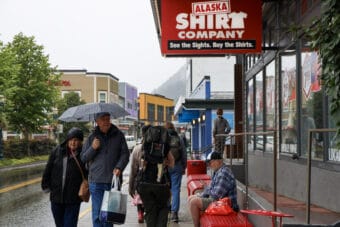
Cruise ship visitors walk the docks in downtown Juneau on Tuesday, May 13, 2025. (Photo by Clarise Larson/KTOO)

The local advocates who filed a petition with the City and Borough of Juneau last month to put harder limits on cruise ship tourism have withdrawn it. 

That means voters won’t see the question on the municipal ballot this fall. According to Karla Hart, one of the advocates who filed the petition, they weren’t able to gather the minimum of 2,720 signatures before Monday’s deadline. 

Hart said she still thinks there is a lot of community support for limiting the growth of cruise ship tourism, but there just wasn’t for this particular ballot measure. 

“In the conversations that I had with people, I don’t think that it’s the right initiative,” she said. “I think that we need to regroup and refocus and take on the myriad of different pieces that are really adversely impacting our lives.” 

The proposed initiative sought to impose a five-ship daily limit, cap the annual number of cruise ship visitors at 1.5 million a year, and limit daily cruise visitors to 16,000 people on most days and 12,000 on Saturdays. It also sought to shorten the season.

Those mirror agreements that the city has already signed with cruise lines. The difference is that those agreements are non-binding and voluntary, while the petitioners sought to make them law. 

The petition saw legal pushback from a tour company. The company’s attorney Scott Collins called the proposed initiative poorly drafted and “wholly inadequate in attempting to address the complexity of limiting, permitting, and penalizing cruise ship visitation.”

Hart said she may revive an iteration of last election’s failed Ship-free Saturday in a future election. But, in the meantime, she said she and other advocates plan to keep pushing for city officials and Assembly members to take action.

“I think that these efforts are important for keeping pressure on and showing that if things don’t improve for the citizens, we do have options and we are willing to exercise them,” she said. 

There are three other proposed ballot propositions currently still in the signature gathering phase. Those petitioners seek to cap the property tax rate, to remove sales tax on food and utilities and to make in-person voting the default again.

Juneau’s ski area is facing a multimillion-dollar deficit. Its future is riding on a gondola.

Parts of the city-owned gondola sit outside at Eaglecrest Ski Area on Dec. 10, 2023. (Clarise Larson/KTOO)

Juneau’s city-owned ski area expects to run a deficit for the foreseeable future. That’s because officials plan to repair some broken and aging infrastructure while boosting pay to employees and preparing to operate year-round. 

But their plan to dig out of the deficit relies heavily on revenue from a gondola that has yet to be built.

Deferred repairs and maintenance for Eaglecrest Ski Area’s aging infrastructure have built up over decades of use. At a Juneau Assembly finance committee meeting on Wednesday, Eaglecrest’s board president Mike Satre said it’s reaching a tipping point. 

“We have to do something different, or we will essentially be shutting down the operation as infrastructure fails or is beyond its useful life,” he said. 

Eaglecrest Ski Area’s board president Mike Satre speaks to the Juneau Assembly on Wednesday, May 14, 2025. (Photo by Clarise Larson/KTOO)

That something different is a gondola that the city bought for about $2 million three years ago. It’s still sitting on the ground and it’s unclear how much it will cost to get it going.

But the plan is that once it’s up and running, it will allow the ski area to operate year-round and eventually make enough money for it to be self-sustaining. 

That’s likely still years out. In the interim, the ski area’s management says some repairs need to happen to other infrastructure. According to General Manager Craig Simmons, those come with a cost.

“None of those numbers are small,” he said. 

Eaglecrest officials also want to increase staffing levels and pay as they transition to operate year-round. That means they’re going to be spending more money than they’re making until the gondola is open. 

At the finance meeting, the Juneau Assembly moved forward with a plan that would allow the city-owned ski area to run a deficit, but it set aside about $3 million in the city’s restricted budget reserve in case Eaglecrest can’t dig itself out. That safety net is required by city code.

“If Eaglecrest was to have their full budget run through next fiscal year and then Douglas fell off into the ocean and didn’t exist and there was no way that they could recover that, then that hole would need to be filled,” city Finance Director Angie Flick said. “That reserve is there in case that hole needs to be filled in the future.”

This isn’t the first time Eaglecrest has run a deficit. It operated with a negative fund balance for almost a decade after its board gave refunds and credits to season pass holders in 2003 to make up for a poor snow season.

The black line represents Eaglecrest Ski Area’s projected expenses, while the blue line represents its projected fund balance leading into the 2033 fiscal year. (Courtesy of Eaglecrest Ski Area)

At the meeting, Assembly member Alicia Hughes-Skandijs voted in favor of the plan. But she said she’s still skeptical of how much it will cost to get the gondola off the ground. 

“I would bet a lot of money that we can’t build the gondola without infusing a significant amount of money in it,” she said. “That’s just outside of Eaglecrest’s control – it really just has to do with the cost of building anything in the world.”

A local Alaska Native corporation, Goldbelt Incorporated, invested $10 million in the gondola in 2022 in exchange for a revenue-sharing agreement. Satre said that funding has helped pay for most of the expenses so far, but with the Trump administration’s new tariffs kicking in, costs could go up.

“I would expect it to exceed the $10 million that we have, and then we’ll have to make some decisions,” he said. 

Assembly member Wade Bryson was the only member to vote against the plan to reserve money for Eaglecrest. He argued that Eaglecrest has had financial issues for years. For at least the past 25 years, Eaglecrest has required support from the city’s general fund for its operations. 

“When do we stop?” he said. “How high does their ask have to be before we say, the community cannot afford this?” 

He recently asked city officials to find out what it would take to privatize the ski area. 

“I fully believe that Eaglecrest is the gem of the community — that does need a new chapter written for it,” he said. “I don’t believe that there’s enough money in the CBJ government to do that.”

The Assembly still needs to finalize the city budget and the plan is still subject to change. Members are expected to vote to finalize it in mid-June. 

Humpback whale health study could prompt new whale watching regulations in Juneau

A humpback whale calf breaches in Juneau's North Pass. Photo courtesy of Heidi Pearson, taken under NMFS ESA/MMPA Permit No. 27342)
A humpback whale calf breaches in Juneau’s North Pass. (Photo courtesy of Heidi Pearson, taken under NMFS ESA/MMPA Permit No. 27342)

Listen to this story:

Pregnant and nursing humpback whales rely on the protected waters near Juneau to fatten up on herring and krill while raising their young. But calves were involved in nine of the 14 recorded incidents of whales getting entangled or hit by boats in the past four years. 

These are the key preliminary results from a study of Juneau’s whale health that started in 2020 in response to rising concerns about whether the multimillion-dollar whale watching industry might be harming the humpbacks that spend the summer here. The City and Borough of Juneau used cruise ship passenger fees to support the research with a $160,000 grant. The forthcoming final results could drive the city to consider limiting the number of whale watching boats. 

Heidi Pearson, a marine biology professor at the University of Alaska Southeast, leads the Juneau Whale HEALTH Project. She said the team’s initial results should lead to greater conservation efforts, since whale mothers drive population growth. 

“The fact that we’re finding that females stay here longer, oftentimes with their calves, means that we should probably think about some additional precautions to protect this really precious component of the population,” she said.

Tourists in Juneau spent $60 million on whale watching in 2019, the latest year with available data. There are more than 80 whale watching boats currently operating in town, according to NOAA.

It’s illegal for vessels to get within 100 yards of humpback whales, speed near them, block their path or disrupt their behavior. There are also voluntary federal and city guidelines that some whale-watching companies follow to ease human impacts, such as not idling near the whales and limiting observation to 30 minutes. 

But Alexandra Pierce, the city’s tourism director, said that isn’t enough to protect whales from the attention.

“We’re the biggest whale watch destination in the world,” Pierce said. “We don’t know of any destination with more vessels on the water. It’s a numbers problem, even if individual operators are behaving well, and a lot of them are.”

In 2023, a whale calf named Tango was killed by a vessel. While officials could not identify what kind of boat struck the calf, they said that collisions are fairly common. 

Pierce said she is working with the industry to try to come up with a plan to regulate the number of boats on the water. Right now, there’s no limit. 

Meanwhile, the research team is still working through the data. Their final results will include whale stress levels, comparing the early COVID-19 pandemic years when there was less boat traffic to the last couple of years when tourism picked up again. To do this, they measured the stress hormone, cortisol, in samples of blubber taken from live whales. 

A peer-reviewed scientific paper is coming later this year or next. It should give researchers and regulators a greater understanding of how humpback whale health is affected by humans watching them. 

Whale acoustic data courtesy of Michelle Fournet, collected under NMFS ESA/MMPA Permit No. 20648. 

Drilling application filed with the state to explore new cruise port on Douglas Island

North Douglas Highway on Wednesday, Oct. 16, 2024. (Photo by Clarise Larson/KTOO)

A construction company has applied for a permit with the State of Alaska to study an area off the coast of Douglas Island for the design of a new cruise ship facility. 

The project is in cooperation with Goldbelt Incorporated, a local Alaska Native corporation, which owns the land on and adjacent to where the study would occur. The data gathered would inform the design of two separate cruise ship docks, and facilities for a small boat harbor and boat launch. 

A public notice of the proposed study was posted on the state’s website on Thursday. 

Last fall, Goldbelt announced a partnership with Royal Caribbean Group to develop a new cruise ship facility on the backside of Douglas Island. But since then, little information about the project has been shared with the public or city officials. 

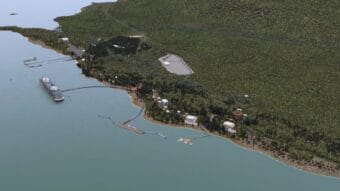
This is a map of the proposed location of a new cruise ship facility on Douglas Island. (State of Alaska)

On Thursday afternoon — the same day the notice was posted — a representative for the cruise line was part of a public meeting with the Juneau Assembly alongside other cruise lines to discuss a variety of industry-related topics. 

During the meeting, the representative dodged questions from the Juneau Assembly about the status of the project.

Goldbelt owns nearly 2,000 acres of land along the northwest coastline of Douglas between False Outer Point and Point Hilda. Satellite imagery over the past month shows portions of the land have been cleared of trees. Officials with the company have not shared whether the activity is related to the dock project and did not respond to a request for comment Friday. 

According to the application with the state, Goldbelt plans to partner with Turnagain Marine Construction, a construction and engineering firm based in Anchorage. The study would involve mooring a barge in Stephens Passage and drilling approximately 28 geotechnical boreholes to study the marine environment of the area. 

The application states the project would “provide safe harbor for two cruise ships and passengers during the visitor season, while helping to decrease cruise ship visitor traffic in downtown Juneau.”

The study would last five months, between June and October. The actual start date would depend on a few factors like contractor availability, permit authorizations and environmental factors.

The application is currently open for public comment. The deadline to submit comments is May 7. 

Royal Caribbean dodges Assembly questions about new dock project on Douglas Island

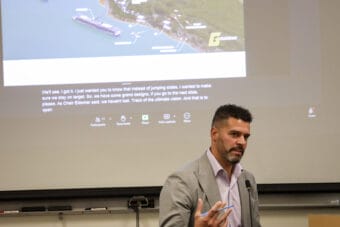
Russell Benford, Royal Caribbean Group’s vice president of Government Relations for the Americas, speaks to the Juneau Assembly on Thursday, April 24, 2025. (Photo by Clarise Larson/KTOO)

A cruise line representative dodged questions from the Juneau Assembly Thursday afternoon about the company’s plans to develop a new cruise ship port on the backside of Douglas Island. 

The interaction took place during a public meeting between the Juneau Assembly and cruise line representatives at City Hall. 

Last fall, Royal Caribbean Group announced a partnership with Goldbelt Incorporated — a local Alaska Native corporation — to develop a new cruise ship dock on the backside of Douglas Island. 

Despite obvious activity going on in the area, Mayor Beth Weldon told a Royal Caribbean Group representative that no one at the city has been informed about their plans for development.

“We see clearing of land on the tip of North Douglas, which has freaked everybody out,” she said. “We’re hearing surveys of docks are done, and so far, we’ve heard nothing from you guys.”

North Douglas Highway on Wednesday, Oct. 16, 2024. (Photo by Clarise Larson/KTOO)

When Goldbelt and Royal Caribbean first announced their plans, the mayor and other city officials said they felt blindsided by the news. And since then, neither company has shared any additional information publicly about the proposed project. 

Goldbelt owns about 1,800 acres of land along the north coastline of Douglas, roughly between False Outer Point and Point Hilda on the island’s west side. In recent weeks, the corporation began putting up no trespassing signs in the area and gated off a trail regularly used by recreational hikers for years, despite being on private land. Satellite imagery over the past month shows portions of land have been cleared of trees. 

Satellite imagery of backside of Douglas Island where the highway ends between March and April of 2025. (Copernicus Browser)

Deputy Mayor Greg Smith asked if either company plans to communicate with the city about what’s going on. 

Royal Caribbean Group’s Vice President of Government Relations Russell Benford suggested at the meeting that it is up to Goldbelt to communicate with the city.

“I don’t want to speak for, I’m not able to speak for the developer,” he said. “But, I can tell you that would be my response to you — I don’t know it’s really on us to speak for them.”

Representatives for Goldbelt were not present at the meeting. But, in a text message to KTOO, Goldbelt President and CEO McHugh Pierre said the company was “inspecting the ground to see what can be built and where it might be built.” He did not disclose if the clearing was related to the dock project. 

During the initial announcement, Goldbelt and the cruise line shared that they hope to develop employee housing, floatplane and whale watching docks, helicopter pads and recreate a Lingít village for passengers to visit, among other business opportunities to go along with the port.

The fate of that proposed dock is in question after the Juneau Assembly approved a tidelands lease for Huna Totem Corporation to build a fifth cruise ship dock in downtown Juneau earlier this month. 

Last year, major cruise lines, including Royal Caribbean, entered into an agreement with the city to observe a five-ship daily limit. If approved, Goldbelt and Royal Caribbean’s dock would be a sixth dock. 

The joint meeting on Thursday also covered topics with the cruise lines like reducing greenhouse gas emissions, supporting local businesses and communicating with city officials.  

There was no opportunity for public testimony during the meeting and the Assembly did not take any action.

Site notifications
Update notification options
Subscribe to notifications