Transportation

Alaska Airlines jet made 3 recent Alaska-Hawaii flights before its cabin wall blowout

Investigator-in-Charge John Lovell examines the hole where a door plug blew out of Alaska Airlines Flight 1282 Boeing 737-9 MAX. (NTSB)

The Alaska Airlines plane that landed safely in Portland Friday despite an in-flight cabin wall blowout had ferried passengers to and from Alaska in recent weeks, including a flight 10 days prior from Anchorage to Honolulu.

A Flightaware.com search of the tail number of the 737 Max 9 from the Friday incident shows that the aircraft flew roundtrip from Seattle to Ketchikan on Dec. 7. That’s the day Alaska Airlines first saw an auto-pressurization warning light illuminate.

It went on to make six more flights to or from Alaska before Friday. Three of them were between Alaska and Hawaii.

It’s not clear the warning light is related to the mishap Friday, said National Transportation Safety Board Chair Jennifer Homendy.

“It’s certainly a concern. And it’s one that we want to dig into and look at what occurred there,” she said at a weekend media briefing about the blowout. “And if there is any relation at all, or correlation to what occurred on this event, we don’t know that at this time.”

The potential of what might have happened to Flight 1282 resonates especially among Alaskans, who take more flights per year than most Americans, and rely on Alaska Airlines more than any other major carrier.

At the time of the blowout, the aircraft was just a few months old. Alaska Airlines had restricted the jet from long flights over water after a warning light that could signal a pressurization problem lit up on three flights, on Dec. 7 and twice in January.

In the Friday incident, the aircraft lost a section known as a door plug – a panel filling the space where an emergency door could be located in a different airplane configuration. Monday, United Airlines reported finding loose bolts securing the door plugs on several of its 737 Max – 9 aircraft.

All Max 9s in the U.S. are now grounded. Alaska Airlines said it canceled approximately 140 flights Monday, or about 15% of its normal schedule. A spokesman said only six of the canceled flights were to or from airports in Alaska.

Homendy, the NTSB chair, said that parts of several seats flew out of the hole in the aircraft Friday, as did the tray table on the back of seat 26A.

“The seats in (row) 26 and … 25 were torqued, and there was a lot of damage to the interior paneling trim,” she said. “My impression when I saw that is, it must have been a terrifying event to experience.”

All but seven seats on the plane were occupied, but not the two closest to the blowout.

Homendy noted that three of the passengers were so-called lap infants – babies under 2-years-old that ride on the lap of their parents or caregivers. Homendy took a moment at the media briefing to say that she advises parents to always buy a seat for their infants, and to strap them into it in a secure infant car seat.

Alaska Airlines recommends that, too.

An investigation into Friday’s decompression continues.

2 bodies recovered from vehicle found snowbound on Steese Highway

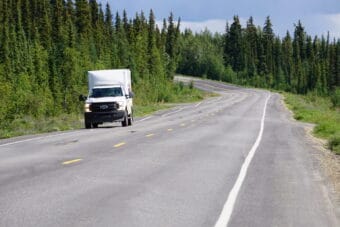
The Steese Highway on Oct. 15, 2014. (Ian Dickson/KTOO)

Alaska State Troopers and state Department of Transportation workers recovered the bodies of two people Friday found dead in a snowbound vehicle on the Steese Highway at Eagle Summit. According to a trooper dispatch, the two were reported to have left Fairbanks on Tuesday headed for Circle.

DOT spokesperson John Perreault says a road crew from an area maintenance station headed up Eagle Summit in stormy conditions Wednesday morning and found three vehicles. Two of the vehicles were still running, but a third was buried in the snow, and the crew got no response when they knocked on the windows or tried the doors.

Perreault says the crew left to help the two other vehicles off the summit and then returned to check the third again.

“They couldn’t see inside,” he said. “The windows were frosted and tinted, and so they cleared the passenger doors. They even tried to pry them open.”

Perreault says the crew came off the mountain about six hours after first locating the vehicle Wednesday morning.

A State Trooper dispatch says they responded that evening and broke a window to get in and found two people dead inside.

“Because the weather I’m told at that time was 60 mile an hour winds, the Trooper and the DOT personnel came down off the summit and had to wait for the weather to clear up. And the vehicle was recovered with the occupants Friday morning,” Perreault said.

The Trooper dispatch says the bodies were transported to Fairbanks for identification and would then go to the state medical examiner for autopsy, adding that no foul play is suspected.

Strong winds are common in the Eagle Summit area, and the DOT has gates to close the highway when conditions warrant. Perreault says a road crew did not lower the gates after completing work around 4:30 PM Tuesday.

“They were open Tuesday night because the pass was clear when our guys came off shift,” he said.

Perreault says the DOT closed the gates Wednesday morning, as conditions had significantly worsened.

“And so traffic had gone over Tuesday night before they had come back on shift to make a determination,” he said.

Perreault says the incident and response will undergo review.

“Anytime tragedies like this happen, we want to make sure that we did everything we could, and we’ll be sure to put those sort of decisions through a process of review and to make sure we’re enabling our staff to protect the public as best they can,” he said.

Perreault encourages drivers to check weather reports and Alaska 511 for conditions, and to let someone know where they’re headed and be prepared with sufficient fuel, emergency supplies and equipment.

Before a door plug flew off an Alaska Airlines plane, an advisory light came on 3 times

This photo released by the National Transportation Safety Board shows a gaping hole where the paneled-over door had been at the fuselage plug area of an Alaska Airlines flight Jan. 7, 2024, in Portland, Ore. A panel used to plug an area reserved for an exit door on the Boeing 737 Max 9 jetliner blew out Jan. 5, forcing the plane to return to Portland International Airport. (AP)

An advisory light on the Alaska Airlines plane that lost a piece of its fuselage last week had come on during previous flights, preventing the aircraft from being used on long flights over water, the National Transportation Safety Board said.

Additionally, the flight crew and attendants described the atmosphere aboard last Friday’s Alaska Airlines-operated Boeing 737 Max 9 flight as chaotic, “loud” and “very violent” once a door plug flew off and left a vast hole on the side of the plane. The flight carrying 171 passengers and six crew safely returned back in Portland, Ore. There were no injuries.

A door plug is used to fill a doorway and held together by 12 stop fittings, which prevent the door plug from becoming dislodged. In this case, the plug was not used for a functional door, NTSB Chairperson Jennifer Homendy said at a Sunday news conference.

The door plug was found in the backyard of a Portland schoolteacher named Bob, Homendy said. Two cell phones were also found – one on the side of the road and the other in a yard, she added.

@strawberr.vy Girls’ trip turned into emergency landing trip… #alaska #alaskaair ♬ original sound – vy ?

An advisory light came on during 3 previous flights

On three flights prior to Friday’s, the plane’s auto pressurization fail light came on, Homendy said.

The flights happened on Dec. 7 of last year, and then on Jan. 3 and Jan. 4 — just prior to last Friday’s flight. The light coming on is “very benign,” Homendy said, and it was tested by maintenance crews and reset.

“We don’t know that there was any correlation of the two,” Homendy said. “It could be entirely separate.”

Alaska Airlines then temporarily restricted the plane from being flown over water to Hawaii, so that it could be easily accessible to an airport. The airline requested that maintenance crews examine the light. However, they had not been fulfilled before the plug came off.

The moment the door plug broke

When the plug flew off, the flight crew reported hearing a loud bang, Homendy said at the news conference.

The crew immediately put on their oxygen masks. Their quick reference checklist flew out of the cockpit door, which had flung open and jammed the door to the bathroom, which was empty. Instead, the captain handed the quick reference handbook to the first officer, who had jolted forward, causing her headset to come off. The crew put their oxygen masks on and turned on the speakers to alert those in the cabin.

The circuit breaker to the cockpit voice recorder was not pulled, so the recorder was therefore empty, Homendy said.

“Communication was a serious issue,” Homendy said. “The flight attendants reported that it was difficult to get information from the flight deck, and the flight deck was having trouble also communicating.”

The NTSB has interviewed two flight attendants who were at the front of the plane and will interview the two who were in the back of the plane on Monday.

The plane seats 178 people. The 171 people on board included four unaccompanied minors and three babies, who were in the laps of caregivers, Homendy said.

Homendy applauded the work of the flight crew and attendants.

“After this explosive event occurred suddenly, the flight attendants were very focused on what was going on with those children,” Homendy said. “Were they safe? Were they secure? Did they have their lap belts on, and did they have their masks on? And they did.”

Homendy pointed out that the NTSB, as well as the Federal Aviation Administration and Alaska Airlines, encourages caregivers to purchase seats for infants under age two and safely strap them into a car seat.

Damage to the interior

The plug was positioned in row 26, on the left side of the plane. No one was seated in the two seats adjacent to the door, seats 26A and 26B. The headrests on both of those seats are gone and the tray table on the back of 26A is missing. The seats have been sent to NTSB to be inspected.

There was a lot of damage to the paneling and trim around the area. The seal to the window was undamaged, Homendy said.

“Those are all not critical to the structure of the aircraft, so I just want to emphasize that,” she said.

The NTSB is investigating the functionality of an oxygen mask that was still in its ceiling panel. Homendy said it either did not deploy or someone must have put it back up after the incident.

There was additional damage in rows 1 through 4, 11 and 12, 25 through 27 and 31 through 33. There was no damage to the exterior of the plane, Homendy said.

What’s next in the investigation

NTSB teams spent Sunday documenting damage to the frame. They have looked for paint transfers and are sending some components, such as the stop fittings, to a laboratory to be examined, where the NTSB will search for things like fractures and shears under a microscope.

The corresponding door plug on the right side of the plane will also be inspected.

The FAA has grounded 171 models of the Boeing 737 Max 9 planes and mandated they be inspected immediately. Alaska Airlines has grounded all of its models of that plane.

“Safety is our top priority and we deeply regret the impact this event has had on our customers and their passengers,” Boeing said Saturday. “We agree with and fully support the FAA’s decision to require immediate inspections of 737-9 airplanes with the same configuration as the affected airplane. In addition, a Boeing technical team is supporting the NTSB’s investigation into the Jan. 5 accident. We will remain in close contact with our regulator and customers.”

“My heart goes out to those who were on this flight – I am so sorry for what you experienced,” Alaska Airlines CEO Ben Minicucci said in a statement. “We are working with Boeing and regulators to understand what occurred tonight, and will share updates as more information is available.”

Copyright 2024 NPR. To see more, visit https://www.npr.org.

FAA orders grounding of certain Boeing 737 Max 9 planes after Alaska Airlines incident

The first Alaska Airlines passenger flight on a Boeing 737-9 Max airplane takes off on a flight to San Diego from Seattle-Tacoma International Airport in Seattle on March 1, 2021. (Ted S. Warren/AP)

The Federal Aviation Administration on Saturday ordered the grounding and immediate inspection of about 171 Boeing 737 Max 9 aircraft worldwide after a mid-flight emergency late Friday involving one of the planes operated by Alaska Airlines.

“The FAA is requiring immediate inspections of certain Boeing 737 MAX 9 planes before they can return to flight,” the agency’s administrator Mike Whitaker said in a statement.

The decision comes after an Alaska Airlines flight was forced to abruptly land in Portland, Ore., on Friday night. Along with the FAA, the National Transportation Safety Board is also investigating the incident.

On Friday night, Alaska Airlines grounded and ordered a fleet-wide inspection of its Boeing 737 Max 9 aircraft. On Saturday, United Airlines also suspended service on some of its Boeing 737 Max 9 aircraft per the FAA’s request. The airline told NPR the grounding will cause about 60 flight cancellations on Saturday.

Southwest Airlines and American Airlines told NPR they do not carry Boeing 737 Max 9s. While they do carry Boeing 737 Max 8s, both airlines said the model does not raise any concerns.

“The MAX -8 aircraft in our existing fleet and the -7 in our future fleet do not have the exit door plug involved in the Friday evening event. Our fleet and operation are unaffected,” a Southwest spokesperson said in a statement.

Meanwhile, India’s aviation regulator ordered the immediate inspections of all Boeing Max 737 aircraft owned by domestic operators, Reuters reported. None of India’s air operators are believed to carry the model that abruptly landed in Portland on Friday.

The incident comes less than four years after Boeing Max aircraft were allowed to fly passengers in the U.S. All Boeing Max planes were grounded worldwide in 2019 after two deadly crashes involving Max 8 jets.

Last week, Boeing urged the FAA to check its 737 Max jets for loose bolts after the discovery of at least two planes with improperly tightened nuts.

In a statement, Boeing spokesperson Jessica Kowal said the company supports the FAA’s call for inspections.

“Safety is our top priority and we deeply regret the impact this event has had on our customers and their passengers,” Kowal said. “In addition, a Boeing technical team is supporting the NTSB’s investigation into last night’s event. We will remain in close contact with our regulator and customers.”

What happened Friday night

Alaska Airlines Flight 1282 took off from Portland, Ore., shortly after 5 p.m. PST Friday, bound for Ontario, Calif. According to social media posts, it appeared that a window and piece of fuselage had broken off midair — leaving a gaping hole on the plane’s left side.

Oxygen masks were deployed as the aircraft quickly returned to Portland International Airport at 5:26 p.m. PST, according to FlightAware.com. The flight had 171 passengers and six crew members on board. No casualties or serious injuries were reported.

KPTV reported that the local fire department arrived on scene and treated minor injuries. At least one person needed further medical attention.

“We are working with Boeing and regulators to understand what occurred tonight, and will share updates as more information is available,” Alaska Airlines CEO Ben Minicucci said in a statement.

The airline grounded all of its Boeing 737 Max 9 aircraft late Friday until it could inspect each plane. On Saturday, Alaska Airlines said it had completed inspections for more than a quarter of its planes and there were “no concerning findings.”

The company added that it will return planes to service after their inspections are completed “with our full confidence.” The airline expects inspections on all 65 of its Boeing 737 Max 9s to be completed in the next few days.

Boeing 737 Max’s troubled history

The aircraft’s safety problems were under global scrutiny after deadly crashes in Indonesia in 2018 and Ethiopia in 2019 — which killed a total of 346 people. After a worldwide halt in 2019, Boeing 737 Max completed its first U.S. commercial flight in December 2020.

Investigators determined that the company’s newly rolled-out flight control system was partly to blame. In both incidents, the system known as MCAS acted on a faulty sensor and forced both planes to erroneously nosedive even as the pilots attempted to regain control.

But it wasn’t just manufacturing flaws. A report by the Department of Transportation’s inspector general found that the company failed to tell regulators about critical changes it made to its flight control system. The report concluded that Boeing did this in order to expedite the plane’s certification process.

In 2021, Boeing agreed to pay more than $2.5 billion to settle a criminal charge related to the crashes. Under the deal, Boeing was ordered to pay a criminal penalty of $243.6 million while $500 million went toward a fund for the families whose loved ones were killed in the crashes. Much of the rest of the settlement was marked off for airlines that had purchased the troubled 737 Max planes.

Copyright 2024 NPR. To see more, visit https://www.npr.org.

An Alaska lawmaker has quietly proposed taking over Anchorage’s port, but won’t say why

Shipping containers are stacked up in the Port of Alaska area in Anchorage on Aug. 15, 2023. (Dev Hardikar/Alaska Public Media)

A powerful state senator from Bethel introduced a bill last year for the state to take over Anchorage’s port, where most of the physical stuff shipped to Alaska arrives.

Still awaiting consideration, Senate Bill 155 would take ownership of that critical infrastructure away from the city and give it to the state, potentially through eminent domain. State Sen. Lyman Hoffman, a Bethel Democrat, is the bill’s unofficial sponsor, but he has so far not publicly talked about it.

And now about eight months later, with the Legislature gearing up for its next session, Anchorage officials are still in the dark about why state lawmakers would pick this fight.

“The state’s gonna do what the state’s gonna do and it’s gonna be the legal fight of the century when we demand that they provide consideration for the taking, if they in fact move on that goal,” Anchorage Assembly Chair Chris Constant said. “It will be a very interesting fight.”

The state Senate spent about 14 seconds last May introducing the bill for the port takeover. The Senate secretary read SB 155’s title, and the Senate President referred it to two committees.

That was the entirety of the public discussion the Legislature has had about the bill. It was lawmakers’ last day in regular session.

“This was quite a shock,” Constant said during a briefing in July.

“I was also surprised,” said Wendy Chamberlain, the city’s state lobbyist.

And, as Port of Alaska spokesperson Jim Jager put it last week, “We were as surprised as anybody when it floated up.”

(If you’re wondering, yes, for now, it’s called the Port of Alaska, but the city of Anchorage owns and operates it. By weight, about half of all goods that enter the state arrive there).

Assembly member Meg Zaletel chairs the local committee that oversees the port. She invited Sen. Hoffman to discuss it in her committee. In November, a Hoffman staffer told her in an email that they weren’t ready.

Staff in Hoffman’s office said no one would be available for an interview for this story, either, until the Legislature goes back into session.

The bill proposes creating a public corporation called the Port of Alaska Authority. It would be run by a board appointed by the governor, legislative leaders, and Anchorage’s local elected officials.

The bill also pays some special attention to an unresolved lawsuit between the city and a federal agency that was responsible for overseeing a botched port expansion project that began in the early 2000s. A trial court judge decided in 2022 that the feds owe the city more than $367 million. The feds appealed, and the parties are working on scheduling oral arguments in federal appeals court.

The bill says the cash-strapped state would pick up the legal costs to continue fighting the case, as well as whatever money the federal government ends up paying the city.

Port Director Steve Ribuffo said his office has not been contacted about the potential port takeover.

“So far, we’ve not been asked one way or another about how we feel about this,” Ribuffo said. “And because it falls into the policy category, and we don’t make policy here, I’m not going to take a position on it. We’re gonna execute whatever the powers that be say is the best way ahead.”

The next legislative session begins Jan. 16.

In the meantime, Mayor Dave Bronson’s chief of staff, Mario Bird, said the administration remains opposed to giving up the port.

“That is not something that the taxpayers of Anchorage have expected for the last 50 or 60 years,” Bird said. “And the administration’s position is that the taxpayers should be respected.”

Anchorage Assembly wrestles to impasse on renaming port after Don Young

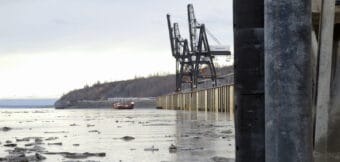
The Port of Alaska on Dec. 8, 2020. (Photo by Jeff Chen/Alaska Public Media)

A proposal to rename the Port of Alaska the “Don Young Port of Anchorage” had seen little public controversy, until the Anchorage Assembly’s last meeting.

That’s when the Assembly found itself wrestling with a panel’s recommendation and a proposed compromise before deciding to postpone making a decision indefinitely. There was no consensus at the Dec. 19 Assembly meeting about what, if anything, to do next.

A previous Assembly had changed the name to “Port of Alaska” in 2017 as a symbolic move, in part to convey to legislators who fund infrastructure projects the port’s importance to the entire state. Most freight, fuel and consumer goods that come to Alaska flow through the port.

When Congressman Don Young died in March of 2022, Anchorage Mayor Dave Bronson proposed another renaming to honor Young.

The mayor and Assembly appointed a panel to look into it and make a recommendation. The panel unanimously recommended “The Don Young Port of Anchorage.”

Then, the night of Dec. 19, multiple issues kept the Assembly from voting.

First, some said, Don Young could behave like a jerk.

“Don Young had his day for Alaska, but he aged into someone who was insensitive, a bully and who disrespected women,” said Assembly member Karen Bronga. “Rewarding a public figure for this bad behavior because he brought the state money is not in the best interest of our city. The naming of a volcano after him is, in my opinion, way more fitting.”

The audience laughed.

Member George Martinez said he struggled with the proposal. He acknowledged that Young helped a lot of people. But Martinez, who is Afro-Latino, also said  Young denigrated people who look like him and used a racial slur for Latinos in a 2013 interview.

Second, there was debate over changing “Port of Alaska” back to “Port of Anchorage.”

“Ports and airports are named after cities, not states,” said Jim Jansen, chairman of the Lynden transportation companies and a member of the port renaming panel. “Alaska has 17 active ports, with Anchorage being the largest, handling about 50% of all of Alaska’s maritime cargo. But it is not the port for all of Alaska. It is disingenuous to name the port after our state.”

City code also discourages renaming a public place within 20 years of the last renaming.

Several Assembly members were frustrated by how singularly focused the renaming panel had been. Assembly member Anna Brawley said the recommendation seemed like a foregone conclusion from the outset.

“Practically speaking, it is impossible to say no to the members of a grieving family once the name is out in public,” Brawley said. “That is the reality.”

The process highlighted flaws of the city’s old ad-hoc renaming process, Brawley said.

The Assembly adopted a new process in September intended to create a more deliberate, fair, thoughtful and consistent process for naming requests like this one. Now, requests are supposed to be run through a new Public Naming Commission.

The latest port renaming proposal began before the new process was created, though. And the new commission only exists on paper. Its members haven’t been picked yet.

Bronson’s Chief of Staff Mario Bird argued that abandoning the panel’s proposal discounted its work, as well as Young’s 49-year run of election wins and Alaska’s current congressional delegation’s wishes.

“Love him or hate him, Don Young achieved an order of magnitude as a statesman in Alaska that should be recognized,” Bird said.

The mayor’s office did not respond to a request for comment about its next step on the renaming effort. The Assembly plans to reconsider its vote to postpone indefinitely at its next meeting on Jan. 9. If the reconsideration goes through, Assembly Chair Chris Constant says he intends to hold a work session to review options before a final vote in February.

Young was 88 when he died. He was the most senior member of Congress at the time, representing Alaska in the House of Representatives continuously since 1973.

Site notifications
Update notification options
Subscribe to notifications