Transportation

Unauthorized $10M steel purchase for Haines dock provokes crisis of confidence in borough

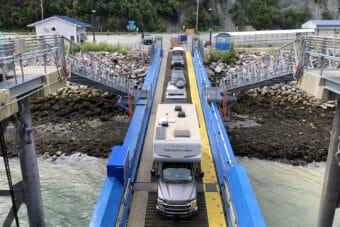
Lutak Dock. (Courtesy R&M Consultants)

Haines elected officials recently learned that the contractor in charge of rebuilding the Lutak Dock has purchased $10 million worth of steel for the project. Borough officials were surprised and angered by the purchase, which represents a commitment to a design that newly elected leaders had expressed interest in changing.

The Lutak Dock is the main entry point for freight in Haines. It was built by the military 70 years ago, and has fallen into disrepair. But the design the borough has settled on has become controversial. The chosen design involves surrounding the existing structure with a wall of metal pipes and adding fill.

Proponents of the design say it will provide the most functionality, and has been approved by the Maritime Administration, or MARAD,  the federal agency that is providing the funds for the project. Opponents say the design is too large for the community’s needs — that it will be expensive to maintain and will have to be rebuilt when the metal pipes eventually rust.

They also say such a large dock would invite mining companies to use the facility for ore transfer, which could attract heavy truck traffic that would pass through downtown Haines.

The debate became central to the last local election, when all the candidates in favor of changing the design got elected. The new leaders expressed interest in pausing the work and considering a design with a smaller footprint. They discussed the situation at a workshop on Nov. 15.

Turnagain Marine Construction is the company in charge of rebuilding the dock. Company president Jason Davis attended the meeting, and two days later he wrote an email to Haines Borough manager Annette Kreitzer to alert her that his company had purchased close to $10 million worth of steel.

“It appears that we had the coil ordered, the steel order converted from a hold to a binding order, I believe it was in August,” Davis said.

Kreitzer says she did not fully grasp the importance of the email until after she returned from vacation, three weeks later. She did not alert elected officials.

“I wanted to talk to MARAD first, and hoped that I would have some kind of an answer for the assembly about the impact or the effect of this action,” she said.

Mayor Tom Morphet says on Dece. 20, he told the manager that he was going to speak with Davis about project costs. That was more than a month after Davis sent the email.

“And that is when the manager shared with me the Nov. 17 letter. And my question for the manager is, ‘When were you expecting to share that information with us?’”

Morphet called a special meeting of the Borough Assembly to find out more about the situation. At the meeting, Kreitzer said she understands assembly members’ frustration, but defended her approach.

“I understand the feeling of assembly members that I’ve been withholding information from them and I apologize for that,” she said. “It is the way that I have done business, in terms of trying to make sure that there is context in whatever I present to the assembly. I try to get the facts so that I can present them to the assembly. You may not like that answer, but that is my answer.”

Assembly members were concerned that purchasing the steel before receiving approval from MARAD to do so might jeopardize the funding.

Assembly member Kevin Forster brought up the case of another grant the borough lost amid allegations of improper management -this one from the Federal Emergency Management Agency, for work on the Porcupine road.

“We are just on the tail of being involved in another grant reimbursement program in which we are still trying to figure out exactly where it went off the rails, but we are left holding the ticket for the bill and we are not being reimbursed by the agency,” he said.

MARAD requested information regarding the steel purchase. Morphet summarized his understanding of the situation.

“Today our project is in limbo,” he said. “The federal department of transportation marine offices, known as MARAD,  which sponsors our $20 million grant, is investigating issues relating to our administration of this grant offer, and why apparently in October, Turnagain purchased $10M of steel without the required authorization of the Haines borough and MARAD.”

Davis, of Turnagain, denied that the company did anything wrong.

“The only reason there is a question about this process is because members of the council want to terminate the project,” he said. “And that’s certainly within your power to do so, but I think that it’s somewhat disgraceful that you are trying to take the borough staff and a contractor that have been working in good faith to execute the agreements and to fulfill the grant obligations and try and find some way to pin fault.”

The meeting went on for more than three hours, and the atmosphere was tense at times. Many questions were left unanswered.

How significant of a breach of the grant’s requirement was it for Turnagain to purchase steel?

Kreitzer recently sent MARAD a letter with a detailed timeline of the purchase. In it, she states that Turnagain purchased the steel at their own risk.

Can the borough still change course and choose a different design under the same grant?

Mayor Morphet says he has been in communication with Sen. Murkowski’s staff and that they are willing to help the borough effect that shift.

If the design is changed, who would be on the hook for the $10 million steel purchase? At this point Turnagain and the borough disagree and point at each other.

The answers will largely be determined by MARAD, and multiple attempts to reach the agency for comments have remained unsuccessful.

Juneau’s first electric bus hasn’t worked in over a year

Juneau’s only electric bus sits out of commission at the City Borough of Juneau Capital Transit’s bus barn on Thursday afternoon. (Clarise Larson/KTOO)

The city’s only electric bus hasn’t hit the road in more than a year. 

Instead, it’s been sitting in a parking lot in the Mendenhall Valley since November of 2022. Throughout the past year, it has undergone numerous repairs but remains out of commission. 

Capital Transit Superintendent Rich Ross says the bus’s problems have been a disappointing start to an exciting plan to electrify Juneau’s bus fleet.

“Being early adopters of new technology, we expected some hiccups along the way,” he said. “We definitely did not expect them to be this significant.”

Juneau’s electric city bus began to run regular routes in the spring of 2021. At the time it was considered groundbreaking as one of the first municipally operated electric buses in the state. It cost about $1 million along with charging infrastructure and was paid for using a federal transportation grant and a state settlement fund.

Ross said the bus first went out of commission because of issues with its wiring harness. He said it took the Southern California manufacturer, Proterra, until May of this year to source the needed repairs. But, after that fix was done – another problem surfaced.

“We were test-driving the bus to verify the repairs and one of the transmissions exploded on it,” he said. 

The replacement for that transmission didn’t arrive until this November. Ross said that was due in part to Proterra filing bankruptcy this summer, which delayed the process a bit. He said the transmission problem has now been fixed, but there are still a multitude of other issues keeping it idled this winter. The additional repairs are expected to take at least another six months and have all been paid for by Proterra. 

Despite the problems with the bus, seven more electric buses are on their way to Juneau next year. They are manufactured by a different company, Gillig, which is the same brand that makes Capital Transit’s diesel fleet. Ross said that will hopefully mean easier maintenance and more reliable buses than the first one – but that isn’t a guarantee.

Ross said moving forward with newer technology is always a process, but he thinks the benefits will outweigh the problems that may arise. 

“It’ll greatly reduce emissions,” he said. “It’s one of the Assembly’s goals to reduce emissions and one of the low-hanging fruit to being able to do that is transportation.”

The new buses were purchased with funding from the Federal Transit Administration and were supposed to arrive early next summer. However, Ross said the build date for the buses got delayed, meaning they won’t likely be shipped to Juneau until late fall. 

Ferry officials ‘hopeful’ – but not certain – they’ll have enough crew for 7-ship summer schedule

The M/V Kennicott leaving Wrangell on Jan. 8, 2021 (Sage Smiley/KSTK)

There’s enough money in the state ferry system’s budget to run seven ships this summer, but it’s unclear whether the Alaska Marine Highway System will have enough crew to operate them.

The ferry system’s marine director, Craig Tornga, said in an interview that the seventh ship would be the Kennicott, serving cross-Gulf routes connecting Whittier with Southeast Alaska and the community of Yakutat, which hasn’t seen a port call since the summer of 2022.

But in recent years, crew shortages have forced the ferry system to scale back its schedule. So will there be enough deckhands, stewards, engineers and captains to run all seven?

The ferry system has made some progress on expanding the ranks, especially in entry-level positions, Tornga said. But he said it’s unclear whether that’ll be enough to run a full schedule.

“We’re challenged right now for crewing,” he said. “But thankfully, you know, we have plans, and hopeful plans, that we can operate a seventh vessel come the summer time, subject to the crewing. And thankfully, the budget supports that.”

For now, the Kennicott is scheduled to be laid up all summer pending crew. That would leave a schedule very similar to this past summer.

At a ferry operations board meeting on Dec. 1, Tornga said the ferry system had hired 42 crewmembers and lost 19 over four months. But Tornga says the ferry system is still struggling to hire U.S. Coast Guard-licensed mates, and especially, engineers.

Because of requirements that licensed mariners spend a significant time at sea, “those are hard to get,” he said.

That’s been a problem across the country. Last year, Washington State Ferries said it was facing unprecedented staff shortages. And it’s not just passenger vessels – the U.S. Navy and Coast Guard are also short on sailors.

“Everybody’s short, and so we are all competing heavily,” he said.

Tornga says he needs about 30 licensed engineers, from oilers to chief engineers. He says one priority is training lower-level engine room workers to fill those vacancies.

“We are trying to build a pipeline there. The entry position there is wipers. We have plenty of wipers, but we’ve got to continue to provide training for them to sit for their next certification, keep moving them up.

But it’s a little trickier on the bridge. A brand-new mate or captain can’t just roll in and start driving. Even if they’re already licensed, it can take years for new crewmembers to get state-mandated credentials so they’re qualified to navigate the fjords and narrows of Alaska’s coast.

Tornga said they’re trying something a little different – running the pipeline in reverse.

“We did get an agreement for some retirees to come back in and help us through this stage,” he said. “That’s been very, very appreciated, as they come with full pilotage, and they’ve helped us through some of the areas where we’re short right now.”

As of the beginning of December, Tornga said seven retirees represented by the International Organization of Masters, Mates and Pilots had agreed to return to service.

Tornga said a decision earlier this year to centralize payroll processing for ferry workers is also helping. That followed complaints from employees about errors in their paychecks.

“That’s not the holdup it was. Now, we haven’t cleaned up the backlog, and there’s a bit of that, but they’re doing great work in trying to get through that at the same time as they’re trying to do payroll,” Tornga said.

Tornga says he’s also pushed to speed processing for new hires, especially for licensed positions.

Tornga said the ferry system wants to grow the number of Alaska high school students entering maritime careers.

“Those are things that don’t help us today, but they’ll help us in the future, as we do find that our local hires tend to stay more than the out of state hires,” he said.

Rep. Louise Stutes, R-Kodiak, a longtime advocate for the marine highway, said crewing is a tough nut to crack.

“It’s just difficult when, in our industry here in the state, we’re paying about 30% or 40% less than the private industry is paying. It’s tough to crew up under those conditions,” Stutes said by phone.

Stutes said she’s confident that ferry managers are doing the best they can under the circumstances.

Sen. Jesse Kiehl, D-Juneau, said in a phone call that he’s pleased with the ferry system’s efforts at creating a pipeline for the future.

“I think that leadership is right on in trying to promote from within and grow our own expertise in the fleet,” he said.

Because lawmakers approved funding through the end of 2024 during the last legislative session, Gov. Mike Dunleavy’s budget proposal released earlier this month would provide a similar level of service in 2025 if approved by the Legislature.

Alaska Airlines flight attendants protest at Anchorage airport as strike vote looms

Flight attendants in Anchorage promised “chaos” if they don’t receive higher pay. (Matt Faubion/Alaska Public Media)

Flight attendants in Anchorage marched Tuesday to demand higher wages from Alaska Airlines. The protest was one of several happening around the country on the same day, in an organized effort to pressure the airline.

Dozens of flight attendants, and a few pilots, turned out carrying signs and chanting slogans as they marched in the snow outside Ted Stevens Anchorage International Airport.

The protestors shouted refrains like, “What do we want? Contract! When do we want it? Now! And if we don’t get it? Shut it down!”

Thresia Raynor is an Alaska flight attendant who leads local union mobilization efforts, and was frustrated that the 14-month-long contact negotiation hasn’t been more fruitful. Raynor said the starting salary for a full-time flight attendant is about $24,000 a year, and many of her colleagues are homeless or struggling with food insecurity.

“Many of our flight attendants are living in poverty, have eviction notices on their front door,” she said. “They’re real everyday humans in Anchorage and all over the state of Alaska and all over the Pacific Northwest that are unable to live on their wages with just one job.”

Raynor said those wages increase with seniority, but said even some veteran workers with more than a decade of experience qualify for subsidized healthcare or food assistance.

The Alaska Airlines flight attendants said Tuesday that they will vote to authorize a strike. That would require approval from national mediators, so Raynor said the process may take months, but that they will be ready if and when that day comes.

Tuesday’s protest comes just weeks after Alaska Airlines announced plans to purchase Hawaiian Airlines for $1.9 billion. Raynor said that may actually help speed things up, because a merger can’t go through until all contracts are in place.

“But at the same time, it’s a little salt in the wound when the company says it’s not economically viable to pay us a living wage, but they can scrape together two billion in cash to pay for an air carrier,” Raynor said.

Alaska Airlines referred inquiries to a web post that said the company respects employees’ right to demonstrate and that they recently provided a proposal that included 15% pay raises.

Raynor disagreed with the airline’s messaging, saying flight attendants are committed to voting for a strike and creating “chaos” until they receive a livable wage.

Broken wings: Complaints about US airlines soared again this year

A traveler looks for baggage amid rows of unclaimed luggage at Los Angeles International Airport in June. (Mario Tama/Getty Images)

If you’re unhappy about the state of air travel in the U.S., you’re in good company.

Complaints about U.S. airlines climbed sharply in the first half of the year, consumer advocates say, as passengers remain deeply dissatisfied despite some improvements in performance.

“The complaint data is pretty jaw-dropping,” said Teresa Murray, a consumer advocate with U.S. Public Interest Research Group, which published a new report based on data released by the Department of Transportation.

Flight cancellations were down significantly in the first nine months of the year, according to the DOT. Murray called that trend encouraging but said delays and mishandled luggage remain major problems.

“People are still ticked off and unhappy with their airline experience,” she said in an interview. “The complaints are continuing to pour in.”

Travelers filed more than 26,000 formal complaints about U.S. airlines in the first five months of 2023 — more than double the number filed during the same period last year, according to the report, and on pace to break the annual record set in 2022.

The aviation system has struggled to keep pace with a surge in demand, as travel volumes rebounded quickly to pre-pandemic levels. That’s left both the airlines and many air traffic control centers short-staffed.

“We are seeing more people flying than ever with fewer cancellations than we have seen in years,” Transportation Secretary Pete Buttigieg said at a news conference last month.

The biggest U.S. airlines canceled about 1.6% of flights from January through September of this year — down from 2.8% during the same period last year.

Buttigieg called that “a clear improvement in the numbers” and said airlines deserve some of the credit, “both in terms of the realism of their schedules and in terms of having the staffing and the preparation to meet the demand that’s come in.”

But at the same time, the number of delays has grown.

The largest U.S. airlines had an on-time performance of 76.2% during the first nine months of the year, down from 76.6% last year. That figure has fallen below 77% only one other time in the past 15 years, Murray said.

The aviation system was largely able to avoid major service disruptions during the recent Thanksgiving holiday. But many travelers haven’t forgotten the meltdown of 2022, when winter storms and a software glitch at Southwest Airlines caused thousands of canceled flights and chaos across the country.

Murray said travelers should brace for another challenging holiday travel season.

“We know that the flights are going to be absolutely jam-packed here in the next couple of weeks,” she said. “We definitely recommend that you do the old thing of getting to airports early because you have less of a chance of getting bumped. You have more of a chance of getting where you want to get.”

Copyright 2023 NPR. To see more, visit https://www.npr.org.

Alaska Airlines is pitching an ‘eco-friendly’ alternative to the mileage run this year. How green is it?

Alaska Airlines planes taxi to and from various Seattle-Tacoma International Airport gates on Jan. 5, 2022. (Jeff Chen/Alaska Public Media)

Abby Query learned early on how to make the most of the Alaska Airlines rewards program.

“My mom got me into all the Alaska Airlines programs,” said Query, who grew up in Juneau. “I’ve been a mileage plan member since I was three.”

Query keeps a close eye on how much she’s flown every year, because if she hits 20,000 miles, she qualifies for elite status, which comes with certain benefits: easier booking, better seats, sometimes even upgrades to first class.

They’re small perks, Query said, but they add up if you’re in the air a lot.

“It just makes the whole flying system nicer,” she said. “And when you live in Southeast Alaska like I do, you fly a lot to go anywhere.”

And often, Alaska is the only airline available.

This year, Query was just shy of reaching elite status, so she booked a trip to Nevada to go rock climbing with friends.

This status-earning trip is called a “mileage run.” Query is not alone in booking one. She’s heard of people booking a weekend trip to Hawaii or just flying to Seattle and back on the same day to top off their miles at the end of the year.

But she knows all that flying – and burning all that jet fuel – has a downside. Aviation accounts for 2.4% of global annual carbon dioxide emissions – and that number is growing, according to a 2021 study.

“It does have a really big impact on the environment,” Query said. “It’s sometimes hard to fathom just because it’s such a normal part of our life. But I mean, my carbon footprint is larger because I went on this trip.”

Alaska Airlines knows mileage runs are a habit for Alaskans who care about their reward status.

This year, in an effort to cut down on these superfluous flights — and their carbon impacts — the airline rolled out a new offer: instead of booking a flight, members can earn elite-qualifying miles through the end of the month by buying something called sustainable aviation fuel, or SAF.

“Our guests recognize the climate impacts of flying and many have asked for that seamless way to take action,” said Alaska Airlines communications manager Cailee Lyngaas. The airline has set a goal of achieving net-zero carbon emissions by 2040. That’s a faster timeline than many other major U.S. airlines.

Lyngaas said SAF will play a major role in achieving that target.

So, what is SAF? Basically, it’s jet fuel that isn’t a fossil fuel. It’s not a product of oil drilling.

Instead, it’s usually a biofuel, made from plant and animal material — anything from waste cooking oil to manure to crops specifically grown for fuel.

The idea is that over its lifetime, from production to the moment it’s burned in a jet engine, it should add significantly less carbon dioxide to the atmosphere than traditional jet fuel. (Though critics point out biofuels can actually increase carbon emissions depending on how they’re produced.)

Cutting emissions from planes is a huge challenge, said Andrew Chen, an aviation expert with the clean energy think tank Rocky Mountain Institute in Colorado.

Chen said the technology for alternatives like electric or hydrogen-fueled planes isn’t far enough along yet. SAF, despite its limitations, is the best solution currently available — besides simply flying less.

“It is the most viable solution today for decarbonizing aviation,” Chen said. “The challenge is that we don’t make or use or buy enough of it.”

SAF is still in its infancy. There’s no big industry producing it. It’s more expensive than traditional jet fuel. And Chen said it won’t be able to compete as long as fossil fuels remain cheap.

But he said it’s still an important tool, and he sees Alaska’s offer as a creative way to spread awareness.

“I think on that aspect alone, it’s fantastic to engage the public and passenger consumers,” Chen said.

Lyngaas acknowledged that this month’s offer alone won’t create enough demand for SAF to lower costs. She said it’s about building public support for fossil fuel alternatives.

“We can help educate our guests on the benefits, and hopefully that translates to bringing the cost down, building scale and advocating for that public policy support,” Lyngaas said.

But is Alaska Airlines’ offer actually better for the climate than your mileage run?

That depends in part on how the SAF is produced and used.

Lyngaas didn’t have specifics on the type of SAF Alaska Airlines currently uses. She said it’s regularly used to fuel planes at San Francisco International Airport, but it’s still not widespread across the fleet.

SAF makes up less than 1% of the airline’s fuel today, according to Lyngaas. Alaska has a goal to reach 10% SAF by 2030.

SAF use is currently “not as much as we’d want it to be, if I’m being completely honest. The scale is not there, and quite frankly, the pricing,” Lyngaas said. “But we will continue to push forward and advance that market.”

On its website, Alaska Airlines offers a calculator for customers to determine the carbon footprint of their flight. For example, it says a round trip flight from Anchorage to Seattle produces 760 pounds of CO2 – roughly equivalent to burning 38 gallons of gasoline, or driving an average car from Seward to Deadhorse.

The airline says spending $200 on SAF would more than offset that carbon impact, while earning 1,000 elite-qualifying miles.

Lyngaas said all the money paid by customers for elite-qualifying miles will go to increase purchases of SAF. However, on its website, the airline says the funds support “climate solutions (SAF, and verified offsets and removals) that reduce or remove greenhouse gas (GHG) emissions in an amount based on your estimated carbon footprint.”

Carbon offsets can vary widely in how much they benefit the climate.

As for Abby Query in Juneau, she’s a little skeptical about how much climate value the program might actually have. But it does make her think harder about the climate impact of flying.

“We see the Instagram pictures and the tans (from travel), but maybe not necessarily the extraction process and the impact it’s having on the planet,” she said.

Query, who hadn’t heard about SAF before, said travel is a big part of her life – and if there’s a way to lower the environmental costs, she’s interested.

Site notifications
Update notification options
Subscribe to notifications