Transportation

Dunleavy makes first official Yukon visit, signs Alaska Highway maintenance agreement

Gov. Mike Dunleavy and the Premier of the Yukon Ranj Pillai, pose for a photo in the Cabinet office during a visit to Whitehorse on Thursday, February 8, 2024. (Photo by Justin Kennedy/Government of Yukon)

In his first official visit to the Yukon during five years as Alaska’s governor, Mike Dunleavy signed an agreement that commits more than $31 million to repairing a damaged section of the Alaska Highway.

The new memorandum of understanding, signed Friday by Dunleavy and Yukon Premier Ranj Pillai, affects the section of the highway between Destruction Bay and the Alaska border.

Under the terms of the agreement, Alaska will provide funding, and the Yukon government will perform the repairs.

More than four-fifths of the traffic that uses that stretch of highway involves vehicles driven by Americans to and from Alaska.

“By working cooperatively with our neighbors in the Yukon, we can help ensure that people traveling to or from Alaska on the road are able to do more safely with fewer road hazards,” the governor said in a prepared statement.

Since 1977, the United States and Canada have followed the Shakwak Agreement, which calls for the United States to pay for the paving and maintenance of the portion of the Alaska Highway from Haines Junction to the border and for the Haines Highway from Haines Junction to the border.

Congress cut funding for the agreement in 2013, and American money ran out several years later. Since then, the road’s condition has deteriorated, causing the Yukon to limit speed limits in particularly rough places.

The federal infrastructure bill of 2021 included funding for Shakwak work, and Alaska’s draft four-year transportation plan calls for spending $31.25 million in state and federal money on the effort between 2024 and 2027.

The Yukon government has estimated that the full cost of the project may be up to CA$500 million ($370.37 million).

The highway memorandum signed Friday was part of a five-year agreement between Alaska and the Yukon to “work together on matters of joint concern and mutual interest” and share information on common issues.

Talking to Canadian journalists on Friday, Alaska and Yukon officials said those issues include security and wildfires.

Dunleavy told the CBC that the threatened shutdown of the Port of Seattle during the COVID-19 pandemic emergency caused his administration to revive talks about the Alaska Highway and relations with the Yukon.

“We decided at that point that we aren’t going to wait for somebody to take care of us,” Dunleavy told reporters, according to the CBC. “We have to start acting like a sovereign on our own.”

This story originally appeared in the Alaska Beacon and is republished here with permission. 

Big Lake lawmaker proposes state port authority take over Anchorage and Mat-Su ports

The Port of Anchorage in 2016. It was later renamed the Port of Alaska, and is now the Don Young Port of Alaska. (Eric Keto/Alaska Public Media)

A legislator from Big Lake has a vision of Alaska where resources extracted in the Interior are shipped by rail to Port MacKenzie, loaded onto cargo ships in the shadow of a bridge spanning Knik Arm and sent off to the global market.

Republican Rep. Kevin McCabe’s vision has multiple unbuilt megaprojects in it, and he thinks a key piece of unlocking the funding to make those projects happen is for the Matanuska-Susitna Borough and the city of Anchorage to hand their port facilities on opposite sides of Knik Arm over to a quasi-independent state port authority.

McCabe is sponsoring House Bill 255 to create the Port of Southcentral Alaska Authority. The bill’s first committee hearing was held Tuesday in Juneau.

“This isn’t envisioned to be any kind of an adversarial buyout or hostile takeover or anything like that,” he said to the House Transportation Committee. “This is designed and the idea – and the discussion that I wanted to engender with this bill was a way for both ports to move forward, whether it be for the bridge, or for the rail spur, or for resilience/redundancy, for earthquakes, or just for the synergies that we both have for docking different vessels.”

Under a port authority, McCabe said the ports would operate together in the entire state’s interest and for Alaskans broadly, rather than for the individual communities. He said that would make it easier for the ports and related transportation infrastructure to secure federal funding.

“There can be no effective resource development, which our constitution requires of us, without transportation infrastructure,” McCabe said. “You’ve all heard me say it: Even if it’s a goat path and a mule with saddle bags, resources need transportation to reach markets, smelting facilities, energy plants or end users. … We are poised to burst at the economic seams if we have all the pieces in place to help us thrive.”

Committee members peppered him with questions. He said he was unable to answer several of the most substantive ones, such as what compensation the local governments would get for giving up their ports, how the transfers might impact local property taxes or how port user groups feel about the idea. He said the bill is a vehicle for those discussions.

Anchorage city leaders have expressed resistance to a state takeover of their port, where most of the physical stuff shipped to Alaska arrives.

McCabe said the bill will be back before the committee, which he also chairs, at a later date.

similar bill in the Senate that focuses exclusively on Anchorage’s port has not been scheduled for any hearings.

NTSB says key bolts were missing from the door plug that blew off a Boeing 737 Max 9

Alaska Airlines N704AL, a 737 Max 9, which made an emergency landing at Portland International Airport on January 5 is parked on the tarmac in Portland, Oregon, on January 23, 2024. (Photo by Patrick T. Fallon / AFP)

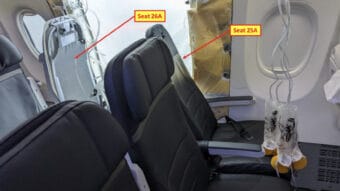
WASHINGTON — The National Transportation Safety Board says four key bolts were “missing” when a door plug blew off an Alaska Airlines flight in midair last month. That’s one of the findings from the NTSB’s preliminary investigative report released Tuesday.

The Boeing 737 Max 9 jet had departed Portland, Ore. and was climbing through 14,800 feet when the door plug explosively blew out. It resulted in a rapid depressurization and emergency landing back at Portland.

No one was seriously hurt, but the January 5th incident has renewed major questions about quality control at Boeing and its top suppliers.

In its 19-page report, the NTSB says four bolts that were supposed to hold the door plug in place were not recovered. Nevertheless, investigators say “the observed damage patterns and absence of contact damage” on the door panel and plane itself indicate the four bolts were “missing” before the door plug was ejected from the plane.

The door plug was originally installed by contractor Spirit AeroSystems in Wichita, Kan. and then shipped to Boeing’s factory in Renton, Wash. for assembly. Once it arrived in Washington, the NTSB says damaged rivets were discovered on the fuselage which required the door plug to be opened for repairs. After that work was completed by Spirit AeroSystems personnel at the Boeing plant, the four bolts were not reinstalled, according to photo evidence provided to the NTSB by Boeing.

The report does not say who was responsible for the failure to ensure the bolts were reinstalled.

The incident has touched off another crisis for Boeing. The troubled plane maker was still working to rebuild public trust after 346 people died in two 737 Max 8 jets that crashed in 2018 and 2019.

In a statement, Boeing said it would review the NTSB’s findings expeditiously.

“Whatever final conclusions are reached, Boeing is accountable for what happened,” Boeing CEO Dave Calhoun said in a statement. “An event like this must not happen on an airplane that leaves our factory. We simply must do better for our customers and their passengers.”

The NTSB investigation is ongoing and may take a year or more before a final report is completed.

The Alaska Airlines 737 Max 9 incident came up during a Congressional hearing on Capitol Hill Tuesday. The administrator of the Federal Aviation Administration, Michael Whitaker, told lawmakers on the House Transportation and Infrastructure Committee this latest 737 accident has created several issues for the FAA.

“One, what’s wrong with this airplane? But two, what’s going on with the production at Boeing?,” Whitaker said. “There have been issues in the past. And they don’t seem to be getting resolved. So we feel like we need to have a heightened level of oversight to really get after that.”

a man
Federal Aviation Administration Administrator Michael Whitaker testifies before the House Transportation and Infrastructure Committee on February 6, 2024 in Washington, D.C. (Photo by Kevin Dietsch/Getty Images)

Whitaker says the FAA has sent about 20 inspectors to Boeing’s Washington facilities, and six to the Spirit AeroSystems factory in Wichita, Kan. where the 737 fuselages are produced. And he said some inspectors may have to remain at those factories permanently.

“Going forward, we will have more boots on the ground closely scrutinizing and monitoring production and manufacturing activities,” Whitaker said. “I do anticipate we will want to keep people on the ground there. We don’t know how many yet. But we do think that presence will be warranted.”

The FAA is in the midst of a six-week audit of production at both facilities, and an employee culture survey at Boeing. Whitaker testified that the agency will wait until those are complete before making any decisions about a permanent inspection plan.

Copyright 2024 NPR. To see more, visit https://www.npr.org.

‘We’re way behind’: EV charging station in Haines could bring tourists, help locals

EV owner Hannah Reeves with her Hyundai Ionic. Despite some glitches, Reeves said she doesn’t think she’ll buy a gas vehicle again. (Photo by Lex Treinen/Chilkat Valley News)

Shelby Flemming has an electric car, but it’s not doing her much good this winter.

She lives on Mosquito Lake Road and owns a 2015 Nissan Leaf that has a 70 mile range  — but only when it’s warm.

Using the heater in colder weather, it doesn’t have the range to get to her work in Haines and back on one charge, and there is no public charging station in town.

A $1.4 million grant from the federal government to the Chilkoot Indian Association (CIA) could change that as soon as this summer, and potentially save Flemming a lot of money next year. If she can charge her car while in town for work, she won’t have to rely on her gas guzzler, with gas hovering between $5 and $6 per gallon.

“I’m super excited about that. I hope it happens quickly,” said Flemming.

Details of the charging station are still being worked out, but EV owners, advocates, and tourism officials are thrilled at the possibility of Haines’ first public charging station. A station would open up the possibility of EV-owning Yukoners making the trip down without having to borrow a car, potentially opening up the “Golden Circle” to EV owners. There are free, rapid charging stations every hundred miles or so in the Yukon, and five of them in Skagway. Haines — so far  — has been the missing link.

“It’s gonna be great to be connected in that regard,” said Haines tourism director Reba Hylton. “We’re way behind.”

The federal government recently announced $623 million in grants for a nationwide effort to boost EV charging infrastructure that included the CIA grant.

Tribal administrator Harriet Brouillette said she’d been hearing about the need in Haines for a charging station. When the federal government opened up the grant application, it jumped at the chance, especially with Haines being an EV charging desert.

“We have an opportunity to provide the community with the EV charging station at a reasonable cost, so it just makes sense for us to take this step,” she said.

The $1.4 million award includes money to purchase property for the charging station. One idea, Brouilette said, is to develop a space into a small “economic hub” where food trucks and other small businesses could park trailers.

Brouillette said if the tribe is able to act quickly, it could start building late this spring.

Brittany Dunbar with CIA said the goal is to have four direct-current fast-charging plugs at the site, which can charge a car up to 80% battery in as little as 30 minutes. But the tribe is still looking into how much those chargers would cost and whether current electricity supply could accommodate fast charging. An alternative is a 220-volt charging station which can charge a car in a few hours. Dunbar said the tribe is still reeling a bit from the news of the grant award.

“I was pretty excited and shocked, but now is the fun part of figuring it all out,” said Dunbar.

CIA officials said the charging wouldn’t be free, but EV owners in Haines say the cost to run an EV per mile is about a tenth of what the price of gas is.

“I did the math and my Toyota Landcruiser was like 30 cents a mile. The (Nissan) Leaf was 4 cents,” said Haines resident Darsie Culbeck.

Culbeck, who sits on the Haines Economic Development Council board of directors, said he thinks a public charging station would be a big boost for tourism in the area. He pointed to a friend in Haines Junction who has an EV and doesn’t visit Haines because of the lack of a charging station.

There’s no official state registry of electric vehicles in Haines, but Mayor Tom Morphet said 17 people have applied for a rebate for owning an EV from AP&T, the local power company. AP&T president Jason Custer would not corroborate those numbers.

Local usership seems to be growing, in no small part due to the enthusiasm of Bart Henderson. Henderson said he’s owned about a half dozen EVs, and has resold more than 10 in Haines.

He currently owns a Chevy Bolt and a Kia Soul. Working with a friend in Juneau, Henderson imports the cars basically at cost to Haines, where he lets people test drive his own cars.

“My theory is once you drive a real electric car, you get back in a gas car and it seems so clunky and old,” he said.

Still, cold is a concern to battery life, as Hannah Reeves recently discovered during a trip to Haines Junction. The family stopped at the cultural center to charge their Hyundai Ionic, but only for about a half hour, which wasn’t enough time to get them all the way back in the cold weather. They found themselves stranded in the pass. Her husband hitchhiked back to Haines and picked up their Ford F350 diesel and towed it home.

Still, she said, she didn’t have any regrets about the car. It works great to commute from her home at Mosquito Lake and back, and having a charging station in town could make it even better.

“I don’t think I want to go back at all to a standard vehicle. It’s amazing, it’s all-wheel-drive, the handling is way better than anything else I’ve ever driven,” she said.

Boeing declines to give a financial outlook as it focuses on quality and safety

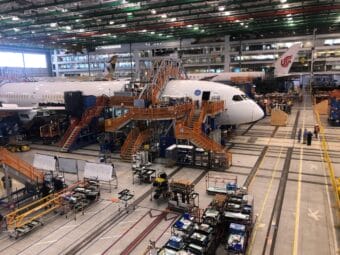
An unpainted Boeing 737-8 MAX parked at Renton Municipal Airport adjacent to Boeing’s factory in Renton, Washington on January 25, 2024. Alaska Airlines said Thursday it expects a $150 million hit from the Boeing 737 MAX grounding, which will limit its capacity growth in 2024. (Photo by Jason Redmond/AFP via Getty Images)

Boeing released its 2023 earnings Wednesday, but the company’s CEO spent most of a call with investors talking about safety and quality.

Boeing is facing big questions about quality control after a door plug panel blew off one of its 737 Max 9 jets in midair earlier this month.

“We are not issuing financial outlook for 2024 today. Now is not the time for that,” chief executive Dave Calhoun said during an earnings call.

Instead, Calhoun focused much of the call seeking to reassure analysts — and the flying public — that the plane maker is taking the incident seriously.

“We will simply focus on every next airplane, and ensuring we meet all the standards that we have, all the standards that our regulator has and that our customers demand,” he said.

Calhoun did not offer any information about the cause of the incident on January 5th, which is still under investigation by the National Transportation Safety Board. No one was seriously injured, but the incident touched off another crisis for Boeing. The troubled plane maker was still working to rebuild public trust after 346 people died in two 737 Max 8 jets that crashed in 2018 and 2019.

Boeing said Wednesday it lost $30 million in the fourth quarter of 2023. That’s a better performance than the final quarter of 2022, when the company lost more than $600 million. Overall, Boeing lost $2.2 billion last year — its best result in 5 years.

But any improvement in the company’s financials has been overshadowed by the latest safety incident.

The Federal Aviation Administration is allowing Boeing 737 Max 9 planes to fly again after an inspection and maintenance. Calhoun said airlines have now returned 129 Max 9 planes to service, out of a total of 171 that were grounded by the FAA.

Earlier this week, Boeing formally withdrew its request for an exemption from federal safety rules in order to speed up certification of its new Boeing Max 7 jet to start flying. The company had been hoping to begin delivering those smaller planes to airlines this year, despite a design flaw with the Max’s engine de-icing system that could be potentially catastrophic.

Boeing wanted to use the same workaround that’s already in use on its Max 8 and Max 9 jets. Now the company says it will focus on a permanent engineering fix instead.

Calhoun told analysts on Wednesday that process is expected to take about nine months, likely pushing certification of the Max 7 back into 2025.

The FAA has also taken the unusual step of ordering production caps at Boeing’s factories. Calhoun said the company will continue producing 737s at the rate of 38 per month until the FAA agrees to lift that limit. And Calhoun told analysts that slowing down production at the behest of regulators would help the company fix problems in its factory and supply chain.

“I’m sort of glad they called out a pause. That’s an excuse to take our time, and do it right,” Calhoun said. “This is what we do, and how we get better.”

The NTSB is expected to release preliminary findings from its investigations of the Alaska Airlines incident in the coming days.

Copyright 2024 NPR. To see more, visit https://www.npr.org.

Proposal to put slot machines aboard Alaska ferries gets rough first reception

Cars drive aboard the Alaska Marine Highway System ferry Hubbard on June 25, 2023, in Haines. (Photo by James Brooks)

A Republican legislator from Wasilla has proposed legalizing some types of gambling aboard Alaska Marine Highway System ships as a way to raise operating revenue for the state-run ferry system.

The proposal encountered rough seas during its first hearing as legislators questioned the financial gain and an expert said it could be difficult to implement.

House Bill 197, from Rep. Jesse Sumner, R-Wasilla, would allow Vegas-style slot machines and other electronic gambling and is envisioned as raising money for the state in the same way that riverboat casinos raise money for states in the Lower 48.

Cruise ships that visit Alaska already have the ability to operate casinos if they’re more than 3 miles offshore, and Sumner said in written testimony that he envisions a similar model for Alaska ferries.

Cody Rice, an aide to the Alaska House’s coalition majority, said he estimates that the bill “would potentially raise in the order of $20 million or more per year, substantially offsetting the Alaska Marine Highway System’s net costs.”

“It will be a win for this Legislature, a win for our ferry system, and most importantly, a win for Alaska,” said Joseph Lurtsema, an aide to Sumner.

But some legislators immediately began questioning the idea. Most of the ferry system’s routes are within 3 miles of shore, noted Rep. Louise Stutes, R-Kodiak and the ferry system’s most passionate legislative advocate.

“There’s only a few routes that this would be applicable for,” said Craig Tornga, marine director of the ferry system.

State ferries sail beyond 3 miles offshore only when traveling between Kodiak Island and the mainland, when traveling to Dutch Harbor, across the Gulf of Alaska, and some spots within Prince William Sound, he said.

That would significantly reduce gambling’s earning potential below Rice’s estimate, which was based on ferry ridership and national average gambling participation.

The ferry system could do some things to offset that, Rice said, including rerouting sailing routes beyond the 3-mile line and adding new routes. Some people might take the ferry just to gamble, just as they do in the Lower 48, he said.

“I suspect it’s conservative,” Rice said of the $20 million per-year estimate.

Tornga also cautioned that Alaska’s ferries — many of which were built in the 1960s — may lack the electrical capacity for large numbers of slot machines or other gambling devices.

“That was back in the day where you didn’t have outlets for charging phones and plugging in computers. And so there’s a little bit of work to do on this. What are the requirements?” he said.

Significant modifications to the ferries would have to be approved by the U.S. Coast Guard and the American Bureau of Shipping, he said.

Any changes to Alaska’s gambling laws may also run into opposition from the state’s established gambling institutions, legislators noted. The state has dozens of pull-tab parlors whose proceeds benefit nonprofit organizations and Native tribes.

Prior bills that sought to change gambling laws have run into lobbying efforts organized by the pull-tab industry.

“I know that that could be a real issue,” said Rep. Sarah Vance, R-Homer.

This story originally appeared in the Alaska Beacon and is republished here with permission.

Site notifications
Update notification options
Subscribe to notifications