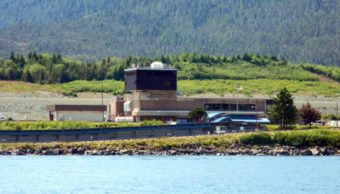
The LeConte docks at Juneau’s Auke Bay ferry terminal last summer.
The ferry LeConte is on schedule to return to service Tuesday, Oct. 8.
The small ship was out of service Oct. 6-7 due to a generator failure. It was tied up at its homeport of Juneau.
State spokesman Jeremy Woodrow says the generator is being repaired, not replaced. He says the work had to wait while parts were shipped up from Ketchikan, home of marine highway headquarters.
The 40-year-old LeConte can carry up to 300 people. It sails from Juneau to Haines, Skagway, Gustavus, Hoonah, Angoon and Tenakee Springs.
Its schedule was delayed last summer due to bow-thruster problems.
Another northern Southeast ship, the fast ferry Fairweather, is also tied up at the Juneau terminal.
Woodrow says it’s undergoing safety tests.
One they’re completed, the ship will sail to Seattle, where its engines will be replaced. It’s scheduled to return to service mid-May.
An Anchorage superior court judge has approved a deal allowing Lynden Inc. to buy out its shipping competitor, Northland Services.
A tug boat hauls a barge laden with containers down Gastineau Channel in August 2012. (Photo by Heather Bryant/ KTOO)
Right now, there are basically two ways to ship a lot of stuff in and out of Southeast Alaska: Alaska Marine Lines or Northland Services.
So when Lynden, AML’s parent company, announced in April it was buying its competitor, the risk of a regional shipping monopoly raised a red flag at the Alaska Department of Law.
The department put together a deal that leaves Southeast Alaska with two competing carriers: AML and the soon-to-expand Samson Tug & Barge.
The plan requires AML to assist Samson with its expansion into Southeast. The specifics are confidential, but Samson would buy assets from AML, lease space aboard AML barges, have a guaranteed barge charter from AML during peak shipping seasons, and have the option to rent AML terminal facilities and storage in Southeast and in Seattle.
A 60-day comment period closed last week with no formal objections. Judge Andrew Guidi approved the deal on Monday.
Samson Tug & Barge VP Cory Baggen
Samson Vice President Cory Baggen says she’s excited about clearing the last major legal hurdle in her company’s expansion.
“Right now, our tentative plan is to start service into Southeast Alaska on November 8th,” she said. “I admit, we’re still working out some of the final details, since the decree did just go through on Monday. So we’re still working through some of the last, last minute details.”
The buyout may not change much in Southeast, but AML President Kevin Anderson has said it will help his company in western Alaska and Seattle.
The parties have 60 days to finalize and execute some contracts in the plan. But otherwise, Assistant Attorney General Ed Sniffen says the transaction is complete.
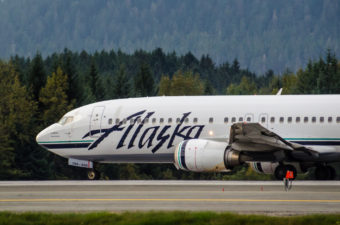
An Alaska 737-800 on approach to the Sitka Airport. (Photo by Jonathan Caves/Flickr Creative Commons)
Alaska occasionally gets caught in federal rules that may work in Ohio, but not in Ozinkie. One such national policy that has been confounding airport managers and pilots may be close to at least a temporary fix for Alaska.
The Federal Aviation Administration has begun enforcing a 37-year-old policy that defines the clearance area for airport approaches. Obstacles in that glide path entering or leaving an airport must be dealt with, or the FAA says those airports will be closed to night or instrument flying.
Alaska Air Carriers Association executive director Joy Journay says that’s a big problem for Alaska:
“So you can come in when the weather is good, when it’s clear. You cannot fly with instruments which automatically means for these closures, they’re all down at night. That’s a very grave concern when you talk about medical evacuations because effectively, the closure at Haines, the closure for two weeks at Sitka, it basically meant if you needed to be airlifted out of there at night, an operator couldn’t come in.”
The obstacles may be trees, a new building, cell tower or in the case of one of Homer’s approaches, a dirt pile.
Journay says Association members have been frustrated by a lack of clarity as to which airports have problems and what the fix will be.
FAA Alaska region head Bob Lewis says about five of the more than 100 that originally had obstacle concerns are still being worked on, but he didn’t have a list.
Steve Hatter is the Deputy commissioner of aviation for the state department of Transportation. Hatter would only say the list is a moving target that changes daily.
“We’ve got a bunch of rural airports up in our Northern region and so that’s, we’re concentrating there right now,” he said.
Hatter says the state operates more than 250 airports and all have come up for review by the FAA. Hatter says they have whittled down the list of concern to a “hand full.”
“That said, they’re still going to continue reviewing approaches out into the future and that’s where we’re trying to get some help from them on when they schedule those reviews. So we’d like to push as many as we can out toward the spring time frame so that if we do discover that there is an obstruction problem, we’ve got reaction time and we can go address it in the spring and in the summer months,” Hatter said.
Hatter says the one size fits all national policy doesn’t work well in a state where 82 percent of the airports are not accessible by road. He says DOT is aggressively working on the issue with FAA.
“We simply can’t shut off access to our rural villages over the application of a safety standard that just doesn’t make sense and we need to make sure we can do medivac 24-7. We need to make sure people have the right ability to get in and out of those villages for whatever function they need.”
The Air Carriers Association’s Journay says Alaska’s congressional delegation has gotten involved and she’s hopeful there will be more clarity in coming days.
Work on the Auke Bay roundabout will be delayed to allow fill material to settle. Miller Construction will build a temporary intersection for the winter. Photo by Heather Bryant / KTOO
The project was supposed to be done in October, but state transportation officials say unexpected issues will delay intersection construction.
Work began on the traffic circle in July. The project includes curb, gutter and sidewalk into Auke Bay and up Back Loop Road to the entrance of the University of Alaska Southeast.
The roadway will be about 11 feet higher than the existing street and that requires a lot of fill material. DOT spokesman Jeremy Woodrow says crews discovered the soil in the area can’t handle the fill without settling.
“The last thing you want to do is throw in a bunch of fill, put a bunch of new asphalt, curb, gutter all around it and then discover that there’s settling occurring and you need to rip it up and do it all over again.”
DOT engineers and contractor Miller Construction have decided to add all the fill now and let it settle over the winter.
Before work stops later this fall, Woodrow says the uplands between Auke Lake Way and Caroline Avenue will be finished, including permanent pavement. Then Miller Construction will build a temporary intersection between Glacier Highway and the Back Loop.
“It’d probably be more like a T intersection that is similar to what they’re seeing right now. It’s not going to be muddy and it’s not doing to be a dirt intersection for the winter,” Woodrow says. “There is going to be a temporary asphalt layer down so it should be good for snow, ice and all the other things that come with winter.”
One work starts again in the spring, it’s hoped the traffic circle will be complete by mid-summer. It will be the second roundabout in Juneau.
According to Woodrow, water over the roadway last week was caused by heavy rains, not a water main break as first thought. Work stopped temporarily while crews cleaned out storm drains and looked for the site where water was seeping into the project.
He says the delays will add to the cost of the $4.8 million roundabout, but it’s not clear how much.
The Oosterdam is the last scheduled cruise ship of the season. (Photo by Heather Bryant/KTOO)
The last few crowds of tourists will start to disappear after the ships leave today. (Photo by Heather Bryant/KTOO)
The Westerdam made an unscheduled stop in Juneau after cancelling other port calls due to bad weather. (Photo by Heather Bryant/KTOO)
The last cruise ships of Juneau’s tourist season sailed away Wednesday.
Cruise ships made more than 550 visits to Juneau this year.
Though final numbers aren’t in, Juneau Convention and Visitors Bureau CEO Nancy Woizeschke says just under a million passengers visited the capital city this summer.
“At the beginning of the season we were hoping to break the million passenger mark for the large cruise ships and that was a little optimistic. And then with the cancelling of multiple Celebrity Millennium stops, I think we won’t be passing that particular mark this year,” Woizeschke says.
In August, multiple mechanical problems sidelined the Millennium in both Seward and Ketchikan, forcing cancellation of several voyages.
Several new ships called on Juneau this summer, including the 1,041-foot Celebrity Solstice, which Woizeschke says is the largest cruise ship to sail Alaska waters.
She says based on hotel occupancy rates, the number of independent travelers to Juneau this summer may be high.
“We think that’s a good indicator of lots of independent travelers coming and spending multiple nights here,” she says. “And then we’ve had a lot of smaller cruise ships, for instance the Un-Cruise Adventures came to port for the first time this year. Lot of those folks, because they depart and come back here, have the opportunity to spend a couple of days in Juneau on either side of their trip.”
Holland America’s Oosterdam and Westerdam were the last two ships in port Wednesday. The Westerdam was not expected, but bad weather earlier this week forced it to revise its schedule.
The first cruise ship of 2014 will sail into Juneau on May 1st.
If you’re an average Alaskan, odds are you fly the SeaTac-based company’s jets frequently, or at least from time to time. (Yes, SeaTac is the name of a city, not just an airport.)
Maybe you’ve memorized your town’s flight schedule. But did you know all this?:
1) Two-thirds of Alaskans belong to the Alaska Airlines Mileage Plan.
2) We earned 530 million miles this summer during a double-mileage promotion, the equivalent of 21,000 roundtrip saver tickets.
3) Half of us are members of the airline’s Club 49 plan, which offers additional discounts, including checked-luggage deals, for Alaskans.
4) The airline has nearly 1,700 in-state employees.
5) 275 staffers are in Southeast.
6) The mileage and Club 49 plans have saved Alaskans $10.7 million so far this year.
7) $8 million of that is from the two-free-checked-bags program for travel in and out of the state.
And here’s one you may have heard of, but decided to forget: