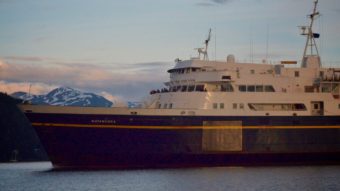
Shuttle ferry drawing by Eliott Bay Design Group. Courtesy Day Boat ACF Design Study Report.
State ferry system officials Tuesday evening will explain the latest design for two Lynn Canal day boats.
It’s the first in a series of forums on the proposal to be held this week in Juneau, Skagway and Haines.
The proposed 280-foot shuttle ferries would serve the three communities, operating 12 hours a day. Current design calls for ships that would carry about 53 standard-size vehicles and 300 passengers.
The state transportation department is collecting public comments on the preliminary design through the end of the month, but DOT spokesman Jeremy Woodrow says this week’s meetings are informational and not public hearings.
“They’re to present the day boat, Alaska Class Ferry design concept to the public, answer questions on the concept itself. It’s not a forum to accept public comments. The official way to submit public comments is to be done online through the email link that’s on the Alaska Class website,” Woodrow says.
AMHS Captain John Falvey, Deputy Commissioner for Marine Highways Reuben Yost, and ferry consultant Elliott Bay Design Group, will be on hand to answer questions.
Juneau’s forum is from 5 to 7 p.m. in the Egan Room of Centennial Hall.
Sessions are scheduled later this week in Skagway and Haines.
The day boat shuttles replace the proposed Alaska Class ferries that were so deep in the planning process a construction contract was to have been awarded in July. Gov. Sean Parnell last year told DOT to scrap the plans and come up with less expensive ships.
DOT has said the two shuttle ferries should not exceed $117 million.
The number of ships through the Bering Strait grew 118 percent between 2008 and 2012, according to the U.S. Coast Guard.
As nations attempt to stake claims for rich Arctic resources, the U.S. currently has little presence there. The Coast Guard has two ice breakers capable of operating in the region. That’s four short of the six required to fulfill the agency’s mission in both the Arctic and Antarctic.
One of those cutters, the Polar Star, is back in service after a major rebuild.
Here’s a look as part of our occasional series on Coast Guard cutters that visit Juneau.
The heavy ice breakers Polar Star and Polar Sea create an access channel for supply ships in McMurdo Sound, during the 2002 Deep Freeze Mission. The Polar Sea is now in caretaker status and could be decommissioned. The Polar Star has undergone a thee-year $90 million overhaul. Courtesy U.S Coast Guard.
Several staggered metal ladders aft the bridge go straight up to a perch called the Aloft Conning Station.
“We have a 360 degree view. That allows us to pick a good way through the ice.”
Kenneth Boda is Executive Officer aboard the Coast Guard heavy ice breaker Polar Star. It’s his third ice breaker tour.
“Typically when you are an ice breaker, you don’t want to break ice. You want to avoid ice as much as possible. So you look for the open water leads and being up there allows you to pick the path of least resistance.”
In the ice, the Polar Star is often driven from the Aloft Conning station. Photo by Dick Isett.
The Aloft Con is 110 feet above waterline on the Polar Star, under the command of Capt. George Pellissier.
“Most of the time in the ice you’re driving from there,” he explained during a recent interview when the ship stopped in Juneau after Arctic ice trials.
Pellissier will command the ship to Antarctica this winter.
The ice breaker’s primary mission there is to resupply McMurdo Station, the largest U.S. research station at the South Pole and the logistics center for other Antarctic facilities. Pellissier said two-thirds of the job is transit time. Then there’s the ice.
“You have to break a channel through the fast ice, which is ice that’s attached to the land, and then you have to make a channel straight enough and wide enough to get a container ship and a tanker in,” he said.
“I’ve seen it as much as 85 miles of ice and as little as 12.”
The upcoming Antarctic trip – called the Deep Freeze mission — will be the first in recent years for a U.S. ice breaker. The Coast Guard has had to lease Swedish and Russian ice breakers.
With only one heavy and one medium ice breaker in the Coast Guard fleet, “there’s no bench strength,” Pellissier said.
The latest study prepared for the Coast Guard indicates the need for three medium and three heavy ice breakers to fulfill U.S. statutory duties in the polar regions.
The Arctic poses the most immediate challenge.
The Coast Guard is responsible for law enforcement, search and rescue, security, and environmental protection where many nations want to drill, mine, fish, and tour. The ice breakers are also scientific research platforms. U.S. Homeland Security predicts a million adventure tourists could visit the Arctic this year.
Other nations have government and commercial ice breakers operating in the region year around. Commander Pellissier points to the region on a large map in his Polar Star office.
“As we come up the Bering Strait and then we head off to the west, all along the North coast of Russia, that’s already a viable route,” he said. “And that’s where you find a large number of Russia’s ice breakers plying that route to keep it open.”
Map courtesy of the U.S. Coast Guard.
The window is narrow now, but as the ice diminishes ships could go through the Chukchi and Beaufort seas to the Northwest Passage, linking the Pacific and Atlantic Oceans.
“If the ice continues to recede, which most scientists are predicting it will, then that route will also become much more viable in the future, pretty much cutting through all the small islands up in the northern part of Canada, and then down through the Labrador Sea and down the East Coast,” Pellissier said.
The new National Security Cutters are the core of the Coast Guard fleet. Despite their versatility, they can’t cut ice.
“They have a very limited window of time they can operate, particularly up in the North Bering and beyond. The ice breakers, particularly our heavy ice breakers, can stay up there year around,” Pellissier said.
Multiple studies indicate the U.S. needs a year-round presence in the Arctic. Existing ice breaker capacity is not enough, even with additional non-ice cutters and aircraft, more operating locations and improved communication and navigation systems.
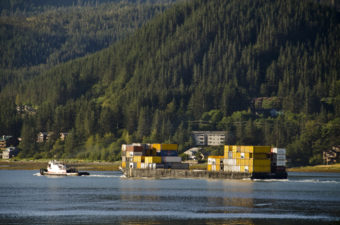
A tug boat hauls a barge laden with containers down Gastineau Channel in August 2012. (Photo by Heather Bryant/ KTOO)
Though the two companies have third party competition elsewhere, Northland and Lynden subsidiary Alaska Marine Lines handle virtually all commercial marine shipping in Southeast. If they merged as-is, Lynden would have an illegal monopoly in Southeast, according to the Department of Law.
The department’s lawyers have filed a plan in court that would leave Southeast Alaska with two competing carriers, but their operations would be intertwined.
The plan requires AML to assist Sitka-based Samson Tug and Barge with an expansion into Southeast. The specifics are confidential, but Samson would buy assets from AML, lease space aboard AML barges, have a guaranteed barge charter from AML during peak shipping seasons, and have the option to rent AML terminal facilities and storage in Southeast and in Seattle.
The filing opened a comment period that ends Sept. 27. After that, a superior court judge in Anchorage must decide if the deal can go forward.
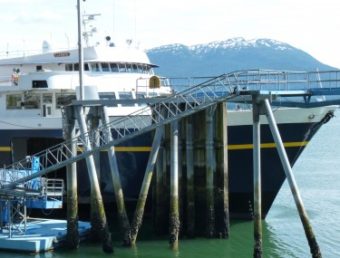
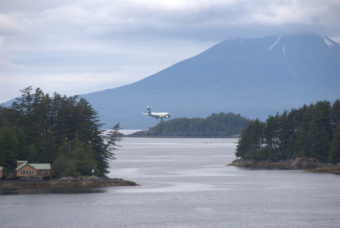
The Ketchikan Gateway Borough Assembly decided Monday to back off its longstanding endorsement of a bridge to Gravina Island, and instead opted to support improved ferry service. The project had been the subject of criticism in 2005 as wasteful government spending with critics labeling it the “bridge to nowhere.”
In a 5-2 vote, the Assembly directed Borough Manager Dan Bockhorst to submit comments to the state Department of Transportation endorsing Alternative G4, which calls for new ferry ramps and improved facilities next to the existing ferry terminals. Assembly members also asked Bockhorst to prepare a resolution mirroring those comments, and ask the state to extend the comment period.
At this point, DOT is accepting comments through Aug. 13 on the Gravina Access project’s Supplemental Environmental Impact Study, released last month. The options include two bridge designs and four ferry plans.
During the Assembly’s public comment, Don Westlund detailed problems he sees with the proposed bridge Alternative F3, which calls for two spans, a low bridge from just south of city limits to Pennock island, and then a high bridge from Pennock to Gravina.
Westlund says the west channel, which would have the high bridge, is not suitable for large ships because of reefs, areas with shallow draft, and other obstacles. He says the second proposed bridge alternative, C3-4, would create possible airspace conflicts.
“On marginal days, they said if the bridge is in the airspace, you wouldn’t have a plane landing, and we have a lot of marginal days,” he said.
Westlund says DOT needs to have another public hearing in Ketchikan, and not in the summertime when everyone is busy. He also wonders why the idea of an underwater tube was not explored.
Eric Muench also spoke during public comment, and says the Assembly should continue to push for a bridge. But, he says, because of Gravina’s low level of development now, a bridge won’t score well for funding. He suggests that the community ask for some ferry improvements now, and a bridge later.
Doug Ward and Len Laurance both asked the Assembly to continue its endorsement of a hard link – a bridge – rather than more ferries.
Later, Assembly Member Mike Painter started the Assembly discussion of the issue. He says it’s unlikely that Ketchikan will ever get a bridge:
“Uncle Ted is no longer with us. Gov. Frank is no longer in office. Our best time for a hard link access to Gravina has come and gone. It did get started; we did get the Gravina Highway; it looked like it was going to happen. But politics as they may be, the moon and the stars are no longer in alignment.”
Painter says he would like to see a better ferry system, with redundancy built in in case of equipment failure. He adds that an endowment fund to help pay for maintenance and operations of the ferries would make sense.
An Alaska Airlines jet waits for boarding at the Juneau Airport last September. Monday’s Alaska Flight 69 from Seattle and Ketchikan was delayed about an hour by the computer outage. File photo.
Flights to and from Alaska were among those affected by a recent international computer system breakdown.
Alaska Airlines reports about 50 planes were delayed Monday night, including 10 out of Anchorage and one from Ketchikan. United, American and Delta were among other affected airlines serving the state.
Delays were caused by a breakdown in the SABRE computer reservation system used by more than 300 airlines worldwide.
Alaska Airlines’ Bobbie Egan says the outage lasted a little more than two hours.
“Our employees had to manually check in passengers like we did back in the good old days,” she said.
Egan said no flights were cancelled. She said extra award-program miles were not offered to passengers, as is sometimes the case. That’s because because delays were short and the flights continued.
“If we had any passengers who were significantly inconvenienced we certainly want to hear from them and they can call our customer care department and we’ll deal with each customer on a case-by-case basis,” she said.
The delays began around 7:45 p.m. Monday, Alaska time.
A motorist follows the parking rules and registers her car at the Downtown Transportation Center parking garage. (Photo by Lisa Phu/KTOO)
CBJ parking enforcement begins again today.
An Alaska Supreme Court decision earlier this year nullified citations not delivered in person. That meant parking enforcement couldn’t serve tickets to vehicles; instead a ticket had to be served to the violator.
Issuing a parking ticket in person just isn’t efficient says Community Service Officer Bob Dilley, “A good use of a person’s time is not waiting for one person to come back to their car to issue them a simple parking ticket for being parked, let’s say, 12 inches from the curb.”
The CBJ assembly passed an ordinance in May allowing the city to handle its own parking violations, and community service officers stopped issuing citations on a wide-scale.
The transition is now over and the city will resume leaving tickets under car windshield wipers.
Deputy city manager Rob Steedle says parking violation appeals will go before a CBJ hearing officer, “We haven’t experienced a lot of appeals in the past, so we don’t think the volume will be great.”
Appeals can only be made for citations issued starting today.
Close
Update notification options
Subscribe to notifications
Subscribe
Get notifications about news related to the topics you care about. You can unsubscribe anytime.