Transportation

After quiet change to state rules, an unintended parking holiday in many cities

A parking ticket
A parking ticket (Photo via Wikimedia Commons)

While things like oil taxes and education funding may get the most news coverage, every year the legislature passes plenty of bills that amount to housekeeping. Mostly, they do unexciting things, like cleaning up administrative code. And then sometimes, they lead to parking ticket holidays in cities across the state.

This is a story of unintended consequences.

When the legislature took up a bill standardizing police-officer paperwork three years back, there wasn’t really talk of language requiring law enforcement to personally serve citations. Less explicit versions of that provision had been on the books since the 1980s, and the idea behind it is you want officers to get the right guys when they issue tickets for things like speeding or underage drinking.

“The Department of Law, the Department of Public Safety, the legislature were thinking about rules that apply across the state for when a police officer wrote you a citation face to face, and making sure that everybody got treated equally and fairly,” says Jesse Kiehl, a member of the Juneau Assembly. “They were not thinking about parking tickets.”

Juneau is just one of many cities across the state that lets the courts handle parking ticket appeals. But as of this month, the court system won’t bother with any case where an officer stuck a ticket under someone’s windshield wiper. They offered their interpretation of the statute in a rules order that went into effect April 15.

Kiehl says that a number of cities have been caught by surprise. That list includes Kenai, Sitka, Seward, and Valdez, to name a few.

“The concern that a whole lot of communities are going to have is that if a police officer or a parking officer — a meter reader — has to write a parking ticket, either they need to wait around for the vehicle owner to come back, or cities are going to have to scramble pretty fast here to change their laws and the way parking violations are treated.”

For a city to keep leaving parking tickets on cars, they’re going to have to work out appeals through a municipal parking authority or city administrator instead of directing any contested ticket to the court. Anchorage and Ketchikan already have systems like that in place, and Fairbanks issues civil fines instead of citations in most — but not all — cases.

To complicate matters, there isn’t any way to get an emergency exception to the personal service statute. The court order clarifying the matter went into effect just a day after the legislature gaveled out; lawmakers aren’t scheduled to come back until next January.

“It’s of those bureaucratic nightmare sort of things,” says Robin Koutchak, the city attorney for Sitka.

So if this bill passed three years ago, how did this issue fall through the cracks?

Rep. Mike Hawker carried the measure on behalf of the Department of Public Safety. He says his office wasn’t that involved in the drafting of the legislation, and that it didn’t spark any controversy when it went through committee. Nobody suggested it would require cities to rewrite their parking ordinances.

“Yeah, I don’t recall any anticipated problem there,” says Hawker. “You know, bills like that get heard. We’ve got a lot of good people in the legislature that look at them. But it appears that there was an unintended consequence of the language that was inside that bill.”

Hawker wonders why cities didn’t registered their concern over the law earlier. The court system had a long review period before making their rules official. Nancy Meade, who serves as their general counsel, says that notice of the rules change was sent on three separate occasions to police chiefs and city officials, along with every attorney in the state.

“It depends on how closely they read the e-mails, and I just don’t know, but apparently some missed it,” says Meade.

The Alaska Municipal League, which lobbies on behalf of the state’s cities, was also notified of how the rule would specifically affect parking tickets a month before the legislative session wrapped up.

With no easy fixes, many communities are in limbo until they change their laws to treat parking tickets as a civil fine, if they even want to do that. Kenai, for one, is worried that they’re going to have to dedicate more staff time to handling appeals.

“We’re in a spot where we may have to raise parking ticket fees to deal with that,” says Scott Bloom, Kenai’s city attorney. He adds that the city will probably have to start towing and booting more cars if there isn’t a fix before the summer season.

As far as Juneau goes, the city’s already drafting an ordinance that would make parking tickets a civil fine, but they’re limited in the ways they can enforce parking rules until that passes.

Kiehl says that’s not ideal, but he’s not expecting mass chaos.

“The republic will not fall,” Kiehl laughs. “People by and large will park and play nice and watch their two hours or whatever the rules are. Might some scofflaw take advantage? The possibility is always there, but I think we’ll deal with this as fast as we can, and I’m sure other cities will, too.”

Ferry system phases out nature interpreters

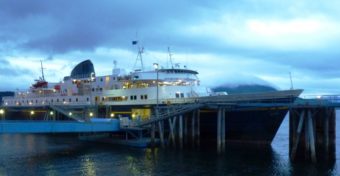
Tustemena in downtown Juneau.
Tustemena in downtown Juneau. (Photo by Gillfoto/Wikimedia Commons)

As the Alaska Marine Highway System approaches its 50th anniversary, the ferry is struggling with its identity. Under intense pressure to cut costs, the ferry’s managers are trying to get back to basics — transporting Alaskans and their freight.

That’s why the state is trying to phase out wildlife naturalists, on all ferry routes. It’s not clear what that means for riders.

It takes the Tustumena three and a half days to sail from Homer to Unalaska. Along the way, passengers will see kittiwakes and puffins, orcas and foxes.

The route has been named a national scenic byway, but the volcanic terrain can be foreign to both for lifelong Alaskans, and visitors passing through from the Lower 48.

That’s why naturalists, like Doug Stuart, travel on the ferry. Stuart says he’s there to provide context for the scenery:

“Of course, we give a lot of informational programs, and cover everything that goes on in the Aleutians — from World War II to the seabirds and marine mammals, and cultural issues with the Native Unangan people that have populated the Aleutians for 9,000 years.”

The Fish and Wildlife Service has employed Stuart as the Tustumena’s naturalist for more than a decade. But he won’t be on the ferry this summer.

The ferry system has given a lot of different reasons for wanting to eliminate the program. One is federal budget cuts.

Federal money covers the naturalists’ salaries. Poppy Benson, who administers the program for the Alaska Maritime National Wildlife Refuge in Homer, says money was tight for the program this year, but she managed to scrape it together by asking other refuges to chip in.

Benson: “So between Izembek National Wildlife Refuge in Cold Bay and Kodiak National Wildlife Refuge, and Alaska Maritime, I came up with enough money to fund a season.”

Woodrow: “We were surprised to even see that they had the funding for an interpreter.”

That’s Jeremy Woodrow, a spokesman for the Alaska Department of Transportation. According to Woodrow, the state wasn’t expecting the refuges to come up with the money with the federal sequester in place.

Benson says the wildlife refuges thought it was just a misunderstanding — but it isn’t. As Woodrow puts it, the State of Alaska has decided that the space the naturalists take up should be sold to residents instead:

“It all comes down to cost. And does it help meet our core mission, which is to help move people between points A and B.”

On the Tustumena, naturalists get free room and board from the ferry system. For an entire summer, that’s about $5,000 worth of support.

But Woodrow says it’s not just about the price tag. The state isn’t convinced that the naturalists bring any business to the ferry system:

“From a marketing standpoint, the Marine Highway System doesn’t see an actual –- I don’t want to say a benefit, but doesn’t see that having an interpreter on board will help fill seats more, especially with the Tustumena where it’s sold out anyways.”

Staterooms on the Tustumena are already selling out for the summer run. But according to Stuart, the Tustumena naturalist, it’s not just residents buying those rooms:

“Quite a few people ride that ship as tourists! I would say by the time we’re out of Kodiak, we’re probably roughly 50/50 tourists and then the other 50% a mix of commercial fishermen and residents. So it’s a pretty big ridership.”

It’s gotten bigger, in recent years. Frommer’s, the famed guidebook, listed the state ferry as one of the top 100 attractions in America for families with kids. One of the big draws? The naturalists.

Stuart says he was always a big hit with tourists. But the naturalists weren’t all about serving visitors. As the ferry progressed on its trip, Stuart says naturalists made an effort to keep all of the passengers in the loop — even if they were locals:

“It’s a very interesting area, but without having anybody explaining it to the people on board, frankly, they don’t have a clue what’s going on out there — particularly if the weather gets bad. Onboard programming, and having that information flow from me to the passengers, is important.”

To replace that, the Department of Transportation is considering adding interpretive displays, or interactive exhibits. They aren’t sure exactly what it will look like, and it likely won’t be in place in time for the ferry’s 50th anniversary this summer.

The Alaska Marine Highway System is planning a celebration, with community festivals throughout southeast and southcentral Alaska.

Stuart was planning events for southwest Alaska on the Tustumena, before he found out the naturalist program was canceled. With no one on board to help the Tustumena celebrate, the anniversary sailings in through southwest Alaska might look a lot like the ferry’s future, in all state waters.

FAA provides details of Alaska furloughs due to federal sequestration

The Federal Aviation Administration on Friday released some details about the effect of the national sequestration budget cuts in Alaska.

In a letter to pilots, Alaska Flight Services Manager Jim Miller says the state’s three main Flight Service Stations in Juneau, Kenai and Fairbanks will remain open seven days a week, 24 hours a day. Most small, satellite facilities will be unaffected as well. But others will see reduced hours through Fiscal Year 2013 due to agency-wide furloughs.

The Ketchikan and Sitka stations are the only facilities in Southeast affected. The Northway, Talkeetna, Palmer and McGrath stations will see furloughs as well.

Miller’s letter says during shortened hours or closures most services will continue to be provided by a parent facility in Juneau, Kenai or Fairbanks.

The furloughs will start Sunday April 21 and last through the end of the federal fiscal year, September 30 or until the sequestration cuts are lifted.

Southeast critiques 2013-2014 ferry schedule

The ferry Malaspina awaits passengers at Juneau’s Auke Bay ferry terminal. Photo by Ed Schoenfeld/CoastAlaska.

Southeast Alaskans critiqued the Marine Highway System’s 2013-2014 fall, winter and spring schedule Tuesday.

Leaders and some others from around the region spoke and asked questions during a teleconference.

Some thanked ferry officials for answering past concerns. But many said other problems need to be addressed.

Here’s an edited version of what they had to say.

Southcentral and Southwest Alaskans gave their comments during a separate teleconference.

“Un-Cruise” line boosts Alaska sailings

Un-Cruise Adventures’ Laurie Cooper, left, and Larry West stand by the Wilderness Explorer, which begins sailings soon between Juneau and Sitka. Photo by Ed Schoenfeld/CoastAlaska.

It’s still a few weeks before the tourist season begins. But the small cruise ship Wilderness Explorer is already tied up at a Juneau dock.

“One thing you’ll notice if you look at the back of the vessel is that it’s been modified to accommodate a platform that can be easily lowered into the water to launch kayaks and things,” says Larry West,  an Un-Cruise Adventures staffer providing the tour.

“Once you’ve done your active adventure, we always have saunas and hot tubs on all of our vessels, so you can come back on board and relax until the next day’s adventure,” adds Laurie Cooper, an expedition guide for Un-Cruise Adventures. 

Kayaks are stacked up on the stern of the small cruise ship Wilderness Explorer.

The 76-guest Wilderness Explorer is one of several ships added to the company’s line-up in recent years.

This year’s addition is the 88-passenger Legacy, where West will lead a team of costumed guides.

“We will be focusing especially on recreating authentic historical moments,” he says.

The living history theme is a different approach for Un-Cruise Adventures, the new name for sister lines InnerSea Discoveries and American Safari.

“The vessel itself is designed to look like and be patterned after a vessel from the late 19th century that would have brought anxious miners to Alaska in search for gold in the Klondike,” West says.

The Legacy will have its first sailing in August.

It used to be the Spirit of ’98, one of a fleet of small ships operated by Cruise West, which went out of business in 2010.

Other companies, including Sitka-based Alaskan Dream, have purchased and renovated other Cruise West ships for Inside Passage operations.

“I think this coming season, we’ll actually be seeing more small cruise vessels in Southeast than ever before,” says Joel Hanson of Sitka, who works for The Boat Company, a two-ship line sailing between Juneau and his hometown.

Unlike the big cruisers, there’s no centralized database of small-ship sailings. But Hanson’s convinced capacity is increasing.

“I think the trend is: It may not grow rapidly, but it does seem to be and it has the potential to continue to grow,” he adds.

The Baranof Dream is operated by Sitka-based small cruise line Alaskan Dream.

The small ships are particularly valuable to Southeast’s smaller ports.

“It’s always nice to have visitors come to town and be interested in our unique culture,” says Liz Cabrera of the Petersburg Economic Development Council.

Her town sees no large cruise ships dock during the summer. So when a new small vessel ties up, the passengers are noticed.

“And hopefully spending a little bit of their money on our local shops downtown. And that’s great for our merchants and also for our sales tax revenue for our borough,” she says.

Many small-ship passengers have more money. Their cruises often run in the range of $3,000 to $12,000 per person. Larger ships offer deals below $1,000 — or less.

A number of the small lines employ regional residents.

Sitka’s Alaskan Dream cruises make that part of its marketing with the slogan, “True Alaska with True Alaskans.”

Dan Blanchard, of the Un-Cruise line, says his company is opening an office in the Capital City this May.

“We are slowly moving more and more up to Juneau, particularly in the form of our operations end of the company. It’s hard to say how far we’re going to go with that, but we’re definitely headed into that direction,” he says.

His company’s 60-passenger Wilderness Adventurer leaves Seattle for Alaska at the end of this month. Other small lines will follow, sailing along with the much larger ships, through September.

Companies sailing small ships in Southeast include:


AMHS wants comments on upcoming schedule

The ferry Malaspina sails near Sitka.

The Alaska Marine Highway wants feedback from the communities it serves on the upcoming schedule.

The ferry system plan for fall, winter and spring of 2013 and ’14 is out for review.

Ferry officials try to keep schedules consistent from year to year, says spokesman Jeremy Woodrow.  They also work with school districts and communities along the routes to accommodate planned events.

Of course there are changes that have to happen with different vessels when they go up into overhaul and lay up periods and those type of things,” Woodrow says.  “So when we meet the schedule with that consistency, it’s looking at what major events are going on throughout the year, and it’s trying to then schedule either additional vessels to meet that traffic demands or to accommodate maybe a larger vessel instead of a smaller one that might be serving that community to meet that traffic demand as well.”

Woodrow says written comments on the proposed schedule should be emailed to dot.amhs.comments@alaska.gov and or faxed at 907-586-8365 before April 5th.

An April 9th  teleconference is scheduled at 10 a.m. to take comments on the Southeast Alaska schedule, and at 1:30 p.m. on the Southwest and Southcentral schedules. The teleconference number is 1-800-315-6338, conference code 3902#.

Woodrow says changes requested by groups, such as city assemblies, village councils, chambers of commerce, or school districts, will carry more weight  than those proposed by individuals.

Site notifications
Update notification options
Subscribe to notifications