Juneau Schools

‘We have savings to weather this storm’: Juneau faces nearly $5M deficit

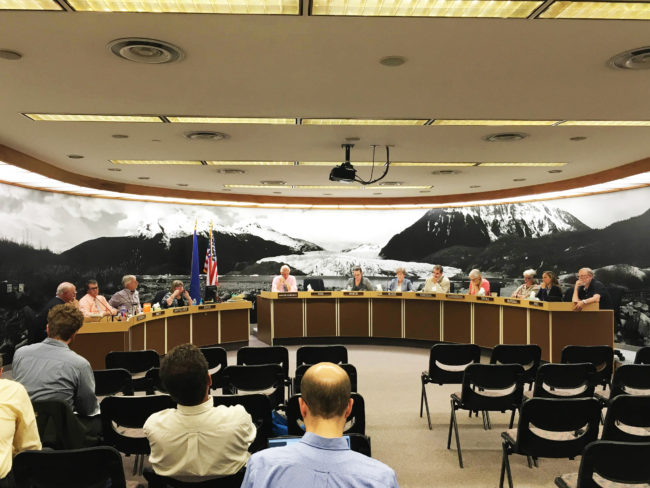
Assemblyman discuss possible solutions during the Juneau Assembly's Finance Committee meeting Aug. 11, 2016. (Photo by Lakeidra Chavis/ KTOO)
Assemblyman discuss possible solutions during the Juneau Assembly’s Finance Committee meeting Aug. 11, 2016. (Photo by Lakeidra Chavis/ KTOO)

Gov. Walker’s budget vetoes earlier this summer have trickled down to local governments, including Juneau. The city and school district are now facing a nearly $5 million deficit for the budget year that began in July, and officials are looking for solutions.

Bob Bartholomew, finance director for City and Borough of Juneau, was preparing Thursday afternoon for the Juneau Assembly’s Finance Committee meeting that would take place later in the evening.

“The meeting tonight for the finance committee is to basically address the deficit that we now have,” he said. “In the schedule you can see it’s about $4.9 million.”

Most of the burden is on the city.

Ideally, the city would pull from its savings, as a one-time fix, Bartholomew said. The city has about $16 million in its reserves.

It’s important to keep the deficit in context, he said.

“Our total budget is $330 million, our general government budget is roughly a $100 million,” he said. “So while $5 million is large, it’s manageable.”

The city passed its budget before the governor’s vetoes, so it couldn’t fully anticipate the cuts. The biggest worry is that the state’s continued budget problems will affect the city for years to come, Bartholomew said.

“If it’s $5 million every year for a number of years, then it’s a much bigger issue and that’s the part where we’re not certain of but we have to prepare that it could be at that level. But I don’t expect it to be that large for a number of years, I think it’s going to be smaller than that.”

The decisions won’t be made immediately, city manager Rorie Watt said, adding that officials want to look at all possible solutions.

“We have savings to weather this storm, and we want to use them the best we can, as we re-calibrate what we do as a local government,” Watt said. “And we don’t need to make a decision this week or this month.”

But the school district’s $500,000 deficit may be harder to tackle.

The school lost funding from the state’s per pupil formula funding and school transportation.

The district told the city last week that it would be able to cover it. But now, school officials say they’d prefer to cover only half.

At the finance committee meeting, Superintendent Mark Miller said while it could pull from its reserve, it would wipe out the district’s savings.

“The flexibility for us to absorb any emergencies that come up using general fund dollars, goes away,” Miller said.

While it can look to the assembly for help, the city has already maxed out what it can give the district under state law.

The finance committee plans to discuss possible solutions at its next meeting, on Sept. 7.

3 of 5 incumbents not seeking reelection to Juneau Assembly, school board

Beth Weldon files her paperwork to run for Juneau Assembly, District 2 at Deputy City Clerk Beth McEwen's desk, Aug. 5, 2016. (Photo courtesy Beth Weldon for Assembly)
Beth Weldon files her paperwork to run for Juneau Assembly at Deputy City Clerk Beth McEwen’s desk, Aug. 5, 2016. (Photo courtesy Beth Weldon for Assembly)

Three of the five incumbents up for re-election in Juneau’s Oct. 4 municipal elections aren’t seeking another term.

Mary Becker, Kate Troll and Jamie Bursell are the incumbents on the Juneau Assembly whose terms are ending.

Kate-Troll_250
Kate Troll
Mary Becker-250
Mary Becker
jamie bursell
Jamie Bursell

Becker and Troll have both indicated they plan to run again. Bursell said Friday she won’t.

“And it was a very hard decision because I have found that I really like the job of being on the assembly. It’s been an incredible learning experience, it’s very academic. And at times, quite difficult to make some decisions, but I like that pressure, I like the challenge of it,” Bursell said.

She declined to say why she wouldn’t run. She’s only had the seat since the assembly appointed her in February to finish Karen Crane’s term, who had resigned to run for mayor.

On the school board, Lisa Worl and Barbara Thurston are also calling it quits.

Lisa and Ricardo Worl 2013 municipal election night
Lisa Worl
Barbara-Thurston-250
Barbara Thurston

Worl said she hopes to free up some time and energy for her family. Worl, who is Tlingit and Filipino, said she hopes the new board reflects the community’s diversity.

Candidate filing opened Friday for three seats on the Juneau Assembly and two on the Juneau School Board.

Mary Becker, Kate Troll and Jamie Bursell are the incumbents on the assembly whose terms are ending. On the school board, Lisa Worl and Barbara Thurston are up for reelection.

Juneau Votes and the League of Women Voters have put together a comprehensive toolkit on how to run. That toolkit and more election information is available on the City & Borough of Juneau’s election website.

Candidate filing closes Aug. 15.

As of Friday afternoon, the only certified candidates are incumbent Mary Becker and retired firefighter Beth Weldon, both for assembly seats.

School District uses data to keep kids from being left behind

Harborview Elementary School
Harborview Elementary School Monday, May 11, 2015 (Photo by Jeremy Hsieh/KTOO)

Bridget Weiss is director of student services for the district. She wants to do a better job identifying all the students who need an extra hand meeting the district’s core curriculum standards.

It’s well-known not all children learn in the same way or at the same pace, but it’s not always easy to realize which kids need extra attention. Weiss is excited about a method that tracks kids’ academic progress and shows the district which ones need an intervention. The method is called RTI, which stands for Response to Instruction.

“In some places, it’s often referred to as Response to Intervention. It is a program based on the philosophy of identifying students’ needs early and attacking those with special interventions outside of the regular core curriculum,” Weiss said.

She said the strategy is being used in other schools around the country. The Juneau School District has used parts of it in a few schools in the past, but now it’s trying to use the strategy district-wide. Weiss said elementary schools used Response to Instruction last year to improve reading skills.

“Some schools are saying, ‘Hey, we really want to spend another year just focusing on reading, because we’re close, we’re not quite there, we really want to get expert at this whole RTI process with reading.’ Some schools are saying, ‘We’re chomping at the bit. We really want to get after math,’” Weiss said.

Student behavior is also on some schools’ RTI to-do lists.

This strategy has a lot of moving parts, but Weiss gave a brief explanation on how it works:

She said it lumps students into tiers according to their performance. Tier 1 is the district’s core instruction that every kid in every classroom is getting. At this level, educators are evaluating how effectively they’re reaching every student in the district.

Tier 2 is for kids who have a “higher level of need.”

“Which would mean they get some additional time in a small group, adding some instructional methods to what they’re getting in the regular classroom,” Weiss said.

She said if a student is “significantly behind,” they’re moved into the Tier 3 category.

“Which just means more time. So we increase the amount of time and focus that they’re getting and some of the strategies that we use,” Weiss said.

She said one of the most powerful parts of RTI come into play after kids are placed in a tier. They’re monitored for improvement. If a student in Tier 2 is getting additional small group instruction and it’s working, educators might keep giving that student more of the same.

“Or is it not working and they need more time, or do they need a different intervention altogether,” Weiss asked.

Finally, if students just aren’t showing enough improvement after multiple assessments and interventions, the district will consider the possibility that it’s dealing with a learning disability and move them towards special education.

Weiss said, “There’s a continuum of work happening here from looking at all kids who might need some assistance, and then narrowing and applying effective practice, as well as identifying students who might need even more than what RTI can do for them.”

She said because RTI is not just relying on teachers’ thoughts and feelings about their students’ abilities, there’s a better chance of catching kids who might otherwise fall through the cracks. It’s a systematic review of students’ performances over time.

Weiss believes RTI can help identify kids’ individual challenges so they can solve them early in their educational careers.

Each student’s data is also unique to them, not to the school. So when students change schools, their data travels with them.


Juneau charter school avoids budget cut

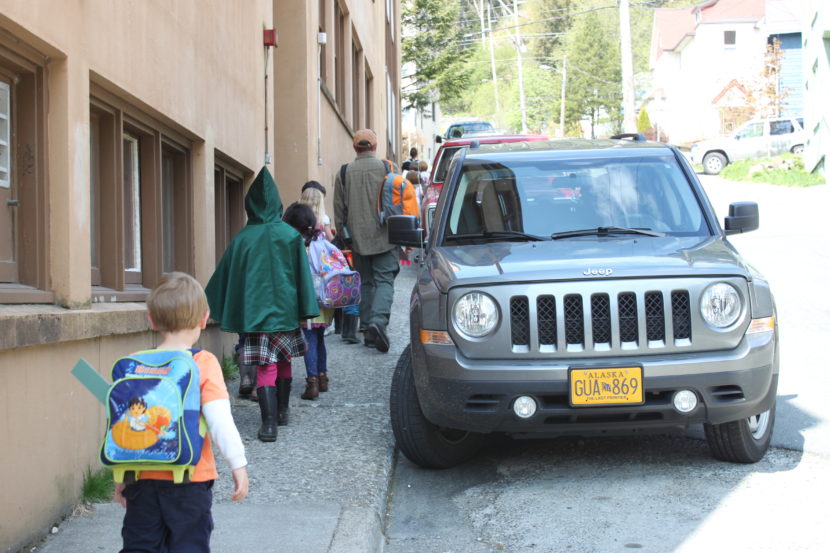
Juneau Community Charter School kindergarten and first grade students on their way to a nature hike up Basin Road. (Photo by Lisa Phu)
Juneau Community Charter School kindergarten and first-grade students on their way to a nature hike up Basin Road on Tuesday, May 6, 2014. (Photo by Lisa Phu/KTOO)

Juneau Community Charter School has dodged a budgetary bullet. Last October, the school’s enrollment dropped to about 74 – down from 100 the year before. That put it one student short of what was needed to prevent a big cut. Ryan Stanley is president of the JCCS academic policy committee.

“When you’re looking at kind of generally decreasing enrollment it’s usually a small number from each grade level. We were looking at a variety of things but certainly letting go of some staff was part of that,” Stanley said.

Stanley didn’t yet know the exact amount that would’ve been cut but said the school prepared for a near $308,000 loss in its worst case scenario. To cope, he said school officials would’ve had to “redesign the program” around the desires of their remaining students’ parents.

JCCS has 95 students enrolled for next school year, putting it well over what it needed to prevent a sizeable cut in state funding. The school has experienced a lot of rapid changes over the last couple of years. Stanley says a previous increase in state funding allowed the school to hire more staff and expand its offerings, but it also saw higher turnover.

“The school itself is basically kind of molting. It grew fairly organically over the years and then around that time, FY14 and FY15, it had to kind of change its organizational structure,” Stanley said.

Stanley believes most of JCCS’ drop in enrollment can be traced back to the impact of that restructuring, competition with other programs, and to some degree, the physical limitations of the downtown building rented by the school.

Stanley is happy to see enrollment back up and said he’s excited to see JCCS continue fulfilling its role in Juneau’s education system.

Despite fiscal uncertainty, school district and employees broker 3-year deal

Ted VanBronkhorst (middle) updates the Juneau School Board during June 14, 2016 regular meeting. (Photo by Quinton Chandler/KTOO)
Ted VanBronkhorst (middle) gives an update to the Juneau School Board during their June 14 regular meeting. (Photo by Quinton Chandler/KTOO)

Juneau School District is close to putting negotiations with its teachers and staff to bed for the next three years.

According to officials, the district is made up of three main groups of employees: about 350 teachers, 300 support staff and 19 administrative staff. Separate three-year contracts have been negotiated between each group’s union and the district.

Ted VanBronkhorst, the district’s director of human resources, said the agreements will give a sense of certainty in a time of fiscal uncertainty.

“That allows us some real breathing room as far as knowing what our costs are going to be, and establishing a budget, and being able to make good plans for the future,” VanBronkhorst said.

Juneau Education Association President Dirk Miller also said having a three-year agreement is largely good for teachers.

“We have been negotiating a lot of short-term, one-year contracts. In fact, this is the second contract we were negotiating this year in my term as JEA president. It’s nice to step away from the bargaining table and now we can teach,” Miller said.

He said most of the district’s teaching staff approved the negotiated contract, but the vote wasn’t unanimous. He said some objected that teacher pay schedules won’t keep up with inflation and health care cost increases, and there’s worry over how the state’s fiscal policy will change in the near future.

“Agreeing to a long-term contract locks us in. We don’t really know what the fiscal climate will look like in two years,” Miller said.

He said many teachers’ associations around the state haven’t committed to a contract because of that uncertainty.

The president of Juneau Education Support Staff said their contract with the district is a good compromise.

Each union’s contract has been approved by the Juneau School Board except for the Juneau School Administrative Association’s. VanBronkhorst expects the school board to approve that agreement during a special meeting on Wednesday.

School district waits for last step in state budget process

Juneau School District Superintendent Mark Miller.
Juneau School District Superintendent Mark Miller. (Photo by Quinton Chandler/KTOO)

A budget passed by the state legislature could give the Juneau School District a $500,000 boost for 2016-17 school year. The spending plan is yet to be approved by the governor.

The Juneau School District is trying to make every penny count. School officials say the district has cut spending on students and laid off teachers over the past five to six years.

The district predicts it will need $82,303,340 to cover expenses next year. And that’s what district Superintendent Mark Miller calls a razor thin budget.

“What we’ve had to do over the last few years is make cuts because the amount of money coming in has been relatively stable but the amount that we have to spend to keep our district running per person is going up. So it’s required pretty massive cuts in the number of personnel,” Miller said.

Since 2011 the district has cut 105 staff positions. Some of those people were laid off, some resigned and some retired.

This year the district will give up about 10 more positions. About nine of those are teachers’ jobs. A district spokesperson said they all either resigned or retired.

The increased expenses the district is absorbing fall under cost of living. Miller said they have to keep up with increasing health care costs and pay raises.

“Teachers typically make a little bit more every year based on the number of years they’ve been teaching, which you would expect. It’s really difficult for a new teacher to do much more than just hang in there on an initial teacher’s salary, but they know that over time they’re going to make more,” Miller said.

Miller said 90 percent of the district’s money goes to salaries, so people are pretty much the only thing they can cut. The district has already committed to keeping a definite number of employees for the next school year, but Miller said they are dependent on that $500,000 increase in funding from the state.

The extra money comes from a bill passed in 2014 that promised to increase school funding for the 2016-2017 school year by about $50 per student enrolled. The legislature had cut that money from its spending bill earlier this year and Miller said he didn’t know what to do.

“To say you’re going to be a half a million dollars short … well, we can’t go back and tell somebody and say, ‘we were just kidding about giving you a job.’ We owe them that job,” Miller said.

Luckily for the district, lawmakers changed their minds and put the money back in the bill, which passed Tuesday.

“Fortunately, I think it played out as well as it could for education, at least for this year. And I appreciate, I think, kind of calmer heads prevailing,” Miller said.

Once the bill becomes law, the district will be safe in a budget that restricts them to larger class sizes, fewer teachers and fewer student activities — at least until it’s time to make a new budget next year.

“School districts in the state of Alaska don’t have the ability to float bonds or do school taxes or generate their own revenue. Other than bake sales and car washes, we really don’t have the ability to raise our own money,” Miller said.

Miller said that means each year the district’s budget is at the mercy of state and local government.

Site notifications
Update notification options
Subscribe to notifications