Juneau Schools

New curriculum standards are changing instruction in Juneau schools

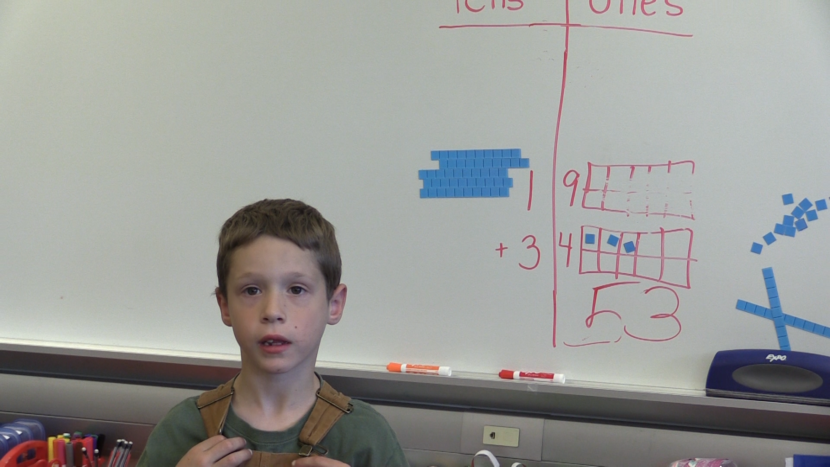
Eli Wyatt is a second-grader at Glacier Valley Elementary School. He answered 19+34 =53.
(Photo by Quinton Chandler/KTOO)

“Nineteen plus 34. Can you do it,” Tia Vreeland, a kindergarten and first-grade teacher at Glacier Valley Elementary School, asked her former student, Eli Wyatt.

Eight-year-old Eli is in second grade. He made a return visit to Vreeland’s classroom to prove second-graders can add double digit numbers.

This is the fifth year of a six-year curriculum review in the district and it is rethinking how hard it should make its classes.

Adding double digit numbers in first grade is a direct result of the district’s adoption of new core curriculum standards from the state in 2012.

That’s why Eli’s class had to learn last year.  Vreeland had Eli demonstrate with magnets on a whiteboard. Some look like sticks and the others are what Vreeland calls “dot” magnets.

They have number values. One stick equals ten.

Vreeland asked Eli to find the answer to the problem 19 plus 34 with the magnets.

She watched him add up his magnets and use them to show how to get the answer: 53.

In the end Eli has five of the stick magnets and three of the dots.

Vreeland said this strategy is supposed to help kids understand the meaning behind addition and subtraction rules like carrying and borrowing.

“I take seven ones, I take eight ones, I put them together and if, ‘Oh it’s over 10,’ I need to regroup,” Vreeland said. “(I) clear my board, and get a 10 so that they can see and touch and feel and understand what that magic one, what I considered a magic one – why it moves over to the next place and that is the value of a 10.”

Vreeland wants her students to understand how the numbers they’re using relate to each other so it’s easier for them to do math in their heads.

“(That’s) instead of trying to hold everything in their head like, ‘OK, I need to take this one and my ones place is only four and I need to do this with my 10,’” she said.

Using the sticks and the dots in her lessons isn’t new for Vreeland. What is new is using them to teach first-graders to add double digit numbers.
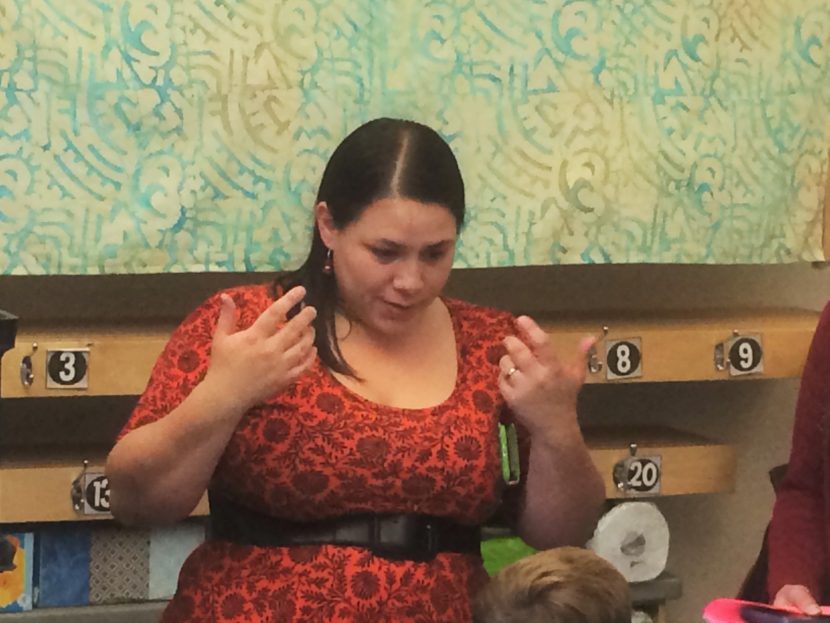
Tia Vreeland is a kindergarten and first grade teacher at Glacier Valley Elementary School.
Tia Vreeland is a kindergarten and first-grade teacher at Glacier Valley Elementary School. (Photo by Quinton Chandler/KTOO)

The new state standards cover English language arts and math.

Ted Wilson, director of teaching and learning support for the district, said its core curriculum is the set of academic goals students are required to reach. He said the math has gotten harder.

“In general the standards were a year ahead of where each grade level was at – starting at kindergarten and going through ninth grade, when they first enter Algebra 1,” said Wilson.

Wilson said the higher standards make the kids learn more complicated math, but they’re also supposed to make them more comfortable with numbers.

“So taking numbers apart, putting them back together,” he said. “Understanding how they relate to each other so when you get to more advanced math later on, you have that foundation of, ‘I get how numbers work.’”
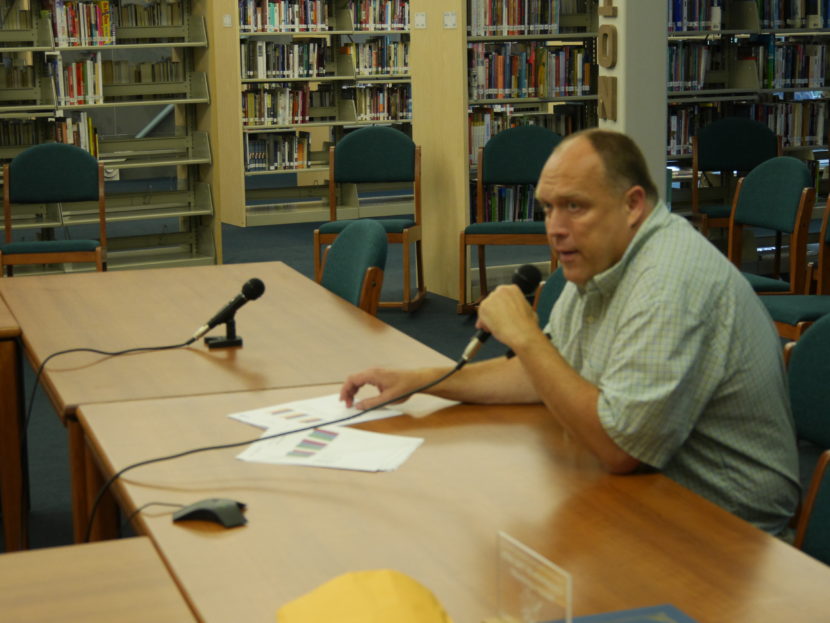
Ted Wilson speaks at a Juneau School Board meeting on Aug. 9, 2016. Wilson is the director of teaching and learning support for Juneau School District.
Ted Wilson speaks at a Juneau School Board meeting on Tuesday, Aug. 9. Wilson is the director of teaching and learning support for Juneau School District. (Photo by Quinton Chandler/KTOO)

By the time they hit third grade Wilson said the kids will start learning how to multiply and divide. They’ll even be introduced to fractions and decimals which kids used to see around fifth grade.

It’s similar for reading standards. Wilson said in the past, elementary kids mostly read narrative stories. Now, they’re being introduced to more nonfiction and they have to answer tougher questions to strengthen their critical thinking skills.

Wilson said in addition to the new state standards the district is also implementing national standards for other subject areas, like world language, social studies and music.

“And in fact this coming year, we’re working on the science curriculum, and so that will be the next subject that jumps up from the previous standards,” Wilson said.

Once the district finishes with science it will be done with the six-year curriculum review, and then they will start a new review cycle with math .

But, Wilson doesn’t think they’ll change the standards again.

They need to make sure the standards line up at each grade level so second-graders like Eli won’t have trouble walking across the hall into third grade.
SHI program trains educators to see Thru the Cultural Lens

Jackie Kookesh is in charge of Thru the Cultural Lens.
Jackie Kookesh is in charge of Thru the Cultural Lens. (Photo by Quinton Chandler/KTOO)

Juneau teachers and administrators were the students on Saturday at a Sealaska Heritage Institute seminar intended to help them see the world from their pupils’ perspectives.

It’s part of an ongoing series called Thru the Cultural Lens in which educators learn about Southeast Alaska Native culture and history. Saturday, they gave presentations on 10,000 years of education in Southeast Alaska.

Jackie Kookesh is the education director for Sealaska Heritage. She is Tlingit and is part of the L’uknax.ádi clan. She was born and raised in Juneau’s Indian village. Kookesh is in charge of Thru the Cultural Lens.

“We provide a semester-long symposium or seminar that is about 50 hours commitment on the part of the teachers once they apply and register for the course.”

Kookesh said this is Sealaska’s fourth year offering the program and in that time they’ve worked with 67 educators in Juneau School District.

Nineteen people are participating this year, including Juneau School Board member Josh Keaton. The last session will be held in November.

Kookesh said the program leads its participants through the politics and history of Southeast, and it gives them an overview of Southeast Alaska Native culture.

“We explore topics like the arts, subsistence life ways; we explore it all in that 50 hours,” she said.

She hopes those who complete the program become “culturally responsive educators.”

“It will help them in terms of how they relate to Alaska Native students in their classroom, how they communicate, how they engage,” Kookesh said. “The outcome is that our students realize their own potential (for) success in schools and in the classroom. Not only Alaska Native students but all students.”

Kookesh said she saw firsthand how damaging a school that doesn’t reflect Native students’ culture can be to be to them. She was in the Juneau School District in the late 1950s and in the 1960s.

She said the atmosphere back then was much worse than today. She left the district to attend a Bureau of Indian Affairs school.

“If I hadn’t attended the boarding school, I probably wouldn’t have graduated from high school,” she said. “At the time that I was attending school here in the Juneau School District, (it) was very racist, and Alaska Native students were very disenfranchised within the district.”

Kookesh’s experience is part of the reason she wants to continue offering Thru the Cultural Lens.

She believes the program is successfully helping teachers fulfill their own desire to build stronger relationships with their students.

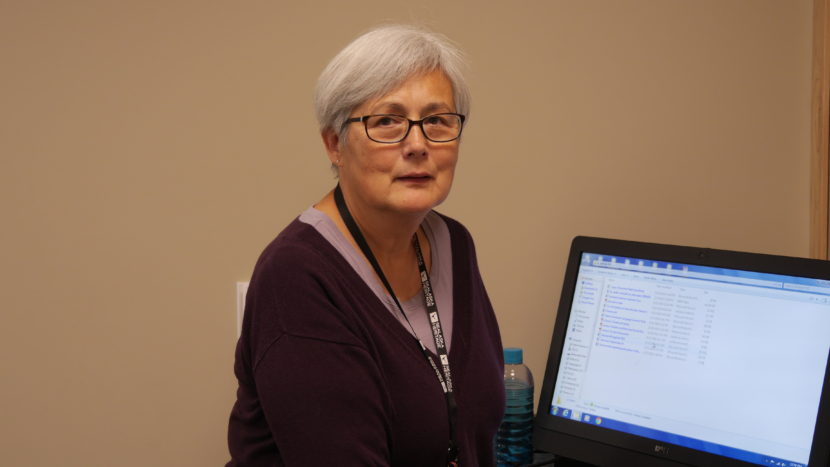
Ed Becker is a social studies teacher at Yaakoosgé Daakihídi Alternative High School.
Ed Becker is a social studies teacher at Yaakoosgé Daakihídi Alternative High School. (Photo by Quinton Chandler/KTOO)

Ed Becker is a social studies teacher at Yaakoosgé Daakihídi Alternative High School. He has high praise for the program.

“I teach Alaska history and world history, and U.S. government. It’s definitely going to cause pause and create some more work for me, but more opportunities for my students to be engaged and learn,” Becker said.

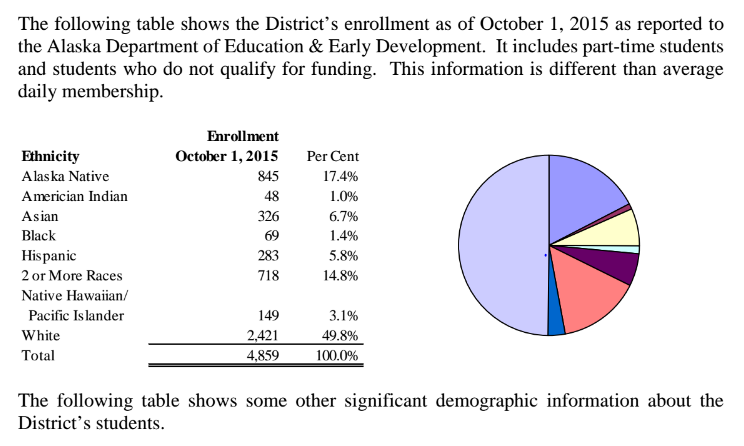
Last year, 17 percent of the district’s students were Alaska Native.

Juneau School District included this table and chart in its Budget Documents for FY2017. (Courtesy of Juneau School District)
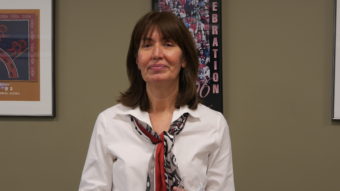
Angie Lunda is an assistant professor of education at the University of Alaska Southeast.
Angie Lunda is an assistant professor of education at the University of Alaska Southeast. (Photo by Quinton Chandler/KTOO)

Angie Lunda is an assistant professor of education for the University of Alaska Southeast. She is Tlingit from the Kaagwaantaan clan and she is teaching today’s session.

“What I hope is that it will cause teachers to dig deep in themselves to really try to reach students where they’re at, to really build on the background knowledge that students bring, to really base the education in this place,” Lunda said.

She said connecting to students through their culture and what they already know about Southeast can help with real problems like the achievement gap between Alaska Native students and non-Native students.

The state Department of Education has reported that in 2015 more than a third of Alaska Native students failed to graduate after four years of high school. That’s compared with one in four students overall.

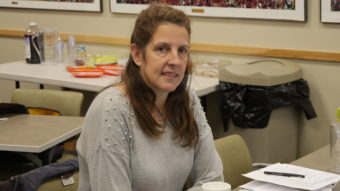
Dianne Zemanek teaches math and science at Dzantik'i Heeni Middle School.
Dianne Zemanek teaches math and science at Dzantik’i Heeni Middle School. (Photo by Quinton Chandler/KTOO)

Dianne Zemanek is a math and science teacher at Dzantik’i Heeni Middle School. She sees Sealaska Heritage’s seminar as an opportunity to continue building on efforts at her school to bring Native culture into their classes.

“We took the core cultural values of the Native Tlingit, Haida, Tsimshian people and took those values to our kids and then asked them to connect to those cultural values and explain what it looks like in our school,” Zemanek said.

In her own classroom, she’s trying to use Alaska Native methods for building halibut hooks in her math lessons.

JPD asks for school board’s help in kindness initiative

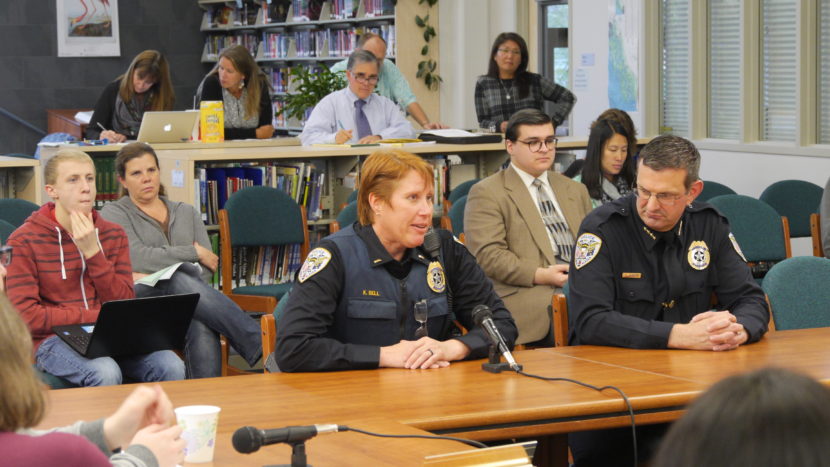
JPD Lt. Kris Sell (left) and Chief Bryce Johnson (right) speak at Tuesday's Juneau School Board meeting. (Photo by Quinton Chandler/KTOO)
JPD Lt. Kris Sell, left, and Chief Bryce Johnson, right speak at Tuesday’s Juneau School Board meeting. (Photo by Quinton Chandler/KTOO)

The Juneau Police Department wants to boost residents’ quality of life with kindness.

JPD Police Chief Bryce Johnson and Lt. Kris Sell presented their idea to the Juneau School Board Tuesday night.

The department wants the community to spend a year trying to make Juneau a more peaceful place by encouraging people to perform random acts of kindness for others.

“What we want to do is encourage people to do at least one kind act per day for another person. And to once a week make that kind act directed at someone who’s not in their normal circle of associates,” said Sell. “Maybe someone of a different culture, different background, different religion, different socioeconomic status.”

Sell said the department asked the nonprofit Random Acts to track what impact kindness will have on the Juneau community through 2017.

She said Random Acts will send a researcher to Juneau in January to gather data on the town. Then the organization will return a year later to see if Juneau’s quality of life has changed.

“And that’s numbers about our crime rates, about our disturbances, about discipline issues in the school, and we’ve talked to the hospital even about tracking our level of disease in Juneau,” Sell said. “We know from studies that being kind actually improves your immune system.”

A column in the Washington Post recently cited a study that found patients who gave their doctors a perfect score for empathy tended to recover from colds faster than patients who gave their doctors lower scores.

But the columnist, who is also a doctor, said evidence of a direct link between empathy and better health outcomes was limited. He also said kindness can’t hurt.

Sell said Random Acts had never heard of an entire town leading a kindness initiative and they said Juneau would be the first.

Sell said she and Chief Johnson came to the Juneau School Board meeting, hoping to recruit young people to take part in the initiative.

She hopes Juneau’s youth will continue making deliberate acts of kindness after the year is up.

She said kindness is “the drug that can replace all other drugs.”

State reverses governor’s $6.35 million school funding veto

Lt. Gov. Byron Mallott & Gov. Bill Walker - budget vetoes
Gov. Bill Walker announces line-item budget vetoes at the Atwood Building in Anchorage on June 29. Lt. Gov. Byron Mallott is also pictured. (Photo by Rachel Waldholz/Alaska’s Energy Desk)

Alaska public schools will still receive $6.35 million in education funding that Gov. Bill Walker tried to veto from the state’s budget in late June.

Walker’s education cuts were part of a series of line item vetoes totaling $1.29 billion.

Department of Education and Early Development spokesman Eric Fry said in an email that the Division of Legislative Finance didn’t believe the K-12 foundation formula funding veto sufficiently addressed technical language in the state’s operating budget bill.

Fry said “instead of allowing uncertainty to continue,” the state will distribute formula funding to schools as if the veto didn’t happen.

He cautioned that formula funding for the fiscal year, which started in July, still is not decided because it is based on estimates.

Final state funding for schools depends on each school’s enrollment, Fry said. Before the veto was reversed, the Juneau School District faced a $212,938 cut in its formula funding.

The governor also vetoed another $6.35 million in student transportation funding that still is in effect. That veto has reduced Juneau School District’s student transportation funding by $248,764.

Together the two cuts would’ve contributed to a roughly $460,000 budget deficit for the district.

Finance committee addresses city’s budget deficit, delays action on school district

City officials are one step closer to solving this year’s budget deficit after a city finance committee meeting Thursday evening.

The City and Borough of Juneau is facing a roughly $4.8 million dollar deficit during the current fiscal year because of budget cuts at the state level.

In an effort to fix the deficit before the fiscal year ends in June, the committee agreed to use the part of the city’s sales tax revenue, deferred maintenance funds, budget reserves and savings.

But these funds won’t help the school district’s current deficit.

The district is short $450,000, because of cuts in school transportation and the per-pupil-formula funding it receives from the state.

The finance committee decided to delay any decisions on the district’s budget until enrollment numbers are finalized in late October. If the school’s high enrollment trends stick, then it may be able to cover the deficit.

Any proposed solutions will still need to be approved by the Juneau Assembly.

The finance committee will meet again on Nov. 9.

Site notifications
Update notification options
Subscribe to notifications