Rep. Sam Kito lll addresses the Alaska House of Representatives in 2014. He and other Southeast lawmakers oppose cutting school funding. (Photo by Skip Gray/360 North)
Southeast Alaska lawmakers express skepticism that the Legislature should look to school funding to cut the state’s budget. In fact, some legislators would like to see spending increase in some education areas.
School funding makes up one of the largest pieces of the state budget. But as the Legislature looks to close a nearly $3 billion gap between state spending and revenue, Southeast lawmakers say school funding shouldn’t be cut further.
Rep. Sam Kito III said the foundation formula funding that makes up the bulk of state school spending should be taken off of the table for cuts. The Juneau Democrat is one of the legislators who said if anything, he’d like to increase funding.
“I do think that right now, we are not providing an adequate education in some areas of the state,” Kito said.
Kito said schools serving communities with large Alaska Native populations, as well as those with high poverty levels, have the highest need for funds.
“That could actually end up requiring additional funding for education. That’s why we do need to look at the services we’re providing, and then figure out how we’re going to pay for those services,” Kito said.
Kito also said the Legislature should weigh how to support the costs of building and maintaining schools. The state program to reimburse school districts for construction bonds was suspended in 2015 for five years.
“There are definitely areas where the program could have been fixed to save the state some money, but without it being there, the state is actually increasing our deferred maintenance of schools, which means school-repair costs in the future are going to be higher,” Kito said.
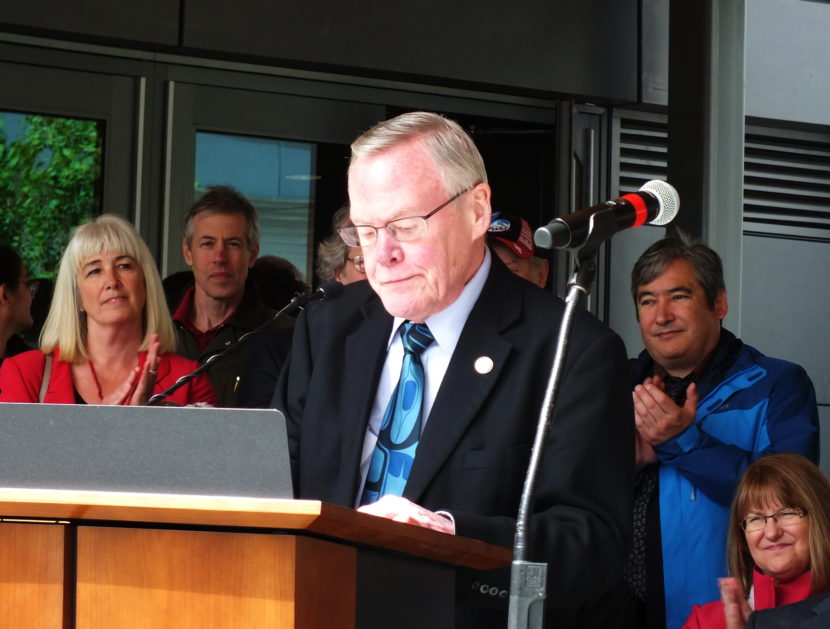
Juneau Sen. Dennis Egan addresses a crowd during grand opening of the Father Andrew P. Kashevaroff Library, Archives and Museum on June 6, 2016. (Photo by Matt Miller/KTOO)
Juneau Sen. Dennis Egan, a Democrat, said he wants to avoid a repeat of last summer when Gov. Bill Walker vetoed school debt reimbursement.
“It was a big blow to Juneau,” Egan said. “And we had to come up with … local funding. I mean, somebody’s got to pay. And it was done after municipalities had passed their budget.”
Juneau Rep. Justin Parish is Southeast’s newest lawmaker. A para-educator, the Democrat is a member of the House Education Committee. He joined Kito and Egan in opposing school funding cuts.
“I recognize that education is the largest component of our budget,” Parish said. “However, it is arguably the most vital for the long-term viability of our state.”
In higher education, the Southeast legislators want to give the University of Alaska more time to put into place its reorganization plan, aimed in part at cutting costs.
Rep. Justin Parish (Photo courtesy Justin Parish for House http://www.justinforjuneau.com/)
Parish said he’s eager to see how the plan affects students.
“I think that while an organization is trying to make cuts intelligently, it’s a little unwise to impose cuts from outside,” he said.
Kito said he’d like to see the university review whether it needs all of its buildings. And he’d like to see it refocus on meeting student needs.
“How can our university system generate graduates that can enter into the workforce in Alaska and be productive members of our state?” Kito said. “And that’s perspective I think they need to be taking.”
And the lawmakers said the state should look to close the roughly $6 billion gap between its pension obligations to retired teachers and other public workers and the assets it has to pay pensions.
Instead of cuts, Egan offered an alternative to the current retirement system. Instead of limiting public workers to the current defined contribution retirement system, Egan would like to offer them the chance to choose between traditional defined benefit pensions and the current system.
“Defined benefits allows people in the system to gain a better retirement if you want to stay here in Juneau, raise a family, pay property taxes, and contribute to the economy of the state,” Egan said.
Egan said defined contribution plans work better for workers who only plan to spend a few years in the state.
Ed Schoenfeld in Douglas and Quinton Chandler in Juneau contributed to this report.
The Juneau School District may get an extra $250,000 for school facilities maintenance from the City and Borough of Juneau.
It’s a fraction of what the district asked for, but Juneau schools Superintendent Mark Miller said it’s enough to pay for one item on the school district’s wish list.
“They said, ‘Well you were going to spend about $250,000 of that on facility maintenance’ – repairing water heaters, carpets and that kind of thing,” Miller said. “‘And so we’ll go ahead and give you that money, but we’re going to give it to you in a fund that you can only use to spend it on facilities.’”
District officials had asked the Assembly to increase local funding to the full amount allowed by state law to help pay for building repairs, and science and computer equipment.
Miller said he is grateful to the Assembly because some money is better than no money, and the district needs to make the repairs. But, he said the district will have to put its other needs on hold.
“Unfortunately we can’t make that decision now. So right now, we just simply have to put it on hold and hope that the numbers improve a little bit next year so we can afford to do it,” Miller said.
Assemblywoman Maria Gladziszewski, one of the four assembly members who voted against the change, said the funding request should have waited until later this spring when the Assembly focuses specifically on budgeting.
The Juneau Assembly’s Finance Committee voted to draft an ordinance for the extra money on Wednesday last week. If the Assembly moves quickly, Assemblyman Loren Jones said the funding ordinance could be introduced at its Jan. 23 meeting and voted on in February.
Here’s a run down of Juneau’s biggest stories of 2016.
A snarky bumper sticker pokes fun at the “Build the Road” controversy. It was spotted in Juneau on March 11, 2014. (Photo by Jeremy Hsieh/KTOO)
A divisive, decades-old community bumper sticker issue was put to rest for foreseeable future. To save money, Gov. Bill Walker announced he was effectively killing the mega-project to extend Juneau’s main road north, 50 miles closer to the road system. While ferry system boosters and environmental interests cheered, others, like Juneau Mayor Ken Koelsch, lamented.
“Today’s announcement definitely feels like a body blow,” Koelsch said.
R.T. “Skip” Wallen’s whale sculpture arrives in Juneau aboard a ferry on Aug. 8. The sculpture’s been raised in a waterfront park under construction near the Douglas Bridge. (Photo by Rashah McChesney/KTOO)
The cruise ship industry hit the City & Borough of Juneau with a federal lawsuit in April. Cruise Lines International Association alleges Juneau is misspending the $5 per passenger tax it collects. Federal law says it can only be spent on projects and programs that address both cruise ship passengers’ safety and accessibility.
The industry is especially irked that its passengers are paying for the waterfront park under construction about a mile from cruise ship ports. The park’s most prominent feature is the life-size bronze humpback whale sculpture that arrived in August. Private donors paid for the whale itself.
Juneau Mayor-elect Ken Koelsch addresses his supporters on election night, March 15, at City Hall. (Photo by Jeremy Hsieh/KTOO)
“My goal is to unite us as a community. I will work hard for you with honor and with integrity. We have our work cut out for us, so let’s unite,” he said.
One issue the new bloc campaigned on was restoring the tax break seniors used to get on the city’s 5 percent sales tax. All seniors had been eligible for the tax exemption on goods and services purchased for themselves.
In economic news, one of the community’s biggest private employers closed up shop. About 180 full- and part-time jobs went with Wal-Mart when it shuttered in February. And there’ve been no announcements for what will become of the big box retailer’s 135,000 square-foot building.
The Juneau Wal-Mart in January 2016, before it closed. It was previously a Kmart. (Photo by Elizabeth Jenkins/KTOO)
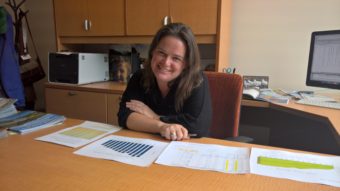
Meilani Schijvens at her desk in August. (Photo by Jeremy Hsieh/KTOO)
“In many ways, the Juneau economy is booming,” Meilani Schijvens of Rain Coast Data said in August.
Schijvens said Juneau has a strong private sector, but still thinks the recession will hit locally.
“It’s coming, I think it’s coming, I’m not looking forward to it. But 2016 is still appearing to be a really strong year for the community,” she said.
In August, the Juneau Assembly made the capital city only the second Alaska municipality after Anchorage to protect its private citizens from discrimination based on gender identity, gender expression and sexual orientation.
The Rev. Phil Campbell of Northern Light United Church was one of about 70 people that crowded into a Juneau Assembly meeting in support of the ordinance.
People shared their thoughts on white boards in Marine Park at a community gathering the Juneau Police Department hosted in July. The event was to celebrate diversity and to stand against violence. (Photo by Annie Bartholomew/KTOO)
“I humbly submit, assembly members, that by the passage of the equal rights ordinance this night that you will facilitate yet more bending toward justice and equality for all people,” Campbell said.
This year, the Juneau Police Department’s leadership championed transparency, accountability, outreach with the community at-large and the at-risk — even simple acts of kindness.
“It’s good if the police did it right, it’s good for the public to know we did it right,” Johnson said. “And if we did it wrong, we need to own that and fix it. And it’s good for the public to know when we do it wrong, that we admit to our mistakes and we make them better.”
Juneau Police Chief Bryce Johnson waves at a community barbecue it hosted in Marine Park to “be counted as a person against violence, against discrimination, and against hate” on July 20. (Photo by Annie Bartholomew/KTOO)
As smartphone video of police officers around the nation using lethal force in questionable circumstances fueled mass protests, JPD contained one potentially tragic situation after another — with little or no violence.
Among the high-profile incidents JPD resolved relatively peacefully this year:
someone having a mental health emergency knifing at imaginary animals in the middle of a downtown intersection, and
a standoff with a suicidal subject with a gun at a downtown motel.
At a hotel police are frequently called to, Lt. Kris Sell explained why police officers were connecting residents to social services, and handing out drug overdose medicine and sharps containers.
(Photo by Quinton Chandler/KTOO)
“Really, modern policing is also about, ‘How do you apply positive pressure so that you can work with the people that are having challenges and get them on a more law-abiding path so they can get along with their neighbors?’” Sell said.
The department does have a huge blemish on its 2016 record. In November, a veteran officer shot a man that was apparently unarmed at a car crash site. The man, Jeremie Tinney, survived and is in custody with Washington state authorities on unrelated charges. JPD hasn’t charged him with anything.
In the immediate aftermath, Chief Johnson’s messaging was consistent.
“Our goal is to conduct a very thorough, very professional, very transparent investigation so we can give very clear answers for what occurred and why what occurred happened,” Johnson said.
State agencies are investigating the incident, which was JPD’s first officer-involved shooting in nearly 10 years.
The police also have their work cut out for them dealing with a huge increase in burglaries. Police officials have said they think drug addictions are a major factor in the upswing.
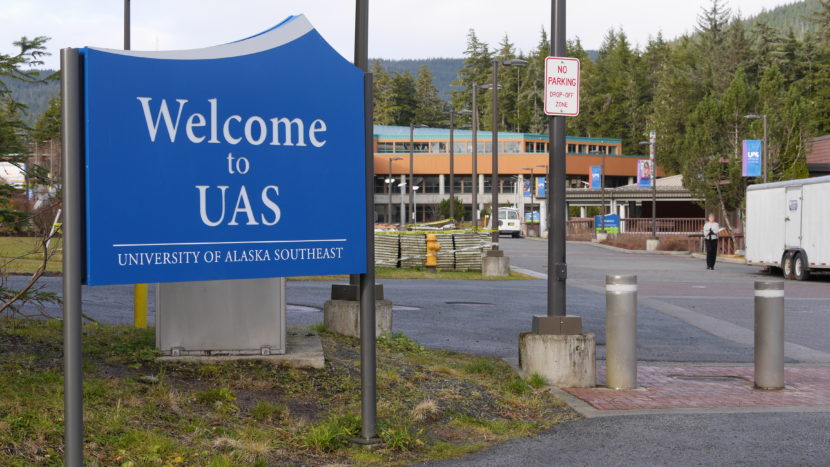
University of Alaska Southeast’s Juneau campus on Nov. 15, 2016. (Photo by Quinton Chandler/KTOO)
The stakes were higher than just the one college, according to Juneau Assemblyman Jesse Kiehl.
Jesse Kiehl
“That College of Education is nine-tenths of the graduate degrees that the University of Alaska Southeast offers,” Kiehl said. “Without a leadership role in one of the major missions of the university system statewide, UAS was in terrible danger.”
The Juneau Empire reports that CBJ officials helped sway the decision by pledging $1 million in support.
The demolition of the Gastineau Apartments wrapped this year. The century old, multi-building apartments became an uninhabitable downtown eyesore after a fire destroyed it in 2012.
The city hired contractors for the demolition over protest from the owners. It’s trying to recover the demolition costs from the landowners in a case pending in Juneau Superior Court.
A multiple choice exam. (Creative Commons photo by Alberto G. )
The Juneau School District is one of the first in Alaska to make the AP District Honor Roll, a prestigious recognition for districts that increased the percentage of students who took and passed Advanced Placement tests.
Juneau School District Superintendent Mark Miller explained how the tests work.
“(A) student takes a college level course that we give at high school and at the end they take a test,” Miller said. “If they score a three, four, (or) five, typically colleges will give them credit.”
Five is the highest score.
The College Board, the organization that offers AP tests, has an honor roll for districts. To make the list, a district has to meet three criteria over three consecutive years.
“One, increase the number of AP tests given – meaning more students are taking more tests,” Miller said. “Second, while you increase the number of students taking tests, you also increase the scores … average scores of students taking the tests.”
Juneau School District’s percentage of students who took the exam had to go up by at least 11 percent. Larger districts have to increase participation by 4 to 6 percent.
For its third requirement, the district had to increase or maintain its percentage of minority students who scored at least a three on at least one exam.
Miller believes having two separate high schools has made it easier to schedule students into AP courses. He also thinks the achievement is a result of training more teachers to teach AP classes, and the administration’s work to make the tests available to as many students as possible.
“It’s really about pushing for equity, pushing to make sure all of our students succeed, pushing students to do their best regardless of their background or where they come from,” he said.
Miller said the AP courses and tests prepare students for college-level classes and if they score well, they could save thousands of dollars in college tuition.
The honor roll dates back to 2011. According to the College Board, Juneau School District is the second Alaskan school district to make the list. The Anchorage School District made last year’s honor roll.
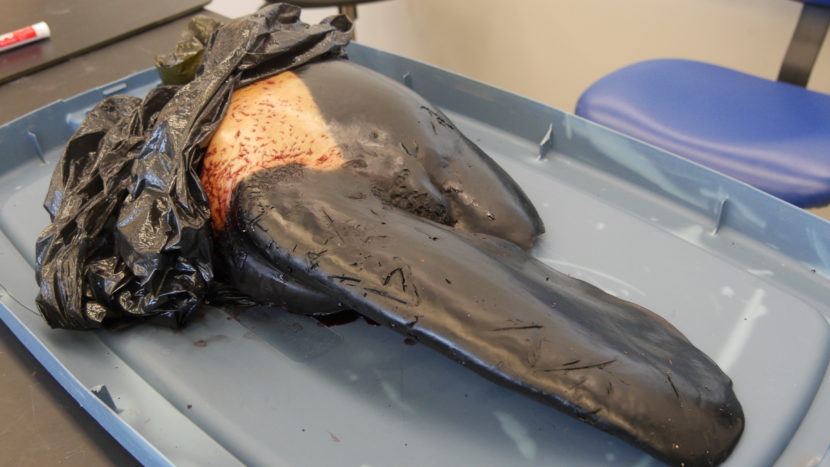
Thursday in a lab at UAF’s Lena Point facility, the new DEMBONES class is shown part of the carcass of a baby orca that they will harvest bones from. (Photo by Quinton Chandler/KTOO)
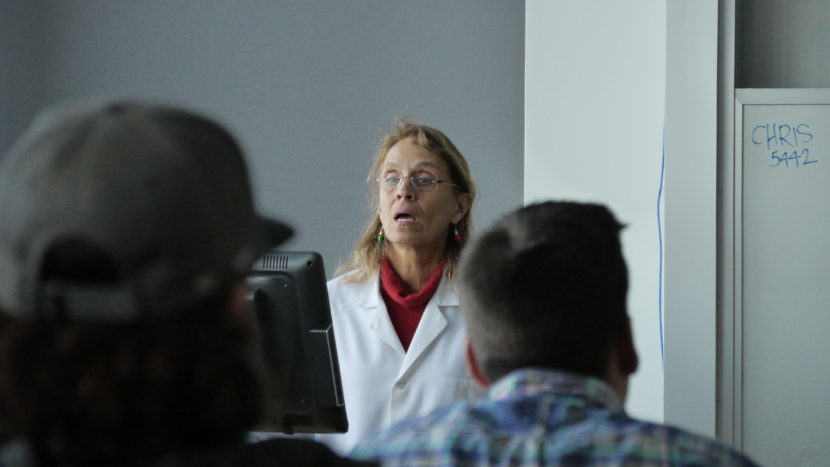
Shannon Atkinson is in a lab showing a Thunder Mountain High School class part of the body of a baby orca, also known as a killer whale.
“This animal happened to be a neonate – meaning it was just born. Its teeth hadn’t even erupted,” she said.
Atkinson is a University of Alaska Fairbanks professor who works out of Juneau. Her specialty is marine mammals.
Thanks to the Juneau School District and a local donor, in a few weeks this class of mostly juniors and seniors will cut into two orcas and take out their bones.
“And ultimately create a museum-quality skeleton articulation,” Atkinson said.
About 50 students will take the college-level marine biology class — and the skeletons will be put on display in their school.
“We’re going to hang a skeleton in the high school. And we’ve got a bunch of them there already,” Atkinson explained. “So when we articulate something we’re basically putting those bones back together.”
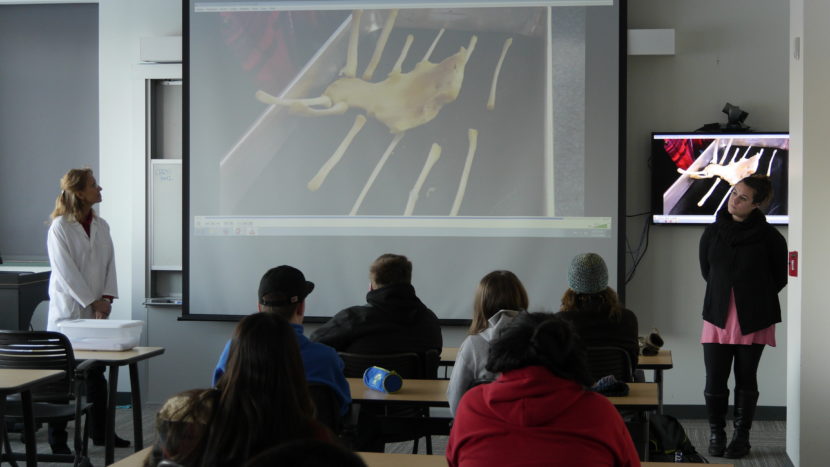
Professor Shannon Atkinson introduced her new class to DEMBONES, Thursday. (Photo by Quinton Chandler/KTOO)
For the past seven years, Atkinson has taught a class called DEMBONES, an acronym for Distinctive Education in Motion Biodiversity of Nature and Environmental Stewardship.
It’s a college-level course for Thunder Mountain High’s marine biology class. The animals they use are usually found dead on the beach.
She said the class gives high school kids a unique opportunity to learn more about marine mammals.
“Everything from anatomy and physiology, ecology of the species, cultural uses of the animal, marine policy …,” Atkinson said.
This school year’s DEMBONES class watched a video of a previous class on Thursday. (Photo by Quinton Chandler/KTOO)
But earlier this year, she was afraid DEMBONES wouldn’t happen. After the state cut funding to the University of Alaska, UAF officials decided they couldn’t pay for the class.
“What is so wonderful is that between the Juneau School District and this community at large, they are so supportive of education that they have found the funding for us to be able to continue the class,” Atkinson said.
At its last meeting, the Juneau School Board voted to add $11,000 to its budget specifically for DEMBONES. Atkinson said the class is also getting new money from a local nonprofit. Most of the new funds will offset tuition and fees.
“My understanding at this point is the tuition for Spring Semester is $192 per credit and this is a two-credit class,” Atkinson said.
With fees, she said the class would cost about $400 per student and she said in the past, students have only paid about $50 of that tuition.
The program also usually gets grant money to take care of miscellaneous expenses.
“We also have costs associated with transporting carcasses, the chemicals that we use to clean them up, the time that it takes for technicians to help us prepare the skeleton,” Atkinson said.
Her past students have reconstructed harbor seals, a Cook Inlet beluga whale and a walrus.
Atkinson said the orca class will start in January and it will take about 13 weeks to put the skeletons together.
The district is already guaranteed more state funding after about 180 unexpected students showed up for classes this year and because the district is getting more money from the state, the City and Borough of Juneau is allowed to increase the amount it gives.
“It’s kind of a double dip Sunday if you will, and I like that,” said Juneau School District Superintendent Mark Miller.
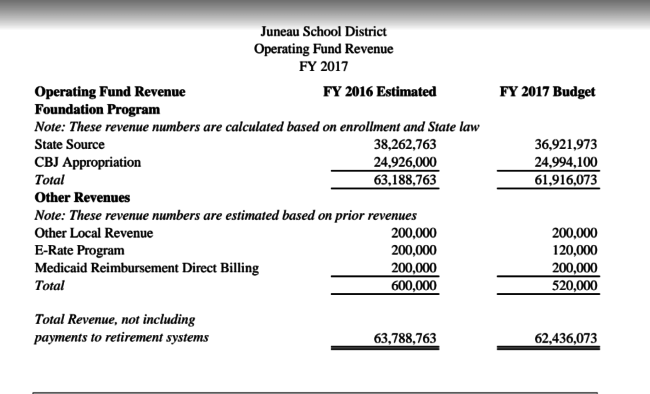
He said the district will ask for $650,000 dollars. That’s in addition to the near $25 million appropriation the assembly has already agreed to give for this fiscal year ending in June.
A breakdown of the FY17 operating fund revenue the Juneau School District budgeted for in June this year. The CBJ appropriation is on the second line. (Courtesy of Juneau School District)
Miller said there’s plenty to spend that on.
“We have about … $300,000 worth of facility repairs that (we) need done,” he said. “Hot water heaters, boilers, things that keep us warm and dry, and allow us to wash dishes that are wearing out. We’d love to replace those this year.”
Miller said the district also needs to buy supplies as early as possible for a new science curriculum it’s launching, and they want to pay for IT upgrades. In all, he said the list would cost over a million dollars.
“We know we can’t do it all, but we just ask them to do the best they can so we can do the best we can, and (we) appreciate that they do that year after year, after year,” said Miller.
He said the CBJ usually chooses to give the district as much as state law allows.
The school board is also discussing the list of issues they want legislators to consider in the upcoming legislative session. Miller said those priorities are mostly related to funding, but they will also ask legislators to “clean up” language in some bills that already passed.
He said those priorities will be finalized during the next school board meeting on Jan. 10.
In the meantime, he’s hoping the Juneau Assembly will be in the spirit to give.
Close
Update notification options
Subscribe to notifications
Subscribe
Get notifications about news related to the topics you care about. You can unsubscribe anytime.