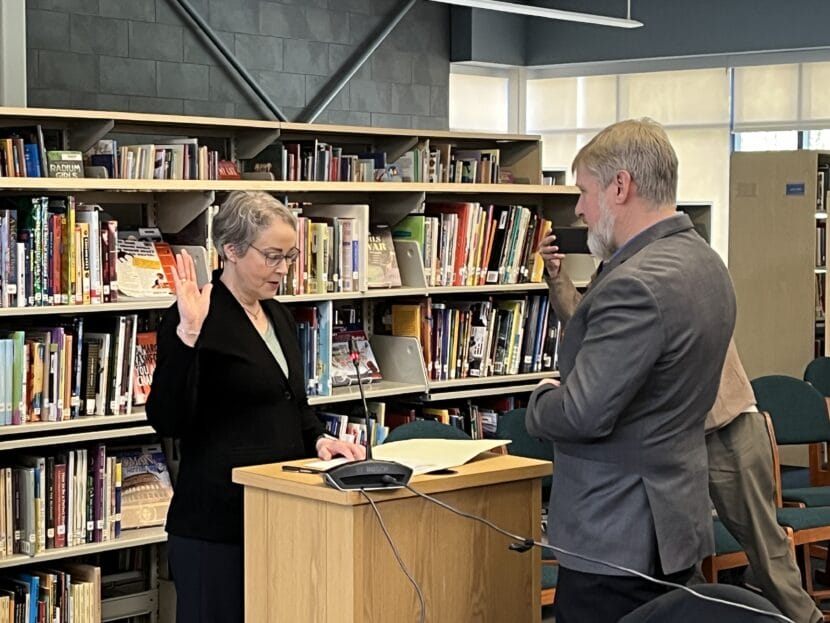
Judge Amy Mead, left swears in Steven Whitney to the Juneau School District Board of Education on May 17, 2025 (Photo courtesy of the Juneau School District)
The Juneau School District Board of Education appointed Steve Whitney to the board on Saturday. Whitney will fill a seat held by Will Muldoon until his sudden resignation from the board last month.
Whitney is a former school board member and works for the National Marine Fisheries Service. He served a three-year term from 2016 to 2019 and decided not to run for reelection in order to care for a family member.
Steve Whitney in 2016. (Photo by Quinton Chandler/KTOO)
In his interview, Whitney said he plans to focus on maintaining the public process at board meetings.
“My mindset going forward would be to focus much more on healing community and collaboration while we deal with difficult decisions, because I believe that is what this time calls for, and that is also what would best serve our children,” he said.
Whitney said he wants to balance ensuring teachers in the district get fair contracts with the district’s budget constraints.
Whitney will serve until the board elections in October, when a new member will be elected to serve the two remaining years of the term.
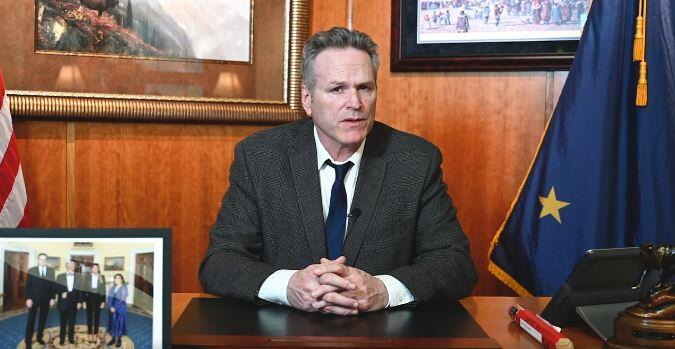
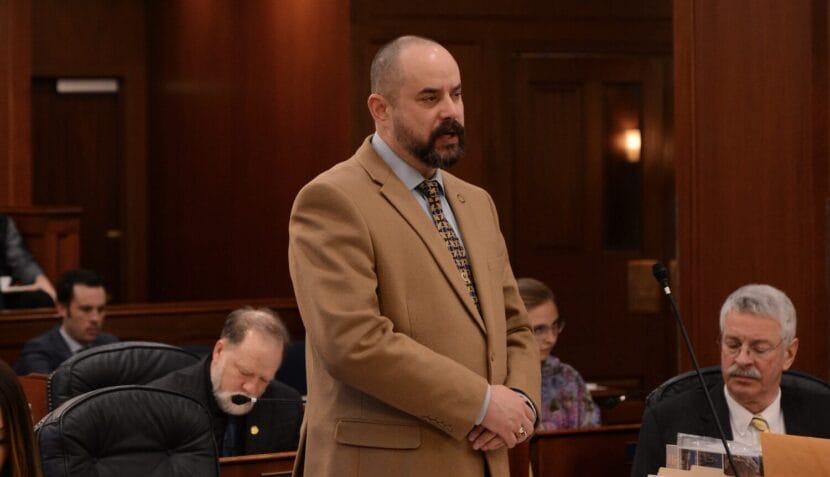
Gov. Mike Dunleavy announces his veto in a video posted on his social media accounts on Monday, May 19, 2025. (Facebook screenshot)
Gov. Mike Dunleavy vetoed a bill Monday that would substantially boost long-term education funding. House Bill 57 would have increased the base of Alaska’s public school funding formula, the base student allocation, by $700, increased student transportation funding and made several policy reforms.
“There is no evidence that a permanent increase in the Base Student Allocation will improve educational outcomes,” Dunleavy wrote in his veto message to legislative leaders. “Therefore, this bill in its current form does not serve the best interest of Alaskans.”
Parents, school leaders, local elected officials and business leaders have long said that the state’s public school system is in crisis after years of flat long-term funding in the face of inflation.
Some legislators said Monday that they’re hopeful they can override Dunleavy’s veto. A vote is scheduled for Tuesday morning.
“Our schools need relief. They need it soon. Many of them are right on the cusp of, basically, insolvency,” House Speaker Bryce Edgmon, I-Dillingham, said.
In recent years, lawmakers have provided one-time funding boosts for schools but have failed to come to terms with Dunleavy on a long-term increase.
In an effort to find compromise, lawmakers included several reforms in the bill — a ban on student cellphone use, targets for the maximum number of students in each classroom, and a variety of reforms aimed at making it easier to create and maintain charter schools, a key priority for the governor.
“It’s really a shame, because I think, in many ways, we gave the governor many wins on education,” Senate President Gary Stevens, R-Kodiak, said. “A lot of the things that he wanted are in there.”
But in the end, Dunleavy said it was not enough.
“We all agree that our schools need some funding. It did not contain the other half, as we say, of the coin,” Dunleavy said in a video posted to social media. “We worked hard on trying to get policies in there that we believe would help kids, would help families, and would help teachers.”
The veto was not unexpected. Earlier this month, Dunleavy told school superintendents he planned to veto the bill unless lawmakers passed additional bills with more of his priorities.
In the video, Dunleavy objected to a few omissions. He said he wanted lawmakers to implement a statewide open enrollment system, which would allow students living in one district to enroll in another.
Lawmakers said the system the governor envisioned would make it difficult for some families, especially military families who move to Alaska midyear, to enroll in the school closest to their home. The bill would have required a legislative task force to study the issue.
Dunleavy also said the bill didn’t do enough to improve student reading performance.
The bill lawmakers sent to Dunleavy sought to create a reading proficiency incentive grant program for school districts — for each student in grades K-6 who read at grade level or demonstrated improvement, districts would get $450.
But, with the state facing a budget crunch because of low oil prices, lawmakers sought to fund the grant program with an expansion of corporate income taxes aimed at capturing more revenue from out-of-state companies who do business in Alaska over the internet. Additional revenue from the tax bill was planned to bolster career and technical education.
But Dunleavy said he opposes new taxes without a comprehensive fiscal plan, which has eluded lawmakers for years. Dunleavy said lawmakers’ decision to tie the reading and tax proposals together was a sign legislators didn’t see the reading program as a priority.
“There was a game played with the tax, is what’s happening here,” he said at a news conference.
Dunleavy also sought additional changes to charter school policies in an effort to improve student achievement, though lawmakers said Dunleavy’s proposals could intrude on the authority of local school boards.
“We couldn’t get agreement on those policies. So in essence, in the end, this became a spending bill that we believe we could have done a lot better with,” Dunleavy said.
But underfunding schools has its own consequences, said Rep. Chuck Kopp, R-Anchorage and the House majority leader.
“Starving our schools also will not produce increased educational outcomes,” he said.
It’s the second year in a row Dunleavy has vetoed a compromise package aimed at boosting funding for public schools. Last year, lawmakers fell one vote short of overriding his veto.
Dunleavy also vetoed a larger standalone funding boost earlier this year that did not include policy reforms. Lawmakers failed to override him by a wide margin.
An override vote on the newly vetoed bill is scheduled for 9 a.m. Tuesday, and lawmakers have said they’re optimistic it could garner the two-thirds majority necessary. Thirteen minority Republicans joined the bipartisan majority caucuses to approve the bill by a combined vote of 48-11, and five would need to favor an override for it to succeed.
It’s unclear whether lawmakers have the votes. But Rep. Justin Ruffridge, R-Soldotna, said he planned to vote to override Dunleavy.
“I think people have been hearing from their constituents over and over and over again that education funding and outcomes are important to them. It’s their No. 1 priority. It’s why many of us are here,” he said.
But in a reversal, Rep. Sarah Vance, R-Homer, said she would vote to sustain the veto. Shortly after the bill passed, Vance said she was willing to override the governor, but she said Monday she had reconsidered.
“I changed my mind,” she said, because “the majority was absolutely unwilling to give him a couple of more of his policy asks.”
But even if an override succeeds, Dunleavy could still veto education funding from the state budget, which would require a three-quarters majority to reverse.
Lawmakers must adjourn their regular session by midnight Wednesday, though legislators say they’re optimistic they may finish their work Tuesday night.
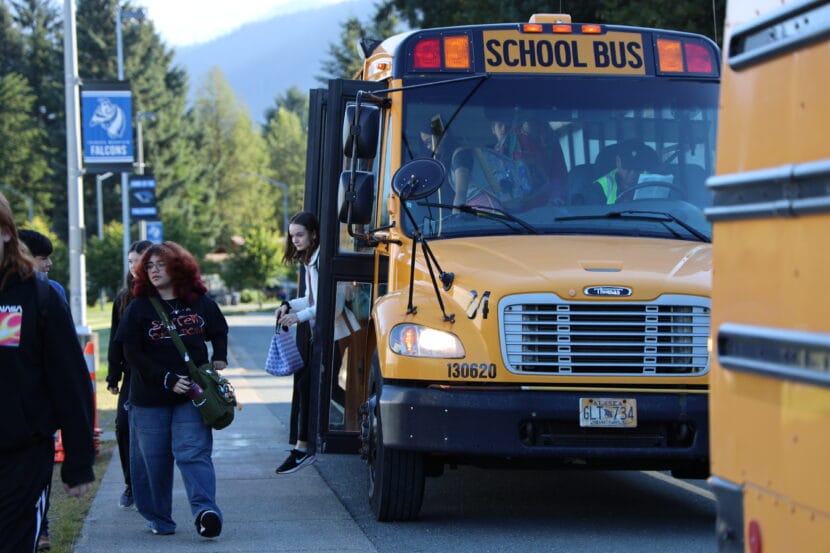
Students walk off a bus to the Thunder Mountain Middle School entrance for the first day of school on Thursday, Aug. 15, 2024. (Clarise Larson/KTOO)
The Alaska Department of Education and Early Development failed a test that allows it to include millions of federal dollars toward its contribution to education funding.
Alaska receives millions of dollars in education funding each year called federal impact aid. That money makes up lost revenue for regions with land that can’t be taxed like federal and Alaska Native owned land. The state can put that money toward its own obligation to school districts in those regions – as long as there isn’t too big of a gap, or disparity, in funding between the most and least funded school districts.
In a Friday letter to state Education Commissioner Deena Bishop, the U.S. Department of Education said the state failed the disparity test. That means what’s usually tens of millions of dollars in federal aid won’t count toward the state’s education contribution for the next fiscal year.
The state failed the test because the gap between the most and least funded school districts it compared was too wide.
The state failed the test before in 2021, but successfully appealed the decision. It received an exemption to leave out state funding for student transportation — a change that allowed it to pass the disparity test.
The letter also says the state can request a hearing with the federal department if it will be negatively impacted by the test result.
Bishop said in a Friday email to KTOO the state is considering its options moving forward.
This comes as the state’s education department is pursuing a regulation change intended to keep it from failing the disparity test. The regulation would further limit how much funding local governments can contribute to school districts. But it’s unclear if local contributions were a factor in the education department’s most recent failure.
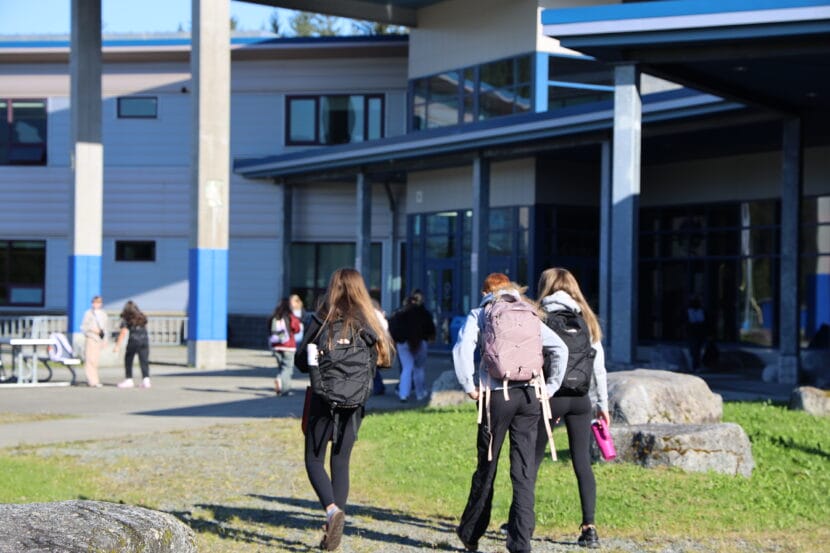
Students walk to the Thunder Mountain Middle School entrance for the first day of school on Thursday, Aug. 15, 2024. (Clarise Larson/KTOO)
Five candidates have applied to fill an empty seat on the Juneau School District Board of Education after board member Will Muldoon resigned last month.
The candidates include a former school board member and two candidates who ran last year but were not elected.
Jenny Thomas ran for the school board last year and fell short of being elected. Thomas led the recall campaign for two members after the board closed and consolidated several schools last year. She wants to evaluate the effects of that plan if elected. Thomas currently owns Icy Strait Plumbing & Heating.
Brenda Taylor was a longtime teacher at Juneau Community Charter School and currently works with Sealaska Heritage Institute as a research coordinator. Taylor said she would focus on supporting teachers through contract negotiations and filling vacancies.
Dom Pannone is the director of program management and administration at the state Department of Transportation and Public Facilities. In his application, Pannone wrote that he went to school in Juneau and wants to “contribute meaningfully to the district.”
Melissa Cullum is a freelance writer and homeschool parent. She wrote that her top priority if appointed would be fair teacher contracts.
Steve Whitney was elected to the school board in 2016 and served one term. He didn’t run for reelection, saying at the time that was taking care of a family member instead. In his application, he said he would prioritize union contracts.
The board will conduct interviews Saturday at 10 a.m. at Thunder Mountain Middle School and afterward select a new member to serve until the next school board election in October.
More information on candidates can be found on the district’s website.
On Monday, the Alaska Legislature joined the call for help by passing House Joint Resolution 5, which asks Congress to reauthorize the Secure Rural Schools and Community Self-Determination Act of 2000.
That act sent $12.6 million to Alaska schools in federal fiscal year 2023, but Congress has thus far failed to reauthorize the program.
The state Senate passed HJR 5 by a 19-1 vote on May 9 after modifying a version originally written by Rep. Jeremy Bynum, R-Ketchikan. The House agreed with the changes, 37-3, on Monday.
The votes against the resolution came from conservative Republicans who generally oppose federal spending.
The Secure Rural Schools Act, as it is commonly known, was designed to compensate rural school districts for tax revenue lost as the federal government began to restrict logging in the 1990s.
In 2023, the law provided more than $250 million to districts nationwide, with about 5% of the funding coming to Alaska.
For some of Southeast Alaska’s rural school districts, the money was a big part of the local budget. Yakutat, for example, received more than $6,500 per student. Wrangell had almost $3,500, and the money was worth $584 for each of Ketchikan’s 2,045 students.
HJR 5, which will be sent to every member of Congress, asks for retroactive funding and for a permanent funding source to pay for the bill.
It also encourages Congress to open more federal land to timber cutting “in a manner that supports rural economic revitalization, conserves habitat, and promotes forest health.”
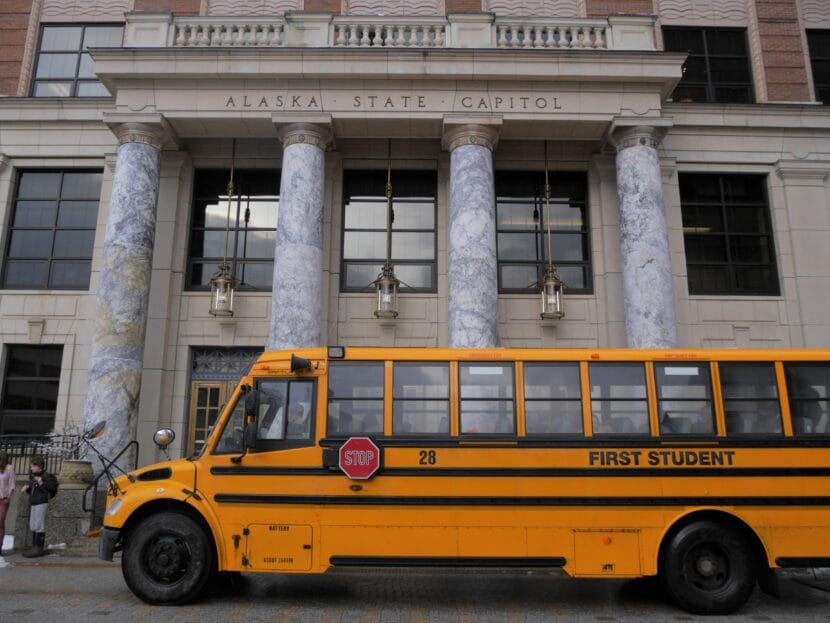
A school bus waits outside the Alaska State Capitol on Feb. 13, 2023. (Katie Anastas/KTOO)
The money local governments spend on their school districts falls in an interesting spot in the maelstrom of Alaska education funding. Under state law, municipalities are limited in how much money they can give school districts annually. It’s called a local contribution.
In Juneau, the local contribution makes up close to half of the school district’s operating budget. Municipalities can also fund specific, non-instructional services outside of the operating budget – and that doesn’t count towards the limit, or “cap.”
“We’re talking about things like extracurricular sports and activities, community schools programs, after school programs, student nutrition, student transportation and pre-K and early education programs,” Juneau School District Superintendent Frank Hauser said at a recent House Education Committee meeting.
He said districts like his stand to lose millions of dollars in local funding if a proposed regulation change from the Department of Education and Early Development, or DEED, goes through. It would further limit the money local governments can give to school districts.
Last month, Rep. Andi Story, D-Juneau, introduced House Bill 212. It would allow local funding for those non-instructional services to continue as it has – outside of the local contribution limit.
A letter from DEED says the state needs to crack down on local spending because it doesn’t want to lose access to millions of federal dollars called federal impact aid.
The state gets to put that money towards its obligation to schools. The money counts toward its contribution as long as the state can prove that it’s funding education equitably between districts. State officials are worried that the federal government may start looking more closely at the local money that goes beyond the limit when it’s deciding if things are equitable.
DEED Commissioner Deena Bishop said her agency is trying to make the change before anything happens.
“The initiative to pursue regulatory clarification is solely on DEED driven by our obligation to ensure compliance with federal law and Alaska law, which includes impact aid as a critical component of the state’s school funding framework,” Bishop said.
Using federal money to reduce state spending
Alaska receives the federal aid to make up for money lost from land that can’t be taxed, like Alaska Native-owned land or military land. That’s the money the state can use toward funding districts if it’s fair by federal standards.
There’s more than $80.8 million at stake this year.
That money is what the state contributes to districts that qualify for the aid, but that’s only if it passes the disparity test.
Alaska is the only remaining state in the country that uses the disparity test. It looks at how much school districts spend per student and takes out the top and bottom 5% of districts, and then sees how big a difference in spending there is between districts. The state passes if there is less than a 25% difference in spending between the remaining districts.
Federal regulation says the disparity test uses current expenditures in the calculations. That’s money that goes toward providing free public education.
This includes “administration, instruction, attendance and health services, pupil transportation services, operation and maintenance of plant, fixed charges, and net expenditures to cover deficits for food services and student body activities.”
Right now, the limited local contributions are counted in the calculations, but not the additional non-instructional spending. Still, Hauser said during his testimony that analysis from the Alaska Council of School Administrators showed that the regulation wouldn’t make a significant difference — including those non-instructional funds is unlikely to influence the results of the disparity test.
Alaska doesn’t need to include state transportation funding in the disparity test after initially failing and then receiving an exemption in fiscal year 2022.
Creating “clear definitions” with House Bill 212
The bill that Story proposed would make it state law that local funding for non-instructional services doesn’t count when the state calculates local contributions to school districts.
Time is running out for the bill to become law this year, but lawmakers could take it up again next year. In addition to passing out of two committees and the House, it still needs to make its way through the Alaska Senate.
But Story said districts have a lot to lose if DEED approves the regulation change between sessions.
“My hope with this bill is again drawing awareness to the issues, trying to make sure we have clear definitions, obviously, hoping it moves along the process,” she said. “And I think it will be a – very much a loss to services and educational opportunities to children across the state if the regulation goes into effect.”
Hauser said in an April interview with KTOO that school districts will have difficult decisions to make if DEED’s regulation change goes through.
“Are we going to provide extracurricular activities, or are we going to have another two or three teachers in the classroom to reduce the class sizes?” Hauser said. “So those are the decisions that boards have to make. How to make up for those funds that really are for non-instructional purposes.”
An administrative order from Gov. Mike Dunleavy froze any new state regulations coming forward. But Bishop said during a Senate Education Committee meeting Wednesday the department will request an exemption with an aim to put the regulation up for public comment at the July state Board of Education meeting.
If approved, it would go into effect for fiscal year 2027 beginning next July.
Close
Update notification options
Subscribe to notifications
Subscribe
Get notifications about news related to the topics you care about. You can unsubscribe anytime.