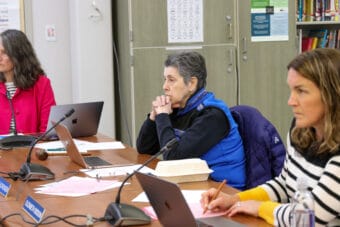
Deena Bishop testifying before the House Education Committee on May 7, 2025. (Photo by Jamie Diep/KTOO)
Lawmakers are setting aside until next year a bill that would kick off a pilot program for tribally-run public schools.
Rep. Andi Story, a Juneau Democrat, is a co-chair of the House Education committee. She said there isn’t enough time to move the House Bill 59 through the legislature this year. But she’s supportive of what tribally compacted schools can accomplish.
“Our education system was responsible for removing the language and culture, and so I think we have a responsibility to bring it back and have education opportunities through this tribal compacting,” Story said. “I think the details are just really important.”
The bill would fund and open five tribally-run schools through a state and tribal education compact, or STEC.
Superintendents in affected areas testified in support of the bill at the most recent hearing for the bill. However, Nome Public Schools Superintendent Jamie Burgess said she wants to see case studies that show how opening a compacted school affects local school districts.
“We are happy to support the development of a STEC school if that does move forward,” Burgess said. “However, I believe that there are still a great deal of questions for some schools. How it impacts each community is going to be unique.”
Story said stakeholders and tribal representatives will spend the time in the interim before next legislative session to get more feedback on the bill.
The Central Council of the Tlingit and Haida Indian Tribes of Alaska is one of the tribes that is involved in the program. Tribal representatives told KTOO earlier this month they plan to continue developing a new education campus if the bill doesn’t pass this year.
The current session ends May 21 and will reconvene next January.
The Klukwan Library has reduced its hours from 35 to four and canceled all future events amid federal funding cuts. (Photo by Jamie Katzeek)
For thirty-five hours each week at the Klukwan Library, people study, check out books, and take workshops on everything from paddle making to Chilkat weaving.
Or at least they used to. The Trump administration recently notified the tribal library that it was canceling two grants that account for the vast majority of its budget. That left the staff no choice but to cancel all future events – and dramatically reduce their hours.
“The letter said that our grant is, unfortunately, no longer consistent with the agency’s priorities, and no longer serves the interest of the United States,” said Jamie Katzeek, the library’s co-director.
The money comes from an agency known as the Institute of Museum and Library Services, which provides funding to communities across the country, including libraries in Native villages. In Alaska alone, the agency awarded library-related grants to dozens of tribes over the last two years.
It’s not yet clear how widespread the cancellations are across Alaska – or the country more broadly. But Theresa Quiner, the president of the Alaska Library Association, has been doing her best to track what’s happening.
“My perception is that most people who are Native American Library Services grant recipients, I have a feeling that most libraries have gotten the cancellation notice at this point,” Quiner said.
Library hours go from 35 to 4 in Klukwan
The Chilkat Indian Village in Klukwan was among them. In 2023, the tribe was awarded a two year grant – called an enhancement grant – of nearly $150,000. The money helped fund a project that aims to both reclaim and sustain traditional knowledge.
Then, in 2024, the tribe also received a much more common, $10,000 basic grant, which can be used to pay for staff hours and other budget items.
But in mid-March, President Donald Trump signed an executive order aimed at eliminating the agency. The order dubbed it – alongside six other federal entities – an “unnecessary” element of the federal bureaucracy.
By early April, the large grant was canceled even though the library still had nearly $100,000 to spend. Three weeks later, the smaller one was terminated, too. That left the library with just one source of funding: an annual $7,000 grant from the state that’s set to wind down next month.
That means Katzeek will work four hours per week until the end of June. She said she will likely use that time ensuring the library spends down the rest of the state grant according to their application.
It all means the library will no longer be able to offer programming and events meant to preserve traditional knowledge – or provide library services to students and other community members during the weekdays and weekends.
“The biggest loss is probably the programming that we offered. We would partner with other organizations and offer instructors for paddle making, moccasin making, beading, Chilkat weaving,” Katzeek said. “A lot of those programs were important to the people that live here in Klukwan, even people from town.”
The cancellations also threaten the library’s ability to apply for the state grant in the next round, given that it typically uses federal funds to meet a state matching requirement.
“That basically makes us ineligible to apply for the next PLA grant, which is supposed to start July first,” Katzeek said.
Library cuts have big impacts in small communities
At least five other tribes that have received IMLS funding could not be reached for comment. But Quiner, of the Alaska Library Association, provided a few additional examples of libraries that have lost funding so far.
Among them is the Kuskokwim Consortium Library, where Quiner serves as library director. She said the library partners with the Orutsararmiut Traditional Native Council in Bethel to get the same $10,000 grant as Klukwan. And they got the cancellation notice, too.
It’s a smaller sum than the agency’s much larger enhancement grants, which go to fewer recipients but often exceed $100,000. But they still matter, Quiner said, particularly in places where $10,000 can be the difference between having some library services or none at all.
“I did hear from the Pedro Bay Village Council that they’ve had to lay off a library worker because of this grant cancellation,” Quiner said. “And so it’s a small amount of money, but it has a pretty big impact in a small community.”
Other libraries, such as the Tuzzy Consortium Library in Utqiaġvik, aren’t as reliant on federal dollars.
The library is part of Iḷisaġvik College – Alaska’s only tribal college – and supports the school’s students and staff. It also provides public library services to seven communities across the North Slope Borough.
Teressa Williams, the library’s director, said the library has received the $10,000 grant for each community for years. And as is the case in Klukwan and Bethel, those grants were cancelled.
She said the loss is a “significant hit” to the library. But she emphasized that the federal grant amounted to just 7% of her overall budget, which means the library won’t be as affected as others. She added that she also doesn’t have to worry as much about the matching requirement for the state grant.
“Thankfully, I’m able to use my local funds to be able to afford the match,” Williams said.
Still, she’s concerned about the broader ramifications of Trump’s effort to dismantle an agency that so many libraries rely on for funding. That’s especially the case, she said, given Alaska’s low literacy rate – and the role libraries play in getting early literacy resources to families in rural areas.
“Libraries provide not only just books, though,” she said. “There’s people in communities that don’t have internet at home. They don’t even have a computer at home. When they need services to apply for the PFD, to file their taxes, where are they going to go, if not the library?”
Further complicating the picture is a federal judge’s decision last week to halt the executive order amid ongoing litigation. Even so, neither the Klukwan Library nor the Tuzzy Library have received any indication that their grants may be reinstated.
In Klukwan, Katzeek said she’s working with the tribal administrator to appeal the cancellations. But for now, her options are limited.
“We don’t yet know what the what it’ll look like for the library after June 30,” Katzeek said. “But we may have to close temporarily.”
X̱’unei Lance Twitchell teaching pre-kindergarten students. (Photo courtesy of “Stories of Kake” team)
Listen here:
Learning a language is hard. Learning a language without a teacher regularly checking in is even harder.
But this year, Kake City School District students got the chance to learn Lingít while creating multilingual poems that give people a glimpse of where they come from.
“I am from the air — daséikw. Salty — li.éil’,” reads third-grader Jessica Padgett. “Like summer. Like fish — xáat. Cold winter, like ice water — si.áat’i héen.”
Switching between English and Lingít, Padgett describes some sights and tastes of Kake in a poem about where she’s from.
This is part of “Stories of Kake,” a project where students from preschool to high school develop literacy skills in English and Lingít through storytelling.
Poems include descriptions of Kake through the five senses, including wildlife and food.
Third-grader Robert Wooten wrote about black bears in his part of the poem.
“I am from black bears — s’eek,” he reads. “They’re always by my creek. They are big. They are black. t’ooch’ yáx̱ yatee.They eat coho — l’ook. They eat humpies — cháas’.”
These poems and more will be featured in a community event and an episode of “A Piece of Kake,” a podcast that features stories and culture of the people in Kake.
“Stories of Kake” began as a grant funded project to improve literacy for preschoolers in Kake, but it expanded to teach elementary and high school students Lingít through storytelling and poetry.
X̱’unei Lance Twitchell is an Alaska Native language professor at the University of Alaska Southeast. He’s the main language teacher for the project. Twitchell said he hopes to give students the skills to speak Lingít more in the community.
“Hopefully they’ll be able to share these words with each other and start communicating in the language with the language to one another, as we sort of try and create a transformation, where you create generations that just use the language more,” he said.
Padgett and the other students said their favorite part of the project was learning more Lingít. Padgett said they learned by making up movements for different words.
“We had music on and we just made up movements, and she said a word in Lingít and English, and we had to do the movement and walk around and do the movement,” Padgett said.
Ryan Conarro is one of the project leaders. He said having Twitchell there means he and classroom teachers are able to learn the language with the students.
“There’s a lot of enthusiasm in this school district for Lingít language, for project based learning. Lot of the classrooms have posters on the wall with Lingít language vocabulary, that the teachers are motivated and they also are looking for support,” he said. “And so we’re psyched that this project has provided some of that support, and that Sarah and I both come in and say, ‘Look, we’re like you. We’re also learning, but we’re going to try to be brave, and keep trying.’”
Sarah Campen is the other project leader and co-hosts the “Piece of Kake” podcast. She and Conarro are learning Lingít together alongside teachers and students with the project as Twitchell teaches the language. Campen said learning, making mistakes and improving together with students makes them more willing to try and improve. She said that’s shown in the podcast.
“One of my favorite pieces, is two students working with X̱’unei and working with Ryan, and saying some words over and over again, and just trying and practicing and not getting it quite right, but practicing and just seeing that evolution over time is so fun, because eventually we get better,” Campen said.
Kake City School District will hold the showcase at the school this Wednesday at 3:15. Campen said the podcast episode “Goodáx Xát Sáyá? / Where Am I From?” is expected to come out on the same day.
Correction: this story has been updated with the correct spelling of certain Lingít words.
The next season of the PBS KIDS show “Molly of Denali” will be the last for the foreseeable future.
The team behind the award-winning children’s TV show will stop working on new content. Molly of Denali is widely celebrated in Alaska because it features an Alaska Native lead character and showcases Indigenous culture.
This comes as the Trump Administration is cracking down on federal funding for NPR and PBS. But Alaska State Writer Laureate Vera Starbard, who is a writer and story editor for the show, said that’s not the full story.
While she and other writers knew the decision was in the works before the presidential election last year, she said they didn’t get the official announcement until last week. And she said she doesn’t think there’s just one reason for the decision.
“What I don’t want is for a show this great and this exceptional to be put into this very polarized political lens of ‘it’s x person that did it. It’s this x action that did it,’” she said. “It’s actually a lot of sort of typical television reasons combined with, ‘yes, I do think [the] funding atmosphere that has been tough for a while, political atmospheres, those all for sure contribute to the much bigger reasons.”
This isn’t the end for the show though. GBH produces “Molly of Denali.” In an email, a spokesperson wrote that there’s still another season that will air, but that PBS KIDS is not commissioning another season of the show.
“Molly of Denali” premiered in 2019 and was the first nationally distributed children’s program to feature Indigenous main characters. The show won its first Emmy Award earlier this year for an episode written by Juneau resident X̱’unei Lance Twitchell. He and Starbard are among several Alaska Native writers who contributed to the show during its run.
Starbard said the news is bittersweet.
“It was just sort of a mix of emotions, hearing about it, being proud that we accomplished this thing all together, at the same time knowing it’s potentially over,” she said.
PBS confirmed new “Molly of Denali” episodes will continue to air through the next year and beyond. The show’s library of episodes, podcasts and games will still be available to people in the coming years.
Gov. Mike Dunleavy, R-Alaska, speaks during a press conference introducing his budget for the next fiscal year on Dec. 12, 2024. (Eric Stone/Alaska Public Media)
Gov. Mike Dunleavy is once again threatening to veto a compromise bill legislators hammered out to boost funding for the state’s public schools and make a variety of policy changes.
Dunleavy has yet to make the threat publicly. But Clayton Holland, the superintendent of the Kenai Peninsula Borough School District, said in an interview that the governor made his intentions clear in a teleconference with school district leaders from across the state.
“Really, what it ended up boiling down to is that he does plan to veto (House Bill 57),” Holland said.
It’s the first time the governor has indicated whether he’ll sign or veto the high-profile bill, which passed the Legislature by a combined vote of 48 to 11. Lawmakers in the bipartisan, Democrat-heavy majority caucuses have said boosting education funding is their top priority for this year’s legislative session, which is now entering its final weeks.
Asked about the meeting, the governor’s press office pointed to a midday statement on the governor’s social media accounts, which did not say explicitly whether Dunleavy planned to veto the bill.
“We need a system that delivers results, not just more spending,” part of the statement said.
House Bill 57 would boost long-term public school funding by increasing basic per-student funding by $700. In an effort to compromise with Republicans in the House and Senate’s minorities and the governor, lawmakers added a variety of education policy changes to the bill. Those range from a ban on student cellphone use to incentive grants aimed at boosting reading performance and an increase in career and technical education funding.
But Dunleavy wants more, Holland said. The governor told superintendents to lobby their local legislators to pass several additional policy items.
Dunleavy told superintendents to advocate for a statewide open enrollment system, which would allow students living in one district to enroll in another. He also asked for additional changes to state laws around charter schools, and for lawmakers to fund a reading incentive grant program included in House Bill 57 without expanding corporate income taxes on out-of-state companies as lawmakers have proposed, Holland said.
School districts, community members, business leaders and local elected officials have pleaded with lawmakers for years to increase formula funding for schools by raising the base student allocation. Leaders say they’ve been forced to close schools, increase class sizes and slash electives and career and technical education programs as the formula has remained largely unchanged since 2017.
Though lawmakers have provided one-time funding for public schools in recent years, district leaders say a boost to the funding formula is essential to stopping a cycle of cuts that have dramatically reduced their offerings.
“It feels like all of the students, even the students that are most in need, are being held as bargaining chips,” said Madeline Aguillard, the head of the Kuspuk School District, who also attended the meeting and confirmed the veto threat.
‘We have nothing left to cut’
Aguillard’s district, with nine schools in seven remote communities along the Kuskokwim River in Western Alaska, is already operating with bare-minimum staff and will face a 10% budget shortfall without additional funding, she said. Even the $700 increase lawmakers approved would leave her district wanting, she said.
“We have nothing left to cut,” she said.
A report from KYUK and ProPublica this year found that the state had so badly underfunded rural schools, including those in Aguillard’s district, that many are crumbling and pose health and safety hazards for students and staff alike.
Already, seven of the district’s schools are forced to rely on offsite teachers, she said, because the district is unable to afford in-person certified teachers. One school in the district has no certified teachers in it at all, she said. In others, students must rely on online learning for core subjects.
“A group of them, it’s, it’s full-blown math class. A group of them, it’s for electives,” she said. “There’s always been online programs, and supplemental (instruction), and things like that. But this isn’t supplemental anymore.”
Without a boost in funding, the few remaining cultural activities for the district’s students, which are more than 95% Alaska Native, would be among the programs on the chopping block.
“Eventually, you get to the point where you can’t cut because you literally don’t have the capacity, the staff, the resources to even open the doors,” she said. “It really feels like we’re being strangled out.”
Aguillard said she was worried the worsening offerings of the local school district would lead village residents to move their families elsewhere, forcing school closures. The Kuspuk School District’s enrollment has dropped roughly 20% since 2019, according to state data.
The threat is existential for the Alaska Native communities her district serves, she said.
“It will kill the village if the school is closed. We’ve had that happen in Kuspuk before,” she said. “We have previously closed a village school, and there are now between one and four residents in that village.”
The outlook is similarly dire for the relatively urban Kenai Peninsula school district, Holland said. The local board voted Monday to close one school, and Holland said that without additional funding, local officials would likely be forced to close at least eight more.
“We have expansive cuts happening already,” he said.
Districts around the state are in crisis, said Holland, who is also the president of the Alaska Superintendents Association.
“There’s not a district in Alaska that is not in this situation,” he said. “This isn’t a superintendent problem. This isn’t a school board problem. When the whole state is in the same boat, it’s a bigger problem, right? It lands back in the executive office and with the legislators.”
The meeting with Dunleavy and Education Commissioner Deena Bishop left Holland disappointed, frustrated and desperate, he said.
“We’ve asked about compromise all year, that’s been our theme,” he said. “And I believe the legislators did that, right? They came up with a bill that no one really got everything they wanted out of it, which I think is … a good thing.”
Even a veto override may not provide relief
Lawmakers have said they’re confident they have the requisite 40 votes to override a veto of House Bill 57. At least six minority Republicans, one more than would be necessary, told Alaska Public Media they’d vote to override the governor.
But that may not be enough to actually boost education funding next school year.
The Alaska Constitution allows Dunleavy to issue line-item vetoes that reduce or eliminate spending, even if it’s required by state law. Holland said Dunleavy had threatened to issue a line-item veto reducing school funding if lawmakers don’t pass the additional policy items he demanded.
It would take 45 of 60 legislators to override a line-item veto, and it’s not clear that enough lawmakers would vote to do so.
It’s thus possible lawmakers could succeed in changing the formula dictating how much school districts should get from the state, but fail to force the governor to actually fund the full amount specified by law.
If Dunleavy were to veto the funding, said Rep. Jeremy Bynum, R-Ketchikan, that would clash with his approach to the Permanent Fund dividend. Dunleavy has consistently proposed budgets with a dividend in line with the amount laid out in statute — even this year, when doing so would have required draining half the state’s savings.
“That’s what he has done this whole time that I’m aware that he’s been putting these budgets out, is that he’s trying to follow what’s in statute,” Bynum said. “I think it’d be a departure from that practice to go in and then veto funding out from a statutory formula.”
Put another way, vetoing the school funding “would effectively be breaking the law,” said Rep. Rebecca Himschoot, I-Sitka.
Even so, overriding a budget veto is difficult — not only because of the three-quarters majority required, but also because it would require lawmakers to gather in a somewhat rare special session. Line-item vetoes are typically announced in mid-to-late June, long after the May 21 deadline for the regular session to conclude.
“I think that veto would be sustained,” said Rep. Andy Josephson, D-Anchorage. “I mean, I can only base it on the experience I’ve had.”
This marks the second year in a row Dunleavy has threatened to veto a school funding bill unless lawmakers pass his preferred policies. Last year, he followed through on that threat, and the Legislature fell one vote short of overriding him.
The Senate minority leader, Sen. Mike Shower, R-Wasilla, said he was optimistic lawmakers and the governor could come to an agreement.
“The daylight between what the governor is asking for and what is left is very small,” he said.
But Himschoot said she remained skeptical of key elements of the governor’s request, especially his call for open enrollment. Lawmakers have previously said the system Dunleavy requested could prevent military families from enrolling in their local school after they’re transferred from elsewhere.
“So many things that work or work differently somewhere else have a different impact in Alaska, and I’m not willing to take risks like that with our system,” Himschoot said.
Josephson said he was frustrated with the governor’s veto threat and the prospect that schools could go another year without a long-term boost in funding.
“I think at some point, supporters of our public schools need to sue,” he said. “I don’t know what else to tell them.”
The facade of the Alaska State Capitol in Juneau on May 22, 2024.
The Alaska House is scheduled to vote Wednesday on a change to corporate income taxes that could raise millions of dollars as the state faces deficits and an uncertain financial future.
Senate Bill 113 would change the way many companies calculate their state corporate income taxes. Backers are pitching it as a tax on large, out-of-state businesses. Sen. Bill Wielechowski, D-Anchorage, told the House Finance Committee on Friday that the bill would change the state’s corporate income tax system to require businesses to pay taxes on the money they bring in from Alaska customers.
“If you buy a Netflix subscription, instead of Netflix claiming the sale occurred at its headquarters in Los Gatos, California, or at its server farm in Texas, the sale is deemed to have occurred where the service is delivered — under this bill, in Alaska,” Wielechowski said.
In a related change, for companies who do a majority of their Alaska business over the internet, the bill would change the corporate income tax formula to look primarily at sales.
The corporate income tax formula currently takes companies’ Alaska payroll and property into account, which means lower taxes for corporations that don’t have much of a physical presence in the state. That means those companies aren’t paying their fair share for state infrastructure like roads, bridges and ports, Wielechowski said.
“Guess who’s picking up the tab for that? Alaskan consumers, Alaskan businesses. That is not fair to our brick and mortar companies,” Wielechowski said. “In fact, I would argue that’s taking Alaskans’ Permanent Fund dividend checks. That’s taking money out of Alaskans’ pockets, because these out-of-state corporations are not paying what they should be paying.”
The bill enjoyed broad support in the Senate, where it passed 16-4 with crossover votes from two Republicans in the minority caucus. The bill would only apply to so-called C corporations, which are typically large businesses, and would not change corporate income tax rates or brackets.
Rep. Jamie Allard, R-Eagle River, said she was concerned the bill could result in higher prices for Alaska consumers.
“I think it’s going to impact people greatly,” she said. “I feel like this is a hidden cost to Alaskans.”
At least 36 other states, from Alabama to Hawaii, have made similar changes to their tax codes. Wielechowski said he didn’t think Alaska was a large enough market to make a substantial difference on prices. Across the U.S., he said, no matter a state’s corporate income taxes, a Netflix subscription is the same price.
At least two House minority Republicans on the House Finance Committee agreed. Rep. Jeremy Bynum, R-Ketchikan, said he doesn’t expect the bill to result in across-the-board price increases.
“Whether it’s Netflix or some other digital company, when they’re paying taxes, they build that into their taxing or into their pricing structure overall,” Bynum said. “Could it cause prices to go up? Maybe. Maybe, in the big scheme of things. … But will they have an Alaska tax? I don’t believe so.”
Another minority Republican, Rep. Will Stapp, R-Fairbanks, said he thought taxing out-of-state businesses would level the playing field for Alaska businesses looking to compete with them.
“Where I live, in Fairbanks, everyone has seen these small businesses go out of business and be replaced by big, national chains,” he said. “Perhaps if we didn’t tax our local businesses unfavorably compared to the ones who don’t live here, fewer of them would go out of business.”
The state’s tax division says the bill could raise $25 to $65 million. If House lawmakers greenlight the bill, it would be the first significant revenue bill to pass this year as lawmakers reckon with large deficits.
Money from the bill would go toward incentive grants for school districts rewarding student reading performance and bolster career and technical education. Lawmakers tied the two programs to the tax bill because of the looming deficits.
If lawmakers in the House approve it, it will go to Gov. Mike Dunleavy. It’s not clear whether he’d sign it. His press office said by email that Dunleavy will make a decision if the bill reaches his desk.
Close
Update notification options
Subscribe to notifications
Subscribe
Get notifications about news related to the topics you care about. You can unsubscribe anytime.