Education

Juneau high schools to hold graduation ceremonies Sunday

New graduates at Juneau-Douglas High School: Yadaa.at Kalé throw their hats in the air at their graduation ceremony on Sunday, May 26, 2024. (Photo by Clarise Larson/KTOO)

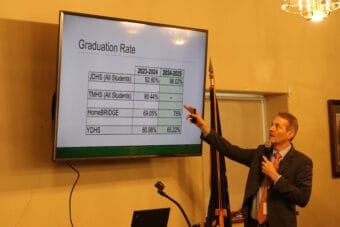
Friday is the last day of school at the Juneau School District, and high school seniors graduate on Sunday.

It will be the first graduating class since the district consolidated Juneau-Douglas High School: Yadaa.at Kalé and Thunder Mountain High School.

Two hundred eighty seniors are expected to walk at the 4 p.m. ceremony, which will be held at the high school auditorium.

Yaaḵoosgé Daakahídi High School will hold its graduation for 38 seniors that same day at the Dzantik’i Heeni gymnasium at 1 p.m.

A district spokesperson said the district is working on a streaming option for Juneau-Douglas High School’s ceremony, which will be posted on its website.

Overcrowding and safety concerns prompt Juneau School District to restructure special education program

A wooden table with a red plastic bowl and blue clipboard next to a small yellow chair.
One of the Developmental Education Communication Classrooms at Kax̲dig̲oowu Héen Elementary School in Juneau on May 15, 2025. (Photo by Jamie Diep/KTOO)

Listen here: 

The Juneau School District is restructuring one of its specialized education programs. While staff and administrators say the change is desperately needed, some parents are concerned about how it will affect some of the district’s most vulnerable students. 

District staff reviewed the changes during a board meeting last Thursday at Thunder Mountain Middle School. Teachers, paraeducators, principals and parents filled the lecture room. Heavy silences punctuated the special education staff’s descriptions of dire circumstances.

“When all you can do is do your absolute best to make sure nobody dies today, that’s a significant problem,” said Phil Buettel, a paraeducator for the Developmental Education Communication Classrooms, or DEC-C, at Kax̲dig̲oowu Héen Elementary School. 

The class is meant to support students as they develop communication skills. But Buettel said that’s not happening.

“We don’t have the bandwidth to accomplish our most basic objective, because we’re more concerned with making sure that kids aren’t killing each other or us,” he said.

The class has 19 students this year. If the program remains unchanged, that number would jump up to 26 students next fall.

Tim Owen is the head teacher for the class at Kax̲dig̲oowu Héen. He’s been there two years, which makes him the longest serving teacher for the program in recent years. But Owen is resigning at the end of the school year. At the meeting, he said 26 students is too many for one class.

“I know 26 doesn’t sound like a lot for a general education teacher, but with the kids that we have and the needs that they have, it is impossible,” Owen said.

The increased enrollment prompted the district to work with Owen and other employees to restructure the program.

The current specialized education program has four classes based at Harborview Elementary School, Mendenhall River Community School and Kax̲dig̲oowu Héen Elementary. Student Services Director Jason DeCamillis said the new program will focus on training to help staff better meet students’ needs.

“We’re not training folks in this really broad, really shallow way,” he said. “We’re going deep and we’re going very narrow to ensure that students are getting the exact right people who have the exact right training.”

In the restructure, each class will focus on one specific skill set, like communication, social emotional skills or navigating different environments. Classes will be placed at a specific school. The proposed class sizes will be smaller, too. The district plans to have no more than 11 students in a given class.

But DeCamillis said there are some downsides to the restructuring. Up to 22 students would have to move schools to go to their new program if families want to participate in it.

“Students will have to move from one school to another, and so understanding what individual student needs and family needs are related to that transition is going to be a huge key to the work that a lot of the folks on this team are gonna have to focus in on,” he said.

The district’s plan includes working with families over the summer to develop ways to make the transition go smoothly for students.

Alyssa Cadiente-Laiti-Blattner has a son in the class at Kax̲dig̲oowu Héen. She said parents weren’t involved in initial discussions when the district first announced the program.

“We are our children’s best advocates. We are there with them every day,” she said. “We live this life with them, and so I wish there had been more parent involvement.”

After learning more about the program, Cadiente-Laiti-Blattner said she is hopeful about the smaller class sizes. But she’s still concerned about the district’s ability to carry it out.

“I know that they do have the best intentions for our children, but it still brings concerns, and this hasn’t changed for me, that they have the plan, but they don’t have the staff, they don’t have the paras, they don’t have the logistics,” she said.

The district is hiring two special education teachers for the current programs, according to job listings on the district’s website. DeCamillis said in an email the district is finalizing where to assign existing staff. 

Owen, who is leaving at the end of the school year, said teachers are reaching out to each student’s family to help ease their transitions.

He said in an interview with KTOO that, in the end, the new program will be good for students.

“For the first time in a long time, I’m actually really excited to share this with families, and I feel like they have reason for hope more than they ever have,” Owen said.

The restructuring, which doesn’t need board approval, is set to move forward. The district will continue working with families through the summer to help students with the transition if they decide to opt in to the program. The district expects it to begin in the fall.

Middle school teacher in Juneau’s Mendenhall Valley brings glacial outburst science into the classroom

Thunder Mountain Middle School students hold up their glacial outburst flood projects beside their teacher, Jess Stanley. (Alix Soliman/KTOO)

Listen to this story:

Thunder Mountain Middle School sits beside Mendenhall River, which has surged over its banks and devastated homes in the Valley twice over the past two years. Floodwaters came close to inundating the school last year.  

Eighth grader Vivian Esmiol just learned why.

“The root problem is, well, it’s the Suicide Basin, which is between the Mendenhall Glacier,” she said. “It’s like a little area where water can build up, and the reason why it formed in the first place is because global warming, as we all know, has been melting down the glaciers.”

She described how rain and glacial meltwater collect in the basin over the spring and summer, causing pressure to build up against the ice. 

“Then, at once, it can burst through, like, an entire large amount of water,” Esmiol said. “That’s how these floodings are happening and why they’re happening yearly.”

The Mendenhall Glacier dams water in Suicide Basin. As the glacier calves, it could be creating more storage space for water. That could cause bigger glacial outburst floods in the future. (Photo by Anna Canny/KTOO)

She learned all of this in Jess Stanley’s Earth science class. Most students said they didn’t know what a glacial outburst flood was before taking the class.

“I came in absolutely clueless,” Esmiol said. “I’m surprised I didn’t even know about this stuff in the first place.”

Now, the students know all about the science behind how it happens, and what’s being done to protect their school and neighborhoods. They mapped the river, plotted rainfall and snowpack and learned about how the melting Mendenhall Glacier affects downstream communities. Local scientists even visited their class and walked them down to the river.

Stanley said this was her first year teaching Earth science at Thunder Mountain Middle School. Her goal was to engage the students on a topic that was close to home. 

“I just wanted to have an opportunity for the kids to learn something place-based, something that’s here — literally in the backyard of our school,” she said.

That approach to teaching about the climate clearly made an impression on the students. Allie Simonson is a seventh grader in the class. 

“I think it’s really cool we get to learn about something that’s happening right now. Because in school, usually you learn about stuff that’s gonna happen in the future or happened in the past,” Simonson said.

Now, when the students gaze out the big picture window in the common area at the end of the hall, they see bulldozers and a huge pile of sand by the river. The city is extending the levee further downstream to protect their school alongside several businesses and homes from possible floods that could be higher than those in the past.

Aiden Key stands in his backyard along the Mendenhall River. Juneau’s record breaking glacial outburst flood on August 5th, 2023 swept away most of his land. He worries that the eroded bank will make his home more vulnerable to future floods. (Photo by Anna Canny/KTOO)

Stanley said a row of trees is getting chopped down near the track and a gravel road has gone in for heavy machines to build the HESCO barriers that make up the levee. 

Ryder McMillan, an eighth grader, said the class learned about that project, too. 

“We talked a lot about HESCO barriers and how they’re being built,” he said. “The most interesting fact that I learned was that they’re really expensive to build, and you wouldn’t assume that because … you think they’re just like, little green blocks with a bunch of sand in them.”

In their notebooks, the students sketched HESCO barriers, including the small outflow pipes to drain rainwater. They also wrote their lingering questions about glacial outburst flooding — some that adults don’t have answers to yet. 

“Nobody really knows what we’re going to do to permanently fix the solution with the Suicide Basin flooding yet,” Esmiol said. “Of course, we have those HESCO barriers up. But besides that, people are still working on it. People are still making ideas, and that’s going to take a while.”

HESCO flood barriers line the Mendenhall River on Wednesday, April 2, 2025. (Photo by Clarise Larson/KTOO)

In the meantime, Esmiol said people should try to plan for flooding. For the last two years, the major outburst flood has occurred during the first week of August.

The students are taking what they’ve learned beyond the classroom. They’re making posters about how Valley residents can prepare for floods, featuring QR codes that link to more information. They plan to tack them up around town this summer. The kids say to pack an emergency kit, sign up for the city’s emergency alerts, and when the floodwater comes, don’t swim in it.

A rejected calculation change could cost Alaska $80 million in education funding

A child in a black jacket and gray hat holds an adult's hand while exiting a yellow school bus.
Children exit a school bus outside the Alaska Capitol on Feb. 14, 2025. (Photo by Jamie Diep/KTOO)

The Alaska Department of Education and Early Development, or DEED, failed a federal test that saves the state millions of dollars. It is not yet clear why the state failed, but the state will now be on the hook for more than $80 million if it can’t appeal the decision.

Alaska school districts receive money from the federal government called federal impact aid. That’s money that makes up for lost revenue from land that can’t be taxed, like federal, military or Alaska Native-owned land.

If the state passes a test to show that it’s funding education equitably, called a disparity test, it can put a lot of that impact aid toward its own contribution to school districts. But a letter sent by the federal Department of Education last week says the state failed the disparity test this year.

Alexei Painter is the director of the state’s Legislative Finance Division. He said Alaska is the only state that still uses the disparity test, and it’s getting harder to pass.

“The increasing difficulties with passing the test is a lot, because education funding has gotten more complicated over the last five or 10 years,” he said.

Painter says the federal government doesn’t require DEED to take the test, but state law does. School districts that qualify for the federal money will get it regardless of the results. DEED estimates Alaska districts will receive more than $110 million in impact aid for the next fiscal year.

But the test allows the state to put federal money toward it’s own contribution to education funding – basically saving the state millions of dollars each year.

Failing the test forces the state to pay those funds itself in its obligation to schools. But there are other calculations the state’s education department can make to pass the test after requesting a hearing. If it continues to fail the test, the state could owe districts more than $80.8 million this year.

Painter said the way the budget is structured means that the money would automatically be appropriated for schools, but he says there isn’t enough money budgeted for that.

This isn’t new for DEED. The state also initially failed the test in fiscal year 2022. But it’s allowed to request a hearing with the federal government to figure out a way to pass the test. Painter said the state was able to change how it accounts for transportation funding to pass the test last time.

“I would expect them to do something similar where they hold a hearing and then ultimately resubmit a test,” he said. “Hopefully they can find a way to reconfigure and pass.”

Last Friday, DEED Commissioner Deena Bishop said the state is considering its options moving forward. DEED officials didn’t respond to questions about its plans to address the failed test.

The test is really complicated. But basically, the state passes if the funding gap between school districts is less than 25% – after getting rid of the top and bottom 5% of funded districts.

The test also doesn’t include all of the state’s education funding in its calculations.

State education funding can largely be split up into two pools. The first is foundational funding – that’s money that goes to school districts’ operating funds, paying for things like teacher salaries, curriculum and anything else needed to run schools. 

The second pool is state transportation money – that’s money that goes to school districts to provide transportation for students.

In the disparity test, DEED can exclude state student transportation funds. That’s because it qualifies for adjustments that account for significant differences in spending across the state for transportation.

But that’s not the only money many school districts spend on transportation. Some districts, like the Kenai Peninsula Borough School District, use operating funds for transportation as well. Painter said DEED changed its calculations this year and tried to take those extra transportation funds out of the test calculations. 

“Under the way that they had submitted the test in prior years, they would have failed,” Painter said. “So it was an attempt to try to pass by submitting the numbers differently, and so the federal government rejected that attempt.”

DEED has 60 days from the day the letter was sent to appeal the decision and make different calculations for the test.

Clarification: This article has been updated to clarify that while the federal government doesn’t require the state to take the disparity test, state law currently does. It was also updated to reflect that DEED officials gave a statement last week.

Alaska legislators override Dunleavy’s veto of education bill

a meeting room
Alaska legislators vote to override Gov. Mike Dunleavy’s veto of a bipartisan education funding bill. (Eric Stone/Alaska Public Media)

Alaska lawmakers on Tuesday voted to override Gov. Mike Dunleavy’s veto of a high-profile education bill that will increase long-term funding for public schools. A joint session of the Alaska Legislature voted 46-14 in support of House Bill 57 a day after Dunleavy announced he had vetoed the bill, lawmakers’ top priority for this session.

It’s the third time in two years that lawmakers have passed a bill increasing the base student allocation, but until Tuesday, they failed to overcome vetoes from Dunleavy.

The bill increases basic per-student state funding for public schools, the so-called base student allocation, by $700. It’s a key part of the formula that determines state funding for school districts, and increasing the figure was a key issue in lawmakers’ election campaigns last fall.

It’s the first substantial increase to the education funding formula since 2017, aside from a 0.5% increase that came alongside the Alaska Reads Act in 2021.

The bill also includes a number of education policy reforms, including limits on student cellphone use, changes to state laws surrounding charter schools and a grant program that would offer performance incentives to school districts based on student reading proficiency. The bill also creates a task force to study additional reforms, including an open enrollment system that would allow students to attend schools outside of their home districts.

Whether the funding ultimately flows to school districts, though, is uncertain. Alaska’s Constitution gives the governor the power to unilaterally reduce or eliminate line items from the budget. Dunleavy said Monday he’s considering whether to veto a portion of school funding from the budget but has not made a final decision.

This is a developing story. Check back for updates.

ANSEP cancels summer acceleration academy after loss of federal grant

ANSEP's building on the University of Alaska Anchorage campus.
ANSEP’s building on the University of Alaska Anchorage campus. (Wesley Early/Alaska Public Media)

The loss of a federal grant has forced the University of Alaska’s ANSEP program to cancel its long-running summer academy, less than two weeks before rural students were scheduled to arrive.

ANSEP, the Alaska Native Science and Engineering Program, operates the yearly Summer Acceleration Academy, allowing high school students in rural communities to come to Anchorage for a five-week program in various STEM courses.

Michele Yatchmeneff, chief operating officer for ANSEP, said many of these students don’t get a chance to take similar courses in their local schools.

“So what we do is offer the course here at the university, so that they can get dual credit,” Yatchmeneff said. “So they can get credit for graduation from high school and then also graduation towards a degree.”

Yatchmeneff said ANSEP officials were informed last week that the federal government had terminated their $2.5 million grant from the National Science Foundation, forcing the last-minute cancellation of the Summer Acceleration Academy. The program was set to begin May 24 and serve 47 students.

“The National Science Foundation right now has been told that they’re getting a 50% cut,” Yatchmeneff said. “They’re mainly supporting a lot of research; I also have had research projects with them. So nationally, this has become an issue, and ANSEP is part of that.”

Yatchmeneff said she’s hopeful the program will return next year, and she doesn’t anticipate any further cuts.

“Right now, we still have federal funding coming in from example, like the National Park Service and a few others, and we don’t foresee any more cuts,” Yatchmeneff said.

Other summer ANSEP programs, including the Summer Bridge internship program and middle school academies, were not impacted by the funding cut.

This is not the only recent impact to the ANSEP program from changes at the federal level. The program recently removed the term “Alaska Native” from many parts of its website, citing compliance with federal guidelines on DEI-related language related to race. The change sparked widespread pushback. In the United States, Native American and Alaska Native tribal members are legally considered a political class, as opposed to just a racial group.

Correction: This story has been corrected to reflect that ANSEP is still referred to as the Alaska Native Science and Engineering Program, despite the removal of “Alaska Native” from different parts of its website.

Site notifications
Update notification options
Subscribe to notifications