University of Alaska

University offers 400 acres on Chilkat Peninsula for timber sale

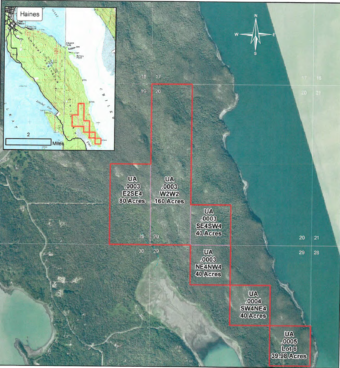
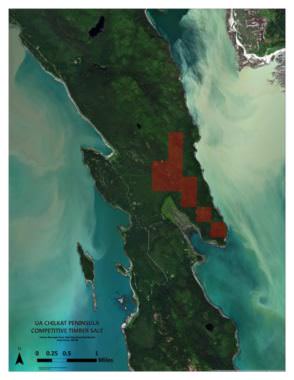
The University of Alaska’s timber sale area on the Chilkat Peninsula. (Map courtesy University of Alaska)

The University of Alaska is offering up 400 acres of its Haines-area land for timber harvest.

The timing of the university’s decision was motivated by a conversation happening at the local level.

The Haines Planning Commission is considering whether to restrict resource extraction in the Mud Bay area.

At a Sept. 14 University Board of Regents meetings, Land Management director Christine Klein said the university’s ability to monetize its Chilkat Peninsula land was under threat.

“The reason we’re bringing this to you now is that there have been increasing efforts to put restrictions on the property and the area in Haines that this land is located at,” Klein said.

The conversation Klein is referring to started back in May, when the Haines Planning Commission noticed an apparent oversight in the code governing the Mud Bay Rural Residential Zone. There is nothing there to restrict resource extraction in the generally quiet residential neighborhoods.

Since then, the commission has brainstormed what kind of rules to put in place for that area. The university and the Alaska Mental Health Trust, both major landowners on the peninsula, spoke out in opposition to any limitations.

University President James Johnson wrote in a letter to Haines officials that revenue from land holdings is critical to UA’s trust programs, which fund student scholarships. University funding has plummeted by $61 million since 2014 in the wake of the state fiscal crisis.

At a meeting in June, planning commission chair Rob Goldberg said there was no rush to answer the Mud Bay resource extraction question.

“We’ve had this code in place for about 25 years and there hasn’t been any major resource extraction during that time,” Goldberg said. “And I haven’t seen a big rush for people to do it.”

Now there does seem to be a rush.

“If we don’t move forward with this, we may be in the situation of losing the ability to harvest the timber,” Klein said at the Sept. 14 regents meeting. “And in doing so, we would also lose our ability to check and verify if there is any mineral potential.”

Haines Forester Greg Palmieri says this is the largest potential timber sale on the Chilkat Peninsula in decades.

“I’m not aware of any timber sales on the peninsula in the last 10 to 20 years that weren’t on private property or very small,” Palmieri said. “This doesn’t compare to anything in the last 10 to 20 years.”

The 400 acres make up a significant swath of the peninsula south of the Haines’ townsite. Dozens of residential properties neighbor the sale area, including Eric Holle’s home.

“It’s not something I’m gonna lose sleep over at the moment,” Holle said.

Holle has lived across Mud Bay for 29 years. He’s also the president of a local conservation group. But he’s not too worried about the timber sale because he doesn’t think the university will be able to make money from it.

“Once they go through and do a timber cruise on this, I think they will be quite surprised on the lack of valuable timber in this area,” Holle said.

Planning commission chair Goldberg lives out Mud Bay, and he also questions the profitability of the timber harvest. He says creating residential subdivisions would be a much more valuable use of the land.

As for how this development will factor into the commission’s conversation around Mud Bay resource extraction, Goldberg says he’s not sure.

“If we were playing a game, it would be like the university has just wiped all the pieces off the board and said ‘game over,’” Goldberg said.

The university will find out if there are interested buyers for this timber sale by the bid deadline on Oct. 23. That’s also the deadline for comments on the plan, which can be sent to ua-land@alaska.edu.

University of Alaska students may see 10 percent tuition hike over next two years

UA President Jim Johnsen (Photo by Adelyn Baxter/KTOO)
UA President Jim Johnsen. (Photo by Adelyn Baxter/KTOO)

University of Alaska officials are considering a 5 percent tuition increase in each of the next two academic years.

UA has seen its tuition steadily increase over the last several years, including a 5 percent increase last year.

Colby Freel chairs the Coalition of Student Leaders. He said increases like this have become an expectation for UA students, but that they understand the strain the state and university are under.

“We want our education here in Alaska, we want to receive the quality learning that we get, so we’re willing to pay for it,” Freel said. 

The university has seen state funding decline by $61 million since 2014 and enrollment drop by 14 percent since 2011. Among the austerity measures, the university has cut about 50 academic programs and reduced faculty and staff by more than 900 positions.

The University of Alaska Board of Regents discussed the tuition increase during its meeting that wrapped Friday in Juneau. The board’s final vote on tuition is expected at its November meeting.

The board also discussed Strategic Pathways, the massive plan to restructure and save money amid ongoing budget uncertainty in Alaska.

UA President Jim Johnsen has spent the better part of the last year meeting with staff, faculty, students and community members to figure out what needs to happen to cut costs while maintaining quality.

“How do we serve the state effectively as our budgets are being cut by the state?” Johnsen said at the meeting. “How do we step up in workforce development, how do we step up in research and economic development and diversification and building a culture of education in Alaska? How do we achieve those goals in this very challenging context?”   

The final recommendations on Strategic Pathways will be presented to the board for a vote in November.

Regents also approved a $50,000 compensation bonus for Johnsen on top of his $325,000 base salary after evaluating his performance and approving his employment contract. Johnsen said the bonus will be donated back to the university through student development and cultural initiatives.

Arctic climate change researchers still conflicted over UAF’s coal-fired powerplant

Work on University of Alaska Fairbanks' new 17-megawatt combined heat and power plant is about half done. University officials say it’s scheduled to go online in December 2018. (Photo by Tim Ellis/KUAC)
Work on University of Alaska Fairbanks’ new 17-megawatt combined heat and power plant is about half done. University officials say it’s scheduled to go online in December 2018. (Photo by Tim Ellis/KUAC)

The University of Alaska Fairbanks is building a heat and power plant to replace the old facility that went into service in 1964.

The new $245 million powerplant, scheduled to come online next year, will feature updated technology that’ll reduce most pollutants – but it will continue to emit greenhouse gases blamed for warming the planet.

Many on campus say that conflicts with UAF’s leadership in Arctic climate-change research.

The work on university’s 17-megawatt combined heat and power plant is about halfway done.

when the state-of-the-art facility goes online around December of next year, Senior Project Manager Mike Ruckhaus said it’ll be among the most environmentally friendly coal-fired power plants in the country.

“From an environmental standpoint, this meets all the current regulations and criteria,” Ruckhaus said during a tour last week around the construction site.

That includes regulations related to the tiny particles called PM 2.5, produced by combustion, which can foul Fairbanks’s air during winter inversions.

“It’s about as clean as you can get on PM 2.5,” Ruckhaus said.

But the plant will emit nearly 132,000 tons of carbon dioxide equivalent annually, about 3 percent less than the old facility, but still roughly the amount of CO2 generated by 26,000 cars annually.

Coal-fired power plants are the main source of atmospheric CO2.

The new power plant still bothers some university researchers who study climate change and its impact on the Arctic even though it’s a done deal and construction is well under way.

“From a scientific perspective, I understand the consequences of burning fossil fuels – and particularly for people who live in the Arctic and the subarctic,” said Scott Rupp, a professor of forestry and deputy director of UAF’s International Arctic Research Center.

He said when UAF officials were debating a decade ago over what kind of power plant to build to replace the old one, he and others favored renewable-energy options like hydro and solar.

“It’s disappointing,” Rupp said in a recent interview. “My personal preference would be to have been able to continue to be a showcase of not only great science on climate change but be able to put some of our innovation into how we power the Arctic university that we are.”

Rupp and others acknowledge that locally mined coal, from the Usibelli operation in Healy, was the only practical option for fueling power plants in Fairbanks.

“We still don’t have natural gas in town, so obviously you can’t rely on that,” University Regent John Davies said.

Davies favored that type of fuel for the new power plant.

And because the need to replace the old facility was urgent, Davies added, “you have to at some point have a plan and move forward on it.”

Davies said UAF’s old plant was well past its design life and that university officials had to make a decision.

“We had replace the power plant because it was 50 years old and it was failing,” Davies said. “It could’ve been a major catastrophe if that plant had gone down in the middle of winter.”

Davies is a longtime advocate for clean air and energy efficiency, and he said he still feels conflicted over the university’s decision to build another coal-fired power plant.

“There certainly remains the irony that this is the only coal-fired power plant in the nation that’s being built – and we’re also the leading group on understanding climate change and the need to reduce the emissions of fossil fuels to reduce the amount of greenhouse warming,” Davies said.

Davies referred to reports from two media outlets, ClimateWire and Alaska Dispatch News, that pointed out the UAF power plant is the only one under construction in the United States.

Davies said he hopes university officials will be able to choose natural gas, or renewable energy, when UAF replaces the power plant again a half-century from now.

UA president calls for action on DACA ahead of regents meeting in Juneau

Jim Johnsen, UA President candidate
Jim Johnsen attends a meet and greet in Juneau on July 7, 2015. He was a candidate for University of Alaska president at the time. (Photo by Jeremy Hsieh/KTOO)

Earlier this week, University of Alaska President Jim Johnsen wrote Alaska’s congressional delegation urging it to quickly resolve the Trump administration’s directive to end the Deferred Action for Childhood Arrivals program, or DACA.

The Obama-era immigration policy protected certain undocumented immigrants brought to the United States as children. Alaska has 138 DACA recipients, according to the Center for American Progress.

Johnsen said in his letter that failing to resolve the issue through congressional action could prevent students from fulfilling their academic and professional goals and would ultimately hurt the state’s economy.

The letter comes as the University of Alaska Board of Regents is meeting this Thursday and Friday at the University of Alaska Southeast campus in Juneau. It’s unclear if it plans to address the DACA issue.

The regents will discuss a plan to create a College of Education at the Juneau campus, a proposal meant to respond to Alaska’s teacher shortage by filling those vacancies with UA graduates.

Regents will also hear updates on Strategic Pathways, a plan to cut costs throughout the university system by consolidating academic programs, and campus efforts to improve the handling of sexual discrimination and assault cases in light of a Title IX investigation by the Department of Education.

The regents livestream their meetings at alaska.edu.

Most University of Alaska campuses see lower enrollment

Fall enrollment is down at most University of Alaska campuses. Early numbers show the university headcount off 4.5 percent, or over 1,000 students, from last fall.

The highest declines are at Southeast and Fairbanks campuses.

UAF’s Institutional Research Director Ian Olson said enrollment is dropping at the Fairbanks campus as student retention and graduation rates rise.

”We’re graduating fairly large classes and we’re getting fewer incoming students, so our replacement rate is down,” Olson said. “Our first-time freshmen enrollment numbers are down.”

Olson said it’s natural for enrollment to level back coming off a recessionary bump, but the university system is seeing the decline continue and even increase.

”To some degree we have to recognize that it is linked to uncertainty related to Alaska’s economy and really the budget circles coming out of Juneau and the Legislature,” Olson said. “That uncertainty, we think, is causing some student to consider enrollment elsewhere.”

Olson said the decline runs counter to assessments that continue to show the University of Alaska to be a good value compared with Lower 48 institutions.

“We frequently get lifted on best value in the West type of rankings from various ranking agencies that are out there,” Olson said. “UAF and UAA in general are recognized a great deal for those seeking higher education.”

Olson said there are some bright spots in University of Alaska enrollment including an increase in the number of UAF community and technical college students this fall, something he said may correspond with a slight uptick in local unemployment.

The melancholy Juneau summer of blue ice

Part of the mass balance group skiing to their pit located behind Emperor Peak. (Photo by Julian Cross, courtesy JIRP)
Part of the mass balance group skiing to their pit located behind Emperor Peak. (Photo by Julian Cross, courtesy Juneau Icefield Research Program)

For many first-time visitors, the Juneau Icefield is a surreal and sublime experience.

“I’m completely in love with it. I cried when we hiked off the glacier the last day,” laughed Hannah Perrine Mode, who’s originally from Boston and who has never been to Alaska before this summer.

Listen to the story about the art and science of JIRP 2017:


Mode served as the first-ever, artist-in-residence for the Juneau Icefield Research Program, or JIRP, a summer research and training program focusing on the ice and snow, ecology and weather and climate of the icefield above downtown Juneau.

The program started in 1946 under the direction of Maynard Miller as the Juneau Icefield Research Project.

During the eight weeks she was on the icefield, Mode painted in watercolors and made cyanotype photographs.

Using her medium format camera, she made long 12-hour exposures on paper painted with light-sensitive chemicals that are used for creating blueprints.

She would fix or set the images using meltwater from the glaciers.

“The blue ice to me is like incredibly magical and beautiful, and it’s also a little bit melancholic in thinking about loss in that way,” Mode said.

Mode, who is currently studying for an masters of fine arts at Mills College in Oakland, California, spearheaded the artist-in-residence program this year. In addition to making art, she served as mentor and held workshops for students and faculty. She also attended lectures and went along on the expeditions helping students with their scientific research.

“Part of why I wanted to do JIRP and to have this experience is because I was really excited to learn about the science,” Mode said.

“It was really this wonderful exchange in which I was able to learn so much about this realm in that I don’t have experience in,” Mode said.

“I think I was able to contribute and bring some students into a different way of a thinking about science communication, teach some workshops and do a lecture have a mentoring role in a different way,” Mode said. “But still learning a lot in the way the students were learning.”

Ann Hill (left, at end of table) is wearing a yellow backpack-mounted radio antenna that was used in taking measurements of glaciers. Hill was part of the Juneau Icefield Research Program's geomatics team that surveyed ice elevation and flow during the summer of 2017, and she helped explain their research during a recent open house at the Mendenhall Glacier Visitor Center.
Ann Hill (left, at end of table) is wearing a yellow backpack-mounted radio antenna that was used in taking measurements of glaciers. Hill was part of the Juneau Icefield Research Program’s geomatics team that surveyed ice elevation and flow during the summer of 2017, and she helped explain their research during a recent open house at the Mendenhall Glacier Visitor Center. (Photo by Matt Miller/KTOO)

Over 30 undergraduate and graduate students from as far away as Germany and Singapore participated in the icefield research program this year.

Skidmore College senior Ann Hill, from Minneapolis, is studying geosciences. She was part of the team that used precise GPS equipment to measure changes in a glacier’s flow and elevation to an inch or less.

“A lot of the glaciers are dropping in elevation,” Hill said. “They’re losing a lot of mass and, ultimately, the surface is a lot lower than it used to be. You can see this even just by walking out on the glaciers because a lot more of the rock is exposed than it used to be.”

Taku Glacier was unique among other glaciers on the icefield because it was not losing mass or retreating. The Taku had been advancing over the last few decades, but Hill said their latest measurements indicate it may now be in a stagnant phase.

“That leads us to think that, potentially in the future, it could start to retreat. Hopefully, with our measures we’ll be able to determine where in the Taku cycle it currently is. Is it currently still advancing a little bit? Is it perfectly stagnant? Or, can we already see signs of retreat?”

The Taku is the icefield’s largest glacier and features a tidewater terminus.

Students Zach Gianotti, Theresa Westhaver, and Ilana Casarez crossing the blue ice at the terminus of the Lemon Creek Glacier before a hike up Nugget Ridge. (Photo by Bryn Huxley-Reicher, courtesy JIRP)
Students Zach Gianotti, Theresa Westhaver and Ilana Casarez crossing the blue ice at the terminus of the Lemon Creek Glacier before a hike up Nugget Ridge. (Photo by Bryn Huxley-Reicher, courtesy Juneau Icefield Research Program)

“It’s a really great experience,” said Tristan Walker-Andrews, a senior at Juneau-Douglas High School. He was part of the ecology team that surveyed the diversity and abundance of lichen and plants at different elevations and locations on the icefield.

Walker-Andrews was one of three Juneau residents who participated this summer. It’s fairly rare for an Alaskan to sign up for the program, much less for a Juneau student.

Tristan Walker-Andrews' notebook shows the type and amount of vegetation found during an ecology survey of the Juneau Icefield during the summer of 2017.
Tristan Walker-Andrews’ notebook shows the type and amount of vegetation found during an ecology survey of the Juneau Icefield during summer 2017. (Photo by Matt Miller/KTOO)

“Any Juneau students from the university or even either of the high schools who are interested in getting out in nature and exploring what is basically our backyard and getting an idea of what is going on up there that will be affecting a lot of people downstream in Juneau and other places in Alaska, I really encourage them to apply to the program and try to get involved in other ways,” Walker-Andrews said.

“It’s really a great program.”

Although he’s not sure yet which field, Walker-Andrews said he’s interested in pursuing a science career, likely something connected to nature or the natural world.

Students explained their research during an August 17 open house at the Mendenhall Glacier Visitor Center.

Site notifications
Update notification options
Subscribe to notifications