University of Alaska

Haines Assembly asks university to press pause on 400-acre timber sale

The Haines Assembly is asking the University of Alaska to press pause on a proposed timber sale which has alarmed local residents.

A couple weeks ago, the university put 400 acres of its Chilkat Peninsula land up for bid.

The timing of the sale was motivated by the threat of new local regulations.

At a recent special meeting, Assembly chambers were filled with residents who live out Mud Bay Road, south of Haines.

They were surprised that a timber sale of this this size could be allowed in their quiet neighborhood.

The proposed timber sale area on a map created by Haines Planner Holly Smith. (Image courtesy Haines Borough)

“It seems unbelievably clear that the intention and all the ordinance and code around it is not to have this kind of resource extraction or commercial use of the land in this area,” Heidi Robichaud said.

But that’s the problem that triggered this 400-acre proposal.

Mud Bay zoning code does not explicitly allow or restrict resource extraction.

Borough attorneys say the general rule in regulating private property is that unless something is explicitly prohibited, it’s allowed.

Since discovering this apparent oversight a few months ago, the planning commission has brainstormed what restrictions, if any, to implement in Mud Bay code.

“The public testimony by and large thought that small-scale resource extraction was fine, people selling a few trees or a few truckloads of trees to support local businesses was fine,” said planning commission chair Rob Goldberg. “People were generally opposed to large-scale resource extraction.”

But as the commission moved toward regulations on resource extraction, the Alaska Mental Health Trust and University of Alaska objected.

Both agencies own significant acreage in the Mud Bay area. And the university’s board of regents took action. The group put 400 acres of land up for timber sale.

The university uses money from sales like this to fund student scholarships.

A couple Haines residents, including Andrew Gray, spoke in support of the university’s right to profit off its land.

“If you do attempt to restrict this, I want to remind you that it would be incredibly clear message to send to the state of Alaska when we are fighting for services, to deny one of the state agencies who is attempting to profit off an allowed use of their land,” Gray said. “I don’t think that bodes well in terms of us fighting for state services.”

But Assembly members agreed with the concerns of Mud Bay residents – the timber harvest seems out of character with that area.

Assemblywoman Heather Lende is one of several people who questioned whether the borough really needs explicit restrictions on resource extraction to prevent this type of sale.

She pointed to other parts of code which indicate the Mud Bay service area is intended to prioritize residential over commercial uses.

“An outside entity proposing a 400-acre timber sale, I don’t know how that fits in with the intent of rural residential,” Lende said.

The Assembly wants to have a conversation with the university about all of this.

The group voted unanimously to request an in-person meeting with both the university and the mental health trust. The Assembly also is asking the university to delay awarding a contract for the timber harvest until after this discussion occurs.

The timeline right now is tight. The university is accepting comments and bids on the sale until Oct. 23.

Assembly member Tom Morphet said there might be room for negotiation.

He quoted from a letter written by university land manager Christine Klein.

“‘UA advertised its Chilkat Peninsula Competitive Timber Sale to protect out interests because the Haines Borough Planning Commission was not engaging us,’” Morphet read. “To me that suggests that the university is maybe not a in a big rush to log out there, but put forward this sale to a certain extent to get our attention.”

If the university doesn’t postpone the timber sale, the Assembly may consider legal action.

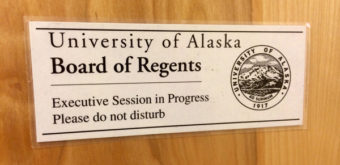
The group met in executive session with the borough attorney for more than an hour to discuss the issue.

Members did not say anything publicly about what they discussed with the lawyer.

UAS campuses celebrate Indigenous Peoples’ Day

Indigenous People’s Day is Monday, and the University of Alaska Southeast will mark the occasion with academic discussions and deer stew.

In June, Gov. Bill Walker signed legislation officially recognizing the second Monday in October as Indigenous Peoples’ Day in Alaska. Alaska is the second state to replace Columbus Day by refocusing the day on Native culture.

Kolene James is the coordinator for the UAS Native and Rural Student Center.

“We have faculty and staff at all three campuses putting together the programs, ” James said earlier this week on A Juneau Afternoon. “We are working with our local tribes, so come and join us for some good conversations about decolonization and the importance of Indigenous Peoples’ Day.”

Ernestine Hayes and Lance Twitchell.
Alaska State Writer Laureate Ernestine Hayes and UAS Professor Lance Twitchell are among the Indigenous Peoples’ Day speakers in Juneau. (Photo courtesy Juneau Public Library)

Events in Juneau will culminate in a panel discussion and a traditional foods demonstration at Elizabeth Peratrovich Hall, followed by a performance by local dance group Woosh.ji.een.

UAS and the Central Council of the Tlingit and Haida Indian Tribes of Alaska will also stream events on Facebook Live.

A full list of Indigenous Peoples’ Day events is available at http://www.uas.alaska.edu/indigenous-day/.

New research at LeConte Glacier predicts record retreat

Glaciologists have wrapped up two years of research on LeConte glacier near Petersburg.

Their preliminary findings show that the glacier could reach a record retreat by the end of the year. And it could be an indicator for what’s going to happen in Greenland.

Glaciers are like frozen rivers of ice, constantly moving. LeConte Glacier feeds into the ocean near Petersburg at a rate of 90 feet a day.

LeConte is the southern-most tidewater glacier in the Northern Hemisphere. Its accessibility makes it a draw for nearby scientists. But that’s not the only reason they’re interested.

The glacier also is a lot like hundreds of others that cover Greenland.

Glaciologist Christian Kienholz and colleagues used equipment to collect data on LeConte Glacier seven times over the last two years. (Photo courtesy of Christian Kienholz, University of Alaska Southeast)

And Greenland has the attention of climate specialists all over the world. When it melts, which they say is inevitable, sea levels could rise quickly.

Christian Kienholz, who is originally from Switzerland, is a glaciologist at the University of Alaska Southeast.

He’s been studying LeConte for the past two years to find models to predict glacial melt in Greenland.

“If we want to better understand than we need to look at an example like LeConte, which is much better accessible than the glaciers in Greenland,” Kienholz said. “LeConte has other advantages because it’s a fairly narrow fjord, which allows us to do the measurements from the boat like transects fairly efficiently.”

Kienholz and a colleague have visited LeConte seven times staying at a base camp about 1,200 feet above the glacier overlooking the end or terminus.

The research required lots of equipment.

They had six time-lapse cameras set up around the fjord taking snapshots every fifteen seconds.

A radar measured the glacier’s speed and elevation every three minutes.

A sonar measured the depth of the fjord.

Seismometers helped detect calving events and runoff. And they tracked the weather–the temperature and precipitation.

Some of the research continued year-round like the time-lapse cameras. Kienholz collected over a half-million images through them.

The winter snow would come and go but the cameras kept rolling.

“That’s something that recently became possible,” Kienholz said. “We have now cards, memory chips that are large enough to actually store that number of pictures. Ten years ago that was not possible.”

Time-lapse cameras caught this mountain goat gazing at the LeConte Glacier terminus. (Photo courtesy of Christian Kienholz, University of Alaska Southeast)

Newer computers are helping translate the still images into surface speeds of the water.

Scientists like Kienholz call LeConte and other tidewater glaciers non-linear systems.

The glaciers are traveling on top of water and become stable when they get to shallower spots known as sills.

So, the terminus usually stays near a shallow spot for a long period of time where there is less calving.

But when the glacier retreats beyond that point onto deeper water, there’s more calving and the terminus jumps back.

“That’s what we have seen with Leconte Glacier,” Kienholz said. “Typically it’s stable for a couple of years, a certain spot, typically on sill, and then it’s retreating pretty fast for a certain period of time and then stable again and then retreating.”

Students at Petersburg High School have recorded the terminus every year for decades and that’s initially what caught scientists attention.

The new and old information has Kienholz believing that the glacier might reach a record retreat this year.

“We know from maps where the glacier was in 1950, for example, and we know from the high school record every year where the glacier terminus was, and at the end of this year, very likely the glacier will be as far back as never before,” Kienholz said.

Christian Kienholz, Glaciologist with the University of Alaska Southeast gathered data at the Leconte Glacier seven times over the last two years. (Photo courtesy of Christian Kienholz, University of Alaska Southeast)

Kienholz was interested in glaciers early in life growing up in Switzerland. He said he has seen major changes just in his lifetime.

“There are quite a few small glaciers. They were already small when I grew up and some of them have gone away,” Kienholz said. “That’s definitely what you’re going to see in the years to come. There are a lot of glaciers that are predicted to retreat almost completely.”

Kienholz hopes that his research can help predict just how fast those changes will happen and maybe help people plan for what they’re going to do about it.

The two-year research project did not only included collecting data from the top of LeConte.

An oceanography team from Oregon State University and University of Oregon has been studying the water near the glacier. The two teams are sharing data and plan to publish their results.

Kienholz hopes that the scientists can secure funding to collect more data from LeConte in the future.

UAS students discuss media literacy at News Engagement Day event

Students at UAS listen to discussion with WikiTribune editor Peter Bale via video conference in London as part of News Engagement Day on Oct. 3, 2017.
Students at UAS listen to discussion with WikiTribune editor Peter Bale via video conference in London as part of News Engagement Day on Oct. 3, 2017. (Photo by Adelyn Baxter/KTOO)

The University of Alaska Southeast participated Tuesday in News Engagement Day, part of a national effort to increase civic participation and media literacy.

Assistant Professor of Communications Rosemarie Alexander, a former KTOO journalist, said she sees as a concerning trend among young people when it comes to news.

“So few young people actually engage in news. And one of the reasons we decided to do it here at UAS is simply, as a former reporter — excuse me, as a reporter who is now teaching also — I can’t believe that students really are not civilly engaged, and so this was an opportunity to help them,” she said. 

Alexander invited former CNN producer Chuck Thompson, who’s originally from Juneau, to lead a discussion on the future of news media.

Thompson connected with Peter Bale, the launch editor of a new news project called WikiTribune led by the founder of Wikipedia. 

Bale spoke to the lecture hall full of students by video conference from London.

WikiTribune aims to fix problems like fake news and distrust of media by allowing users to fact-check news articles along with professional journalists. It is expected to launch later this year.

Students grilled him on the wisdom of allowing news articles to be annotated by members of the public and asked him how he would ensure objectivity in reporting.

Taylor Hrupek, an exchange student from the University of South Dakota studying communications, said it was exciting to hear about WikiTribune’s plan.

“This will probably end up being a pretty big deal on some worldwide spectrum, so it’s cool to see, like, we’re in the town of Juneau, Alaska, and we’re getting a front row seat to what’s going on in the world,” Hrupek said. 

Alexander said News Engagement Day is just the beginning of a larger effort to increase media literacy at UAS.

Special meeting on proposed Chilkat Peninsula timber sale

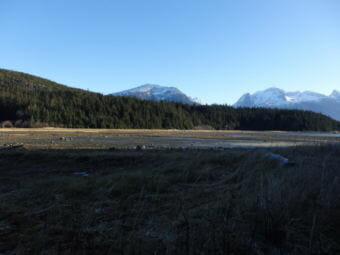
The University of Alaska’s timber sale area on the Chilkat Peninsula. (Photo courtesy University of Alaska)

The Haines Assembly is holding a special meeting this week to discuss what the borough manager has called a “politically motivated” proposed timber sale.

The University of Alaska is offering 400 acres of Haines-area land for timber harvest. The land is located on the Chilkat Peninsula and abuts many residential properties.

The university is advertising the sale at this time because of the threat of new local restrictions.

In the spring, the Haines Planning Commission realized the Mud Bay Rural Residential Zone does not explicitly allow or forbid resource extraction. The commission has been brainstorming potential restrictions over the last few months.

That worries university land managers, who want to capitalize on the property. Money from a timber sale would go to the university’s trust programs, which fund student scholarships.

At its last meeting, the Haines Assembly voted unanimously to explore potential land swaps in the Mud Bay area.

Member Heather Lende floated the idea of a temporary moratorium on resource extraction in Mud Bay, considering the planning commission’s work.

“Until we make a ruling on how resource extraction is gonna go on the peninsula, mainly in light of the Mud Bay land use area historic residential values and the situation out there,” Lende said.

Lende and fellow Assembly members Ron Jackson and Tresham Gregg requested a special meeting this week to talk about the proposed timber sale. The assembly members requested the planning commission and borough attorney participate.

The meeting is set for Thursday at 6 p.m. in Assembly chambers. Part of the discussion may be held in executive session.

Comments and bids on the Chilkat Peninsula timber sale are due by Oct. 23.

UAS, Coast Guard establish training and scholarship program for students

Coast Guard members recruit at the University of Alaska Southeast campus in Juneau on Oct. 2, 2017.
Coast Guard members recruit on the University of Alaska Southeast campus in Juneau on Monday. (Photo by Adelyn Baxter/KTOO)

By next fall, the first batch of University of Alaska Southeast undergraduates are expected to begin a first-of-its-kind scholarship program for Alaska.

Students that are accepted to the College Student Pre-Commissioning Initiative, or CSPI, become active-duty enlisted members of the Coast Guard, receive full salary and benefits and start a track to become fully commissioned officers upon graduation.

UAS and the Coast Guard on Monday signed an agreement, establishing the program. During the signing ceremony, Coast Guard Rear Adm. Michael McAllister said the partnership opens up an “exchange of knowledge” between the campus and the Coast Guard.

“It’s a great opportunity for the many, many Coast Guard men and women in Alaska, but particularly Southeast Alaska, to get engaged back in the classroom, whether they’re as students, as mentors, or even guest instructors from time to time,” McAllister said. “It’s an opportunity for students here at UAS to get out and learn about some of the things the Coast Guard does in terms of marine environmental protection, in terms of fisheries enforcement, in terms of search and rescue and give them experiential learning out in the field.”

Students must be full-time sophomores or juniors to apply. Much like ROTC, students accepted into the program are on track to become fully commissioned officers upon graduation. They also receive up to two years’ full tuition. Unlike ROTC, CSPI students are active-duty enlisted members of the Coast Guard and receive full salary and benefits.

Lt. Junior Grade Collin McClelland graduated from the CSPI program at Norfolk State University more than a year ago and is now assigned to Juneau. McClelland comes from five generations of military service, so being involved in a tight-knit community was a major factor in his decision to join.

“Being a part of the Coast Guard in an area like this is something to be proud of and something that definitely makes you go home, go to sleep at night and you feel like you did something,” McClelland said.

UAS Chancellor Rick Caulfield signed the agreement with McAllister, and said the campus has plans to create a scholarship for freshmen and sophomore students who plan to enroll in CSPI.

“Juneau has a great marine industry, and the more we can educate young people about all aspects of the maritime industry here, whether it’s joining the Coast Guard or getting involved with the fishing industry or marine repair,” Caulfield  said. “It gives students an idea of how they can make a living in this beautiful setting that we’re in and how important maritime industry is to our economy here in Juneau.”

Applications for the first CSPI class at UAS will be due in January.

Site notifications
Update notification options
Subscribe to notifications