Climate Change

Transcript: Obama’s remarks to Alaska Native leaders

Dena’ina Civic and Convention Center
Anchorage, Alaska

4:22 P.M. AKDT

THE PRESIDENT:  Well, I am thrilled to be in Alaska.  And I look forward to spending the next few days with everyday Alaskans to tell me what’s going on in their lives and what’s going on in this remarkable state.

I want to thank our Governor, Governor Walker, Lieutenant Governor Byron Mallott, as well as Senator Lisa Murkowski, and Secretary Sally Jewell of the Department of Interior for joining us.

But the main purpose of this meeting was to give me an opportunity to interact and listen to some Alaska Native tribal leaders.  A number of them I’ve met with before during the Tribal Summits that we’ve had in Washington.  But this gave me a chance to focus more intensely on specifically what’s happening in Alaska.  And they don’t just represent a large portion of Alaska’s population; these are communities that have been around for 10,000 years or so.  So it’s worth paying attention to them because they know a little bit from all that history.

Street-level view of the Dena'ina Civic and Convention Center. (Creative Commons photo by Paxson Woelber)
Street-level view of the Dena’ina Civic and Convention Center. (Creative Commons photo by Paxson Woelber)

Since I took office, I’ve been committed to sustaining a government-to-government relationship between the United States and our tribal nations.  We host tribal leaders in Washington every year.  I’ve visited Indian Country at the Standing Rock Reservation and the Choctaw Nation.  This week, we’re going to be visiting two more tribal communities here in Alaska — in Dillingham and Kotzebue.

And in fact, by the end of my time in office, I’ll have visited more communities — more tribal communities than any previous sitting President, which I feel pretty good about — in case anybody is keeping track.

One of the things that we’ve been focused on is how can we work together and improve communication, consultation, collaboration and participation in dealing with the issues that face Native communities.  And we’ve made progress so far in providing support for tribal youth, expanding access to health care, improving disaster assistance, making sure that we’re addressing squarely the profound issues around violence against Native women.

We’ve also made a couple of news announcements today.  Obviously the big one was returning the most magnificent peak in our nation to its original name — Mount Denali — something that the people of Alaska had been working on and petitioning consistently since 1970.  And I’m glad that we were able to respond to that.

My administration also is taking new action to make sure that Alaska Natives have direct input into the management of Chinook salmon stocks, something that has been of great concern here.

But one of the biggest things I heard during this discussion was the need for us to work more intensively and more collaboratively with communities, particularly in rural areas, that are burdened by crippling energy costs, that are obviously continually concerned about hunting and fishing rights and their ability to sustain their way of life in the face of profound climate change that’s taking place — taking place, in fact, faster — twice as fast here in Alaska as it is in the Lower 48.

And so, in addition to initiatives around renewable energy and how we can be more creative in helping local communities deal with high energy costs and bringing them down, housing construction that’s more energy efficient that can save people money, we’re also going to be paying a lot of attention to how we can work together and tap into the wisdom and knowledge of tribal communities in managing and conserving land in the face of what is a profound global challenge.

Many of the issues that were raised here — everything from voting rights to land trusts — are issues that my agencies will be following up with on an ongoing basis.  And we’ve already had a lot of visits from various Cabinet Secretaries and Deputy Secretaries, working with the people around this table.  That’s going to continue for as long as I remain President.  And hopefully we will have set a new pattern and a new set of relationships that will extend well beyond my own presidency, because when it comes to the First Americans, how we interact with these communities says a lot about who we are as a country. And I think the people of Alaska understand that as well as anybody.

So, again, I want to thank all the leadership here for everything that they’ve done in working with us.  I want to thank you for all the great ideas that you offered.  And I want to thank the Governor, Lieutenant Governor, and the Senator for their participation as well.  They obviously feel very deeply about these issues in their home state as well.

All right.  Thank you very much, everybody.  Thank you, pool.

END
4:28 P.M. AKDT

Obama to announce icebreaker program in Seward

The Polar Star completes ice drills in the Arctic in July 2013. Built in the 1970s and only meant to last 30 years, the vessel is the U.S. Coast Guard's only heavy icebreaker. U.S. Coast Guard/Reuters
The Polar Star completes ice drills in the Arctic in July 2013. Built in the 1970s and only meant to last 30 years, the vessel is the U.S. Coast Guard’s only heavy icebreaker.
U.S. Coast Guard/Reuters

The United States is accelerating its icebreaker program as part of a newly announced initiative to build capacity in the Arctic.

The White House said in a news release early Tuesday morning that during his visit to Seward and the Exit Glacier Tuesday, President Barack Obama will propose speeding up acquisition of a “replacement heavy icebreaker” by two years, from 2022 to 2020.

Obama also wants to work with Congress to plan for an expanded icebreaker fleet, “To ensure the United States can operate year-round in the Arctic Ocean,” he said.

Typically, it is Alaska’s congressional delegation that calls for more vessels able to operate in the icy waters of the Arctic, and rarely is there much traction.

In the same release, the White House sketched a new observer program in Alaska’s marine waters, partnering federal agencies with Alaska Native communities to gather data on changing ecological conditions, and expanded scientific scientific research projects on Arctic biodiversity.

GLACIER conference ends with vague, dire tones

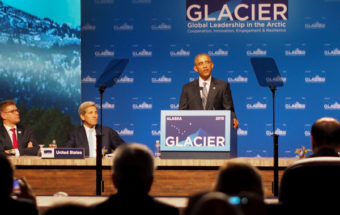
President Barack Obama addressed the GLACIER conference in Anchorage Monday. (Screenshot)

As President Obama continues touring Alaska, the aims and outcomes of Monday’s GLACIER Conference are still being sorted out.

Independent of the president’s visit, the State Department organized for 20 diplomats with ties to the Arctic to gather in Anchorage’s Dena’ina Center. The aim, according to Secretary of State John Kerry, was figuring out next steps for international efforts on climate change ahead of talks in Paris later this year.

“We very much look forward to building a record, an agenda, a roadmap, if you will, to lead us into Paris, where we have a critical negotiation this year,” Kerry said during opening remarks.

Throughout the day, diplomats convened for closed-door meetings. Meanwhile, breakaway sessions elsewhere focused topics of particular interest to Alaska and the high North, like Arctic home-design, coastal erosion, and mitigation, as well as how to manage Arctic fisheries.

The common thread was in offering evidence that a changing Arctic environment is impacting economies, nations, and communities faster than anyone can adapt. Northwest Arctic Borough Mayor Reggie Joule told delegates that Native people in Alaska are seeing some of the resources closest to home threatened.

“Subsistence is our means for providing for our families,” said Joule, who spoke throughout the day on different topics, but stressed that hunting, fishing, and foraging remains fundamental to the economies and cultural identity of many Alaska Natives. “For many, more than half of our daily take of nutrition is from our traditional foods.”

By the end of the day’s sessions, Kerry said productive discussions would be reflected in a document set to be put out soon.

“We confirmed today that we cannot afford to wait until someone else moves to implement solutions to the challenges that confront us in the Arctic,” Kerry said. “I’m very pleased that through today’s GLACIER meeting we made progress in a host of areas, and our communiqué will summarize that.”

But particulars — both about the conference’s deliverables and about what steps the administration will announce — remain vague.

During closing remarks, the president cast a serious tone about the stakes of inaction on dire climatological changes. He alluded to details to come during his two remaining days visiting different parts of Alaska. But at the close of Monday’s Glacier conference, the one certainty is widespread agreement that manmade climate change is exacting a real toll on Alaska.

In fact, there was one other universal point of agreement within the conference’s crowded closing session.

“I think we could say that Denali has never looked better than it did today,” Secretary Kerry said to a battery of applause.

After an executive action Sunday, the name of North America’s highest mountain was officially restored to Denali. The weather in Anchorage was clear and the mountain’s summit was visible.

200 gather to protest Arctic drilling during GLACIER conference

Carl Wassilie, left, stands with protestors against Arctic drilling. The protest took place during the GLACIER conference in Anchorage where President Obama began his Alaska trip. (Photo by Anne Hillman/APRN)

About 200 people gathered on the Park Strip in downtown Anchorage Monday afternoon to protest offshore drilling in the Arctic and to call for stronger measures to fight climate change.

Danielle Redmond with Alaska Climate Action Network helped arrange the protest, which featured a model of Shell’s drilling rig with the moniker “Polar Profiteer” instead of “Polar Pioneer.” She says they’re glad Obama is in Alaska and has spoken about climate change, but he hasn’t done enough.

“The message that has become clear to us is it’s absolutely up to us, to ordinary people, to create the political space that is needed for real change,” Redmond said.

Redmond says it’s hard for Alaskans to speak against the human causes of climate change.

“People are terrified and they feel like they’re the only ones and are alone because we’re an oil state,” Redmond said. “Our economy depends on it and so it is a challenging thing to confront that and face that reality and to find solutions on how to move forward in a better way.”

Anchorage resident Terri Pauls was in the crowd waving a dark blue flag with an image of the planet earth.

“I feel pretty strongly that the way to look at this topic is through science, and I just find it super disappointing that so many people chose to ignore or dismiss solid science,” Pauls said.

Carl Wassilie from Western Alaska joined the event. He also attended protests against Shell in Seattle. He says he objects to offshore drilling because he says the oil industry has not helped Alaska Natives and infringes upon their rights.

“We’re still in the same situation we were 40 years ago, getting Third World diseases in the villages and that’s with 40 years of drilling onshore, primarily onshore in the Arctic,” Wassilie said. “We don’t need to go offshore. It’s not going to help the planet and it’s not going to help the people.”

Others spoke about the impacts of drilling on wildlife and subsistence hunting.

Americans for Prosperity had also planned a rally, but it was canceled for logistical reasons.

In The Stomach Of A Seabird, A Glimpse Of An Ocean Heating Up

Professor Douglas Causey logs information as he tags and takes basic measurements of the birds he harvested in the Aleutian Islands on June 4. He is looking at the birds' blood and their diet, hoping to find out the ways the ocean is changing as it warms. Bob Hallinen/ADN
Professor Douglas Causey logs information as he tags and takes basic measurements of the birds he harvested in the Aleutian Islands on June 4. He is looking at the birds’ blood and their diet, hoping to find out the ways the ocean is changing as it warms.
Bob Hallinen/ADN

On a rare sunny morning in the northern Pacific Ocean, biologist Douglas Causey takes to the sea to conduct his research — binoculars in one hand, and a shotgun in the other.

As he bounces around in his boat, Causey, a researcher at the University of Alaska, has got an eye out for the little dots on the water in the distance: seabirds. They spend 80 percent of their lives on the open ocean, which makes them especially sensitive to changes in the environment. By the time they fly back to their nests at the western tip of the Aleutian Islands off Alaska, Causey is dying to know what those birds have been up to.

When he spots a pelagic cormorant, he lifts his gun and takes aim. Two shots ring out, the bird falls from the sky and Causey moves in to collect the body.

Most scientists don’t kill their samples, but Causey, who has a permit, says it’s necessary for his team to find out how seabirds are adapting to global warming. They’re at the top of the food chain — so any changes in the environment will show up in their diet. Different parts of the bird contain atomic signatures of what it ate and when, a bit like a food diary.

By looking at the bird’s blood cells, he says can actually tell what it was eating a few weeks back. Beyond that, researchers can see how much herring this bird ate, as opposed to crab or shrimp. That can indicate what’s actually available in the ocean — and how it’s changing as the ocean warms.

Causey fires at a cormorant from a U.S. Fish and Wildlife Service research boat. He collects the shot birds for research — to examine the changing diet of the top of this region's food chain. Bob Hallinen/ADN
Causey fires at a cormorant from a U.S. Fish and Wildlife Service research boat. He collects the shot birds for research — to examine the changing diet of the top of this region’s food chain.
Bob Hallinen/ADN

Compared to historical records, Causey says he’s finding major shifts in diet. He’s also finding evidence that seabirds are ingesting plastic.

“I ask why — why are things like this,” he says. “We’re in a state where we don’t know much about most things.”

And this is partly because Alaska is so vast and remote. This part of the Aleutian Islands is closer to Russia than the rest of the United States. But research assistant Ashley Stanek says it’s easier to test one bird than the entire ocean.

“You can’t necessarily measure every resource available to them if you don’t know even where they’re going,” says Stanek.

Those resources will shift as Alaska continues to heat up. It’s happening twice as fast in the state as the rest of the nation, on average — around 2 degrees over the last half-century. But it’s not a steady climb.

“It’s somewhat like the stock market,” says John Walsh, the chief scientist for the International Arctic Research Center in Fairbanks. “When good times are here, the overall trend is upwards. But as you go through the weeks and the months, there are ups and down along the way.”

One of those ups is a large blob of superheated water that appeared in the northern Pacific Ocean two years ago. It has raised temperatures by up to 5 degrees Fahrenheit.

“If you look at the projections of what the world should look like in 50 or 100 years, the oceans are warmer — especially the Pacific,” Walsh says. “And what we’re seeing now could be typical of a warmer climate. So in that sense, this could be a preview.”

Seabirds are not in crisis mode — at least, not in the Aleutians. Their population has been shrinking for years. What’s changed is that researchers like Causey aren’t the only ones paying attention.

“The U.S. and the world has suddenly woken up to the fact that the Arctic is changing faster than anywhere else on Earth.”

President Obama is heading to Alaska on Monday, with plans to talk about climate change and its effect on life around the country. During the visit, Obama will be speaking at a conference on global climate change that goes by the acronym GLACIER.

And Douglas Causey will be there in the audience, listening closely to what the president has to say.

Copyright 2015 NPR. To see more, visit http://www.npr.org/.
Read Original Article – Published AUGUST 30, 2015 8:02 AM ET

Murkowski thanks Obama for restoring Denali; Obama directs his gaze on climate change

Down the valley towards Denali on with the park road wending its way. (Creative Commons photo by Nic McPhee)

President Barack Obama touched down in Alaska Monday for a three-day tour to the state, and beyond focusing on climate change in visits to Anchorage, Dillingham, and Kotzebue, the president began his trip by restoring the Koyukon Athabascan name to North America’s highest mountain.

Senator Lisa Murkowski, in a video posted on YouTube Sunday, thanked the president for the long-sought change.

“For generations Alaskans have known this majestic mountain as The Great One,” Murkowski’s video message begins. “Today we’re honored to be able to officially recognize the mountain as Denali. I’d like to thank the president for working with us to achieve this significant change to show honor, respect, and gratitude to the Athabascan people of Alaska.”

Beyond Denali, Obama’s Alaska itinerary focuses on climate change. It’s a topic he’ll discuss at the GLACIER conference in Anchorage, an acronym for the international meeting on global leadership in the Arctic. He also plans to discuss an initiative assessing relocation needs of more than 30 Alaska Native communities due to the changing climate and rising sea levels. The effort will be led by the Denali Commission, an independent federal agency, with Senator Murkowski at the helm.

In a video released by the White House Friday, Obama turned the national spotlight on those Alaska communities.

“A lot of these conversations begin with climate change,” the president said, “and that’s because Alaskans are already living with its effects: some of the swiftest shoreline erosion in the world—in some places more than 3 feet a year. This is happening to our fellow Americans right now. In fact, Alaska’s governor recently told me four villages are in imminent danger and have to be relocated. Already rising sea levels are beginning to swallow one island community. Think about that. If another country threatened to wipe out an American town, we’d do everything in our power to protect ourselves. Climate change poses the same threat, right now. Because what’s happening in Alaska is happening to us, it’s our wake-up call.”

On Wednesday, Obama will head to Western Alaska, spending the morning in Dillingham and finishing his trip in Kotzebue. Many in Western Alaska have wondered about the impacts the president’s visit will have on the vital air transportation and freight so many rural residents rely on.

Like Anchorage, the Federal Aviation Administration is implementing Temporary Flight Restrictions in both Kotzebue and Dillingham. In each case, the TFR will consist of an inner 10-mile ring of heavily restricted airspace, and an outer ring of less restricted but still limited flying to 30 miles out. Airmen are urged to check the TFRs for updates and specific information.

The FAA notes all aircraft within 10 miles of Kotzebue will be prohibited to only law enforcement and military flights Wednesday between 4:30 p.m. and 9 p.m., but those times are expected to fluctuate.

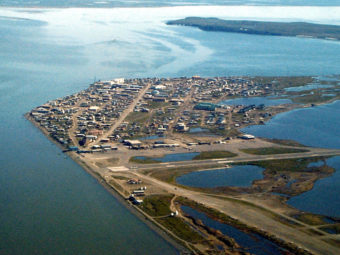
As all eyes move to Kotzebue for Obama’s trip—the first time a sitting U.S. president will travel above the Arctic Circle—the president’s schedule has him on the ground for just a few hours, delivering remarks at the community school.

But the trip has left many in Nome—which the U.S. Army Corps of Engineers picked as the leading candidate for a deep-draft Arctic port—wondering why the potentially strategic harbor isn’t seeing a presidential visit.

White House senior adviser Brian Deese told a conference call of reporters last week that the president’s agenda is simply too full.

“If we had more time and more space the president would love to visit more of the state,” Deese said. “Lots of things [are] going on in Nome, including the Army Corps’ exploratory work that’s ongoing. This is a packed trip, he is using every minute of his time to try see as much as he can, but we can only get in so much.”

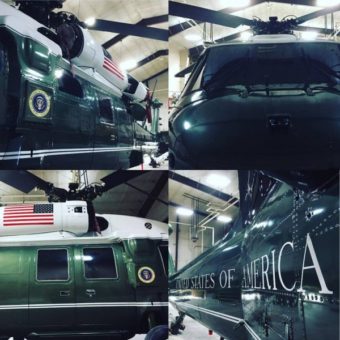
The White House says Air Force One will take off from Kotzebue Wednesday evening—ushering President Obama out of Alaska.


Site notifications
Update notification options
Subscribe to notifications