Alaska is on the “bucket lists” for a lot of people, but for President Obama it’s on his famous list of things that rhyme with bucket.
Obama will become the first U.S. president to head to the Arctic Circle Monday as part of a multi-day trip intended to draw attention to the issue of climate change. He will hike a shrinking glacier, but even before he steps foot on it, he is pushing back against criticism — and irony — that his administration approved a lease for Shell to drill off the coast of Alaska.
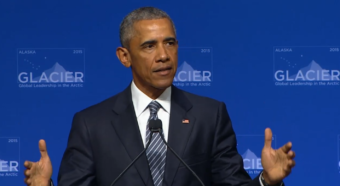
“I know that there are Americans who are concerned about oil companies drilling in environmentally sensitive waters,” Obama said in his weekly address. “Some are also concerned about my administration’s decision to approve Shell’s application to drill off the Alaskan coast using leases they purchased before I took office.”
He added, “I share people’s concerns about off-shore drilling.”
But, Obama pointed out, he is trying to balance domestic economic concerns as he tries to push the world to wean itself off oil.
“Our economy still has to rely on oil and gas,” Obama said. “And, as long as that’s the case, I believe we should rely more on domestic production than on foreign imports.”
Make no mistake: This is all about the president’s legacy. He’s been ticking through that bucket list — with a host of executive actions, his Iran deal, and, now, he wants to be known as the first American president who did something meaningful on climate change.
He will have that chance at a climate change conference in Paris in December, and this trip is the first step in the P-R campaign to win a deal there.
Copyright 2015 NPR. To see more, visit http://www.npr.org/.
Read Original Article – Published AUGUST 30, 2015 1:22 PM ET
President Barack Obama’s visit to Alaska this week, aimed at highlighting his push to fight climate change, comes just two weeks after his administration approved drilling for oil in the Arctic Ocean. Some Alaskan environmentalists see a disconnect between the president’s rhetoric and his actions on climate change.
The Obama administration hopes the Alaska trip—Obama arrives in Anchorage Monday afternoon—will help sell the president’s proposals to rein in America’s greenhouse gas emissions.
“What’s happening in Alaska isn’t just a preview of what will happen to the rest of us if we don’t take action. It’s our wake-up call,” Obama says in a White House video filled with images of dripping glaciers and raging wildfires. “The alarm bells are ringing. And as long as I’m president, America will lead the world to meet this threat—before it’s too late.”
The president’s Alaska agenda includes seeing the rapidly retreating Exit Glacier near Seward and meeting some of the rural Alaskans hit hardest by climate change in Dillingham and Kotzebue.
“The changes that we have been seeing over time seem to have accelerated,” Northwest Arctic Borough mayor and former Democratic state legislator Reggie Joule said Thursday in Kotzebue. Obama is scheduled to fly there Wednesday.
The Native village of Kivalina—at the western edge of a borough bigger than Indiana—has been seeking funding for more than a decade to relocate before it gets washed into the Arctic Ocean.
“But not just at the coast. It’s in-river, as well,” Joule said. “Every single one of our communities in our borough has some level of impact of climate change.”
Hazards, Benefits Both Great
Even where the hazards from fossil fuel use are stark, Joule said the economic benefits are great. State government in Alaska runs mostly on oil taxes.
“It is a conundrum for us because we are feeling the effects of a global activity,” Joule said.
With Alaska’s icy landscapes melting and villages eroding into the sea, few Alaskans deny that the climate is changing any more. They do question how big a priority fighting it should be.
“Climate change is a reality. The shipping lanes coming over the northern sea route [crossing the Arctic Ocean] are already open,” Port of Dutch Harbor director Peggy McLaughlin said.
The closest deep-water port to the U.S. Arctic, Dutch Harbor is a staging area for Shell Oil’s 31-boat Arctic fleet this summer. McLaughlin said the United States is not the only nation drilling in the Arctic Ocean.
“The Arctic is so much bigger than drilling and the climate change issues are so much bigger than drilling,” she said. “It’s so much bigger than the U.S. exercising its leases on various drilling sites in the Chukchi and Beaufort Seas.”
The state’s entire Congressional delegation has been urging President Obama to learn about Alaskan issues other than climate change while he’s in the far North.
Republican Sen. Lisa Murkowski said she’s looking forward to welcoming the Democratic president on his first official trip to Alaska.
“I think it is somewhat disappointing, though that he apparently intends to use this as nothing more than a backdrop for climate change,” Murkowski said.
Republican Rep. Don Young issued a statement suggesting Obama “give that stump speech from somewhere else” if he was simply coming to Alaska to promote his environmental platform.
‘Absolute Contradiction’
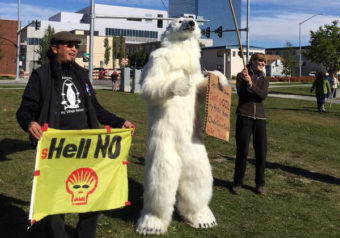
You might think Alaskan environmental groups would be cheering the president’s climate-themed visit. Instead, the groups most focused on climate change are organizing a protest rally. They argue President Obama can’t claim to be a climate leader after his administration gave the green light to Shell Oil to drill in the Arctic Ocean.
“We know that offshore drilling in the Arctic is not compatible with a stable climate future,” Danielle Redmond with the Alaska Climate Action Network in Juneau said. “And yet the Obama administration approved Shell’s final permits just days before coming up here to host a conference highlighting climate change in the Arctic. It’s really just an absolute contradiction.”
Global diplomats including Secretary of State John Kerry are meeting in Anchorage to discuss the rapidly changing Arctic, and Obama is scheduled to join them Monday.
Negotiators have been trying to put the brakes on global warming for years, with little success. While emissions reductions have been elusive, they have settled on a goal of allowing no more than 2 degrees Celsius of warming this century.
A study by energy researchers this year in the journal Nature found that goal requires leaving most fossil fuels in the ground.
“The results indicate that all of the Arctic resources should be classified as unburnable,” lead author and energy modeler Christophe McGlade from University College London said.
In theory, according to McGlade, you could burn Arctic Ocean oil and avoid dangerous levels of climate pollution, but that would require the rest of the world not to burn any of its oil. That scenario is extremely unlikely, not least because conventional oil is cheaper to produce than drilling beneath the remote and icy Arctic Ocean.
McGlade said if the world wants to stave off dangerous levels of climate change, world leaders “need to accept the fact that some of your fossil fuel resources and reserves will have to stay in the ground. And the sooner you accept that fact, the better for tackling climate change.”
White House Pushback
If geologists’ forecasts are correct, there’s enough oil and gas under the Arctic Ocean to give a big boost to global energy supplies—and to global concentrations of carbon dioxide in the atmosphere.
The White House has pushed back against environmental groups’ accusations of climate hypocrisy. In the president’s weekly address Saturday, Obama defended his support for Arctic offshore drilling. He said the United States was leading the world’s transition away from dirty energy sources.
“Even as we accelerate this transition, our economy still has to rely on oil and gas,” Obama said. “As long as that’s the case, I believe we should rely more on domestic production than on foreign imports, and we should demand the highest safety standards in the industry.”
On Aug. 3, the White House unveiled its Clean Power Plan, with Obama calling it “taken to combat climate change.” The administration estimates its plan will reduce CO2 emissions from power plants by 870 million metric tons.
Yet the administration’s approval of Arctic drilling could wipe out any savings in pollution from that plan many times over, according to Lois Epstein with the Wilderness Society in Anchorage. Using Obama administration figures for the amount of technically recoverable conventional oil in the Chukchi and Beaufort seas, Epstein has calculated that using all that oil would generate 10 billion metric tons of CO2—15 times more than the clean power plan would save.
She said that much pollution would be enough to increase the CO2in the global atmosphere by another 1.3 parts per million.
Concentrations of CO2 in the earth’s atmosphere are currently at 401 parts per million, their highest in at least 800,000 years. Burning of fossil fuels and deforestation drive CO2 concentrations up another 2 parts per million each year, according to the National Oceanic and Atmospheric Administration.
Obama is expected to reveal more details about the project while in Kotzebue on Wednesday. (Photo courtesy U.S. Army Corps of Engineers)
Word is out already on one initiative President Obama is likely to announce while he’s in Alaska — a plan to put the Denali Commission in charge of a project on village relocation. That came out in Nome this week, at a meeting of The U.S. Arctic Research Commission.
Renewable energy, climate change and port development were all highlighted at the U.S. Arctic Research Commission’s second day in Nome, but it was a special announcement about the president’s upcoming visit to Alaska that got the room buzzing.
“Next week when the president is here, he’s going to announce that the Denali Commission is going to be the lead agency to look at the environmentally threatened communities in Alaska,” says Lorraine Cordova, project manager of the U.S. Army Corps of Engineers’ Alaska Deep-Draft Arctic Port Study. She broke the news Wednesday. The Denali Commission is an independent federal agency that has provided infrastructure and economic support throughout Alaska since 1998.
The project will focus on 31 communities throughout the state, from Barrow on the North Slope down to Port Heiden on the Bering Sea and east to Eyak. Over a span of three years, the Denali Commission’s efforts will help determine whether each community should “protect in place” or relocate due to the effects of climate change.
“It’s a difficult community question to answer. Do we move or do we stay. What parts do we move. What moves first. I mean, it’s not as easy as one might suggest,” Cordova said.
In a public teleconference organized by the Denali Commission Friday morning, Lt. Gov. Byron Mallot says the White House intends to put Sen. Lisa Murkowski at the reigns of the project.
Denali Commissioner and President of the Alaska Federation of Natives Julie Kitka chimed in with her approval about the historic announcement
“I think that this is unprecedented to have the president of the United States mention the Denali Commission and be willing to engage and have his administration step up the effort to meet community needs, and I really do think that what we’re doing today, and as we move forward, is going to be incredible. I really do think it really is pretty darn historical, she said.”
Obama is expected to unveil more details about the Denali Commission’s role in the project during his visit to Kotzebue on Wednesday.
President Barack Obama. (Creative Commons photo by mikebrice)
To a president calling for global action on climate change, Alaska serves as a big show-and-tell exhibit. White House Senior Advisor Brian Deese told reporters in a conference call that as President Obama travels around the state, he’ll draw worldwide attention to the impacts of climate change, which scientists say is changing the Arctic more dramatically than anywhere else on Earth.
“The president has a unique opportunity in going to Alaska to try to highlight why it is important that we act and that there is an urgency in acting,” Deese said. “So I think you can anticipate that he will be trying to speak quite plainly to those issues.”
Details are finally shaking out about Obama’s Alaska visit. The White House says the president will announce new policy initiatives while he’s here, but as Deese described it Friday, they aren’t aimed at cutting off access to Alaska’s natural resources, as some state leaders fear. At least, that’s not the primary thrust.
The cat is apparently out of the bag on one announcement.
Deese also confirmed what’s been rumored for weeks — the president plans to visit Exit Glacier, in Kenai Fjords National Park.
“The president will have an opportunity to spend some time in the park and experience both the beauty and the impact that the climate has had on that area,” he said.
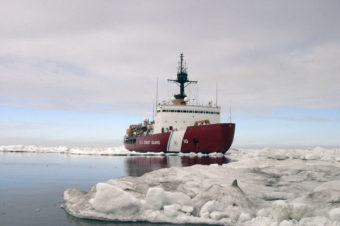
Researchers say Exit Glacier has retreated more than a mile since the early 1800s. Deese says the president will talk to Seward business owners and fishermen, and also plans to board a Coast Guard cutter to view the park from the water.
Wednesday, Air Force One is off to Dillingham, followed by Kotzebue, where Obama will become the first sitting president to touch U.S. land above the Arctic Circle.
Obama has been getting grief from environmental groups for permitting Shell to drill in Arctic waters this summer. In Alaska, political leaders complain he doesn’t allow enough development of natural resources, and he infuriated them by recommending wilderness status for much of the Arctic National Wildlife Refuge. U.S. Sen. Lisa Murkowski, among others, has said she worries Obama will try to use the Antiquities Act to put ANWR off-limits to oil and gas development forever, and some fear a big announcement of that kind on this trip. They might be heartened by some of the statements the senior advisor made.
“It is the president’s view that if we’re using oil and natural gas, that we’re better positioned to rely on American resources and to be able to put in place the highest and most stringent safety standards,” he said.
That’s the kind of statement made by proponents of more oil drilling on federal land. On the other hand, Brian Deese also spoke highly of Obama’s use of the Antiquities Act, which allows a president to create national monuments without seeking Congressional approval.
“This is a president who has used his authorities under the Antiquities Act to protect more public lands and water than any other president in history,” he said.
Deese wasn’t specific, but he says the new policies Obama will unveil are about spreading strategies Alaska communities have deployed in the areas of alternative energy and response to climate change.
“Principally, the policy initiatives that we’ll be talking about on this trip are ones that are about trying to identify ways the federal government can work more effectively with the communities, with the tribal nations, with the state to build on success.”
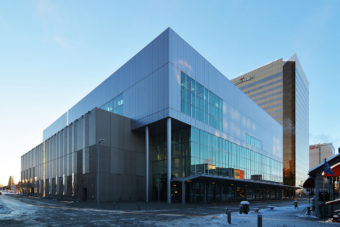
Obama is expected to arrive Monday at Joint-Base Elmendorf-Richardson and speak during the closing session of a State Department conference at the Dena’ina Center.
Part of the Tongass National Forest. A new study says the Tongass holds more carbon than other western coastal forests. (Photo Courtesy U.S. Department of Agriculture)
Some conservationists want President Obama’s climate change agenda to include Southeast Alaska’s rain forest.
The Oregon-based Geos Institute released a study last week pointing to the Tongass National Forest’s role in combatting global warming.
Chief Scientist Dominick DellaSala says old-growth Tongass trees help fight climate change.
“They are some of the most carbon-dense forests in the world. And so, as they’re sucking up that carbon dioxide from the atmosphere and they grow for centuries they hang onto that carbon and keep it from going back up,” he says.
The study’s release is timed to coincide with Obama’s Alaska trip later this month. He’s scheduled to visit communities affected by climate change and address an international conference.
The president plans no stops in Tongass communities.
The Geos Institute study shows the Tongass will fare better than other West Coast forests as temperatures rise.
Geos Institute Chief Scientist Dominick DellaSala says preserving Tongass old-growth trees could slow climate change. (Courtesy wildcalifornia.org)
DellaSala says that’s because Southeast Alaska is cooler and wetter than other coastal rain forests in the Pacific Northwest, British Columbia and Alaska.
“As the climate heats up further south in the rain forest region, for instance, down in the redwoods, we will see species losing their preferred habitat and potentially going extinct,” he says. “But on the Tongass, as long as they can find habitat as the climate changes on them, they should be able to get through the coming climate change storm that we’re seeing all over the planet right now.”
The study is part of a larger push to end old-growth logging in the Tongass.
The Forest Service has made that a priority, but DellaSala and other activists say it’s taking too long.
“What we would like to see the White House do is speed up the process. Because we think they could get to the starting line, get out of old-growth logging and into the second-growth, faster than what everybody’s been saying,” he says.
The report predicts Sitka spruce, western hemlock and red cedar will be least affected by warming temperatures.
But yellow cedar, mountain hemlock and coastal redwoods will lose significant habitat over the next 60 or so years.
Yellow cedar are already in decline. Their shallow roots need snow to protect them from freezing, and less snow is staying on the ground.
DellaSala will speak about Tongass issues at 7 p.m. Monday, Aug. 24, at Juneau’s Silverbow Bakery. The event is sponsored by the Southeast Alaska Conservation Council.
Close
Update notification options
Subscribe to notifications
Subscribe
Get notifications about news related to the topics you care about. You can unsubscribe anytime.