Gardentalk

Gardentalk – Listener question lightning round

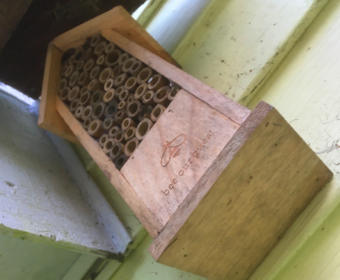
This is the second year that this beehouse has remained vacant in a North Douglas yard.
This is the second year that this beehouse has remained vacant in a North Douglas yard. (Photo by Matt Miller/KTOO)

In this week’s edition of Gardentalk, Master Gardener Ed Buyarski tackled a series of yard and garden care questions sent in by listeners.

The first few questions were related to last week’s segment on garlic.

“I’ve harvested and dried my garlic, but haven’t cut the stems off each bulb yet. Is it necessary to cut stems off before storing over winter?” asks Ann.

Buyarski said it depends on how much room you have.

“If you’ve got three foot long stems, you can use those stems to hang up a bunch,” Buyarski said. “Simple answer is no, it doesn’t matter.”

A reminder to keep them in a warm place about 60 degrees. Don’t refrigerate them.

“How do you know its ready? Not a lot of luck here. I am told it’s too hot, but then why do we have wild garlic growing?” asks Bonnie.

Buyarski said he hopes that it doesn’t mean her garlic is still in the ground. He said it certainly should have been harvested now.

“When to plant garlic in Oklahoma?” asks Ida.

Buyarski said the basic rule is planting at four to six weeks before the ground freezes.

“I’m planting garlic right now and I have planted garlic as late is between Christmas and New Years when the ground’s not frozen,” Buyarski said. “So, that gives her some
latitude.”

“I’d love to hear some bee friendly recommendations from Ed. And, do those bee houses that popped up everywhere actually help our bees?” ask Sarah.

Buyarski said those beehouses are usually good for orchard mason bees. But he can’t confirm if they actually work in Juneau.

He said bee-friendly plants commonly found in Juneau include dandelion, raspberry, crocus, and pussy willow.

“I planted peony crowns in spring (in pots) and transplanted to a south slope. How do I best prepare the transplants for winter?” asks Andrea.

Buyarski recommends lightly fertilizing them with bulb food, cutting off all stems to two inches above the ground, and sheltering them for the winter with spruce boughs or other material.

“So, they don’t emerge too early in the springtime, and hopefully, have a few flowers next year,” Buyarski said.

Listen to the Oct. 3 “Gardentalk” focusing on listener questions.


Finally, the Garlic Lovers Potluck will be held 5 p.m. to 7 p.m., Oct. 26 at the Northern Light United Church. Everyone is invited to bring a tasty dish with garlic in it. Buyarski said that has previously included soups, salads, and garlic flavored brownies and chocolate cake. The free event will also include presentation on the basics of garlic growing, harvesting, and storage.

Do you have a garden question for Ed? Fill out the form below, and he’ll answer your question in an upcoming segment.

Listen to past episodes and subscribe to the podcast on the “Gardentalk” page, so you’ll never have to worry about missing Thursday’s live radio broadcasts.

Gardentalk – How do you plant 10,000 garlic?

Garlic
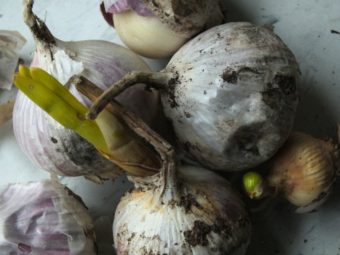
These homegrown hardneck garlic bulbs weren’t stored properly after harvest and already started sprouting before planting. Break apart each bulb, and set aside the smallest individual cloves for cooking. Use the biggest cloves for replanting. Plant each clove with pointy end up, about 6 inches apart at a depth of 2 inches. On top of the soil, layer with seaweed or other mulch, and then cover with plastic so the garlic doesn’t start rotting during the fall rains. (Photo by Matt Miller/KTOO)

A Haines vegetable grower is set to embark on a mammoth effort to plant thousands of tiny garlic cloves.

Master Gardener Ed Buyarski explained more about Scott Hansen’s efforts during a recent edition of “Gardentalk.” He said Hansen will enlist the help of family members to get 10,000 garlic cloves planted over the weekend or over several days. Since garlic cloves must be oriented with the pointy end up, they all have to planted by hand.

But Buyarski said Hansen has found a way to expedite harvesting on his half-acre plot next summer.

“He is going to try to use his tractor and potato digger to lift the garlic once it’s ready,” Buyarski said.

Buyarski and a fellow grower in Juneau together have harvested about 500 bulbs each year, which usually yields about 3,000 individual cloves.

Listen to the Sept. 26 edition of “Gardentalk” about garlic planting.


Whether it’s 10 or 10,000 garlic, there are some basic techniques that any gardener should keep in mind.

It’s best to use hardneck garlic, not the softneck garlic that you usually find in the vegetable section of retail stores.

Break apart each garlic bulb and use the biggest individual cloves for replanting. Set aside the smallest individual cloves for cooking.

Find a plot with good drainage and ample sun.

Before planting, be sure to mix extra nutrients into the soil in the form of compost, seaweed, horse manure, brewers grain, or coffee grounds.

Plant each clove with the pointy end up, about 2 inches deep and 6 inches apart.

On top of the soil, layer with seaweed or other mulch, and then cover with plastic to prevent the fall rains and winter snow from rotting the garlic and washing the soil’s nutrients away.

Hundreds of garlic plants waiting to be harvested in July 2019.
Hundreds of garlic plants waiting to be harvested in July 2019. (Photo courtesy of Ed Buyarski)

Do you have a garden question for Ed? Fill out the form below, and he’ll answer your question in an upcoming segment.

Listen to past episodes and subscribe to the podcast on the “Gardentalk” page, so you’ll never have to worry about missing Thursday’s live radio broadcasts.

Gardentalk – Planting for a colorful fall

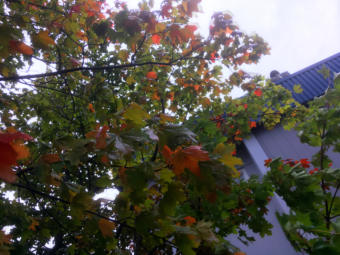
Leaves begin to turn on a Norway maple outside KTOO studios in September 2019. (Photo by Matt Miller/KTOO)

Do you enjoy the trees and shrubs that are changing color around Juneau right now?

Master Gardener Ed Buyarski says you can plant in your own yard now or plan for next year instead.

“So, we can add more to basically get more enjoyment out of our fall landscape,” Buyarski said.

Screen capture of Picture This app tries to identify leaf of a tree near KTOO studios.

Popular trees, which show autumn colors and grow well in the Juneau area, include the maple, birch, cottonwood, dolgo crabapple, cherry, and golden willow. The Japanese katsura will change from pink to salmon to orange colors.

Color-changing shrubs include the wild blueberry, devil’s club, red twig dogwood, gold flame, and the burning bush.

“If you go past Fred Meyer’s, there’s some beautiful burning bush plants turned from green to bright red-orange,” Buyarski said.

For flowers and perennials, Buyarski recommends monkshood, ligularias, turtlehead, and black-eyed Susan. The Miskin lilac and the P.J.M. rhododendron will eventually turn purple in the early fall.

Buyarski says it’s a great time of year for planting, because the early fall rains are finally moistening the soil. He recommends loosening the roots once you get the plant or tree out of the pot.

“Water them once thoroughly, throw some compost on the surface or some seaweed, and a couple inches of mulch over the top,” Buyarski said. “The roots will continue to grow well into the fall as long as the ground isn’t frozen.”

“The mulch is really important, because of the potential for freeze-thaw action during the winter if we don’t get consistent snow cover,” Buyarski said.

Listen to the Sept. 19th edition about fall colors:


If you’re reluctant to do any planting now, then Buyarski encourages taking pictures of trees and shrubs as part of next year’s planning. There are several plant identification apps that are available for your phone that will help figure out the type of plant or tree that is changing color.

Do you have a garden question for Ed? Fill out the form below, and he’ll answer your question in an upcoming segment.

Listen to past episodes and subscribe to the podcast on the “Gardentalk” page, so you’ll never have to worry about missing Thursday’s live radio broadcasts.

Gardentalk – The bulbs have arrived

Bulbs
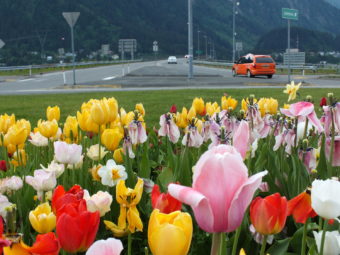
Bulbs bloom in the middle of the Douglas roundabout in spring of 2015. (Photo by Matt Miller/KTOO)

Pick your bulbs now and plant later this fall for a colorful yard next spring.

In this week’s edition of “Gardentalk,” Master Gardener Ed Buyarski said local retailers and service organizations are getting all types of bulbs shipped into Juneau now. But don’t start planting as soon as you get those bulbs home.

“We don’t want them in the ground yet because then they might start growing too early and then (they’ll) start getting killed too early,” Buyarski said.

He suggests storing them in a cool, dry and dark place until the end of September or early October, or at least until just before the ground freezes and the snow falls. Only then should you plant the bulbs.
Listen to the Sept. 12 edition of “Gardentalk” about bulbs:


Buyarski said tulips are popular as an annual in Juneau, while some varieties, like daffodils and crocus, may return in subsequent years after the initial planting.

“Tulips have a difficult time returning year after year because so many of the bulbs are native to the Middle East, to Southern Asia, Russia and other places where they would normally get dry baking conditions,” Buyarski said.

Do you have a garden question for Ed? Fill out the form below, and he’ll answer your question in an upcoming segment.

Listen to past episodes and subscribe to the podcast on the “Gardentalk” page, so you’ll never have to worry about missing Thursday’s live radio broadcasts.

Gardentalk – How to avoid the greenhouse blues

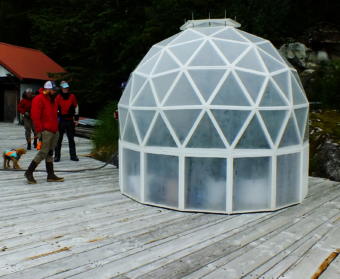
In this picture taken in early June 2019, tomatoes, peppers, and other vegetables thrive in the scratch-built geodesic greenhouse that Tom Lafollette made at the Annex Creek Hydroelectric Facility in Taku Inlet. Lafollette explains that he's set up an automated watering and venting system to keep the plants watered and the greenhouse ventilated.
In this picture taken in early June 2019, tomatoes, peppers, and other vegetables thrive in the scratch-built geodesic greenhouse that Tom Lafollette made at the Annex Creek hydroelectric facility in Taku Inlet. Lafollette explains that he’s set up an automated watering and venting system to keep the plants watered and the greenhouse ventilated. (Photo by Matt Miller/KTOO)

For those gardeners with greenhouses, don’t forget to open the vents and windows to create some air flow inside. Otherwise, gardeners may be disappointed to find their vegetables and plants turned to mush and covered with a grayish mold.

“That’s with our cooling temperatures, nighttime temperatures and higher humidity,” said Master Gardener Ed Buyarski. “That’s what happens. It’s perfect mold-growing conditions.”

Buyarski encourages using heavy oscillating fans inside the greenhouse to keep the air moving and prevent mold spores from settling on your plants.

He also advises removing the offending leaves and parts of the plant immediately if they become infested with mold.

Tomato plants may still be flowering, but Buyarski recommends thinning plants, trimming plant tops, and removing any of those new flowers. It’s way too late anyway for those new flowers to develop into ripe tomato fruit this season.

“So, if we can trim those tops, then that forces the plant to put his energy ripening the tomatoes it’s already set,” Buyarski said. “We can also help stress them to do that by slowing our watering.”

Also, don’t forget to harvest other vegetables, like cucumbers, that have already stopped producing.

Listen to the Sept. 5 edition of “Gardentalk” about greenhouse management and woolly bear caterpillars (again).


In this picture taken in early June 2019, Tom Lafollette, caretaker of the Annex Creek Hydroelectric Facility in Taku Inlet (obscured behind left side of greenhouse), explains to visitors how he built this scratch-built geodesic greenhouse for growing tomatoes, peppers, and other vegetables. The greenhouse is about 10 feet in diameter and is a slightly smaller version than a previous greenhouse he constructed from plans.
In this picture taken in early June 2019, Tom Lafollette, caretaker of the Annex Creek hydroelectric facility in Taku Inlet (obscured behind left side of greenhouse), explains to visitors how he scratch-built this geodesic greenhouse for growing tomatoes, peppers and other vegetables. The greenhouse is about 10 feet in diameter and is a slightly-smaller version than a previous greenhouse he constructed from plans. (Photo by Matt Miller/KTOO)

Buyarski said he’s still getting comments about removing woolly bear caterpillars before they attack kiwi plants, berry bushes and apples trees. He got some feedback at the recent Juneau Food Festival from someone who wasn’t happy about his suggestion of squishing and squashing the fuzzy, black-and-orange caterpillars into oblivion.

“I’m growing stuff for me, for my friends and for other people, and trying to teach people to do that ,” Buyarski said. “Grow food for us. I’m selective about who I’m sharing with, let’s say.”

Buyarski also reports that a neighbor recently developed a severe allergic reaction after getting a woolly bear caterpillar and its irritating long, white hairs down his shirt. His skin was already blistering by the time his neighbor’s wife got his shirt off.

“She ended up giving him a couple of Benadryl and using some alcohol to wipe down, to clean off the skin,” Buyarski said. “And it took some hours for the swelling and reaction to go away.”

Buyarski also said that an emergency room provider suggested applying an oatmeal paste or a paste of water and baking soda on the blisters to help soothe the skin.

Captured! A woolly bear caterpillar with those irritating white hairs crawls inside a jar shortly before it starts cocooning for the winter.
Captured! A woolly bear caterpillar with those irritating white hairs crawls inside a jar shortly before it starts cocooning for the winter. (Photo by Matt Miller/KTOO)

Do you have a garden question for Ed? Fill out the form below, and he’ll answer your question in an upcoming segment.

Listen to past episodes and subscribe to the podcast on the “Gardentalk” page, so you’ll never have to worry about missing Thursday’s live radio broadcasts.

Gardentalk – Is the drought over? Can I stop watering now?

Potato, potahtoe
Potatoes for sale at Farmers Market and Food Fest 2014 at the JACC. (Photo by Matt Miller/KTOO)

No, the drought is not over. And don’t stop watering, said Master Gardener Ed Buyarski during this week’s edition of “Gardentalk” on KTOO’s “Morning Edition.”

Buyarski said a few days of rain showers is not enough to keep the ground moist for your garden vegetables. The National Weather Service also has said that sporadic spurts of rainfall will not be enough to remedy dry conditions in Southeast Alaska over the last two years.

“Dig down deep and see what the soil is telling us,” Buyarski said. “We need a lot more moisture.”

Buyarski also notes that extra watering — especially on the tender plants themselves — will help provide a little frost protection as temperatures drop to near-freezing with clear skies overnight. Jugs of water placed around the garden during the height of the afternoon sun will serve as a heat sink and delay frost conditions, if they occur. Blankets and sheets placed over squash and zucchini plants will also provide a layer of insulation.

“Clear (sheets of) plastic isn’t the answer,” Buyarski said.

Listen to the Aug. 29 edition of “Gardentalk.”
Buyarski also answered a few questions from listeners this week.

After last week’s segment about woolly bear caterpillars, Juneau listener Jolene asked about alternative methods of eradicating them, instead of squishing or stepping on them. Buyarski said a less brutal alternative that does not require touching the caterpillars includes using a spray bottle to spray the caterpillars with a soapy water solution.

Juneau listener Cathy asked about purchasing garlic bulbs. Buyarski said several vendors may be on hand selling garlic and other vegetables during the Juneau Food Festival at the Juneau Arts and Culture Center on Saturday, Aug. 31 from 9 a.m. to 1 p.m. Free workshops are also planned on a variety of gardening and preservation subjects.

Do you have a garden question for Ed? Fill out the form below, and he’ll answer your question in an upcoming segment.

Listen to past episodes and subscribe to the podcast on the “Gardentalk” page, so you’ll never have to worry about missing Thursday’s live radio broadcasts.

Site notifications
Update notification options
Subscribe to notifications