Gardentalk

Gardentalk – Ripe corn and woolly bear caterpillars

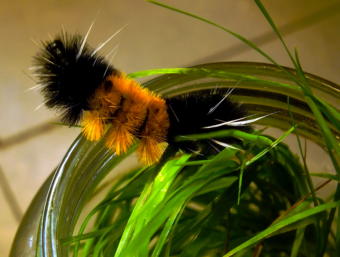
Woolly bear caterpillar tries to escape its glass prison located in a North Douglas kitchen in August 2019. (Photo by Matt Miller/KTOO)
Woolly bear caterpillar tries to escape its glass habitat located in a North Douglas kitchen in August 2019. (Photo by Matt Miller/KTOO)

Master Gardener Ed Buyarski said he’s almost ready to pick his sweet corn that he’s growing this season in his garden.

“The ears are filling out when I feel them,” Buyarski said. Each of the 2-inch-diameter ears feel solid, and their silk is turning brown.

Buyarski recalled that this is probably the first time he’s tried growing corn in Juneau in over 20 years.

In this week’s edition of “Gardentalk,” he said the final test will come in about a week or so when he carefully peels back part of the husk and silk from an ear. The kernels of the bicolor corn should be yellow and white, and their juice should spurt out when the kernel’s skin is punctured.

As for winter squash, Buyarski said they’ll be ripe when you’re able to scratch a thumbnail through the outer skin, but you’re unable to scratch through into the hard inner shell.

And don’t forget to check on your potatoes. Steal a few early spuds for dinner and contemplate digging them all up soon.

Listen to the Aug. 22 edition about corn, squash, caterpillars, and the Harvest Fair:


Buyarski also answered a question about the woolly bear caterpillar, the larval form of the spotted tussock moth, that is seen around Juneau. Before they weave a cocoon, he said the non-native, orange-and-black caterpillars like to feed on raspberry plants, alder trees and apple trees. He said that’s why he tries to get rid of them when they enter his yard and garden.

He also has a caution for children and those with sensitive skin who would be affected by handling the fuzzy caterpillar and touching their white, spiky hairs.

“People might have a skin irritation or allergic-type reactions to them,” Buyarski said.

The Juneau Community Garden on Montana Creek Road is holding its annual Harvest Fair and Farmers Market on Saturday, Aug. 24. Juneau gardeners are invited to bring in their fruits, vegetables, flowers and preserves for judging before 11 a.m. Entries will be open for public display at noon.

An award winning basket from the 2015 Harvest Fair.
An award-winning basket from the 2015 Harvest Fair. (Photo by Matt Miller/KTOO)

Do you have a garden question for Ed? Fill out the form below, and he’ll answer your question in an upcoming segment.

Listen to past episodes and subscribe to the podcast on the “Gardentalk” page, so you’ll never have to worry about missing Thursday’s live radio broadcasts.

Gardentalk – ‘You can be the bee’

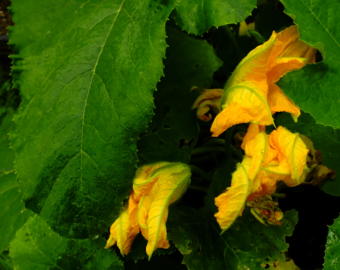
Sugar pie pumpkin flowers close up at the first drops of rain on August 15, 2019.
Sugar pie pumpkin flowers close up at the first drops of rain on Aug. 15, 2019. (Photo by Matt Miller/KTOO)

In this week’s edition of “Gardentalk,” Master Gardener Ed Buyarski explains what gardeners can do to help with pollination, especially if bees and other insects are not around.

“We would like to have warm and sunny weather so the insects are more active,” Buyarski said.

If vegetable plants and berry bushes are blooming during wet or cool weather, then Buyarski said there may not be that much natural pollination happening.

He suggests moving pollen from one plant to another plant of a similar variety.

Some plants like beans, peas and tomatoes pollinate themselves. Others, like squash, have male and female flowers. There are also other plants, like kiwi, which require pollination between separate male and female plants.

“You can actually tear off those plant (flowers) and in your greenhouse and you can be the bee,” Buyarski said, explaining how the male flowers can be dabbed on the female flower pistils for pollination.

Listen to the Aug. 15 segment of “Gardentalk” about pollination.
 

Do you have a garden question for Ed? Fill out the form below, and he’ll answer your question in an upcoming segment.

Listen to past episodes and subscribe to the podcast on the “Gardentalk” page, so you’ll never have to worry about missing Thursday’s live radio broadcasts.

Gardentalk – How to eat your flowerbed

Beebom, nasturtium, and begonia flowers ready for eating.
Beebalm, nasturtium and begonia flowers ready for eating. (Photo by Matt Miller/KTOO)

Flowers from ornamental plants and even garden vegetables are much more than just pretty. They’re tasty, too.

Master Gardener Ed Buyarski said beebalm, nasturtium and begonia flowers are a great addition to any salad.

Calendulas, pansies, johnny jump ups and violets also produce edible flowers.

From the vegetable garden, flowers from bolting radishes, turnips and broccoli can actually taste quite sweet. Buyarski said he stuffs squash blossoms and dips them in a batter before frying.
“I would advise that folks be growing these with clean soil and probably organic fertilizers,” Buyarski said.

He cautions against eating flowers from plants that were purchased from a retailer. You’ll probably never know what kind of fertilizer or pesticides were used by the nursery.

Listen to the Aug. 8 edition of “Gardentalk” about edible flowers.
 

Buyarski also notes that some flowers, like buttercups and anything from the buttercup family, are just plain poisonous. Other poisonous flowers you should avoid eating include peonies, delphiniums, monkshood or wolfsbane, columbine and foxglove.

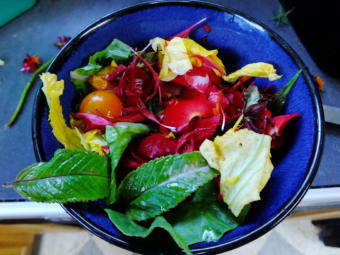
Beebom, nasturtium, and begonia flowers liven up what would've been a routine and forgettable salad.
Nasturtium and begonia flowers, and beebalm flowers and leaves, liven up what would’ve been a routine and forgettable salad. (Photo by Matt Miller/KTOO)

Do you have a garden question for Ed? Fill out the form below, and he’ll answer your question in an upcoming segment.

Listen to past episodes and subscribe to the podcast on the “Gardentalk” page, so you’ll never have to worry about missing Thursday’s live radio broadcasts.

Gardentalk – Juice, jams, jellies and pie. Oh, my!

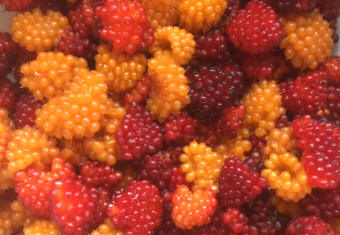
These salmonberries recently picked from North Douglas may be enough for a few pies or a homebrew.
These salmonberries recently picked from North Douglas may be enough for a few pies or a homebrew. (Photo by Matt Miller/KTOO)

What can you do with all those berries you just picked?

Master Gardener Ed Buyarski said there are plenty of things you can make out of the blueberries, cherries, salmonberries and other berries found around Juneau.

Buyarski said homebrewers may be able to make homemade wine with some yeast from a homebrew shop or supplier.

“I’ve had some real good red currant wine,” Buyarski said. “The wild stink currants makes some surprisingly good wine.”

Buyarski just finished making natural juice by putting a little water or apple juice in a stove pot and cooking the berries or cherries until he could gently squeeze out the juice. He advises using a colander to strain out the clear juice instead of running berries through a crank grinder, which will leave more pulp in the juice. He’s heard of berrypickers who’ve used their own juice to flavor their homemade kombucha.

Jams and jellies are always a favorite. Buyarski said gelatin or pectin packets usually contain directions and recipes for the novice jammer or jelly maker.

“And, of course, there’s a YouTube video for everything,” he said.

My personal favorite is frozen yogurt, which I make almost every season from salmonberries picked from the bushes in my yard.

Not sure what to make right now? Stick those berries into a freezer bag and freeze them for now.

And don’t forget pie. Buyarski reminds novice bakers to add enough sugar and corn starch to sweeten and thicken the pie filling.

“Apples are going to be ready here. In fact, some of them are already ready for pie,” Buyarski said. “They are so early this year.”

Listen to the Aug. 1 edition of “Gardentalk.”
 

Do you have a garden question for Ed? Fill out the form below, and he’ll answer your question in an upcoming segment.

Listen to past episodes and subscribe to the podcast on the “Gardentalk” page, so you’ll never have to worry about missing Thursday’s live radio broadcasts.

Gardentalk – Nip that flower after pollination

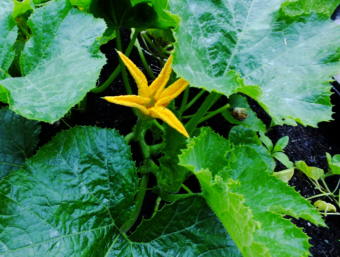
A sugar pie pumpkin flower opens in the early morning sunlight in a North Douglas garden. Visible just to the immediate right is a previously bloomed flower that has fallen onto a leaf and began developing mold. At the far right is a cucumber plant that needs support up off the soil's surface.
A sugar pie pumpkin flower opens in the early morning sunlight in a North Douglas garden. Visible just to the immediate right is a previously bloomed flower that has fallen onto a leaf and begun developing mold. At the far right is a cucumber plant that needs support up off the soil’s surface. (Photo by Matt Miller/KTOO)

In this week’s edition of Gardentalk, Master Gardener Ed Buyarski starts out with a listener question that is very appropriate for this week’s cooler, wet weather.

“How do I keep my Zucchini and Squash from rotting?” asks Christine.

The best way to prevent rot or fungus is to remove the plant’s female flower when it starts shriveling up. Buyarski said it’s a sign the flower has already served its purpose in the pollination process.

“That dying flower is a perfect avenue for fungus to attack,” Buyarski said. “The flower first and then go into the end of the zucchini.”

For plants in a greenhouse, don’t forget to ventilate by turning on fans and opening doors, windows and vents.

Other methods include removing leaves and branches — particularly those that are yellow and dying — at the bottom of the plant near the soil to enhance air circulation.

Buyarski said such techniques are also useful to prevent fungus development on cucumbers and tomatoes.

Use care while watering so that fungus spores in the dirt are not splashed up on the plant.

Trim off extraneous tomato and cucumber stems and provide ample support with cages or string for lifting the plants up off the soil.

On a related subject, Buyarski had another reminder to harvest all your garlic now, regardless of whether all the stems and leaves still haven’t all turned yellow. White mold will soon develop in the lower stem and creep into the bulb.

Listen to the July 25 edition of Gardentalk about squash flowers and coffee grounds:


Finally, most gardeners have their own technique for trapping or eradicating slugs, like beer and bricks. But Buyarski said a gardening friend told him that old coffee grounds spread out on the soil’s surface seems to keep many slugs at bay. And it’s good for plants when it breaks down in the soil, too.

Do you have a garden question for Ed? Fill out the form below, and he’ll answer your question in an upcoming segment.

Listen to past episodes and subscribe to the podcast on the “Gardentalk” page, so you’ll never have to worry about missing Thursday’s live radio broadcasts.

Gardentalk – It’s garlic harvesting time!

Hundreds of garlic plants waiting to be harvested.
Hundreds of garlic plants waiting to be harvested. (Photo courtesy of Ed Buyarski)

It’s a sure bet that some gardeners just can’t wait. All that garlic they planted last fall is almost ready to be harvested.

In this week’s edition of Gardentalk, Master Gardener Ed Buyarski has some tips and hints for harvesting garlic and long-term storage techniques.

If you see yellow or brown developing in garlic stalks and at least half of the leaves, then the garlic is ready to be picked. For those gardeners who did not trim the scapes earlier, Buyarski said if you see them curl and then straighten up, then that’s another sign that the garlic should be harvested.

Carefully loosen the soil around the garlic and gently reach for the bulb so that you don’t damage the fragile, thin skin surrounding them. Don’t bang the bulbs together to shake off the dirt or you may bruise or damage the skins and the cloves. Those skins are essential for proper curing and long-term storage.

Leave the stems and roots on the garlic and let them dry out for a while in a warm and dry environment. Buyarski said you don’t necessarily have to leave them in a darkened room under 50 degrees.

“I do some of this in my greenhouse,” Buyarski said. Other potential places include a furnace room or another dry place with 70- or 80-degree temperatures.

After a few weeks, you can trim off all but two inches of the stems and all of the roots, and gently clean the skins of any dirt.

Listen to the July 18 edition of Gardentalk:


If you have very small garlic that is already turning yellow, then you may want to harvest them now. You could cut off the stems, fertilize again, and leave them in the soil over the winter.

But Buyarski said you’re not going to get bigger bulbs or cloves, just many more small cloves. It’s better to harvest now, break apart the cloves, and replant this fall.

He also notes that bulbs left too long in the soil during the late summer’s rains will develop a fungus that will eventually break down the important outer skins.

Do you have a garden question for Ed? Fill out the form below, and he’ll answer your question in an upcoming segment.

Listen to past episodes and subscribe to the podcast on the “Gardentalk” page, so you’ll never have to worry about missing Thursday’s live radio broadcasts.

Site notifications
Update notification options
Subscribe to notifications