Outdoors

2 swimmers cross Frederick Sound for the first time in living memory

Simmonds’ friend and boat captain, Josef Quitslund, intermittently fed him chocolate chip cookies on his seven-mile journey across Frederick Sound. (Shelby Herbert/KFSK)

There were icebergs on the horizon, and the surface temperature hovers in the low 50s. The waters of the Frederick Sound were cold — like knives in your skin, cold. That’s how it felt when I go to grab a “diver down” flag that fell overboard.

When you’re completely immersed, it feels like the breath is being sucked out of your lungs. That’s why Andrew Simmonds was wearing wearing a wetsuit so thick, it takes him half an hour to put it on. The suit protects him from the worst of the chill — but he’ll spend the rest of the day in that freezing water.

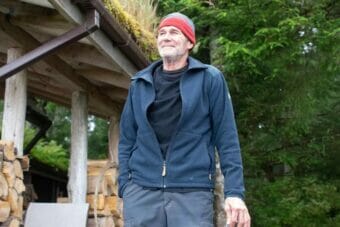
Simmonds, age 61, is the first person in living memory to try to swim across the sound. Last summer, he got close, but didn’t quite make it. He wanted to make it all the way this time, in what he says will be his last try.

But things have changed — now, he’s going for silver. Simmonds was beaten to the punch when another swimmer made it across just three days earlier. His name: Scott May.

“It was actually the shortest tide swing of the month, and the weather was looking beautiful,” said May.

May, age 59, is a retired teacher from Juneau. He saw the opportunity in a good weather window and pounced.

“I talked to my wife, Bridget, and my good friend, Tommy Thompson, and said, ‘Hey, let’s go out on the boat Wednesday morning,’” said May. “Then we went over there and jumped in the water, and the rest is history, I guess.”

Scott May may have been the first to cross, but he took the shortest route. Simmonds is gunning for the longest way across: seven miles.

However, there’s camaraderie between the two swimmers  — even from a distance. They didn’t meet in person until after Simmonds’ second attempt. On the day of Simmonds’ swim, May is watching him from his house through a pair of binoculars. May also passed along some advice — for him, the hardest part was enduring the extreme temperature. He says the cold was almost unbearable at the halfway point.

“I was getting discouraged because it was getting colder, and Frederick Point wasn’t getting any closer,” said May. “I didn’t want to quit — I’m not somebody who gives up easily. When I saw the rocks and the seaweed, I just pushed through that last stop and didn’t even stop and just literally crawled out and sat down. That was the greatest part of the whole thing.”

Terrified of encountering sea life on his swim, Simmonds was blissfully unaware of the curious seal (pictured right) that followed him along for about ten minutes. (Shelby Herbert/KFSK)

Last year, Simmonds had to fight a strong current just before he reached the end. It burned him out, and he had to get back on the boat. Gearing up for this trip, he admitted he’s worried his “old bones” won’t make it. But he’s laughing through the nerves — like those surrounding his deep fear of bumping into the marine life lurking below.

“I thought I would have a heart attack if as I looked down into the water and there were eyeballs looking up at me,” said Simmonds. “It would’ve really freaked me out. But that was part of it — facing one’s fears.”

Simmonds is three quarters of the way across the sound when the discomfort really sets in. He’s feeling the cold – his exposed face is pale and bloodless.

Simmonds is on Petersburg’s Search and Rescue team, and he hurt his left shoulder a few weeks ago hauling equipment for firefighters who were putting out a blaze that consumed the local catholic church.

Josef Quitslund is piloting the rescue boat. He periodically stops to check in with the man in the water; sometimes, offering him food – chocolate chip cookies and milk, per his request.

Andrew Simmonds gets close to touching down on the opposite side of the Frederick Sound. (Shelby Herbert/KFSK)

Simmonds is flagging a bit. And he’s fighting the current – just like last year. From the captain’s seat, Quitslund points out how it’s strong enough to move his boat. But Simmonds’ arms and legs never stop churning.

Seven hours after he left the shore of Sandy Beach, Andrew Simmonds touches the face of the cliff on the other side. He lands just a few yards away from a waterfall, tumbling into the ocean.

Last year, Simmonds said he was crossing the sound for “no good reason.” But now, he says he has several.

Scott May (right) and Andrew Simmonds (left) met for drinks at Petersburg’s Harbor Bar after Simmonds completed his swim to talk shop. (Shelby Herbert/KFSK)

“It’s about the imagination and it’s about seeing how far I can push these old bones,” said Simmonds. “It’s about the wonderful support I received last year.”

What’s next for the two swimmers? They don’t know — but they’re thinking about starting a club. For now, it’s a just club of two  — at least, until others gather the courage to swim across the unforgiving waters of the Frederick Sound.

Surfers in Turnagain Arm catch the country’s longest wave: ‘It’s trippy’

Surfers wade into the shallow water of Turnagain Arm on Monday. (Dev Hardikar/Alaska Public Media)

Twice a day, the normally calm waters of the Turnagain Arm surge upwards, creating a wave known as a tidal bore, a rare tidal phenomenon that surfers like Pete Beachy can ride for a very long time.

“We’re pretty lucky that we get to measure our waves in terms of miles,” said Beachy, who lives in Girdwood. “We might only get two waves a day, but we might be able to ride for four or six miles.”

Pete Beachy and his van at a pullout off the Seward Highway. Beachy comes to the area, just south of Bird Point, almost every day to surf the bore tide. (Dev Hardikar/Alaska Public Media)

Beachy is part of a tight-knit group of about a dozen local surfers who head to the waters off the Seward Highway almost every day to surf the country’s longest wave. He’s been doing it for 12 years. But it’s not just Alaskans drawn to the long wave – surfers come from all over the country to try it. Beachy started a guide company in 2015 to help teach surfers experienced in other waters the intricacies, and the dangers, of the bore tide.

“It is tough to learn, but once you learn how to catch the wave, you’re able to be on the wave for minutes,” Beachy said. “A lot of places, you catch a wave and you stand up for a few seconds and then you kick out. So in terms of time on the wave, you can get a whole month’s worth of board time in one wave.”

On a recent sunny afternoon, Beachy was preparing to take seven surfers out into the water. They were pulled over on the side of the highway, just south of Bird Point, donning wetsuits and waxing their boards.

Cory Johnson (right) and his family get ready to paddle out. (Dev Hardikar/Alaska Public Media)

Joe Sullivan came from Hawaii with his daughter Pueo to surf the bore tide. He’s been here for two weeks, and said it’s like nothing he’s ever done before. In other places, the longest waves he’d surfed were under a minute. But here, at Turnagain Arm, the ride can last five to 15 minutes, and if you paddle out far enough, it can be up to an hour.

“This is way longer for sure,” said Sullivan. “And you can feel it. You can feel it in your legs and you feel it in your mind. You’re like, what is happening right now? It’s trippy.”

The bore tide is caused by the extreme 40 foot difference between high and low tide. Every 12 hours, when the tide comes in, the shape of the channel funnels the water into a wave that runs all the way up the Arm. There’s not many places where tidal bores occur regularly – the Turnagain Arm and Knik Arm waves, both in Cook Inlet, are the only surfable bores in the United States.

For Sullivan, it means his Alaska itinerary revolves around catching the wave every time it breaks, twice a day. He lives what he calls “mini days.”

“Where everyone else is living 24 hour days, we live 12 hour days,” he said. “So you wake up, you surf, you eat, you sleep, and you wake back up and you surf and you eat and sleep.”

Nearby, Cory Johnson and his family, visiting from Carlsbad, Calif., were preparing to surf the bore for the first time. Johnson said he’s used to warmer water, shorter rides and more waves, but he couldn’t wait for the new experience.

“I’m excited,” he said. “I don’t like the idea of you only having one chance. You don’t have a whole lot of time to learn the wave.”

Cory Johnson (second from the right) and his family are visiting from California to surf Alaska’s bore tide. (Dev Hardikar/Alaska Public Media)

As the group stepped into the water, Beachy warned them about one of the dangers of surfing in the area: the mud flats. The mud is like quicksand, and the tide rises extremely fast.

“It’s a deadly area to play in,” Beachy said. “And that’s what I try and teach people out here, is how to do it safely, how to be respectful of the waters.”

Beachy got himself stuck and demonstrated how to escape the mud by throwing his arms wide and slowly working his legs out one at a time.

Then it was time to paddle out. But there were no waves to push through like in ocean surfing. There was just the one on the horizon. It was barely visible, but you could hear it coming.

Joe Sullivan flashes a “hang loose” sign after catching the Turnagain Arm wave with his daughter Pueo. (Dev Hardikar/Alaska Public Media)

And then it was finally here. The line of surfers jumped on their boards as the bore tide hit them.

The ride lasted almost four minutes. All seven of the surfers caught the wave. Pueo Sullivan even had time to hop from Beachy’s surfboard onto her dad’s.

It dropped them off right where they launched. They peeled off their wetsuits under the hot sun.

The Turnagain Arm wave was about waist high, and carried the surfers for nearly four minutes. (Dev Hardikar/Alaska Public Media)

Beachy said the day’s ideal conditions spoke to the group’s wave karma.

“Everybody was happy, everybody had a good time,” he said. “So I can’t ask for anything more than what we had today. It was perfection.”

And he’ll be back out again tomorrow for the next wave.

Pete Beachy described the day as “perfection.” (Dev Hardikar/Alaska Public Media)

Correction: This story has been updated to reflect that there are two surfable bore tides in the United States: Turnagain Arm and Knik Arm. Both are in Cook Inlet.

Dunleavy nixes Alaska e-bike bill with rare veto as sponsor says she will seek override

An electric bicycle stands in Alaska eBike in Anchorage. Electric bikes have not been formally regulated in Alaska, despite their increasing popularity. (Photo by Sophia Carlisle/Alaska Beacon)

Gov. Mike Dunleavy on Friday vetoed just the fourth bill of his five-year tenure, canceling legislation intended to deregulate electric bike use in Alaska.

The governor has frequently used line-item veto powers to shrink the state budget but has rarely vetoed policy bills.

Thirty-nine other states have passed laws similar to the bill the governor vetoed, and the Alaska Legislature approved House Bill 8 by a bipartisan vote of 57-2, but in his veto message and a statement provided by a spokesperson, the governor said it “creates unnecessary bureaucracy by regulating a recreational activity.”

An official in the governor’s office offered an example: Because the bill defines unregulated e-bikes as having no more than 750 watts of electric power, existing bicycles with more than that might now be considered motorcycles or mopeds.

“If people want these types of activities regulated, the governor believes the decision should take place at the local level, where communities can decide for themselves what they permit and prohibit,” said Shannon Mason, a spokesperson for the governor.

Bicycles with auxiliary electric motors, commonly called e-bikes, are not currently regulated by the state of Alaska and aren’t mentioned in state law. HB 8 would have confirmed that lower-powered versions are not considered motor vehicles and can be used on sidewalks. Some Alaska communities had requested the clarification, as had bicycle proponents.

Rep. Ashley Carrick, D-Fairbanks and the lead sponsor of HB 8, said she was told about the governor’s decision about a week and a half ago and tried calling his personal cellphone to convince him otherwise.

“It’s frustrating. We have a bill that was supported by the vast majority of the Legislature, and here we are,” she said.

Carrick said she will try to convince her colleagues in the House and Senate to override the governor’s decision.

That would require the support of 40 of the Legislature’s 60 members, meeting in a special joint session when the Legislature reconvenes in January.

Sen. Scott Kawasaki, D-Fairbanks, said he also tried to convince the governor to allow the bill to become law.

He said that among lawmakers, there’s a belief that the governor’s decision was driven by more than just the bill itself.

Carrick was among the legislators who criticized the governor’s decision to reduce a temporary funding increase for K-12 schools.

She was among several members of the House’s minority caucus who called for a special session to override the governor’s budget reductions and went so far as to write an opinion column in the Fairbanks Daily News-Miner.

“I can say there’s been chatter about the governor being hard on particular legislators,” Kawasaki said. “I just think the governor’s been a little petty with some of the obvious politics around good bills.”

Carrick declined to say that she believes the veto was retaliatory.

“I would prefer that each issue that we take up … be weighed separately, and I would have liked to see a better dialogue about the contents of House Bill 8 before the veto,” she said when asked.

The governor’s office, when asked whether the veto was retaliatory, flatly denied it.

“No, the veto is not retaliation,” Mason said.

The governor has signed other bills sponsored by critics of his budget vetoes. On Friday, the same day as his veto of the e-bike bill, he signed a bill proclaiming October as Filipino-American History Month. That bill was sponsored by Rep. Genevieve Mina, D-Anchorage, who also signed a letter calling for a veto-override special session.

Dunleavy’s previous policy-bill vetoes were of a 2019 bill that would have restricted the governor’s ability to OK higher pay for some employees; a 2022 bill regulating and taxing electronic cigarettes; and a bill related to legislative pay increases, with the veto ultimately allowing higher pay for legislators, commissioners, the governor and the lieutenant governor.

Kawasaki said that even if the Legislature fails to override the governor’s veto, he has his own version of the e-bikes bill that could be brought up for a vote next year, if lawmakers are willing.

This story originally appeared in the Alaska Beacon and is republished here with permission.

Skagway’s music festival has a special guest this year: a giant fiberglass potato.

The giant potato has traveled the country for 11 years, and this will be its first trip to Alaska. (Big Idaho Potato Truck)

A giant potato has been traveling around the country for 11 years, and is coming to Alaska for the first time this weekend, heading to Skagway in Southeast Alaska. The outsized tater may be a promotional scheme by the Idaho Potato Commission, but Skagway is embracing the weirdness and rolling out the red carpet.

There is a classic Idaho postcard. It has a tractor trailer on it.

“And on the back is a giant potato, and it’s all made up. And it’s like, ‘They grow them big in Idaho!’” said Sue Kennedy who has spent her career with the Idaho Potato Commission’s marketing department.

In 2012, for its 75th anniversary, the commission decided to bring the postcard to life. The group built a fiberglass potato the size of a humpback whale, loaded it on a bright red semi truck and sent it on a yearlong tour to promote the local crop.

“And people loved it,” said Kennedy. “It was only supposed to be on the road for one year, so now, we are 11 years. And we’ve been to every city so many times. So we thought, ‘Let’s go someplace new!’”

That place is Skagway.

“They should be here hopefully — barring no more trouble with the truck — they’ll be here on Friday,” said Skagway tourism director Jamie Bricker.

A good cruise season brings up to a million visitors to Skagway, population roughly 1,000. August 3, 2022. (Stremple/KTOO)

Bricker said when the Idaho Potato Commission called her earlier this year to inquire about visiting, she saw an opportunity to add color and weirdness to a local yearly event.

“We are doing a parade through town, and then the potato truck will go out to Dedman’s stage for Skagway Arts Council’s Blues, Brews and Barbecues,” she said.

The music festival has taken on a spud theme. Local bands are getting a makeover.

“The Ma Tater Delia band will make a showing, and Dick Tater and the Tots will be there,” said Bricker.

The mayor is expected to read a proclamation at the next borough assembly meeting, declaring July 22, 2023 as Idaho Potato Day in Skagway. Two locals with Idaho roots will be crowned Queen and King of Potatoes for the day. And local restaurants will serve a variety of potato dishes.

Under the whimsical outreach, potatoes are big business. Kennedy said about 13 billion pounds of the vegetable are grown every year in Idaho. That’s one of every three potatoes grown in the U.S. Kennedy said another giant potato was built before.

“Have you heard of the potato hotel?” she said. “Because we had another version of this but it just couldn’t travel anymore because it was made of steel and some concrete. So now we planted it in Idaho and it’s an AirBnB.”

Kennedy said her potato travels about 25,000 miles a year. When asked how much the operation costs, she said she can’t disclose the numbers, but her answer opens a small window into the world of traveling food effigies.

“I’ll tell you what,” she said, “our budget is small potatoes compared to some of the other traveling mobiles that are out there. Like the Oscar Meyer Wiener mobile. I think they’ve been up to Alaska. And the Planter’s peanut mobile, the Peanutters. Yeah, they’ve got bigger budgets.”

Kennedy said the giant potato will travel to Hawaii soon, too.

Yamaha will stop selling snowmachines in North America

A pair of Yamaha snowmachines on Svalbard. (Graham Racher/Creative Commons photo)

Yamaha Motor Company — the Japanese manufacturer of motorcycles, boats, and other recreational vehicles — announced Wednesday that they were phasing out their snowmachines. After over five decades since the first Yamaha snowmachine model was released, the company said they plan to end sales of the machines in North America after the 2025 model year.

In a statement, the Japanese company said it aimed to grow its business through more environmentally friendly motors, and it would “be difficult to continue a sustainable business in the snowmobile market.”

For many Alaskans, especially those living in Northern Alaska, snowmachines are an essential part of winter travel. That’s especially true for rural communities not connected by roads.

For some, snowmachines serve a recreational purpose. Mike Vasser is the executive director for  Iron Dog — billed as “the world’s longest and toughest snowmobile race.” The 2,500 mile course begins in Big Lake and travels north to the Seward Peninsula and Northwest Arctic before circling back. Vasser says the Yamaha phase out would have little effect on the Iron Dog Race.

“It shouldn’t have any impact on us,” he said. “We haven’t had the Yamaha sled entered in the race for at least seven years, I think. Nor have they been a sponsor.”

While Vasser called the move a “sad day for the snowmobile industry,” he’s not really losing sleep over it.

“I’m personally a Yamaha vintage collector and have been for a long, long time,” he said. “So in my opinion, the value of my sled just went through the roof because they’re not gonna be available anymore.”

Yamaha thanked their dealers and customers for years of loyalty. They said parts, availability and maintenance service will be available after the final production run in 2025.

Yamaha’s new 2024 snowmachine models are in production and scheduled for fall delivery.

As 3 seasons of bridge work loom, Denali managers and tourist industry adjust

The landslide at Pretty Rocks, at about the halfway point of the Denali National Park road, is seen on May 5. The project to install a new bridge that will allow the road to reopen is challenging because of geologic and logistical complexities, which include ice-rich permafrost, a band of difficult clay and overall remoteness, The expected completion is now midsummer of 2026, pushed back from an earlier esimate of 2025. (Photo by Yereth Rosen/Alaska Beacon)

By midsummer in 2026, visitors will likely be traveling over a sophisticated new bridge that clears a geologic hazard that has become a poster child of climate change in Alaska.

Until then, the National Park Service and the tourism industry will be coping with three more years of shutdowns at about the halfway point of the sole park road to avoid ongoing landslides at a steep and perilous site called Pretty Rocks.

Where there used to be a curve at about mile 45 of the 92-mile road, a site known for its spectacular views of a valley called the Plains of Murie, a section of road is now gone, leaving a nearly sheer drop-off in its place. When the sun hits the rock face on the north side, as it did on the first Friday in May, clumps of dirt and rock tumble almost incessantly down the slope.

In August of 2021, the road was closed there; that section was still intact but deemed too dangerous for public travel. By then, the perils were obvious, said Dave Schirokauer, Denali’s science and resources team leader. He pointed to a site on the now-collapsed road section.“Right over there in the corner, we could see ice. Very, very ice-rich permafrost was at the surface and was very visible,” he said during a May 5 tour.

Pretty Rocks got this way in Hemingway-like fashion: gradually, and then suddenly.

The slope was moving slightly in the 1960s and likely for decades earlier, according to the park service. But prior to 2014, it was causing little trouble beyond some occasional small cracks in the road surface, according to park officials. As the climate continued to warm, slope movement that was measured in inches per year before 2014 increased to inches per month in 2017, inches per week the following year, inches per day in 2019 and, in 2021, 0.65 inches per hour, according to park officials. A collapse in August of 2021 forced the abrupt road closure and an early end to some Denali trips.

The project to reopen the road at Pretty Rocks, expected to cost about $100 million, is challenging. The site is remote and steep. The bridge has to be suitable for permafrost terrain, strong and secure enough to carry tour buses and withstand earthquakes, subtle enough in appearance to blend in with surroundings and constructed in a way that minimizes impacts to park visitors and wildlife.

Dave Schirokauer, Denali National Park’s science and resources team leader, stands on May 5 at the East Fork turnaround site on the park’s road, at about mile 43 of the 92-mile route. Tour buses can go no further on the road because of the closure a couple of miles to the west at the dangerous Pretty Rocks landslide site. (Photo by Yereth Rosen/Alaska Beacon)

The design includes anchors to lodge vertically and at angles. It also includes 23 thermosyphons — devices that pull heat out of the ground — to preserve a pocket of ice-rich permafrost discovered 85 feet below the surface at the east end, said Steve Mandt, the park engineer coordinating the project.

Site geology pushes back road opening

The site’s geology makes any fix complex. There is permafrost overlain with a rock glacier, which is a frozen but thawing conglomeration of rock and ice. There is clay, which thaws at a lower temperature than that needed to melt ice. There is rainwater that infiltrates all that and, depending on the season, expands the ice or hastens the melt. “So you’ve got rock, you’ve got rain that freezes and you’ve got this major ice layer that’s moving,” Schirokauer said.

The clay has proved particularly problematic. A recent discovery that workers will have to remove 80,000 cubic yards of clay on the west side of the planned bridge site rather than the 30,000 previously estimated means a one-year delay in the project’s expected completion, said Denali spokesperson Sharon Stiteler.

The change from a 2025 road opening is a setback to the tourism industry.

“With the additional delay, obviously, that is disappointing,” said Jillian Simpson, president and chief executive officer of the Alaska Travel Industry Association. But the road is “a critical piece of infrastructure” and the industry understands “how important it is to get it right,” she said.

“Denali is the linchpin of tourism when it comes to exploring Alaska on land,” Simpson said.

As the bridge becomes reality, Denali will be busy with more than the usual tourist crowds.

Tourist businesses lining the Parks Highway outside of the Denali National Park entrance, at a strip nicknamed “Glitter Gulch,” are seen on May 5. The shops, restaurants and tour companies, not yet open that day, depend on Denali crowds. Last year, with the second half of the road closed, there were more opportunities for some companies but challenges for others, like restaurants, which did not have the staffing to manage crowds. (Photo by Yereth Rosen/Alaska Beacon)

A camp at the park’s gravel site operated over the next summer seasons will serve 50 or more workers who will shuttle back and forth, their vehicles in some places alternating with the tour buses.

The approach to the Pretty Rocks site is so narrow that work trucks are to be backed in because there is not enough space for large vehicles to turn around. There will be some noise, like from pile driving, though the plan is to keep that to a minimum.

For tourists, this will be another year of stopping at the site called East Fork at the road’s 43-mile point, where there is a temporary ranger station in a yurt and enough space for buses to turn around.

“This is the new Eielson,” Schirokauer said, referring to the temporarily closed Eielson Visitors Center at the road’s 66-mile point, normally a popular stopping and turnaround site.

Last year, the first full year of the closure at Pretty Rocks, visitation bounded back from extreme lows resulting from the COVID-19 pandemic, though it was still only 88% of typical pre-2020 levels, according to an analysis by the Alaska Department of Labor and Workforce Development. Those who came to Denali were curious about the landslide, park staffers said. Many who rode the bus as far as they could, to the East Fork turnaround, walked the extra distance to see the site for themselves, Stiteler said.

This year, with Alaska on track for a record 1.6 million cruise passengers, the crowds are expected to be bigger. But Denali should be able to handle the increased traffic, even with half the road closed, said Brooke Merrell, the park’s superintendent.

“We feel like we got a good practice year last year to make sure we have it right,” she said. “We believe we’ll be able to accommodate it with the part of the road we have this year.”

A temporary staircase at the East Fork turnaround area on the Denali National Park road, seen here in May of 2022, gives visitors access to the river plain below the roadbed and a route for exploring park territory beyond the Pretty Rocks closure area. (Photo provided by National Park Service)

It remains possible to travel around Pretty Rocks to the western half of the park.

There is temporary access provided by a steep stairway from the East Fork bus terminus to the river valley below. About 15% of the visitors who rode the shuttle bus that far last year chose to make that descent for brief walks or even more extensive hikes, according to park staff.

Backcountry users with the appropriate permits can keep going from there to explore the territory that is currently beyond park road access. Well-heeled travelers can, moreover, fly into Kantishna, the patch of private land at the end of the road, and stay at deluxe lodges where daily rates are well above $1,000.

How the construction affects Alaska tourism

The tourism industry has been adjusting to the new reality.

For local companies, last year was a “mixed bag,” with some operators able to take advantage of increased traffic resulting from the shorter bus trips but others struggling, said Vanessa Jusczak of the Denali Chamber of Commerce, based in Healy. Excursion companies had more business, but short-staffed restaurants were burdened by crowds appearing at what were normally low-volume times, she said by email.

In Anchorage this summer, Denali-bound tourists appear to be well aware of the road closure, said Jack Bonney, vice president of the Anchorage Convention and Visitors Bureau.

“It doesn’t seem to be affecting their choice about whether they go to Denali or not,” he said. While “the closure is in the back of people’s minds,” the park continues to be seen as an attractive destination, he said.

More than people are affected by the road closure. The park service is embarking on a study of bears to see how the lack of road traffic might be affecting them, Schirokauer said. The plan is to collar 18 to 20 animals, with half on the east of Pretty Rocks and the other half on the west side where the road is closed, he said.

Landslides increasing across the north

While Pretty Rocks is a dramatic and visible case because of its location and the inconvenience it is causing, thaw-induced landslides are increasing all over the north.

Within the Denali road corridor, more than 140 landslide-prone sites have been identified.

Cruise passengers stroll the waterfront in Juneau on May 9. Cruise visitation in Alaska is expected to hit a new record this year, and that in turn is expected to send more visitors to Denali, where half the road remains closed because of landslide dangers. (Photo by Yereth Rosen/Alaska Beacon)

Along other roads in Alaska, there are dangers in other national parks and sites outside of parks. Those include Slate Creek along the Parks Highway just outside Denali’s entrance, where permafrost thaw appears to be combining with extreme rainfall to create potential maintenance headaches and threats to a recently installed fiber-optic cable and other infrastructure, and the Dalton Highway, the sole land route to the North Slope oil fields, where thawing “frozen debris lobes” of ice, dirt, rock and vegetation are creeping downslope and forcing diversions and adjustments. East of Alaska, in Canada’s Northwest Territories, thaw-triggered landslides and slumps are eating away at the Dempster Highway.

Away from roads, big hazards come from thawing mountainsides, especially of coastal mountains, where dumped debris can cause localized tsunamis. One landslide hotspot is northern Southeast Alaska, where tall peaks rise dramatically from glacial fjords. There, and in neighboring parts of Canada; the pace of landslides is accelerated through  combined glacial retreat and mountain permafrost thaw that destabilizes slopes. In 2015 in Taan Fjord, a coastal area of Wrangell-St. Elias National Park, the side of a mountain collapsed, sending rocks and debris into the water and triggering a local tsunami that reached over 630 feet, making it the fourth highest ever recorded. No people were affected by that, but the story was different in Greenland in 2017, when a massive landslide in a glaciated area caused a tsunami that killed four people.

In Denali, the Pretty Rocks bridge will not be the end of the work. The federal funding secured for the bridge is also intended to cover a second project phase to address another unstable site less than a mile to the east called Bear Cave.

This story originally appeared in the Alaska Beacon and is republished here with permission.

Site notifications
Update notification options
Subscribe to notifications