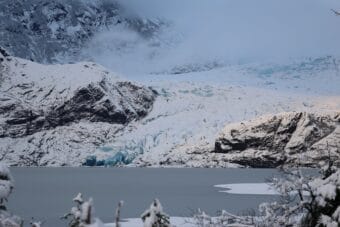
Mountains in Kachemak Bay State Park, seen from the Homer Spit on Oct. 14, 2023. (Jamie Diep/KBBI)
After a two-year-long lawsuit, personal watercraft like Jet Skis are once again banned on Kachemak Bay. An Alaska Superior Court judge ruled against the Alaska Department of Fish and Game in a case earlier this month.
Back in 2020, the Fish and Game repealed a jet ski ban that had been in place for nearly two decades. The ban extended through the Kachemak Bay and Fox River Flats Critical Habitat Areas, This spans nearly 230,000 acres, which covers most waters of the bay, as well as mud flats and marshlands on its northeast section.
Fish and Game Commissioner Doug Vincent-Lang argued that the department had the authority to repeal the ban because since 2001, jet skis changed to where they wouldn’t be more damaging than watercrafts allowed in the bay.
“We didn’t see any potential impact from allowing jet skis,” he said.
The Alaska State Legislature established these areas in the early 70s as especially important for fish and wildlife.
In response, Cook Inletkeeper, Kachemak Bay Conservation Society, Friends of Kachemak Bay State Park and the Alaska Quiet Rights Coalition filed a lawsuit against the department in 2021 to reinstate the ban.
Cook Inletkeeper co-executive director Sue Mauger said they filed the lawsuit over concerns about the jet ski’s impact on the bay compared to other watercraft.
“Just the way that it moves in shallow waters, typical behavior that’s used on those is very different,” she said. “They don’t tend to be a transport from A to B, and they tend to be in groups, and they tend to, again, be in shallower habitats that are really critical for, juvenile fish or nesting birds.”
Judge Adolf Zeman ruled in favor of the plaintiffs, basing the decision on two reasons.
First, the statute establishing critical habitat areas to repeal the jet ski ban did not give the commissioner the authority to repeal the ban.
Second, the order stated repealing the ban was inconsistent with the statute’s intent. In this case, the department has the authority to create and repeal regulations with protecting fish and wildlife in the area as its primary goal. The court decided repealing the ban did not align with that intent.
However, Vincent-Lang still disagrees with the decision.
“We’re very perplexed with the judge’s ruling,” he said. “We seem to have the ability to adopt a regulation that prohibits jet skis, but we don’t have the ability to revisit that regulation based on current science.”
Moving forward, he says the department plans on filing a motion for reconsideration, or to appeal the decision in a higher court.
Snow dusts trees on a mountain in Juneau on Nov. 30, 2023. This week’s forecast doesn’t call for enough snow to open Eaglecrest Ski Area. (Katie Anastas/KTOO)
Juneau skiers will have to wait at least one more week to ski Eaglecrest. The city-owned ski area’s opening date has been tentatively pushed back to Dec. 9.
Eaglecrest had planned to open on Saturday. But at a Juneau Chamber of Commerce luncheon on Thursday, Manager Dave Scanlan said there isn’t enough snow in this week’s forecast.
“Unfortunately, Mother Nature has been playing her way with us this past week,” he said. “We’re pushing off our opening day for one more weekend, hopefully.”
Scanlan said Eaglecrest’s high-efficiency snowmaking machines can be up and running as soon as temperatures drop to 28 degrees. And they have seven more of them this year, bringing the total to 22.
Scanlan says that investment has helped bolster sales. Last year saw record purchases of season passes, and nearly as many have already been sold this year.
“People now can trust and have faith that we’re going to be able to deliver a good product,” Scanlan said.
But Scanlan said that as winter temperatures rise and the cruise season extends, the ski area is also looking at new ways to attract visitors.
Scanlan told luncheon attendees that warming winters are one of the reasons the gondola, which the city bought last year, will be such an important addition to Eaglecrest.
“It’s all about the sustainability of Eaglecrest, both from a climate sustainability and a financial sustainability standpoint,” he said. “As we have warm winter weather, the gondola is going to give us a lot of ability to not be so reliant on all our revenue coming in in the winter season.”
In an interview, he said the snow-making equipment runs best at 25 degrees or below.
In the summer, Scanlan said, the gondola could help people get to hiking and mountain biking trails from a stop partway up the mountain. In winter, they could snowshoe or Nordic ski. And he said longer cruise seasons could even give some tourists a chance to ski.
“I think as we’re having boats arrive earlier in the spring, there’s going to be some great learn-to-ski packages being sold as some tour opportunities,” Scanlan said.
Scanlan said he thinks Eaglecrest could comfortably handle about 500 summer visitors per day. A traffic analysis is still underway. He said the goal is to open the gondola during the 2025-2026 ski season.
A bull moose photographed by an Alaska Department of Fish and Game game camera on Mitkof Island in 2018. (Courtesy of Dan Eacker/ADF&G)
Hunters have reached a new high for the month-long moose hunt in Central Southeast Alaska: 141 bulls. The new record is nine more than the previous record harvest, which was set in 2021: 132 bulls.
The hunt was open Sept. 15 through Oct. 15. Hunters had until Friday to report their kills to the Alaska Department of Fish and Game.
Most of this season’s moose — 61 bulls — were harvested on Kupreanof, which is where hunters consistently rack up the most moose over the years. The second highest harvest — 31 bulls — came from Kuiu Island.
Frank Robbins, who manages the hunt area for the state, said that’s a remarkable change for the island, compared to the last few decades.
“It wasn’t that long ago when there was virtually no harvest of moose on Kuiu Island,” said Robbins. “Then, in the last six years, it’s kind of seen a skyrocket harvest.”
Petersburg’s Mitkof Island was another outlier. Twelve moose were also taken on the island, when only three bulls were harvested.
Over the past decade, moose hunters have set several records in the region, called RM038. Robbins says that’s because the moose are moving in. A couple decades ago, there were very few of them in the region — and the hunt was almost entirely relegated to the mainland. But over the years, he says he’s seen more moose cropping up on remote islands.
“The trend, lately, has been the distribution that gets expanded across Kupreanof into Kuiu, which largely accounts for the increase in the harvest over time,” said Robbins. “That’s sort of the big change. The harvest has sort of shifted westward. The moose have expanded from the mainland to these island habitats over time, and slowly increased in numbers. And that’s reflected in the harvest.”
Over the course of the month, hunters told state managers that they saw many total moose — meaning bulls, cows, and calves — across the hunt area. Robbins says that bodes well for future hunts. T
Joe Stock, author of The Alaska Factor and, now, The Avalanche Factor, skiing in the Alaska Range. (Peter Throckmorton)
It’s that time of year when Alaska’s backcountry skiers, snowboarders and mountaineers are thinking about enjoying the snow-covered mountains. And, of course, it’s on those snowy slopes that avalanches can strike.
Well, one of Alaska’s foremost backcountry ski guides and avalanche safety educators has a new book out on the subject.
Joe Stock’s “The Avalanche Factor” follows his well-known guidebook “The Alaska Factor.”
Stock says the new book is equal parts avalanche science and avalanche risk mitigation. And he says it’s the culmination of many years of experience and education prompted by a very unfortunate incident decades ago on the other side of the globe.
Listen:
The following transcript has been lightly edited for clarity.
Joe Stock: Yeah, I’ve kind of been interested in avalanches I guess since when I first went backcountry skiing as like a little kid. But then in my early 20s, in New Zealand, I was going to college in New Zealand, and a friend and I were descending from a climb on the third day, and we were really out of food, out of water, soaking wet, tired, and it stormed that night, and he was avalanched over a cliff and killed. And they didn’t find him for eight months. But that was when I realized that, you know, my understanding, that I needed to learn a lot more about avalanches. And they’re much more complex than I actually previously thought. But, you know, this avalanche education is a lifelong thing. You always find out more stuff that you need to know. So that was like the first time I realized, “Wow, this is really complicated. And there’s a lot to learn about this.”
Casey Grove: Yeah, no doubt. And, you know, sorry about your friend. I think a lot of people that do risk mitigation or, you know, are traveling in the backcountry in different ways, have, unfortunately, similar stories. A friend that was close to them passed away, and it motivated you to learn more.
What can you tell me about the unpredictability of avalanches? I mean, I feel like there’s information, and people talk about what the danger level is for a particular day, but it’s a little bit more complicated than just like a green light, yellow light, red light kind of thing, right?
Joe Stock: Right, yeah, that’s very true. Yeah, there’s only so much you can actually know about the avalanche conditions in the snowpack. And then the key there is recognizing that there’s this inherent uncertainty and you don’t know it all. Sometimes, you know more, like when it’s frozen into a brick on a spring morning, but most of the time in the winter, there’s a lot you don’t know about the snowpack. So you add these margins of safety, just to stay away from that potential avalanche. So margins for safety, you’d be spreading out, stopping the safe zones, spotting your partner, turning around — turning around a lot, just based on like a bad feeling — starting on small terrain, and then maybe go into bigger terrain, if everything aligns. So it’s, yeah, adding these margins of safety, because you don’t really know exactly when it’s going to avalanche or not avalanche. So acknowledging that and putting those margins of safety in place to account for that uncertainty.
Casey Grove: Yeah. You’ve written about a lot of different stuff at stockalpine.com, in the posts that you do there and trip reports and things. And one that just kind of popped into my head, you were talking about kind of the difference between, you know, “Were we smart, and that’s the reason why we avoided an avalanche today? Or did we just get lucky?” And I wonder if you can tell me a little bit more about that.
Joe Stock: Yeah. Are we smart, or were we lucky? Are we really good? Are we lucky? So that’s, that’s a great question. Because a lot of these avalanche decisions you make, you can have a good outcome, but it doesn’t mean you made a good decision. You know, luck is a real thing in avalanches, and we all know that. It’s kind of like this taboo subject that we almost don’t really talk about, but luck is real. And the more you practice, and the more you learn, and the more you debrief, and the more you gain knowledge, the luckier you’re gonna get.
Casey Grove: I think I read in a note about the book release that you said it had taken four years to write this book. So why did it take you so long, Joe?
Joe Stock: Yeah, it took me four years to write this book, because it’s a complicated topic. You know, writing the guidebook, “The Alaska Factor,” took a year, because it’s relatively straightforward. It’s just like getting the stuff in my head down on paper. But the avalanche topic, there’s so much to it and trying to wade through what’s important and what’s not important, and then put this in a logical order, so you can read the book all the way straight through. Getting the thing initially written took a year, and then I took a year to revise that on my own. And then I took another two years to get edits from other people. And that was a really interesting and a great learning process to talk to so many knowledgeable people about avalanches.
Casey Grove: You know, this is not my personal opinion, but people will say, “Well, why do you even go there to begin with?” Because it’s inherently dangerous. And, you know, if you just stayed home, you would be mitigating the risk, like, almost 100%. So why even do this?
Joe Stock: Yeah, going backcountry skiing is dangerous. Well, there’s ways of reducing your danger down enough, your risk down enough, to a level that you feel comfortable with. I mean, there’s always the inherent danger out there that you’re exposed to. But, you know, going out in the backcountry and exposing yourself to these dangers is part of living a complete life and being alive. You know, if you’re not exposed to any danger, then it’s like, well, I guess, what is life? So it kind of adds so much being in the backcountry and learning how to manage those risks and reduce them and trying to make smart decisions, and it is part of living a full and complete and happy life.
The Okeanos Explorer live streams a lot of their expeditions. (Courtesy of Okeanos Explorer crew)
The Okeanos Explorer, an exploratory vessel operated by the National Oceanic and Atmospheric Administration, discovered an unidentifiable golden orb deep in the Gulf of Alaska late last month. The orb ended up making national headlines for stumping the ship’s scientists.
The attention came as a surprise, said expedition coordinator Sam Candio.
“I’m not even sure that that was the most interesting thing on that dive,” he said. “We, aboard, pretty much forgot about it. And then once it started getting all the media attention, it was just like, ‘Oh, that’s what everybody’s focused on.’”
Researchers still haven’t been able to identify the golden orb.
“We don’t know what it is, and I haven’t gotten any compelling ideas from people ashore. But a lot of theories right now are kind of the same ones that we had when we first came across it,” he said. “It could be some sort of sponge, maybe a coral, I’m kind of on the egg-case train.”
It was found about about 2 miles under the ocean’s surface during the ship’s work along Alaska’s coastline.
Underwater, the orb was a bit more circular and had kind of a golden shine, but when their drone brought a sample to the surface, it was a matte brown and had a flaky texture with a hard center.
Scientists used an aquatic drone to bring it to the surface for testing. (Courtesy of Okeanos Explorer crew)
Scientists aboard the ship took several photos and ran tests. Candio said the crew will have to send the orb along with a myriad of other potential new species to the Smithsonian National Museum of Natural History in Washington, D.C., for further analysis.
“We got a lot of things that are new to science, which is really exciting,” he said. We’re processing them, making sure that we get them all packed away safely.”
He said while the orb intrigued the crew, they were more fascinated on this particular dive by seeing octopi tending to eggs – that’s previously been a rare sight. In their time in Alaska, the scientists found several octopi tending to eggs, with 10 mothers off the coast of Kodiak Island.
The Okeanos Explorer is about to complete its work in Alaska. The ship’s last stop is in Seward, and then the crew will head to San Francisco for the winter. Candio said he was glad to visit so many places around the state.
“Just seeing how incredible all the life and the landscapes and the geology and how diverse and beautiful it was with crazy coral forests and chemosynthetic communities, and pretty much everything you could hope to see,” he said. “It’s amazing to see that both on land and at sea.”
The boat is scheduled to begin mapping waters around Hawaii next year.
A livestream set up by Explore.org in the Katmai National Park for bear enthusiasts captured a missing hiker pleading for help on Sept. 5. (Screenshot by NPR/Explore.org)
A handful of wildlife enthusiasts were probably hoping to catch a glimpse of Katmai National Park’s famous brown bears when they logged on to a livestream of a remote Alaska mountaintop last Tuesday. But the resident celebrities were nowhere to be seen when a distressed hiker walked into view instead and pleaded for help.
The scene unfolded on the Dumpling Mountain livestream, one of 12 camera views operated by Explore.org inside the Katmai National Park.
Around 3:30 p.m. local time on Sept. 5, a man in a green rain jacket, wet and disheveled, appeared on screen and looked straight into the lens, clearly mouthing the words “help me.” He returned a few minutes later, giving a thumbs-down signal.
“There is someone distressed on the camera,” one viewer posted in the rolling comments beneath the stream. That message was seen by a volunteer chat moderator, who in turn messaged a Katmai park ranger.
After reviewing the footage, the ranger mobilized a search and rescue team, which found the man just about three hours later, not far from the site of the web camera.
Bear Cam saves a hikers life! Today dedicated bear cam fans alerted us to a man in distress on Dumpling Mountain. The heroic rangers @KatmaiNPS sprung into action and mounted a search saving the man. – more details to come. pic.twitter.com/JzgfApK371
The man was ultimately unharmed, Cynthia Hernandez, a spokesperson for the National Park Service, told NPR in an email. She added that the rangers were notified of the distressed hiker directly thanks to the concerned viewers.
When the chat moderator shared this news with the viewers, there was a flood of kind words and a sweet celebration.
“Aaaand I’m crying because I’m so relieved,” posted the user who originally flagged the man’s appearance. “Those rangers made it up there fast!”
Dumpling Mountain isn’t typically a popular livestream
The cameras have been around since 2012, but really started to take off in 2014, with the advent of Fat Bear Week — a delightful man-made tournament in which the public votes on which of the park’s bears has grown the most rotund as preparation for their winter hibernation. (This year’s Fat Bear Week has yet to be announced, but the competition usually lands in early October).
Roughly 10 million people tuned in to the Katmai live streams last year, according to Mike Fitz, a naturalist with Explore.org who previously worked as a ranger at the park.
But most of those views went to the cameras trained on Brooks Falls, where the bears make daily stops during salmon spawning season.
Sitting about 2,200 feet above sea level, the Dumpling Mountain camera is more of a “scenery cam than a wildlife cam,” Fitz said.
Stunning sunsets, like this one highlighted by Explore.org, are a main reason to tune in to the Dumpling Mountain live camera. (Screenshot by NPR/Explore.org)
The camera auto-pans across a sweeping vista: Colorful alpine tundra shrubs dot the landscape while the largest lake in a U.S. national park (Naknek) stretches out in the foreground. Some of Katmai’s 14 active volcanoes are visible in the distance.
But that height comes with tempestuous weather, which can often obscure the view and offers little in the way of shelter and food for the kind of big-ticket animals viewers crave. When NPR checked the stream on Friday morning, only 12 people were watching.
The camera itself is about 2 miles away from the nearest trail, which is described by the National Park Service as a “strenuous hike” featuring “steep portions” and some overgrown areas.
The climb rises 800 feet over 1.5 miles and ends about 2.5 miles from the actual summit of the mountain, but an unmaintained footpath continues on for a while before petering out.
Fitz says that makes it “a great place to find some quick solitude away from the river, away from the bears,” but also shrouds the path in danger.
It’s still unclear how the hiker found the remote camera
Cell service and shelter can be hard to come by on the rounded and short-shrubbed mountain peak.
And, during poor conditions, like the kind that set in on Sept. 5, “You really have no sense of direction,” Fitz said. “The landmarks you saw on the way up disappear when the clouds come down.”
The 4.1-million-acre Katmai National Park is tucked between the Pacific Ocean and the Bering Sea, making it a prime spot for storms in any season.
Rain and wind were detectable on the camera Tuesday. Due to fog, the visibility appeared to be about 50 feet or less.
It’s still unclear how the hiker found the camera installation. Fitz says the collection of solar panels and wind turbines sticks out amid the short vegetation, but it still isn’t huge — maybe about 20 to 30 square feet total.
“This was certainly a first for us,” Fitz said of the hiker asking for help, though wildlife viewers around the world have flagged pressing emergencies before, like an injured elephant at a Kenyan wildlife sanctuary.
“Our webcam viewers, collectively, are very sharp-eyed and they don’t miss much,” he added.
That was evidenced again on Sunday, when Dumpling Mountain’s viewers, still recovering from the stress of seeing the hiker, caught sight of a big thing in a slim six seconds of the stream: A brown bear, rambling across the camera’s view, miles away from his typical hangouts.
Copyright 2023 NPR. To see more, visit https://www.npr.org.
Close
Update notification options
Subscribe to notifications
Subscribe
Get notifications about news related to the topics you care about. You can unsubscribe anytime.