Flowers bloom in the Rainbow Foods garden in Downtown Juneau on April 3, 2024. (Photo by Chloe Pleznac/KTOO)
With the spring equinox behind us and a stretch of sunny, warm days over the last few weeks, it feels like spring has arrived full-force in Juneau. Trees are budding, birds are singing, and things are starting to stir in the earth.
Master Gardener Ed Buyarski says it’s time to start doing the garden prep that will set you up for success later in the season.
“It’s a time for cleanup in the garden, if we didn’t do cleanup last fall,” he said. “Getting all the old cabbage and broccoli plants out of there, and other slimy stuff. Removing slug habitat is a good start. Greenhouse clean up, tidying up. And, if folks are like me — we had a greenhouse collapse this winter — getting that new greenhouse on order or rebuilt.”
Buyarski also suggests that gardeners should get their own bodies ready for the physicality of the growing season.
“One thing for me that I have found helpful as I have become rather mature is getting in ‘garden shape,” he said. “That’s doing some stretching exercises each day. Getting the shoulders exercised, stretching out the back and the legs and all of the rest of that.”
And as far as our recent weather? Buyarski says to pay attention to warmer days for opportunities to start the growing season off on a good foot.
“A gradual warm up is good. That’s what we want. Waking up soil microorganisms if we’re mixing in some compost and some organic fertilizers and making sure to have your garden beds covered with clear plastic right now so the soil can warm up,” he said.. “We’re trying to encourage everything to grow better, whether the clear plastic is directly on the soil, or we have hoops with clear plastic over them, little mini greenhouses — all of that will help.”
If you have questions or ideas for future Garden Talk features, please email chloe.pleznac@ktoo.org or leave a message at (907) 463-6492.
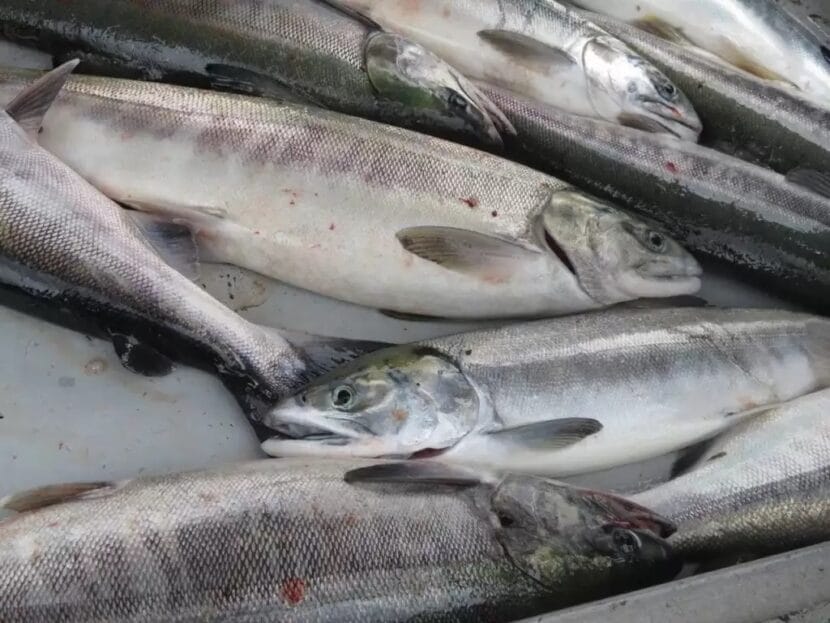
Salmon lie on the deck of a commercial fishing boat. With refinements to eDNA tracking methods, researchers can now collect data about what fish were present in an area up to two days after the fish have left the area. (Meredith Redick/KCAW)
Scientists have many ways to track fish populations – but they usually require seeing the fish. Now, researchers at the National Oceanic and Atmospheric Administration are refining a method to collect data about what fish were present in an area — up to two days after those fish have moved on.
Diana Baetscher is a research geneticist at NOAA’s Alaska Fisheries Science Center in Juneau. She said that when fish swim, they shed scales, slime, and other tiny fragments into the water. Those fragments contain DNA – and they can provide a breadcrumb trail for scientists looking to learn about fish populations.
“eDNA is environmental DNA,” Baetscher said. “It’s sort of a really simple concept. At its heart, it’s the fact that all organisms shed DNA or genetic material into the environment, and that can be water or air or soil.”
Baetscher said collecting environmental DNA is less time-intensive than some other methods. Scientists can scoop up seawater and test it to get a picture of what species of fish have recently passed through.
“eDNA has sort of grown as this way of trying to shortcut some of the amount of time that goes into those other ways of counting fish,” she said.
Baetscher is the author of a paper published on March 12 that will help scientists better interpret the data in those scoops of seawater. She says that while the signs can stay in the water for up to 48 hours after fish leave an area, that signal might be affected by factors such as tide and water temperature.
“So you know, if you have a really strong current downstream of a whole bunch of fish, do you see that signal changing because the current is changing, or the wind is changing, or the tide is changing? So, you know, we actually need to study the movement of the eDNA separate from the fish to be able to then use that to understand something about fish.”
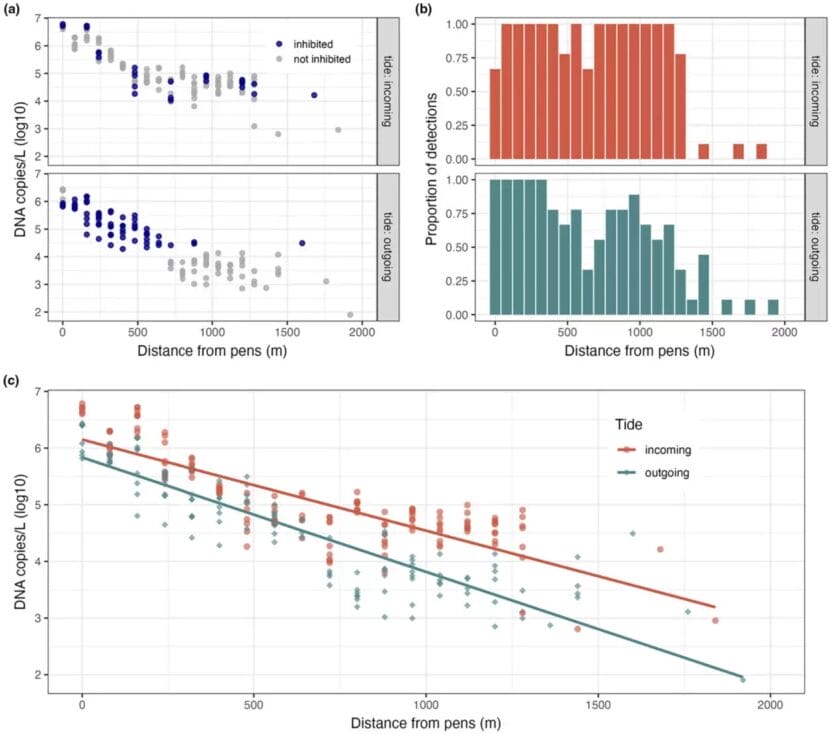
Baetscher looked to net pens full of hatchery chum salmon in Juneau’s Amalga Harbor for a dense, consistent source of eDNA. She found that the signal left by the chum salmon was strongest at the water’s surface, and it disappeared faster during outgoing tides. Baetscher said this study was just one step towards making eDNA a more useful tool. In the meantime, eDNA is already being used to expand where scientists can track fish — like for Arctic fish communities under sea ice.
A figure from the March 12 paper shows that eDNA signs get weaker with distance from the net pens, and that the effect is stronger during an outgoing tide.
“Another that we’re really excited about is looking at changing species distributions in the subarctic and the Arctic,” she said. “What do those fish communities look like, and how much are they changing year over year and throughout a calendar year?”
Baetscher hopes the data collected by filtering water under the sea ice will give researchers a snapshot of fish communities that they otherwise would be unable to access.
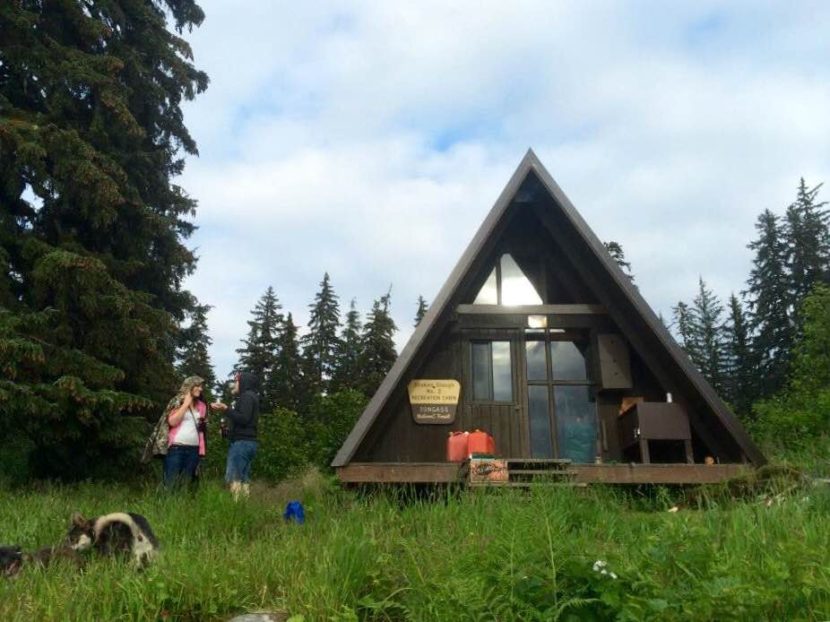
Campers arrive at the Shakes Slough U.S. Forest Service cabin on the Tongass National Forest. (Photo by Katarina Sostaric/KSTK)
It’s been nearly three decades since the U.S. Forest Service released their first management plan for the Tongass National Forest.
During a presentation at the Juneau Economic Development Council’s Innovation Summit last week, Southeast Alaska’s Deputy Forester Chad VanOrmer said it’s time for an update. The development of a new Tongass forest plan will inform the agency’s management decisions for the next 15 to 20 years.
“The Forest Plan is really kind of a compass, is how I like to look at it,” VanOrmer said. “It gives a direction on our desired future outcomes.”
The existing management plan was developed in 1997. Since then, there have been some amendments concerning timber management and the transition from old growth to young growth logging. But otherwise, the original plan has remained largely untouched.
In many ways, it fails to keep up with the modern-day opportunities and challenges in the Tongass.
For instance, when VanOrmer started his Forest Service career on Prince of Wales Island — just a few years after the original 1997 plan came out — there were only about 500,000 cruise ship passengers visiting the Tongass region annually.
“I call it the ‘Field of Dreams,’ because we were doing a lot of ‘build it and they will come,’” he said. “So we were investing a lot of money in building trails and cabins and all sorts of recreation infrastructure for a tourism and recreation industry that was yet to actually arrive.”
Now the tourism boom has arrived in full force, with 1.7 million cruise ship visitors last year. And the number of tour guiding businesses in the forest has more than doubled, from 68 in 2000 to at least 177 today.
Time has also revealed new threats that will shape the Tongass and the communities that rely on it. VanOrmer said climate resilience planning will be a priority in the new plan.
“In 1997, climate change wasn’t even a thought in the forest plan – it wasn’t even really contemplated,” he said. “And here we are today where it’s really frontline, headline news and we have a forest plan currently that doesn’t really prepare ourselves for it.”
To make a plan that works for the present day, the agency wants to strengthen relationships with community organizers and tribal governments.
VanOrmer said the introduction of the Southeast Sustainability Strategy in 2021 set a precedent for that by sending millions in funding to tribal and Indigenous organizations for sustainable development projects — things like forest restoration, trail work and Indigenous cultural education projects.
A lot of that work has already begun.
“We have multiple crews that are working, doing stewardship on the landscape. But they aren’t Forest Service crews,” VanOrmer said. “They’re local tribal crews, they’re other youth crews, they are other scientists coming to the table and really wanting to roll up their sleeves and expand the capacity and scope and breadth of the work here on the National Forest. “
VanOrmer said the new Tongass Forest Management Plan will set the foundation up for more projects like that.
The Forest Service will spend the next year hosting workshops around Southeast Alaska to gather input on the next version of the plan. It will likely take two to three more years to develop a final version.
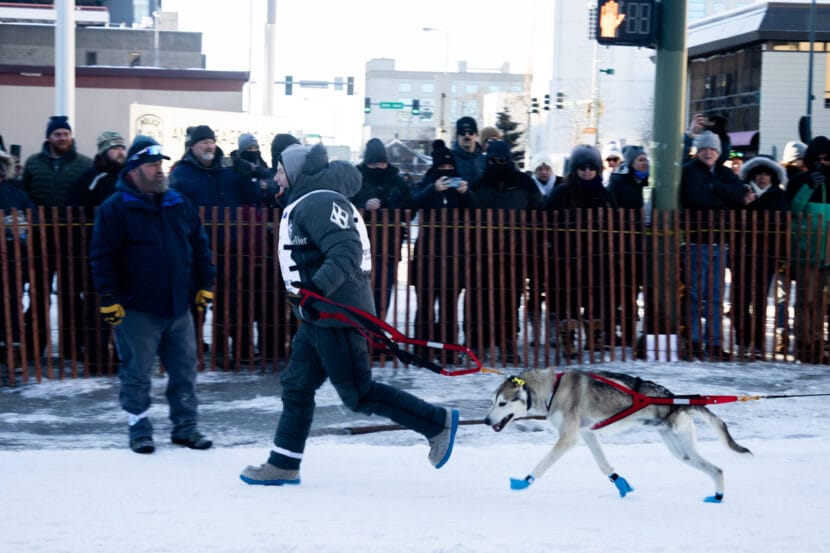
Dallas Seavey runs with Whopper toward the Iditarod ceremonial starting line on Saturday. (Adam Nicely/Alaska Public Media)
Top 2024 Iditarod Trail Sled Dog Race contender Dallas Seavey shot and killed a moose to defend himself and his dog team early Monday about 100 miles into the 1,000-mile race, officials said.
Seavey’s team was about 14 miles past the Skwentna checkpoint when the moose “became entangled with the dogs and the musher on the trail,” according to a statement from the Iditarod. Seavey shot the moose in self-defense and notified race officials at about 1:45 a.m. Monday, the statement says.
When he arrived at the Finger Lake checkpoint at about 8 a.m. Seavey was forced to drop a dog that had been injured in the encounter with the moose, the statement says. Seavey’s kennel identified the dog as Faloo. Race officials said the dog was flown to Anchorage and was in the care of veterinarians.
Race rules allow Iditarod mushers to carry firearms for protection from large animals like moose, but they must stop to gut any big game animal they shoot so it can be salvaged. The rules also say that any mushers who come upon a fellow competitor in the process of gutting a game animal must stop and help, and they’re not allowed to pass until the musher who killed the animal has continued on the trail.
Seavey spoke about the early morning incident to the Iditarod Insider crew in Finger Lake.
“I gutted it the best I could, but it was ugly,” he said.
Race Marshal Warren Palfrey said in the statement that efforts had been underway to salvage the moose meat.
Another Iditarod veteran, Jessie Holmes, had mushed through the same section of trail ahead of Seavey and told the Insider he had also seen an angry moose, possibly the same animal.
“I had to punch a moose in the nose out there,” he said. “Oh my gosh.”
Fellow race veteran Paige Drobny saw the moose up close after it was shot, and so did mushers behind her on the trail.
“It’s dead in the middle of the trail,” Drobny told the Insider. “Like my team went up and over it.”
Gabe Dunham’s dog team hit it, too.
“There happened to be a dead moose in the trail, that kind of flipped the sled,” she told the Insider. “I did laugh and think, ‘Man, even when they’re dead they’re still getting me.’”
Bailey Vitello described it as “the experience of a lifetime.”
“I can’t say I’ve ever ran a 16-dog team over a moose, so that was kind of interesting,” he told the Insider. “It was an experience, you know, that’s what Iditarod is all about, is having experiences. And that was a cool one to say I did. So check that one off the bucket list — don’t know if I want to do it again, but it was cool.”
He said the moose carcass was around a corner, and he had to go over it because if he tried to stop, he worried his team would try to eat it..
Palfrey, the race marshal, said in the statement that he would continue to gather information about the incident.
By late Monday afternoon, Seavey and his 15-dog team had continued down the trail, and were just beyond the Rainy Pass checkpoint at race mile 153.
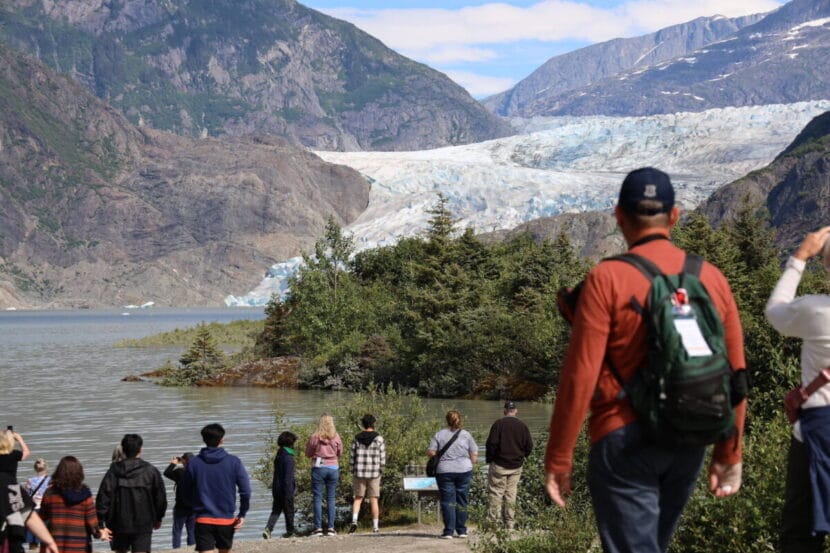
Mendenhall Glacier Visitor Center in July, 2023. (Clarise Larson for the Juneau Empire)
This summer, there will be a new type of guide at the Mendenhall Glacier, one whose job it is to educate visitors about how Lingít history is intertwined with the glacierʼs.
The role is part of the new co-management strategybetween the U.S. Forest Service and the Central Council of the Tlingit and Haida Indian Tribes of Alaska.
Tlingit and Haida President Chalyee Éesh Richard Peterson says that, in the past, staff at the glacier wouldnʼt know what to say when visitors asked them about the Indigenous history of the area.
“The feds at the time out there at Mendenhall said ʼWell, they didnʼt have anything to do with glaciers.ʼ And that was kind of dumbfounding to us,” he said. “Iʼm Kaagwaantaan, we have migration stories about the glacier. I think everyone does. We have songs and stories about the glacier.”
Now, Peterson said, this position will allow for the hundreds of thousands of annual visitors to the glacier to understand the history and original language of the area more deeply.
“I think if you want them to have an authentic experience — a more inclusive experience — then the voice of our people need to be out there in that representation, and so weʼre moving towards more opportunities for co-stewardship and make sure that our voices are represented out there.”
Itʼs not just for the benefit of tourists, he said. Roles like these reinforce the Lingít communityʼs place on the land and in its caretaking.
“That weʼre still here and that our language should be valued and our placenames should be valued, and as all people, we should be valued,” Peterson said.
The Tribe plans to hire up to four people for the job. It’s a seasonal position, from March to September, with a training period before the cruise ships start arriving. Ambassadors will be paid $20 an hour.
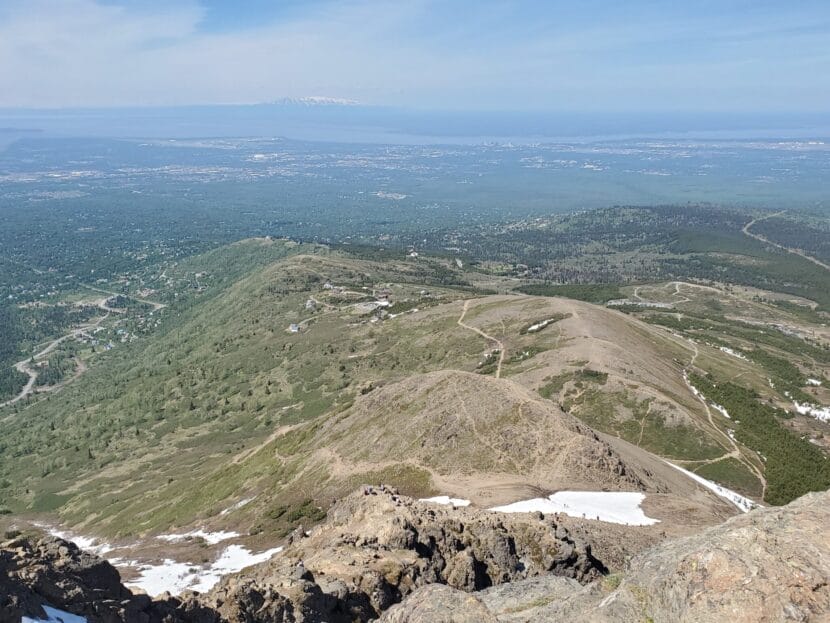
Braided trails created by crowds of hikers are seen on May 30, 2022, from the top of Flattop Mountain in Anchorage’s Chugach State Park. (Yereth Rosen/Alaska Beacon)
Trail advocates are asking legislators to appropriate more than $20.3 million for 21 projects envisioned as part of a system connecting more than 500 miles of trails between Fairbanks and Seward.
The request, from the nonprofit organization Alaska Trails and its coalition partners, would help continue steady progress to creating what is being called the Alaska Long Trail, a network that would run from the Resurrection Bay coast of the Kenai Peninsula to the boreal forest of Interior Alaska. The campaign seeks to improve, expand and link existing trails to create a system in Alaska that is similar to the Appalachian Trail on the East Coast or the Pacific Crest Trail on the West Coast.
Much has already been accomplished to make the Alaska Long Trail vision a reality, Haley Johnston, deputy director of the nonprofit organization Alaska Trails, said in a presentation Tuesday at the state Capitol in Juneau. Trail expansions and improvements have already been completed, and more are underway, she said.
Perhaps most notably, Johnston said, is that visitors to Alaska and outdoors enthusiasts who live here are taking notice of the Alaska Long Trail idea.
This year, visitors are expected to be hiking from Seward on the coast of the Kenai Peninsula to Eagle River, the woody community on Anchorage’s northern outskirts. There are a few missing trail sections between those spots, but there are options for passing through them, she said.
“We’re excited that the little sections that we’re missing are small enough now that they won’t be prohibitive to folks coming and doing this section of it,” she said. “So we’re going to see folks hiking that Seward to Eagle River section, stopping in businesses along the way, camping in campgrounds, staying at hotels, going to the brewery in Girdwood, all of the economic benefit that we’re hoping to see will finally have some numbers about that.”
Also ongoing this year is a sweeping feasibility study by the U.S. Bureau of Land Management and funded with federal appropriations secured by Sen. Lisa Murkowski, R-Alaska, to consider whether the Alaska Long Trail can be designated a National Scenic Trail. Such a designation would help secure more federal funding while relieving the state’s funding burden and continuing northward progress, Johnston said.
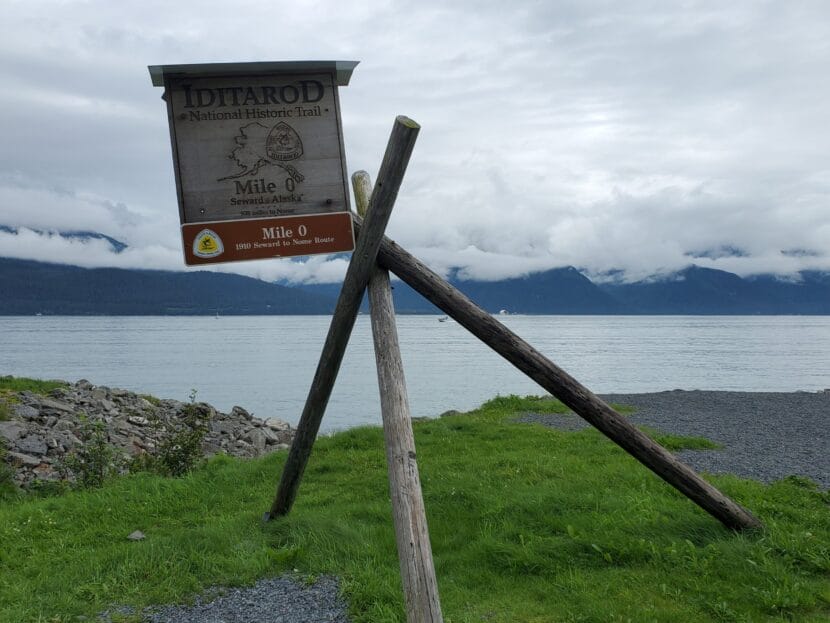
The southern tip of the historic Iditarod Trail, seen on Aug. 27, 2022, is at the edge of Resurrection Bay in Seward. The Alaska Long Trail project envisions this as the southern terminus of a 500-mile trail network stretching north to Fairbanks. (Photo by Yereth Rosen/Alaska Beacon)
For the state legislature’s consideration this year, almost all of the Alaska Long Trail-related budget requests are for projects in the Municipality of Anchorage and the adjacent Matanuska-Susitna Borough, which combined hold a little over half of the state’s population. Funding requests this year range from $60,000 for the design of trail improvements at Peters Creek Valley in Anchorage’s Chugach State Park to $3.5 million for the design and engineering of a 7-mile trail between Carlo Creek and McKinley Village just outside of Denali National Park and Preserve.
Among the highest priorities on the wish list concerns one of Alaska’s most heavily used hiking sites: Flattop Mountain in Chugach State Park. The request is for $2.7 million to realign trails on the mountain that have deteriorated through time and use to the point where they pose a safety hazard, sometimes spurring the need for emergency responses, according to the project description.
As they seek state funds, Alaska Trails and associated advocates have been pitching trail projects as worthwhile economic investments.
The U.S. Bureau of Economic Analysis, which in recent years started measuring economic impact of outdoor recreation nationally and within states, has calculated that outdoor recreation accounts for 4% of Alaska’s gross domestic product. That percentage is near the top among states, just behind Montana, Wyoming, Vermont and Hawaii, according to BEA calculations, Johnston said in her presentation. Additionally, Alaska outdoor recreation jobs grew by 14% in 2022, the third-highest growth rate among U.S. states, she said.
More generally, trails help draw people to live in Alaska or keep them here, making them a “nice antidote to outmigration,” Johnston said.
“I know that I showed up in Alaska at the ripe age of 20 to do some outdoor recreating and then promptly decided to live here for the rest of my life and buy a house and get married and create a community. And I’ll never leave, in large part because of outdoor recreation,” she said.
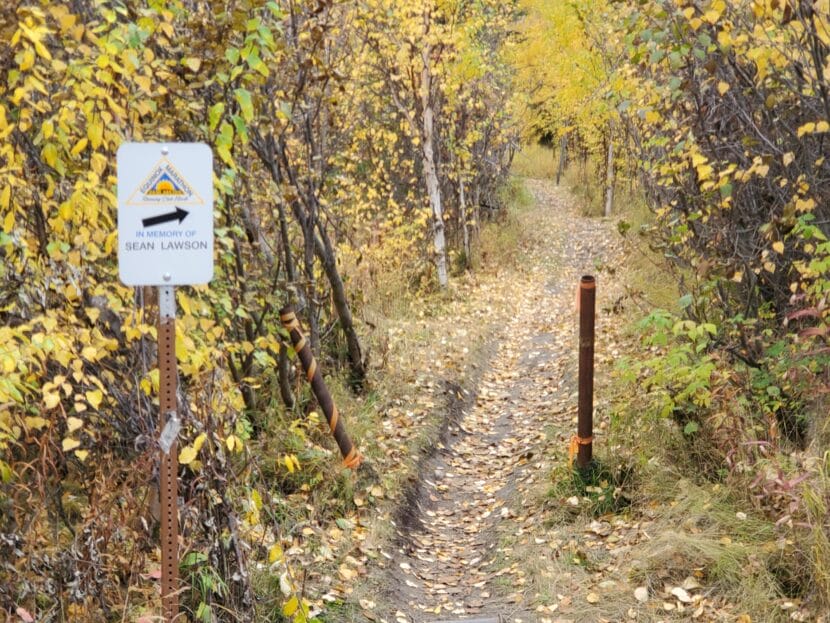
Fall colors are displayed on Sept. 18, 2022, along a section of Equinox Marathon trail in Fairbanks that leads uphill on Ester Dome. The Equinox trails would be incorporated into the Alaska Long Trail, under the project plan. (Yereth Rosen/Alaska Beacon)
If experience in Juneau is any guide, only a minority of the desired Alaska Long Trail projects will win funding in the budget that legislators are assembling this year.
The budget for the current fiscal year, which ends on June 30, funded three projects for $1.43 million; while Alaska Trails and its partners had requested $9.4 million for 13 projects. The previous year, the budget provided $4.22 million for seven projects; Alaska Trails and its partners had requested $14.75 million for 15 projects.
Among the rejected budget requests, some had been approved by lawmakers but were vetoed by Gov. Mike Dunleavy.
There are multiple other sources of money for the trail projects that far outweigh state contributions, however.
Aside from federal funding, which through 2023 amounted to about twice the amount that came from the state, money has come from sources outside of government through nonprofit organizations, Johnston noted in her presentation.
One example is the Mellon Foundation, which has provided $1.7 million for Indigenous language signage along Anchorage trails. Work on that project, which aims to erect 32 place-name signs, has already started.
Budget request rejections and Dunleavy vetoes notwithstanding, support for trail projects is widely popular among legislators.
“‘Trails is usually our favorite topic,” Sen. Kelly Merrick, R-Eagle River, said during Tuesday’s presentation, which she organized. She noted that most of Chugach State Park lies within her district. “People in Eagle River love their trails. But not just Eagle River. It’s everyone from across the state.”
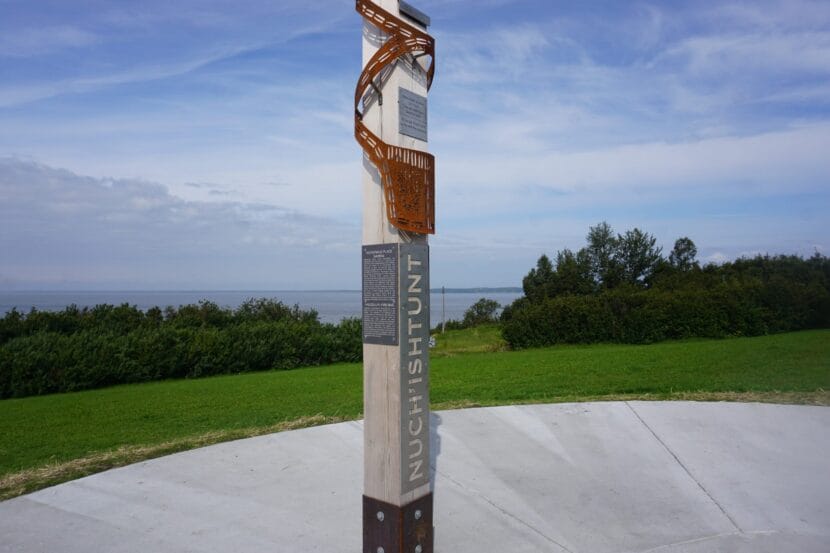
A signpost at the site Anchorage residents commonly call Point Woronzof, seen on Aug. 21, explains that the Dena’ina name is Nuch’ishtunt. meaning “the place protected from the wind.” The sign, dedicated on Aug. 18, 2023, is the fourth in a program that is intended to result in 32 Dena’ina place-name signs around the city. In the background is Cook Inlet, which bears the Dena’ina name Tikhatnu, meaning “big water river.” (Yereth Rosen/Alaska Beacon)
The recreational value of trails became evident during the COVID-19 pandemic, when use skyrocketed, she said.
“I think it’s fantastic because it’s something that your whole family can enjoy. And this is really going to bring a lot of economic opportunity to some of our smaller communities along the way,” Merrick said.
The overarching project is again being called the Alaska Long Trail, even though its promoters last year selected a new name – the Alaska Traverse – to differentiate it from other major trail systems like Vermont’s Long Trail.
That reversion was done for bureaucratic reasons, Johnston said during her presentation on Tuesday. While Alaska Trails and its coalition partners have flexibility to change the name, Congress and the BLM do not, she said. To reduce confusion, all parties will be using the same Alaska Long Trail name, at least until the BLM finishes its feasibility study, she said. “Once that’s done, we’ll reapproach what the long-term name is going to be.”