Outdoors

Juneau mushroom enthusiast grows community connections through edible fungus business

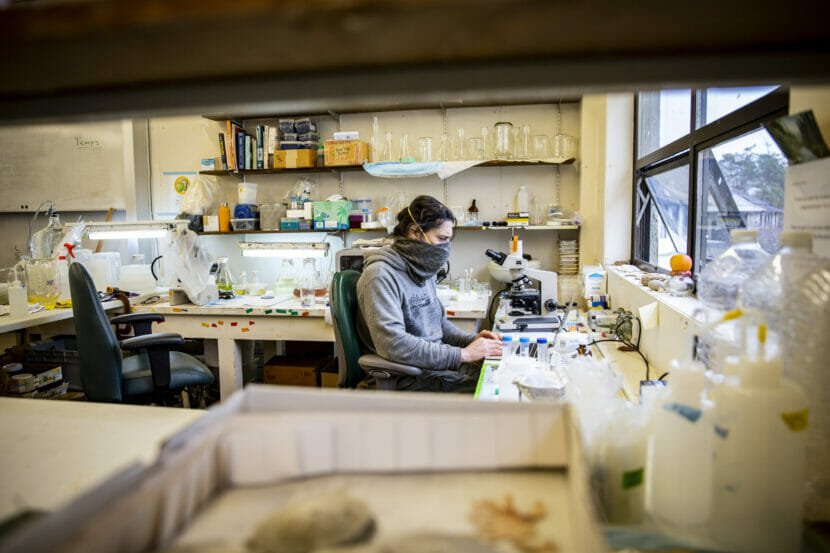
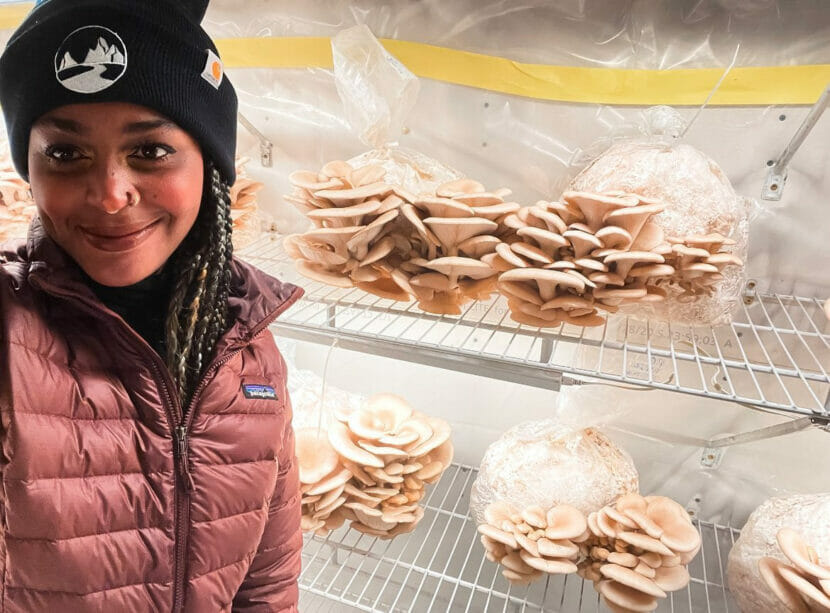
Alannah Johnson in her “incubation room” where she prepares new batches of fungi to sell through her business, New Earth Fungi. (Photo courtesy of Alannah Johnson)

Alannah Johnson fell in love with the fungi of Juneau’s rainforest nearly a decade ago.

Now, she’s selling delicious mushrooms from her gourmet and medicinal mushroom farm, New Earth Fungi.

On a snowy day at the Brotherhood Bridge Trail, Alannah Johnson recalls the lush green of summertime.

“This whole entire area would just be like, covered with moss. And it kind of reminds me of a little fairyland,” she said.

As her boots crunch along the trail, she stays vigilant, peeking around trees.

“Under a branch or like the space in the bottom of a tree. There’s usually mushrooms in there,” she says.

In the February cold, there are only conks, a woody, bitter shelf mushroom. But Johnson says the forest is abundant with edible mushrooms during the rest of the year. Plump white puff balls as the summer begins, the golden-yellow “chicken of the woods” later in the season, and trumpet-shaped winter chanterelles as summer turns to fall.

Johnson has a passion for microbiology, and a sharp eye for the tiny details of mushroom identification. Subtle differences in colors, shapes and even the spores of fungi help her to tell them apart. And her drive to find them keeps her in tune with the forest.

“I just love the challenge of looking for mushrooms and like paying really close attention to detail,” she said.
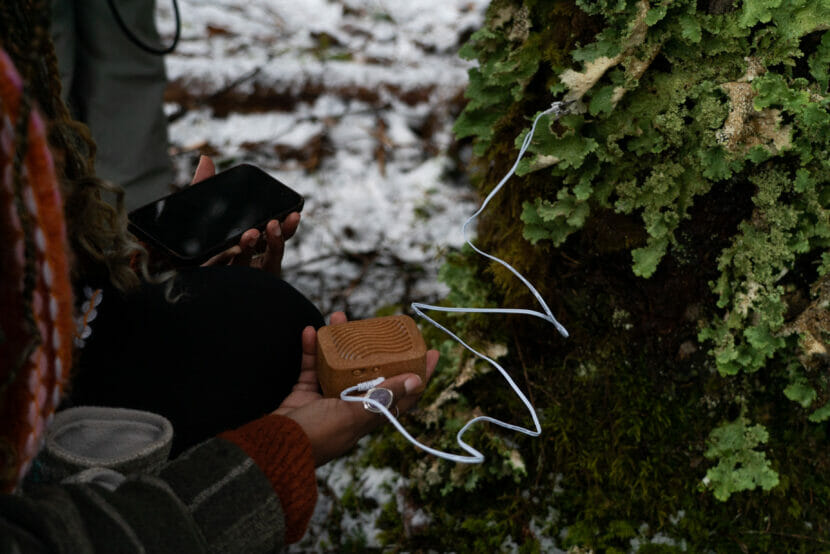
Mushroom enthusiast and owner of New Earth Fungi Alannah Johnson uses a device to record the sounds of mushroom “music”. (Photo by Andrés Javier Camacho/KTOO)

She says mushrooms have helped her feel more connected to nature and the food she eats. And those values are the core of her business New Earth Fungi.

Mushrooms have always been a hobby for Johnson. Growing up in California, she started by cultivating shiitakes on logs. But the hobby grew to a full-on passion after she transferred to the University of Alaska Southeast during her sophomore year.

She was taken by the diversity of Southeast’s forests, where she made frequent trips for “mushroom forays,” gathering mushrooms to identify, study and eat. As the founder of the UAS mycology club, she started inviting others to join her.

“I put up some fliers announcing my first foray. And I was really shocked at how many people showed up. I think the first group was about 35 people,” she said. “I didn’t realize that there are other people who were also super passionate about learning about fungi.”

Now, Johnson regularly leads forays for tourists and locals alike. Equipped with wicker baskets and a stack of field guides, she works to demystify fungi as food.

Johnson always knew she wanted to share her passion for mushrooms with others, but she didn’t know how until the pandemic hit. She was doing a post-grad stint as a Peace Corps volunteer in the Caribbean.

“And all Peace Corps from all around the world were evacuated back to the U.S.,” she said. “So I was just like, I don’t know what I’m gonna do. I felt depressed about the whole situation. And then I was like this is the time to start my mushroom business.”

Johnson had no experience as an entrepreneur, but she knew there was a demand for locally-sourced mushrooms. So she started by cultivating them in her home. Her first batch was oyster mushrooms, a popular fluted fungi known for its mild savory flavor.

“They’re pretty easy for me to grow. And a lot of people are familiar with them,” she said. “So I started like, okay, what do people want to eat?”

Soon, she wanted to add new flavors and textures to local palettes with the lion’s mane mushroom, a shaggy white fungus.

“They see it in the grocery store, they’re like, what is that weird thing, and it’s like got little, like, tentacles,” she said. “But then I tell them how to cook it. And now it’s become more popular. And I tell them what the medicinal benefits are. And they’re just in love with it,” she said.

Slowly, Johnson started to introduce new varieties and new mushroom products, like medicinal mushroom tonics. She now cultivates eight varieties. They grow out of large plastic bags that line the white metal shelves of her fruiting room, which she operates out of her home.

A combination of education and cultivation form the foundation of New Earth Fungi. Johnson refined her business plan at the Path to Prosperity three-day business boot camp, an annual business development competition hosted by Spruce Root, a nonprofit focused on community development.

Johnson at the “Path to Prosperity” awards ceremony in January. She stands beside fellow winner Rebecca Kameika of Costa Brava Bakery & Pâtisserie in Haines (Photo courtesy of Alannah Johnson)

She pitched New Earth Fungi, alongside 12 other small business finalists. A team of independent judges selected Johnson as one of two recipients of a $25,000 small business grant.

Johnson said the news came as a great relief.

“When I got off the phone I just broke down,” she said. “I just started crying because I feel like I’ve put so much work, time and energy into all of this and sometimes it can feel like there’s definitely days where I’m like, why am I doing this?”

She says it’s been exciting to see her mushrooms out in the community. They’re sold at grocery stores like Juneau Natural and Rainbow Foods. Some restaurants like Red Spruce, Black Moon Coven and Zerelda’s make dishes centered around them. And individuals who buy them or gather them on mushroom forays will tag her on social media to show off their mushroom dishes.

But she’s been struggling to keep up with growing demand. Cultivating mushrooms at a commercial scale demands sterile conditions to keep mold and undesirable fungi at bay. Johnson says that’s been really hard to do while operating out of her house.

She says she plans to use the prize money to invest in mushroom sterilizing equipment, and maybe a larger commercial space. And plans to hire some help too.

“I think that would be wonderful to hire some people who are really passionate about cultivating mushrooms and participating in mushroom education,” she said.

And most importantly, she believes that improving the cultivation process will free up more time for educational events, where she hopes to forge stronger connections with the land and local food.

“It’s just such a relaxing but healing thing to just be connected and know what things are around you, to have to have a greater appreciation and respect for food, wild food, food that we grow,” she said. “And I feel so connected to this place through mushrooms. It makes me feel warm and fuzzy inside.”
Diminished population of sunflower sea stars may get Endangered Species Act listing

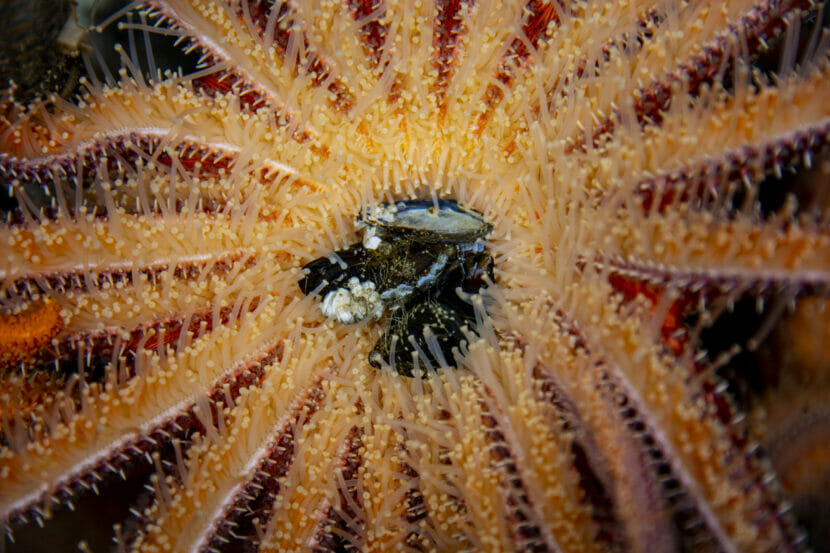
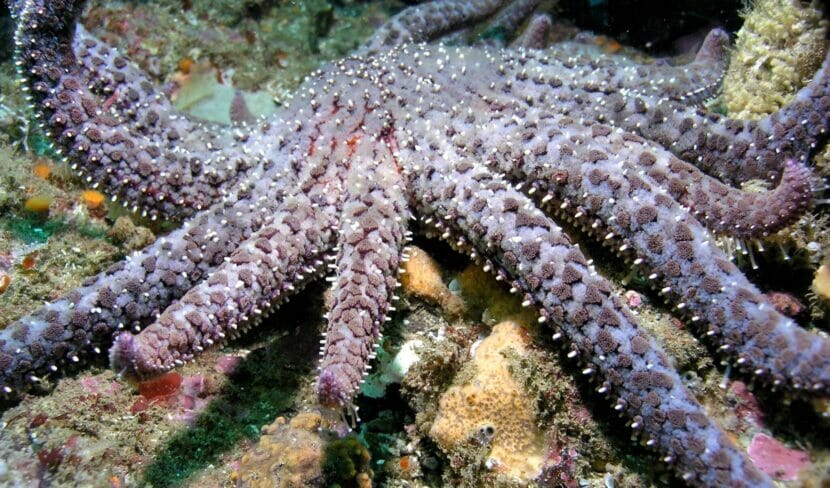
A sunflower sea star is seen on the ocean floor. They are some of the world’s biggest sea stars. Their habitat ranges from waters from the western tip of the Aleutian Islands to the coast of Baja California. But sea star wasting syndrome has cut the population by about 90% since 2013, and federal regulators are considering an Endangered Species Act listing. (Photo by Kevin Lafferty/U.S. Geological Survey)

One of the biggest sea stars in the world has been devastated by a malady likened to an underwater “zombie apocalypse” and could soon be granted Endangered Species Act protection.

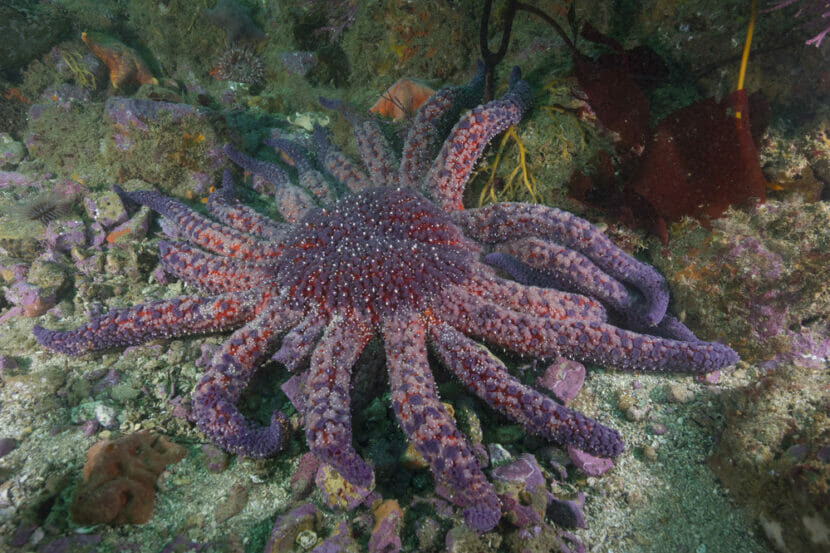
Sunflower sea stars, fast-swimming creatures that can have up to 24 arms and grow to three feet in diameter, have largely vanished from their habitat, which stretches from the western tip of the Aleutian Islands to the waters off Baja California.

The culprit is sea star wasting syndrome, a body-mangling disease sweeping the North Pacific that scientists say is the biggest known epidemic to hit any wild marine species. Multiple species are affected, but sunflower sea stars have particularly suffered.

The National Oceanic and Atmospheric Administration is on the verge of a decision on an Endangered Species Act listing sought in a 2021 petition filed by an environmental group, the Center for Biological Diversity. The petition cites an approximately 90% loss of the animals since 2013.

A sunflower sea star is seen on the ocean floor. These sea stars, some of the biggest in the world, can have up to 24 arms and can measure 3 feet in diameter. (Photo provided by National Park Service)

“Sunflower sea stars have been decimated by sea star wasting disease, urgent action is needed to prevent their extinction,” the center’s petition said.

A listing determination should come within a month, said Sadie Wright, a Juneau-based protected species biologist with NOAA Fisheries. If the agency decides to list sunflower sea stars as threatened or endangered, a proposed rule would be published, followed by a final rule a year later, she said.

Endangered Species Act listings allow the federal government to take actions to conserve wild populations facing threats of extinction.

Sea star wasting syndrome has been linked to climate change. The disease “does appear to be exacerbated by warming ocean temperatures, or significant shifts in water temperature,” Wright said by email.

Preserving sunflower sea stars is about more than preventing extinction of a distinctive and colorful sea creature. Their loss is “devastating for the entire kelp forest ecosystem in which they live,” the Center for Biological Diversity’s listing petition said.

“Sunflower sea stars are a keystone species and a top predator in the intertidal zone. In the absence of a healthy population of sea stars, sea urchins can proliferate and devour the kelp forests that provide habitat for many fish and other wildlife. The decline of sunflower sea stars has caused a cascade of harmful changes in the ocean food web,” it said.

The underside of an adult sunflower sea star is seen in 2021 feeding on mussels at the University of Washington’s Friday Harbor Laboratories. The sunflower sea star captive breeding program there, a partnership between the university and The Nature Conservancy, is a pioneering project that may help in restoration work. The sea stars eat sea urchins, and by keeping urchin populations in check, they help preserve underwater kelp forests. (Photo by Dennis Wise/University of Washington)

While the most severe impacts have been in the southern parts of the range, sunflower sea stars’ disappearance from Alaska waters has been profound. Prince William Sound and Kachemak Bay have been some of the places notably affected, said Brenda Konar, a marine biology professor with the University of Alaska Fairbanks.

“I used to see a ton of them while diving in Kachemak and they totally disappeared for a while,” Konar said by email. “They are starting to make a patchy comeback but it is really slow.”

The International Union for the Conservation of Nature in 2021 listed the sunflower sea star as critically endangered. However, the IUCN uses different listing criteria than those used in the Endangered Species Act, Wright said.

Listing holds possible implications for the fishing industry. While the warming-associated wasting disease is the overwhelming threat, an additional threat is bycatch, the unintentional catch in harvests targeting other species. The animals occasionally wind up in the pots, traps and nets used to catch fish, so listing could mean stricter rules preventing that.

The Alaska Department of Fish and Game and some Alaska fishing groups, in comments to NOAA Fisheries, argued against listing. Their comments said listing is premature and based on incomplete science and that NOAA Fisheries should consider that there are some signs of recovery emerging in Alaska waters.

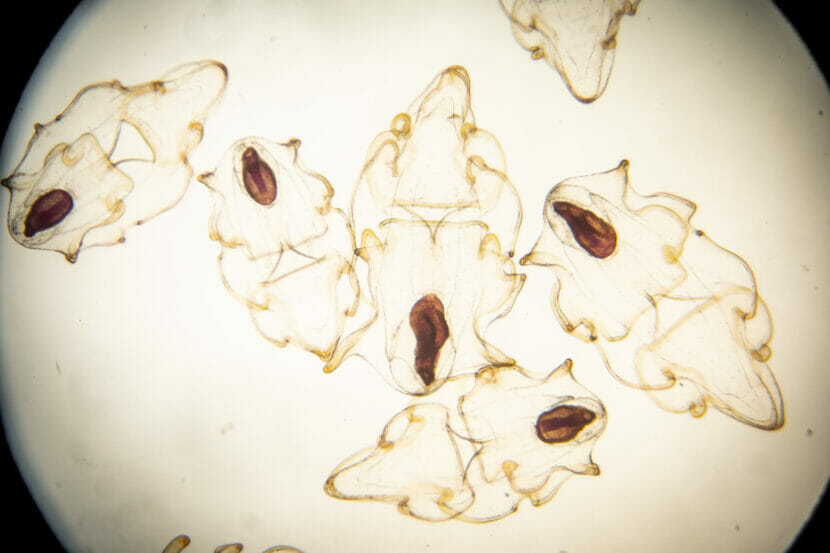
Sunflower sea star larvae, born in January of 2021 at the University of Washington’s Friday Harbor Laboratories, are seen under a microscope. The sunflower sea star captive breeding program, a partnership between University of Washington and The Nature Conservancy, could contribute to efforts to recover the population. (Photo by Dennis Wise/University of Washington)

Even if the population is nearly wiped out in the southern part of the range, the Department of Fish and Game said in its comment letter, sunflower sea stars could shift their range north. “This possibility changes the lens through which the risk of extinction should be viewed: a population that shifts its distribution can look like an extinction at the local scale, but not at the regional scale or across the range,” the department’s letter said.

Preserving sunflower sea stars could benefit the Alaska fishing industry, however. By keeping urchin populations in check and thus protecting kelp beds, sunflower sea stars benefit the marine ecosystem that produces the fish the commercial industry harvests, scientists say.

A possible benefit of listing would be more attention to the sunflower sea stars’ plight – and that could lead to more support for a pioneering captive-breeding program at the University of Washington’s Friday Harbor Laboratories.

The program, a cooperative effort with The Nature Conservancy, started with 16 adults collected in the wild in 2019. The group is now in its third generation, with over 100 1-year-olds now at the lab, said senior research scientist Jason Hodin, who leads the program.

Jason Hodin, a research scientist at the University of Washington’s Friday Harbor Laboratories, is seen in 2021 in the sea star captive rearing lab. Hodin is leading the program. (Photo by Dennis Wise/University of Washington)

The Friday Harbor Laboratories operation is far too small to repopulate the Pacific coast with sunflower sea stars, and that is not its mission, Hodin said. “We’re not a sunflower sea star production facility,” he said. “We’re scientists. We’re trying to understand the lifecycle of organisms.”

However, the work at Friday Harbor might lead to new captive-breeding programs, and restocking parts of the range might wind up as part of a recovery plan, he said. “If we can get more of these, and larger-scale ones, there’s a lot more that can be done,” he said.

This story originally appeared in the Alaska Beacon and is republished here with permission.

Skull found along Porcupine River belonged to a man who was likely killed by a bear in the ’70s

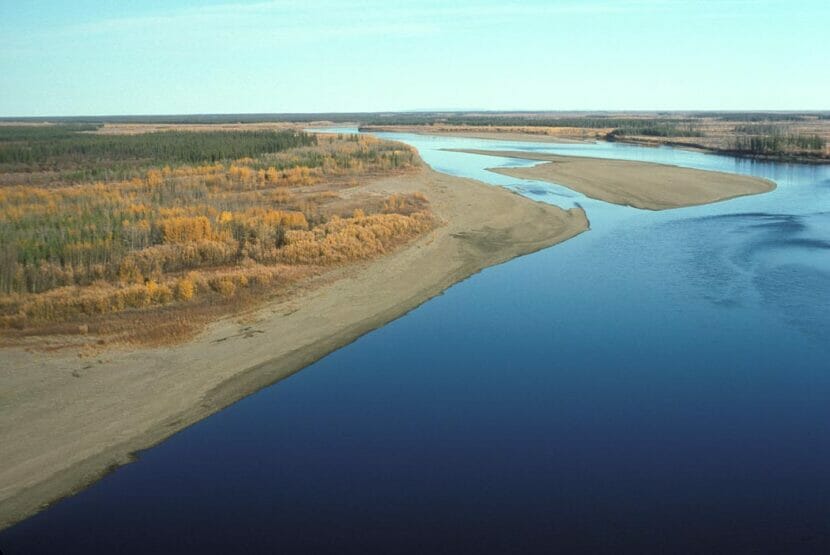
Aerial view of the Porcupine River. David Spencer/USFWS)

Genetic genealogy recently helped Alaska State Troopers identify a human skull found 25 years ago.

Interior Alaska commander Capt. Eric Spitzer, said a pair of hunters found the skull along the Porcupine River near the Canadian border in September of 1997. It was later retrieved and delivered to the state medical examiner.

“The cause of death was suspected of being the result of bear mauling,” Spitzer said.

Spitzer says the identity of the bear attack victim remained unknown until last April, when a DNA sample from the skull was compared to a genetic genealogy database enabling investigators to home in on relatives. The testing tentatively identified it as belonging to Gary Frank Sotherden of New York.

“The Alaska State Troopers contacted a suspected brother of Gary who submitted a DNA sample to Family Tree DNA, which subsequently resulted in positive identification, determining that they were indeed brothers,” Spitzer said.

Spitzer said troopers were also able to fill in the Alaska part of Sotherden’s story.

“While speaking with family members, Alaska State Troopers learned that Gary was dropped in and around the area where the remains were found, sometime in the early to mid-1970s, presumably to go hunting,” Spitzer said. “He has never been heard or seen by his family since then. A family biography and grave marker for Sotherden annotates he was lost somewhere in Alaska at the age of 25.”

Spitzer said Sotherden’s brother was notified about the positive identification Dec. 27 and put in contact with the state medical examiner’s office so the family could make arrangements to take possession of the remains.

Fluctuating winter weather in Juneau set the stage for an avalanche at Eaglecrest

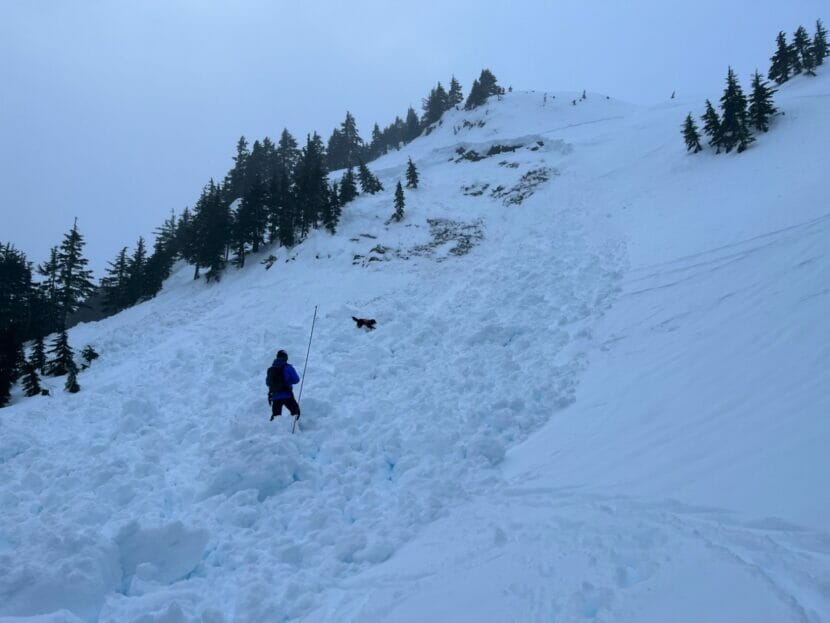
Eaglecrest ski patrol surveyed the East Bowl Chutes following a large avalanche on Jan. 26th, 2023. (Photo courtesy Dave Scanlan)

The upper-mountain at Eaglecrest ski area in Juneau was closed on Friday following a large avalanche Thursday morning. No one was hurt, but the area above the Hooter lift will remain closed as the ski patrol works to address potential hazards.

The slide dropped about 6 to 7 feet of snow over a 100 yard swath in the East Bowl Chutes.

“It’s very rare, actually, that we have this size of an avalanche occur within our boundaries,” said Eaglecrest General Manager Dave Scanlan.

At the time of the slide, the area was closed, along with many of the mountain’s steeper, avalanche-prone slopes. The slide wasn’t human-caused, but Scanlan says there are some die-hard backcountry skiers who still venture out into closed areas.

Alaska SEADOGS, Juneau Mountain Rescue and the Alaska State Troopers were called to assess the scene, and confirmed that there wasn’t anyone in the debris. Poor conditions have kept many skiers off the mountain this week.

“We didn’t see any evidence of skiers coming in and out,” said Scanlan. “But it’s a great training opportunity and kind of a standard protocol within the ski industry.”

He added that ski patrol would be out on the mountain again Friday to mitigate ongoing slide hazards. They’ll examine the snow layers and deploy avalanche explosives to create smaller slides that will stabilize the snowpack.

Avalanche conditions change rapidly depending on changing temperature, moisture or winds. A week of active weather set the stage for the slide.

Heavy snow last week was followed by a tropical front that brought several days of warmer weather and heavy rains. That added significant weight to the existing snowpack, and weakened the bond between snow layers. Eaglecrest closed altogether this past Wednesday due to rainy conditions, and the upper mountain terrain remained closed to allow that extra moisture to drain.

But Scanlan says it’s not just this week. Frequent fluctuations between warm, rainy weather and colder, snowy weather this winter have created a relatively weak snowpack at Eaglecrest, and across the urban slide zones too.

Each storm creates a different layer in the snowpack, and the frequent freeze-melt cycles this year have created thinner, weaker, less defined layers, especially lower in the snowpack. This makes them more unstable and prone to slides.

Scanlan says it’s raised concerns for slides of all kinds this winter.

“All the avalanche professionals are talking about this,” he said. “It’s a little more uncommon. Typically our region has a much more cohesive total snowpack with less layering in it.”

He says that colder temperatures heading into the weekend will help to stabilize the snowpack and lower avalanche risk. Groomers will be out to prepare trails today, and they’re expecting to re-open some of the upper mountain trails on Saturday.

Board of Game authorizes first Zarembo Island elk hunt in 17 years

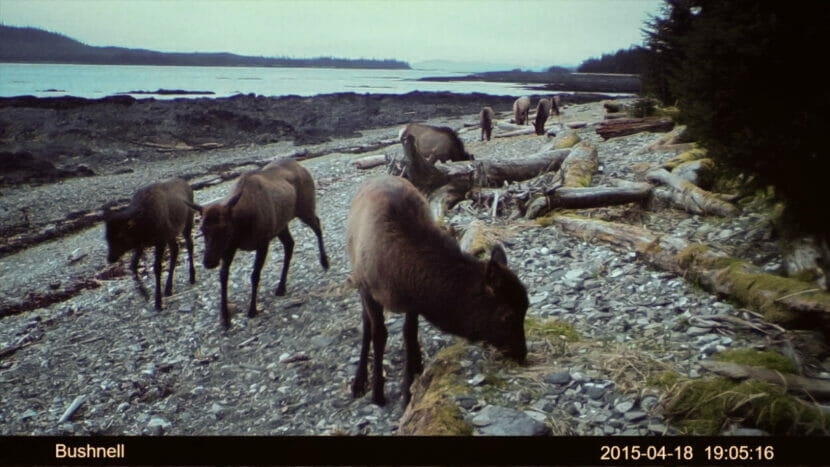
A game camera photo of several small elk on a gravelly beach
Elk on a Zarembo Island beach. (Courtesy Mike Kampnich)

Alaska’s game management board has authorized an elk hunt on Zarembo Island in Southeast Alaska for the first time in nearly two decades. The state Department of Fish and Game opposed the hunt, but strong support from Wrangell and other local communities helped convince the board to take the leap.

Elk are not native to the Alexander Archipelago in Southeast Alaska. They were introduced to Etolin Island in the mid-1980s and spread to other islands nearby. That includes Zarembo, which is about 10 miles across the Zimovia Strait and visible from downtown Wrangell.

But the Alaska Department of Fish & Game has shut down elk hunting on Zarembo for the past 17 years, concerned about low population.

Chris Guggenbickler is the chair of Wrangell’s Fish & Game Advisory Committee. He says locals have kept the flame for a Zarembo elk hunt.

“Elk is always something that we’re talking about,” he says. “There are so many people that have talked to us about the abundance of elk on Zarembo and the fact that they want to have a hunt again.”

Biologist Frank Robbins, who oversees Game Unit 3, the area around Petersburg and Wrangell, told Board of Game members at their January meeting in Ketchikan that he’s seen at most 23 elk on Zarembo Island. He says the current population is around 50, although that’s just an estimation because elk are hard to spot on the island.

“There is no available data that suggests that the Zarembo Island elk population has increased since hunting ended in 2006,” Robbins told the Board of Game.

For Board of Game members, that raised the question of whether it’s possible to sustainably harvest elk when the population is so small. Biologist Robbins was doubtful but conceded it’s feasible.

“I’ve been a biologist for pushing 30 years,” Robbins related, “I did at one time manage the Chitina bison herd, and year in and year out we would fly over the Chitina bison herd and count 50 animals. We issued two permits annually.”

Committee member Guggenbickler doesn’t think Fish & Game’s population estimate is correct .

“The last hunt was in 2006 — there were six bulls taken. They closed the hunt, thinking that there really weren’t a lot of bulls left on the island,” Guggenbickler says, “And then the proposal came off of the books. It’s been 17 years since we’ve had a hunt, so they’ve had that long to rebuild.”

There’s already a federal subsistence elk hunt in the area, but it excludes Zarembo and Etolin Islands and some of the smaller neighboring islets.

The Board of Game rejected three other elk hunt proposals, including a different proposed hunt on Zarembo and nearby islands, as well as two proposals to modify the current elk hunt on Etolin Island, south of Zarembo. But they unanimously supported Guggenbickler’s and Buness’s proposal at their January meeting.

Hunters from around the region wrote letters and spoke to the board about how they’ve seen increasing numbers of elk on Zarembo Island. And Guggenbickler says he believes the strong show of public support for the proposal helped swing the board’s favor.

Burnett said his opinion on the hunt was also somewhat swayed by the fact that elk aren’t a native species.

“Maybe elk just don’t belong there, and maybe it’s just not an appropriate place for elk,” Burnett said.

Robbins, the biologist, referenced a research project in the 90s which found significant overlap — about 64% — in the diets of elk and deer, especially when resources are strained after a heavy snow.

Guggenbickler says he explained to the board that deer are a major meat source in Wrangell, and hunting elk could reduce the deer’s competition for food.

“We were worried that if there was a hard winter, the deer were gonna end up on the beach, the elk would have ate all the food, the deer would have been compromised,” he said.

The newly approved elk hunt will take place in October. Hunters can apply for one of up to 25 tags to take one bull, but the actual number available will be up to Robbins, the area biologist.

Guggenbickler expects the department to be cautious in how they issue tags.

“The department is going to be conservative because they feel there’s going to be a higher success rate,” he said. “Etolin has a very low success rate; there are actually quite a few tags that go out but the success rates are only two or three percent.”

Guggenbiclker says he and colleagues on the Wrangell Advisory Committee may try to add a residency priority to the hunt.

“We were concerned that the entire proposal might fail based on that,” he said. “So the idea was just to kind of get the whole thing in the books – let’s baby-step this thing, and then hopefully we can get a resident priority later on.”

For now, they’re just glad it passed.

“Elk are kind of one of those species we don’t get a shot at much around here, and there’s some huge animals,” Guggenbickler says, “And I think everybody’s just hoping they might draw that tag and kill that great big bull.”

If the new Zarembo elk hunt makes it on the official regulation books in time, hunters may be able to submit their names for an elk tag on Zarembo this fall, with the first season in October of 2024.

The Chilkoot Trail has been designated a national historic trail

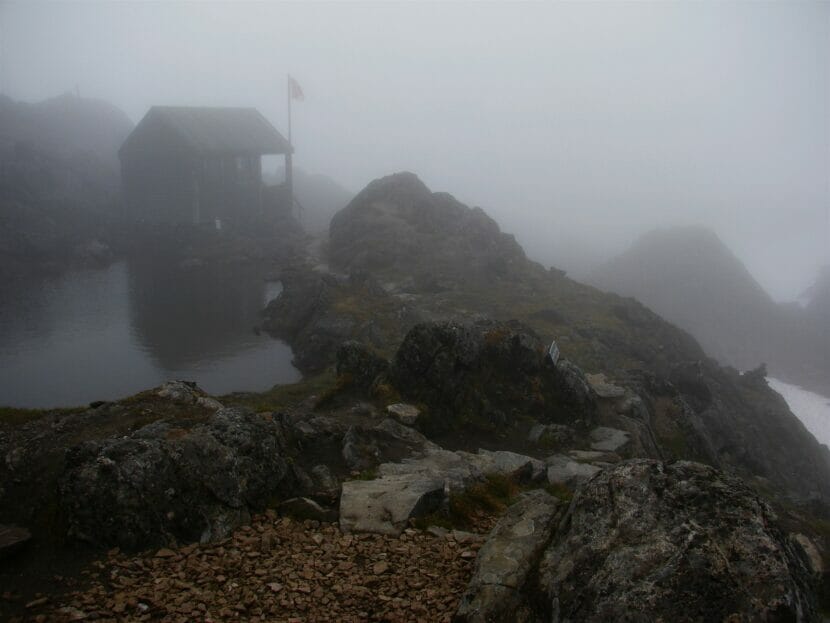
A foggy view of the Chilkoot Natonal Historic Trail’s summit warming shelter. (K. Unertl/National Park Service)

The federal government has designated the Chilkoot Trail as a national historic trail. The designation, which was included in the federal omnibus spending bill, was announced Jan. 7 in a press release.

“It’s a great honor to be recognized as the Chilkoot National Historic Trail,” said Angela Wetz, superintendent of the Klondike Gold Rush National Historical Park. “To get people learning about the history of this area, of the park and the stories of the people that came here and the people that have been here for millennia.”

The Chilkoot Trail is the 20th in the nation to get the designation and, at 16 miles, the shortest. The designation could lead to some funding opportunities.

“There is some trail system funding that’s out there, not necessarily something we would get right away,” Wetz said. “But we would be able to compete for those funds in the Park Service.”

Right now the trail is closed due to flood damage from an October storm. Wetz says the designation will not affect the pace of repair.

“We are aiming towards an Aug. 1 opening, but we still have a lot of logistical  issues with supply chains and everything else to get us there,” she said.

To celebrate the designation, the park intends to hold a ceremony when the trail reopens.

Site notifications
Update notification options
Subscribe to notifications