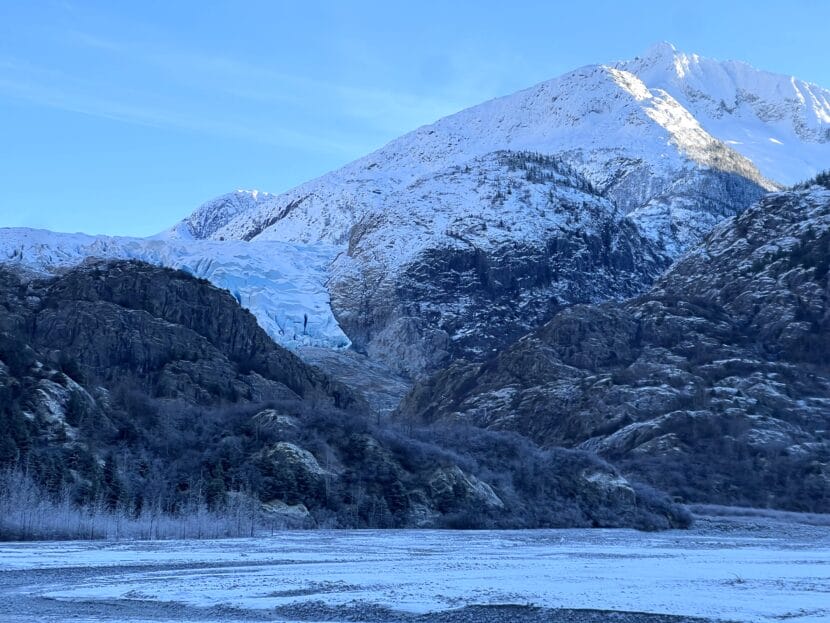
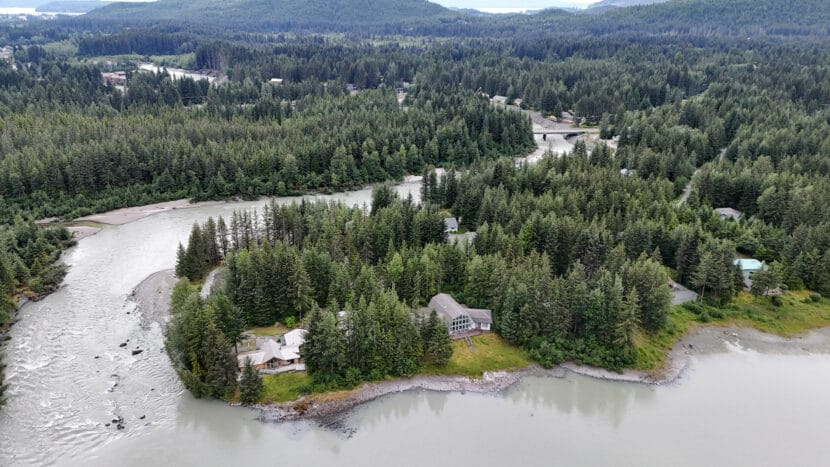
Herbert Glacier on Nov. 27, 2025. (Photo by Alix Soliman/KTOO)
After proposing to build a new cabin near Juneau’s Herbert Glacier, the U.S. Forest Service released a draft decision last month abandoning it.
The cabin site was initially selected due to public interest. It would have been built within a mining claim block across the river from the proposed New Amalga gold mine owned by Grande Portage Resources, Ltd. The Forest Service approved exploratory drilling at New Amalga in April.
But Paul Robbins, a public affairs officer for Tongass National Forest, said the agency’s decision to cancel the cabin is unrelated to mining interests and is instead due to the challenging location and limited staff capacity. This comes after the agency lost a third of its staff in Alaska last year.
“The proposed cabin site’s elevation, distance from the trail, design requirements and the need to move materials through difficult terrain all add to the complexity of that cabin project,” Robbins said.
He said the agency’s landscape architects and engineers could be overwhelmed with work if they moved forward with building the cabin.
But some residents in Juneau submitted public comments saying they don’t believe those reasons are genuine.
“Cancelling the project seems to be influenced by mining interest across the river which would inherently be hard to make compatible,” wrote Riley Moser, a Juneau resident. “It appears that the Forest Service is bending to corporate interests instead of listening to the needs and concerns of the public.”
Staff from the Alaska Miners Association and Grande Portage submitted comments to the agency before the draft decision, saying that building a cabin near the proposed mine could lead to disputes over how the land is used.
“Selection of a site to be used for recreational lodging, which can be easily placed anywhere, within an area of active mineral exploration could unnecessarily invite land use conflicts that do not and should not exist, and could incite litigation and appeals for years,” wrote Deantha Skibinksi, executive director of the Alaska Miners Association.
Kyle Mehalek, a technical specialist at Grande Portage, wrote that “it would be incredibly challenging, likely impossible, to protect the proposed cabin from potential visual and noise impacts with the same effectiveness as the existing trail.”
The cabin would have been part of the Alaska Cabins Project, the Forest Service’s biggest public-use cabin expansion plan in 50 years, which plans to bring around 25 new cabins to the Chugach and Tongass National Forests, including four in Juneau at Mendenhall Campground, Montana Meadows, Treadwell Ditch Trail and Dupont Beach.
Robbins said cancelling this cabin won’t affect the other proposed cabins. He said the Forest Service plans to reroute part of Herbert Glacier Trail and build a scenic overlook there instead.
Although there is a lot of public support for building a cabin near Herbert Glacier, Robbins said the agency is unlikely to change course.
“Only because our decision was based on the complexity and capacity, not on whether or not the site was popular,” he said. “We know the site is popular, that’s why we wanted to initially build a cabin there.”
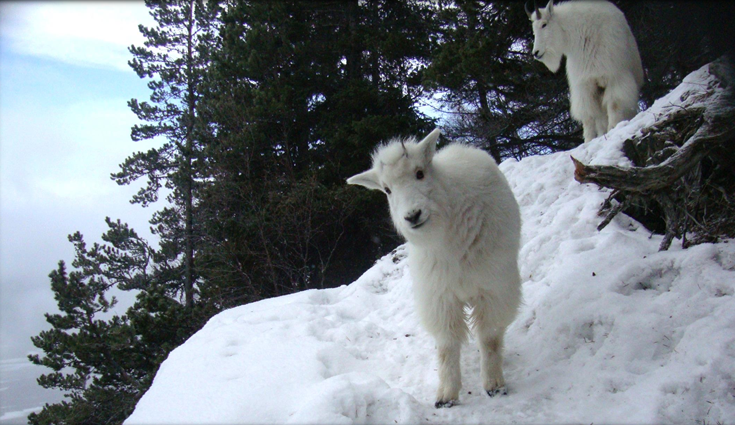
A healthy mountain goat kid and adult pictured in the Haines area. (Photo courtesy of Alaska Department of Fish & Game)
A Juneau resident took home a sick mountain goat kid with crusty skin lesions after hiking Perseverance Trail last weekend and contacted the Alaska Department of Fish & Game. Officials say the goat had a highly contagious viral skin infection that can transfer to humans and pets.
“It’s very important that people — if they see a sick or a dead wild animal — that they call Fish and Game, and not try to take it home themselves,” said Kimberlee Beckmen, the wildlife health veterinarian at ADF&G. “It’s also illegal to pick up wildlife and take it home.”
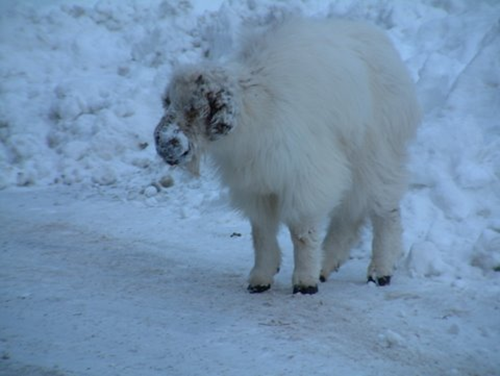
Beckmen said the goat had contagious ecthyma. It’s not always fatal in sheep and goats, but it’s usually more severe and deadly in lambs and kids. It causes skin lesions to develop around openings in the body.
“When it covers their face, their eyes, their mouth, they can’t eat,” she said. “This recent case — the poor animal was starving to death and was completely dehydrated. It could not see out of its eyes.”
She said the goat probably would have died from the infection within a couple of days, and ADF&G euthanized the animal over the weekend.
In people, the infection is called orf and it’s typically mild. A lesion usually appears within a week of exposure. Beckmen said it’s not fatal to humans or dogs, and the lesions typically go away on their own after several weeks. The virus can transfer when the scabs make contact with openings in the skin.
A mountain goat with contagious ecthyma that wandered into a Juneau neighborhood and later died. (Photo courtesy of Alaska Department of Fish & Game)
But Beckmen said hunters can still eat the meat of an infected animal if it’s handled properly.
“We recommend that people wear gloves when they’re harvesting their animal and butchering it, and if they see any lesions on the skin or anything unusual, they want to make sure that they clean their knives off before they cut into the meat,” she said.
ADF&G officials said they get calls about the infection popping up every once in a while. Carl Koch, the department’s area biologist in Juneau, said his team collected a dead goat kid with ecthyma near the Flume Trail in December. He said the department received a call in October about twin goats with the early stages of an infection, and thinks the two that died recently could be them.
Beckmen said this is not an outbreak or an unusual occurrence. Sporadic cases have appeared in Dall sheep and mountain goats across Alaska since the 1980s, and she said the state is not currently concerned about it affecting those populations.
ADF&G requests that people report ecthyma cases to the wildlife disease surveillance hotline at 907-328-8354, by emailing dfg.dwc.vet@alaska.gov or calling the local ADF&G office. People can also report sick or injured wild animals through the department’s web form.
Koch said the person who took the goat home last week had called the department and left a message while out on the trail, but didn’t get a response since it was Saturday. He said people can call the police non-emergency number at (907) 586-0600 if they don’t hear back from ADF&G about a time-sensitive wildlife issue over the weekend.
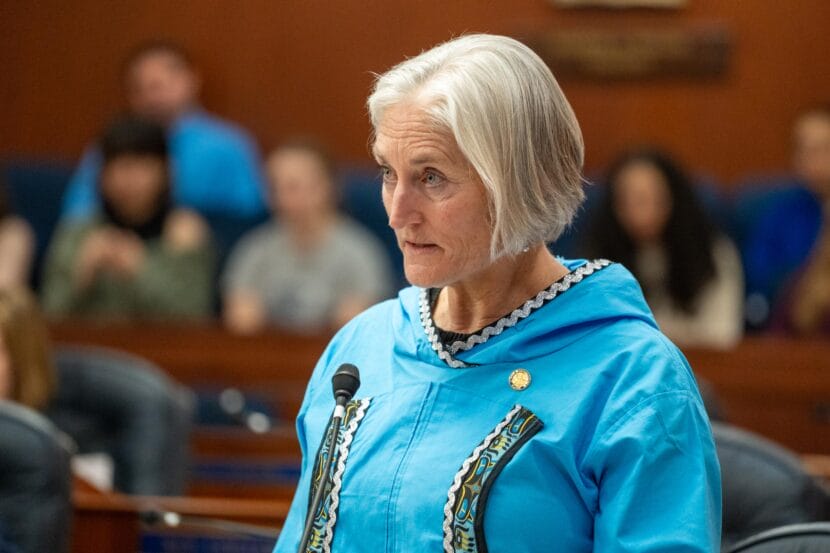
Sitka independent Rep. Rebecca Himschoot speaks in support of House Bill 93 on the House floor on Jan. 30, 2026. (Eric Stone/Alaska Public Media)
The Alaska House of Representatives passed a bill Friday that would tighten residency requirements for Alaskans buying hunting or fishing licenses.
House Bill 93 aims to ensure that only people who spend enough time each year in Alaska to qualify for a Permanent Fund dividend can buy resident hunting and fishing licenses, which tend to cost less and offer higher bag limits than nonresident licenses.
State law currently limits resident licenses to people who are physically present in Alaska with no plans to leave, do not claim residency in another state and have maintained a home in the state for 12 consecutive months. But it does not require that resident hunters and fishermen actually live in the state for a full year.
Rep. Rebecca Himschoot, a Sitka independent who sponsored the bill, said that definition leaves a big loophole.
“The last point means that we allow someone who rents a room in a home from friends, or someone who has a liveaboard boat that’s on a trailer but actually is in the state for less than a month — less than two months, potentially less than a week — to hunt and fish and enjoy the higher bag limits that are reserved for residents who are here year-round, shoveling snow, volunteering in their communities and putting their kids in our schools,” Himschoot said.
Himschoot’s bill seeks to close that loophole. If the bill becomes law, Alaskans would have to be physically present in the state for at least 180 days each year to get resident licenses, though there would still be numerous exemptions, including for military servicemembers, students and others allowed to be outside the state while remaining eligible for Permanent Fund dividends.
In some cases, people ineligible for dividends would still be eligible for resident hunting and fishing licenses. For example, new Alaskans moving to the state would be eligible for resident licenses 12 months after they arrive. Permanent Fund dividend eligibility rules generally require new residents to live for an entire calendar year in the state, from Jan. 1 to Dec. 31, before applying for a dividend.
People who do not qualify for a resident license would have the option to buy a nonresident license instead.
The deputy director of the Alaska Wildlife Troopers, who enforce fish and game laws, told a House committee in 2024 that the current definition makes it difficult to prosecute people who violate the residency requirements. By contrast, state prosecutors often bring charges against people who fraudulently apply for Permanent Fund dividends.
“The problem is that our enforcement officers don’t have the right tools,” said Rep. Donna Mears, an Anchorage Democrat.
A wide range of local governments, tribes and fish and game advisory committees spread across the state backed the bill.
Twelve House Republicans opposed the bill, including Big Lake Rep. Kevin McCabe, who said he was concerned the bill would exclude some Alaskans from the benefits of a resident license.
“What about those pilots that have vacation homes elsewhere, that would like to go spend two months in Hawaii, say, and then they have to fly out of state for 15 days a month?” McCabe said.
The bill, however, had broad support and passed with a bipartisan two-thirds majority in favor.
A board shows the final vote on House Bill 93 on Jan. 30, 2026. (Eric Stone | Alaska Public Media)
“Is there a problem? I think that we all acknowledge there is,” said Rep. Dan Saddler, an Eagle River Republican. “Is this a solution? I think it is. Is it the perfect solution? No, it’s not. But we don’t deal in perfect and ideal. We do what’s best and what we can do.”
“An Alaskan is and always will be an Alaskan,” Himschoot said. “But if you live outside Alaska, and you enjoy those lower prices at the grocery store and other costs of living that are much reduced compared to what we experience here in Alaska — if that is you, we ask you to please hunt, fish and trap as a nonresident.”
The Mendenhall River surrounds homes on View Drive in the Mendenhall Valley on Tuesday, July 22, 2026. (Photo by Clarise Larson/KTOO)
The City & Borough of Juneau tip-toed toward a federal buyout program for homeowners on View Drive this week, a street that’s been hit the hardest by annual glacial outburst flooding. The city’s asking those residents if they’ll help pay for it.
Eighteen homes line the forested cul-de-sac on View Drive, which extends into the Mendenhall River like a peninsula. They’re located beyond the temporary levee the city built last year, which protected hundreds of homes during the record flood in August.
The buyout program, through the Natural Resources Conservation Service, or NRCS, would cost roughly $25 million if every household participates. The federal government has offered to cover three-quarters of the cost. The local portion could be around $6 million.
City Manager Katie Koester spoke about it at a Juneau Assembly finance committee meeting on Jan. 7.
“The project would be a buyout of up to 18 homes on View Drive, and those homes would need to be demoed and turned into parkland in perpetuity,” she said.
The city sent an informal ballot and letter to View Drive residents on Wednesday, asking if they’d be willing to give up hundreds of thousands of dollars from their home payout to shoulder that local portion. But it’s still unclear how this would work. In exchanges with KTOO, staff from the federal agency and the city explained it differently.
Tracy Robillard, a spokesperson for NRCS Alaska, said in an email that state governments typically sponsor the 25% cost-share — including in New Jersey and Connecticut, and upcoming projects in New Mexico and South Carolina — where state environmental protection agencies have programs to purchase floodplains. In other cases, city governments have paid the local portion, Robillard said.
Brett Nelson, Alaska’s watershed program manager at NRCS, said at the committee meeting there is another option.
“The more likely route would be some sort of third party coming up with the 25% local cost share,” he said.
That third party could be a nonprofit. City staff spoke with the Southeast Alaska Land Trust back in July, but leaders there said they can’t commit millions of dollars in such a short time frame.
NRCS hopes to offer the buyout before the next flood, expected this summer, Nelson said.
The U.S. Army Corps of Engineers is working on an engineered solution that would protect the whole Valley, but it’s still years away. In the meantime, homes on View Drive are expected to flood again and again. Some residents have said that leaving feels like their only option.
“That’s an individual decision for those property owners, whether or not to, you know, take their chances and wait for an enduring solution,” Koester said at the meeting.
If the buyout program moves forward, homes would be appraised at their 2024 value, prior to the flood that year.
The city is asking residents to submit their informal ballots by Feb. 16, and plans to discuss the results at a Juneau Assembly committee meeting on Feb. 23.
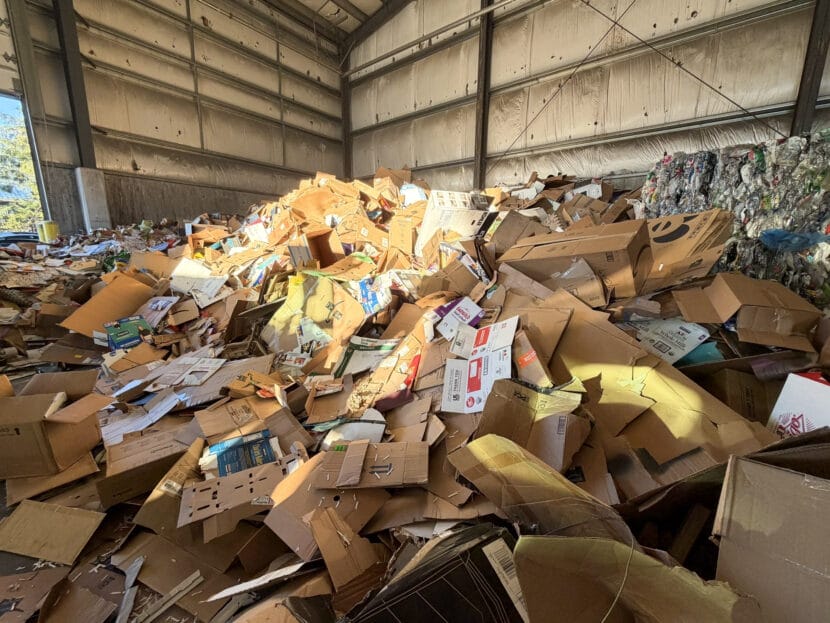
Cardboard and other recyclable materials stack in a pile at Juneau’s recycling center in Lemon Creek. (Photo courtesy of Stuart Ashton)
Juneau’s recycling center is closed again in order to repair damaged critical equipment.
It could be quite a while before the center opens back up again, according to Denise Koch, the city’s director of Engineering and Public Works.
“Recycling is a really important service, and we recognize that the people of Juneau really value this service,” she said. “What we are doing right now, we hope that we’re talking about a timeframe of weeks.”
The city contracts with Waste Management — the private company that runs the landfill — to operate its recycling program in Lemon Creek. The center has been closed on and off since late December, after Juneau was hit with back-to-back record-breaking snowstorms. That inundated the open-air warehouse with a backlog of materials to process.
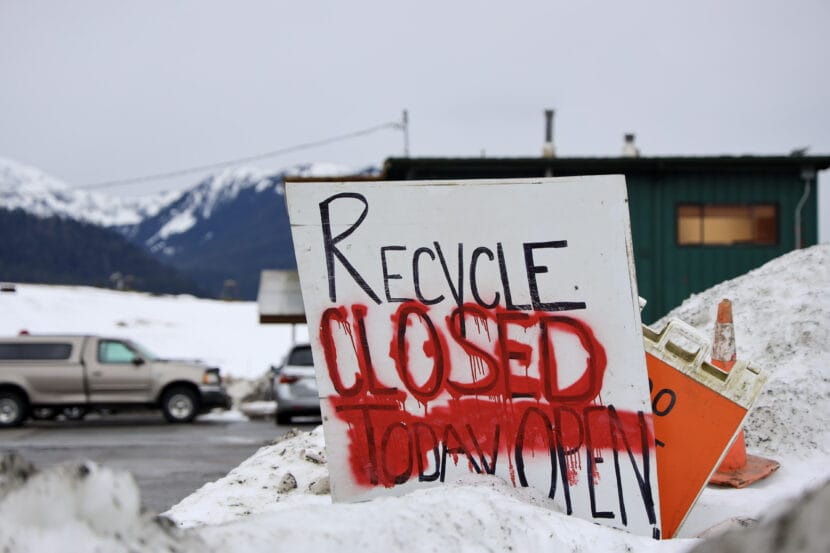
A sign sits in the snow outside Waste Management’s Capitol Disposal Landfill on Wednesday, Jan. 28, 2025. (Photo by Clarise Larson/KTOO)
The closures have left many residents and businesses without a place to recycle. That’s a problem, Koch said, because the alternative to holding onto the recyclables is to throw them in the landfill, which is estimated to run out of space in the next decade. She said having the city’s recycling program up and running again is crucial to extending the landfill’s life.
The closure is due to multiple issues with the recycling baler, Koch says. The baler is the machine that compresses the recyclables into blocks, which are then shipped by barge to recycling facilities in Seattle that repurpose the materials. Koch said it’s the most critical piece of equipment for the center to operate.
“We’ve identified three different problems with the baler. So we’re trying to solve three problems, and that’s part of why we are working as quickly as we can to try and solve those problems,” she said. “But, it’s challenging to identify a date certain when all three problems will be solved.”
In the meantime, Koch recommends people hold onto their recycling as long as they’re able before they opt to throw it in the garbage. She said the city will provide updates about the status of the center as it becomes available.
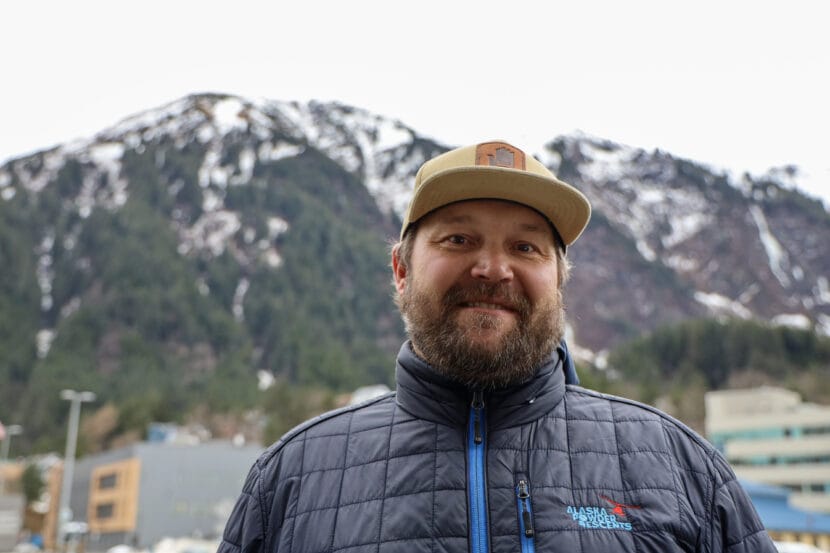
John Bressette, the city’s avalanche advisor, smiles for a photo under Mount Juneau on Wednesday, Jan. 28, 2026. (Photo by Clarise Larson/KTOO)
John Bressette is Juneau’s new avalanche advisor, tracking weather and avalanche risk in the capital’s urban paths. He joined the city just before record snowfall, followed by rain and flooding, pushed the community to declare a disaster and issue evacuation advisories downtown.
KTOO’s Mike Lake spoke with Bressette about navigating that moment and what first drew him to avalanche forecasting.
Listen:
The following transcript has been lightly edited for clarity.
Mike Lane: You’re not new to forecasting avalanches. How did you get your start in this field?
John Bressette: Well, I grew up here in Juneau, and I started going heli-skiing with my friends when I was about 18 years old, and decided I better start learning about avalanches to make sure I knew what I was doing. So I took my first avalanche class here through Bill Glude, who is a longtime avalanche specialist in Juneau and worked on some of this urban stuff a long time ago. Took some classes with him, helped him out with some research projects, and started working for him under Alaska Avalanche Specialists. And in the beginning, he had a contract with AEL&P to do forecasting for them. We also worked out at Kensington Mine and kind of helped develop the program they have going out there now and then I worked for AEL&P directly for a long time under Mike Janes as an avalanche tech assistant forecaster.
Mike Lane: Where did you work before CBJ?
John Bressette: Well, I was doing backcountry forecasting for the Coastal Alaska Avalanche Center. And still am trying to balance both of those for now. It depends on the time of year; I’m a commercial fisherman in the summer, heli-ski guide in the spring and avalanche forecaster in the winter.
Mike Lane: So this isn’t a full-time position with CBJ. This is more of a seasonal?
John Bressette: Yeah, seasonal for now, and we’ll see how it plays out moving forward.
Mike Lane: Immediately, when you started working at CBJ, you were immediately right in the midst of of a disaster, so what was it like to experience that kind of timing?
John Bressette: Yeah, it was intense right off the get go there. So there wasn’t a whole lot of learning on the job. It was right into it. But I feel like everybody at CBJ was really good to work with, and we kind of seamlessly moved into a pretty good workflow, and were able to kind of make decisions on the fly and keep the public informed of what was going on, and I hope that went well from their perspective.
Mike Lane: What are some misconceptions people have about avalanche danger?
John Bressette: Oh, some of the big myths in the avalanche world are that loud noises can set off an avalanche, which is untrue. I think maybe one of the others is that we can predict how big or how far an avalanche will run. And that’s one of the real tricky points to avalanche forecasting, is not knowing how big or how far an avalanche will run during a given avalanche cycle. So it’s — the science behind it is coming a long ways, but it will always be an unprecise science as far as predicting the size of avalanches.
Mike Lane: Do you have any advice that you could give to those folks who are heading into avalanche terrain in the backcountry?
John Bressette: Yeah, so that’s, I want to make it clear that you know forecasting for the urban danger is much different than forecasting for the backcountry, which I do both. So I’m happy to speak on both, but it’s a completely different thing when you’re talking about people traveling into avalanche terrain, you’re looking more at human-triggered avalanches, whereas in the urban, especially in a place like Behrends, where we can’t do control work, you’re looking at more natural avalanches. So yeah, the advice for people, if they’re heading into avalanche terrain is to take an avalanche class, get some education, find the right mentors and group of people that also practice safe habits and just get yourself educated and find the right people to travel with.
Mike Lane: And what about equipment?
John Bressette: Yeah, with equipment. I mean, the bare minimum you want to have is a beacon, probe, shovel, partner — and know how to use those things, too. You know, it doesn’t do you any good if you don’t know how to use the equipment. So getting comfortable with those specific tools are kind of the bare minimum that you need to travel safely in the backcountry.
Mike Lane: Okay. And as far as avalanches go, what do you think we could improve on, CBJ specifically? Are there any lessons to be had that we should know about?
John Bressette: Yeah, I think that having more monitoring tools and using technology that’s come a long way for avalanche and weather monitoring is something we’re pushing really hard to get done. Right now, we’re working with AEL&P and DOT to put together a weather station on Mount Juneau, or, I should say, rebuild. There was one there previously, but we’re kind of revamping it and getting it live again, as well as, thanks to the state and the governor’s office, through this disaster declaration, we were able to buy what’s basically an avalanche radar. So it points at Mount Juneau, and we can now detect when avalanches happen at night or during foul weather. So that’s a really useful tool for us to kind of know when activity starts if we can’t visually see it or hear it. So I think those two things are going to have huge, huge benefits down the road when we enter this kind of avalanche cycle again.
Mike Lane: Are there any hot spots right now that you look at today? You step outside and you look up and you go, Hmm, that’s something we want to keep an eye on, more so than these other areas?
John Bressette: Yeah. I mean, I would say that the Behrends and the White Subdivision pass, the Bartlett pass. Those are our three big ones. Debris came a lot closer to people’s homes and the roads than than we previously thought. So you know, there was debris within 10 feet of a couple homes and on Thane it came down under the power lines and was within 100 feet of Thane road and stuff like that. So, yeah, I would say, when we get a big snow cycle like that, there’s, you know, places that we don’t typically think of the hazard being high that actually came pretty close. So those are the reasons we got people out of their homes. And yeah … I hope that comes through, that people’s safety was of the utmost importance.
Close
Update notification options
Subscribe to notifications
Subscribe
Get notifications about news related to the topics you care about. You can unsubscribe anytime.