Weather

Nome could see Iditarod champ as early as Tuesday afternoon

Mitch Seavey beds down his team in Kaltag during the Iditarod. Seavey was expected to finish in Nome sometime Tuesday evening. (Photo by Ben Matheson/KNOM)

Updated | 2:11 p.m. Tuesday

Mitch Seavey’s speed continues to exceed expectations. With Seavey out of the Safety checkpoint at 1:10 p.m. Tuesday, an arrival in Nome as early as 3:30–4 p.m. is now possible.

Original story | noon Tuesday

Nome may be less than 24 hours away from its 2017 Iditarod finish.

Assuming no unexpected complications or changes in his pace, Mitch Seavey could arrive under the Burled Arch as this year’s Iditarod champion by about 7 p.m. Tuesday — perhaps slightly earlier.

The elder Seavey, currently Iditarod’s race leader, departed the Elim checkpoint at 6:13 p.m. Monday with 12 dogs, having spent two hours 47 minutes resting there.

A good rule of thumb for approximating an Iditarod champion’s finish is to add 24 hours to his or her departure from Elim.

This would, therefore, place Mitch Seavey in Nome at about 6:15 p.m. Tuesday.

Another, slightly more complicated means of reckoning places Mitch Seavey in Nome around the same time.

In 2015, when the Iditarod ran the same route as this year, Dallas Seavey, the eventual champion, arrived in Elim at 11:51 p.m. on the Monday a week after the race start. This year,

Mitch Seavey arrived in Elim about eight and a half hours earlier than Dallas in 2015. Both men — Dallas in 2015, Mitch in 2017 — rested in Elim for about 3 hours. If Mitch Seavey matches his son’s 2015 pace from Elim to Nome — which may be a reasonable guess, given that both Seaveys have similar mushing mentalities, similar dogs and, of course, come from shared mushing backgrounds — we might expect Mitch to arrive eight and a half hours earlier than Dallas did, which would place him in Nome at 7:45 p.m. Tuesday (8.5 hours earlier than Dallas’ 2015 arrival at 4:15 a.m. Wednesday).

Nome could see an early evening finish 6:15-7:45 p.m.

Of course, these estimates assume the absence of unpredictable factors like strong winds or other disruptions on the trail to Nome.

Certain areas near Safety, such as Topkok and “the Blowhole,” are especially notorious for their unpredictable, sometimes-suddenly-blustery weather.

Such a storm — in a remarkable series of events — derailed the Iditarod run of Jeff King in 2014, pushing Aliy Zirkle to second and giving Dallas Seavey the first of his (so far) three-in-a-row Iditarod victories.

But if Mitch Seavey’s current pace continues, the 2017 race seems to be his to win or lose. And if he does win, Nome might expect him around dinnertime Tuesday.


You can follow Alaska Public Media’s Iditarod coverage here, or listen to the Iditapod podcast below:

300 miles to Nome: Race dynamics change as Iditarod moves to the coast

Jeff King mushes into Kaltag in the Iditarod. (Photo by Zachariah Hughes/Alaska Public Media)
A sleepy sled dog lays down in Kaltag during the Iditarod. (Photo by Zachariah Hughes/Alaska Public Media)

Iditarod teams have left the Yukon river and reached the Bering Sea coast.

Mushers are shedding equipment, dropping slow dogs, and looking to make a move in the final 300 miles of the Iditarod.

Willow musher Wade Marrs was the first to reach Unalakleet, winning a bag of Bering Sea gold nuggets worth $3,500 as part of the Wells Fargo Gold Coast Award.

But it was two-time champion Mitch Seavey who left first, breezing through the checkpoint in the bright Sunday afternoon.

After posting some of the fastest run times among the leaders, Seavey said in Kaltag he’s focused on keeping his team moving at a fast clip for the final third of the race:

“Whatever we do will be to keep the speed in the dogs. I don’t want to slow down; it takes too long and is too boring,” he said. “Maybe right at the end. Keep resting them, keep taking care of them.”

“We need to be clever because the guys behind me haven’t given up,” Seavey said.

After arriving, Seavey has swapped out his large sled for a smaller, more nimble one to head toward the coast. He has systematically rotated out dogs from the gangline to rest in the sled, but now, that technique is over.

A dozen sleds bearing freight tags were lined up in Unalakleet, awaiting mushers looking to pick up speed.

Racing in the front, Seavey will work his way north, seeking to hold off four mushers who are all decades his junior.

“I guess I’m little bit anxious, because I’m in a position where I can win this thing if something doesn’t go wrong,” Seavey said. “My son, Dallas, is extremely tough and extremely competitive. He’s already talking to me like, ‘oh, you’ve got this sewn up.’ I think he’s playing poker. I don’t think he believes that.”

“He won’t quit; he won’t give up. So, it will be a race,” he said. “I think I have better speed and a better position, but that can change.”

After completing the portage trail over from Kaltag, Dallas Seavey arrived Sunday afternoon in Unalakleet and rested just shy of four hours before leaving in pursuit of his father.

He’s resisting the temptation to chase down his dad.

“We’re going to run these guys; we’re going to keep running our race. I’m not saying we’re tapping out. The simple math says chasing him doesn’t help anybody; chasing him makes us vulnerable to mushers behind us, and all of that is really irrelevant. I’m going to get these guys down the trail as fast as possible. If we end up closer to him at the finish line, I guess we gained on him.”

The younger Seavey said he expects the gap to widen between him and his dad, but he’s not throwing in the towel.

“[In] 2014, I thought I finished in third. You never give up, you keep plugging away,” he said. “If my dad gets lost and is in the middle of nowhere for two hours, I don’t want to say ‘what if I had pushed harder, would I have been able to snatch that spot?’”

Beginning with the Fairbanks start on the Chena River, the 2017 Iditarod trail has been dominated by river miles.

That changes now, as the course takes teams over sea ice and exposed, treeless expanses.

Coastal dog mushing is all about the wind, said  Middy Johnson, Unalakleet checkpoint boss and Iditarod veteran.

“The biggest thing is the wind: you can face it between here and Shaktoolik, Shaktoolik on, you can face it at Safety, at Topkok,” Johnson said. “It’s brought teams to a halt before.”

2011 champion John Baker lives in Kotzebue and has built a team in those conditions.

“Any type of weather comes at any minute.”

For the mushers chasing Mitch Seavey, any opening is welcome, but it needs to come soon if they’re to reel in the two-time champion on the trail to Nome.


You can follow Alaska Public Media’s Iditarod coverage here, or listen to the Iditapod podcast below:

School buses stuck in snow, district pushes on despite parents’ disapproval

A school bus drives down Front Street on Monday morning, March 13, 2017, in downtown Juneau. (Photo courtesy Tripp J Crouse)

Update | 2:10 p.m. Monday

The National Weather Service in Juneau reports 10.6 inches of snow has fallen at their office in Mendenhall Valley since midnight Monday.

Original Story | 1:50 p.m. Monday

Several school buses were stuck in the snow Monday morning.

David Means, director of administrative services for the Juneau School District oversees busing services.

“There was a bus stuck in Douglas on Second Ave. there. They just needed to put chains on it and then it drove itself out,” Means said. “There were some other special education buses stuck on roads that were not plowed, basically on turnarounds as they were trying to pick up special education students.”

Means said one or two more buses may have been stuck.

He said a spokesman for First Student, the company holding the district’s busing contract, was pleased with how this morning went despite the hangups.

“He noted that some routes were running late, primarily due to the slowness of traffic and they were running late,” Means said. “But overall he said he was very pleased with how things came out this morning.”

The district runs 38 buses.

Some parents have complained that school should not have been open considering how much snow has fallen.

The district made the decision to keep school open using the best information available early this morning, Means said.

This morning, First Student drove the roads to evaluate them. They decided the major thoroughfares were passable. The district also consults The Juneau Police Department and the City and Borough of Juneau before it decides whether to hold classes.

“(If) we make a decision to close school, that would be a day that would have to be made up and also many parents who both work often would have to find very last minute daycare arrangements and, or, choose to stay home themselves,” Means said. “We find that when we make a decision to close schools, we’re making it not just for our school system but for the whole community.”

Superintendent Mark Miller said this is his second time deciding whether to close school for snow in his three years with the district. He said whether students can commute to school and back safely is the only factor considered in his decisions.

The National Weather Service expects 3-5 inches of snow to fall today. There is a winter storm warning in effect until 6 pm.

Editor’s note: In a previous version of this story, the word “disapproval” was misspelled in the headline. It has be corrected.

Mitch Seavey, first to Kaltag, is confident yet cautious

Mitch Seavey travels on the Yukon River toward Kaltag after leaving Nulato.
Mitch Seavey travels on the Yukon River toward Kaltag after leaving Nulato. (Photo by Ben Matheson/KNOM)

Mitch Seavey is the first Iditarod musher to reach Kaltag. He arrived at the Yukon River checkpoint at 7:40 pm Saturday after running his team from Koyukuk. Seavey blew through Nulato in the heat of the afternoon and declared his eight-hour rest upon checking into Kaltag, the last possible spot. As the race leaves the Yukon River for the 85-mile portage trail to the coast, Seavey was confident.

“This isn’t even really that hard. I hate to say it like that. The way we train, I mean, I ended up telling Dallas it’s only 1,000 miles, we do what we’ve been doing. We go 9-10 miles per hour and take short breaks. It’s going to be hard because we’re going to put the hammer down. But to here, we’re sort of maintaining. We put a little push on today. We need to make use of this eight (hour rest), right, so I did a couple of shorter stops. The speed was the same. The dogs are happy; they ate every scrap.”

For being the first to reach Kaltag, Seavey wins the Bristol Bay Native Corporation Fish First Award, and with it, $2,000 cash and 25 pounds of Bristol Bay salmon.

The race picture is coming into focus now that the top teams have completed their mandatory rest. Seavey will swap out his large sled for a smaller, more nimble one to head toward the coast. Seavey has strategically rotated out dogs from the gangline throughout the race to rest in the sled, but that technique is coming to an end.

“Whatever we do will be to keep the speed in the dogs. I don’t want to slow down; it takes too long and is too boring. I don’t want to slow down. Maybe right at the end. Keep resting them (and) keep taking care of them. We need to be clever because the guys behind me haven’t given up.”

In Kaltag, Mitch Seavey beds his dogs with straw.
In Kaltag, Mitch Seavey beds his dogs with straw. (Photo by Ben Matheson/KNOM)

Seavey has a shot at earning his third Iditarod title. He says he’s too tired to be nervous, but he knows there are a handful of young mushers pushing to Kaltag overnight that will be looking to make a move.

“I guess I’m little bit anxious because I’m in a position where I can win this thing if something doesn’t go wrong. My son Dallas is extremely tough and extremely competitive. He’s already talking to me like ‘oh, you’ve got this sewn up.’ I think he’s playing poker. I don’t think he believes that. He won’t quit; he won’t give up. It will be a race. I think I have more speed and a better position, but that can change.”

Seavey has placed second to his son Dallas in the past two races.


You can follow Alaska Public Media’s Iditarod coverage here, or listen to the Iditapod podcast below:

Facing harsh conditions Iditasport racers scratch, competition ends early

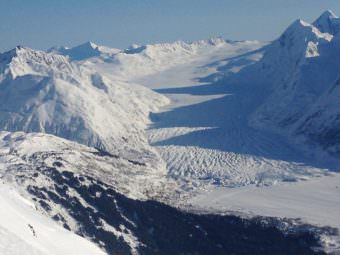
An aerial view near the Alaska Range.
An aerial view near the Alaska Range. (Photo by David Dodman/KNOM)

While mushers along the Iditarod are enjoying good trail conditions, the same isn’t true for the Iditasport. The event bills itself as a “human powered ultramarathon,” where participants bicycle and walk the traditional Iditarod route. It ended prematurely when all the competitors scratched.

The first Iditasport was in 1997, but it went defunct in the 2000s. This year, to commemorate the 20th anniversary, it was relaunched. Though poor snow conditions along one section of the trail re-routed the Iditarod sled-dog race, the three Iditasport participants set out from Big Lake and toward the Alaska Range on the heels of the Iron Dog in mid-February. But getting just halfway to Nome was nearly impossible.

Jan Kriska looks severely beaten up.

“I’ve been frostbitten now, 4-5 days ago, they were my fingers. They were a minor frostbite, but they became a major frostbite.

Kriska is a doctor, originally from Slovakia, but now living on a farm in North Carolina. His nose is discolored, fat bandages swaddle fingers that look a disturbing shade of purple, and he can barely walk.

“Friction and the pressure and no circulation plus cold caused big chunks of foot ya know, side of the foot to be missing.”

We’re talking in Ruby, which Kriska was only just barely able to reach as he ran, walked, and post-holed through hundreds of miles of remote country. He’s one of three people who entered the Iditasport hoping to reach Nome following the traditional Iditarod route. But this year, because the sled-dog race was re-routed to Fairbanks, there was less traffic along the trail heading up and over the Alaska Range toward the Yukon. And recent snows, along with deep cold, make things even more challenging.

“The accumulation of the snow later on, the section between McGrath and Ruby was essentially, there was no trail because Iron Dog had gone through a long time ago, then, accumulation of the new snow abolished the existing trail.”

Though the Iditasport requires entrants to have completed an “Alaskan winter event,” it only has to total 370 miles. Survival training is mandatory, but the program is just eight hours long. Kriska has done other cold weather races, but he wasn’t prepared when things started going wrong.

“It was… I thought I wasn’t gonna make it. I lost my snowshoes. Then, I didn’t have matches, so I couldn’t make water. It was (negative) 40°. Then, the stove stopped working. So I decided I’m not gonna bivy out anymore, so I pushed the last 30 miles through the night and came here (at) 3 o’clock in the morning.”

He was in touch with race organizers through a two-way communicator, so they had an idea of where he was and what was going on. But even Kriska says he didn’t know how bad things were until he visited the clinic in Ruby and saw the extent of the damage to his feet. Iditasport doesn’t have staff beyond McGrath, where a number of participants ended a similar, shorter outdoor race. Now, Kriska is preparing to catch a plane back to Anchorage.

He isn’t alone. Another runner trying to reach Nome is Jorge Latre who reached Ruby a few hours after Kriska flew out.

“You’re going at less than a mile an hour, and you’re in a thousand-mile race, so you think you’re gonna spend the rest of your life doing that. The last three nights were very cold, all below negative 30°, so it took a lot of skill not to lose your fingers or toes or nose. As you had to go about your normal routine, like, just putting on and off your gators, that time is enough to freeze your fingers off. So, every single activity becomes harrowing and difficult.”

Latre is in much better shape than his trail mate. Though he’s got a bandage over his nose, he looks otherwise unscathed as he shovels down a plate of fresh fruit, pancakes, and breakfast meats. But he’s not going any further. He thinks it was just a rough year in terms of conditions and doesn’t see the need to push his luck. Latre believes the safety precautions for the race are adequate, so long as you know how to identify trouble.

“People know where you are, and you send for an SOS, you can call for help, you can call with questions, so you have a line and people know where you are. If things get totally out of hand, you can get rescued or pull through self-rescue. But absent that: you’re on your own.”

Neither Latre or Kriska knew if they’d try the race again.

Musher suffers dog loss at Galena checkpoint

The trail between Ruby and Galena.
The trail between Ruby and Galena (Photo by Ben Matheson/KNOM)

A dog has died in this year’s Iditarod. It happened shortly before midnight at the Galena checkpoint.

The dog was part of race veteran Seth Barnes’s team. Upon arriving at the checkpoint vets tried resuscitating the animal but to no avail.

There is no official cause of death yet or official statement from the Iditarod Trail Committee. Typically a necropsy is performed on dogs that pass away during the race.

Barnes first ran the race in 2015.

Site notifications
Update notification options
Subscribe to notifications