Weather

Climate scientists worry NOAA budget cuts will hinder weather forecasting in Alaska

Scientists who study Arctic climate say their research will suffer if the Trump administration goes ahead with big budget cuts reportedly under consideration for the National Oceanic and Atmospheric Administration.

Those scientists also say the proposed cuts also would hinder meteorologists’ ability to forecast weather in Alaska and worldwide.

President Donald Trump has made it clear he has doubts about climate change. And he’s declared he’ll reduce non-defense-related federal spending.

Recent reports about big cuts under consideration for the National Oceanic and Atmospheric Administration, or NOAA, have generated a lot of anxiety among scientists who depend on the agency’s satellites to study Arctic climate.

“We are quite concerned about the possibility of losing an eye in the sky,” said Mark Serreze, a senior research scientist with the National Snow and Ice Data Center.

Cuts like those reported last week in the Washington Post would cripple NOAA satellite climate-monitoring programs that provide information to the Colorado-based snow and ice data center and many other research agencies, he said.

“Certainly, if there were steep budget cuts, then we and many others would really be hurting.”

More importantly, Serreze said the cuts reportedly under consideration would hamper research essential to meteorologists – especially those who predict weather in Alaska, and offshore.

“A lot of other people depend on this information,” he said. “For example, if you want good weather models, good numerical weather prediction, you need to know what the sea-ice cover is doing, where that sea ice is.”

Zack Labe, a doctoral student with the University of California-Irvine’s Department of Earth System Science, studies sea ice to among other things determine whether it influences weather in the middle latitudes.

Labe, a prolific tweeter of climate data, worries that budget cuts to NOAA’s satellite programs would aggravate the problem of gaps in data that may occur as older satellite systems are phased out before they’re replaced by new systems.

“Budget cuts to the satellite network would not only affect climate monitoring but would also affect weather monitoring,” Labe said.

The satellites are essential for researchers and weather forecasters here and worldwide, he added.

“There in Alaska, there are a lot of locations that don’t have radar observations and Doppler radar for weather,” he said. “Meteorologists in Alaska rely on the satellite network to provide weather forecasts.”

But Labe and Serreze, and other researchers who spoke on background for this story, all say it’s too soon worry about budget reductions, because the administration hasn’t completed its proposed budget for the coming fiscal year.

The Post story says NOAA’s overall budget would be cut by 17 percent, and that the agency’s Office of Oceanic and Atmospheric Research by 26 percent, and that that office’s satellite data division would be reduced 22 percent.

A Commerce Department spokesman declined Thursday to confirm the numbers or to comment on NOAA’s budget. NOAA is part of the Commerce Department.

Serreze said he thinks Congress wouldn’t allow those kinds of cuts.

“I strongly feel that what comes out of Congress is going to be quite different than what is proposed,” he said.

That’s basically how Alaska’s senior senator sees it.

“Those deep reductions would have a negative impact on not only our nation but specifically Alaska,” said Karina Petersen, a spokeswoman for Sen. Lisa Murkowski. “We rely on timely, accurate environmental monitoring and other services from NOAA that help to secure our communities and boost our economy.”

Petersen said Murkowski agrees the federal budget need to be trimmed, but that she disagrees with these purported cuts.

“Senator Murkowski will absolutely advocate for these programs within NOAA’s budget, that are key and important to Alaska,” Petersen said.

Congressman Don Young spokesman Matt Shuckerow said the numbers cited in the Post story and elsewhere are not official. He said once the president sends a proposed budget to the Congress, Young will go over it and oppose cuts he believes are harmful to Alaska.

“There’s been Alaska-specific programs that have fallen under attack in prior years, and the Congressman is very good at going to the floor and defending those interests,” Shuckerow said.

The president is expected to send a budget to Congress later in the spring.

Mushers hit Tanana, weighing rests; as first to the Yukon, Petit feasts

Iditarod mushers reached the Yukon River at Tanana on Tuesday night.

Teams are ready to launch their race plans as the eight-hour and 24-hour rest periods come into view.

But first, they must run the longest stretch of the race between checkpoints and make it through the early race with their teams intact.

As the sun went down Tuesday, Nicolas Petit staked his claim as the first musher to the Yukon River. He receives $3,500 in $1 bills and a five-course meal prepared by chefs at the Lakefront Hotel.

First, he needed to find a guest. Martin Buser, the musher who arrived 36 minutes after him wasn’t up for it.

“The Yukon River dinner? I might? Otherwise, I may have to find someone else,” Buser said. “I have to go to sleep; I don’t like all of that hoopla.”

Tanana Mayor Donna Folger presented him with gifts from the community and, ultimately, found him a date.

“You guys arm wrestle for it? Blanche, will you eat with him for me? Yes, Blanche!” Folger said.

Tanana resident Blanche Edwin joined Petit for the gourmet meal as cameras clicked. Andrew Adlesperger, food and beverage director at the Lakefront Hotel, described the salad course.

“Our sun-dried cranberry pear and gorgonzola salad on fresh springs, and it’s topped with a raspberry lime dressing.”

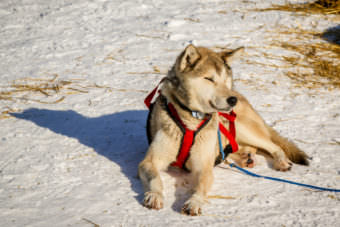
Petit’s team, however ate a less leafy meal in the dog yard at 25 below.

“Chicken fat and chicken skins and beef tripe and kibble,” Petit said. “No rib eye steaks. I’ve done that before, and it backfired.”

While Petit ate, several teams pulled into Tanana.

Jason Mackey arrived fourth, right behind Mitch Seavey.

“I had no idea there were only three teams here in front of me,” Mackey said. “I had no clue. Well, I did see a bunch of teams parked.”

Dozens of teams Tuesday afternoon pulled off to the side of the trail and rested in the midday sun before Tanana.

While the forecast is for mellower temperatures, Iditarod chief veterinarian Stuart Nelson and his volunteers are playing close attention to the athletes’ body condition over the course of another frigid interior Alaska night.

“Very few dropped dogs, very low numbers. Overall, the dogs are healthy; we want to really monitor the hydration and body weights,” he said. “But they’re pretty perky and peppy.”

Upon reaching the Yukon, mushers’ mandatory rest strategies are on the horizon: teams can now take their eight-hour rest at checkpoints between here and Kaltag in addition to their 24-hour layover.

Mackey wants to get hundreds of more miles behind him before taking the big rest.

“I’m set up in my 24 starting in Galena, and Huslia, Koyukuk and Nulato,” Mackey said. “If I can get all the way to Nulato, that would be the best, I think. The further you can go for the 24, the better off. There is a slew of teams that are thinking the same way.”

Before many take the eight-hour break, teams will head west on the Yukon to Ruby: the longest stretch between checkpoints at close to 120 miles.

Petit’s plan is to have options with the gear and supplies he packs.

“I plan on loading up my sled with anything I might need,” Petit said. “You see I still have straw? I still have a bunch of food. I don’t make a plan because I don’t know what the trail is going to do, and I don’t know what the weather is going to do, and I don’t know what my dogs are going to do. I just leave equipped for anything.”

For Wade Marrs, the fifth musher into the checkpoint, the next couple runs to Ruby will determine how quickly he needs to bank his big rest.

“If the dog team does really good coming across here, then we’ll take an eight and keep on going,” Marrs said. “If they don’t, we’ll take a 24 when we get to the end of this run and go from there.”

Twenty-five minutes behind Marrs was Bethel musher Pete Kaiser.

“I prefer to take my 24 first; we’ll see how it goes,” Kaiser said. “It all depends on what the dogs need at any given time. It’s nice to have the option for either from now on. But I don’t think we’ll need either of them, here.”


You can follow Alaska Public Media’s Iditarod coverage here, or listen to the Iditapod podcast below:

Mushers adjust to deep cold near Manley Hot Springs

The Manley Checkpoint (Photo by Ben Matheson/ KNOM)
The Manley Checkpoint (Photo by Ben Matheson/KNOM)

During the first night of this year’s Iditarod, teams endured frigid temperatures on the Tanana River to reach the second checkpoint of Manley Hot Springs.

Teams are adjusting to the deep cold and preparing to push to the Yukon River, where the race will unfold.

Nicolas Petit drove far into the night before pausing to rest.

In Tuesday’s bright afternoon sun, Petit said the long, early run on the way to Manley behind past champions Martin Buser and Mitch Seavey is all part of the plan.

“If they’re not tired enough to not go 100 miles an hour, they’ll get frostbit,” Petit said. “There is a reason for my madness.”

Other mushers cruised through Manley, choosing to camp further up the trail.

Petit said the trail was hard and fast out of Nenana, meaning, he needs to watch his speed at this early stage in the race.

“They’re good enough to where I can tell them which speed to go, and they’ll just go that speed, so I don’t really have to hold them back too much to go 7-and-a-half miles an hour,” Petit said. “If I ask them to they’ll go 12. But we don’t have to do that quite yet. And then we can go 14 (mph) on the way to Nome.”

Veteran Rick Casillo swapped out dog coats for a different style to keep the males from getting frostbitten. He was breaking up his runs into five-hour stretches to manage the cold and keep his string of 16 dogs intact.

“I think it’s going to be a cold one tonight,” Casillo said. “I think we’ve got one more day of this crap.”

The forecast call for milder temperatures after Wednesday.

A few parking areas away from Petit, Dallas Seavey, the winner of the last three years, was feeding an extra snack before he left the warm sun of Manley Hot Springs.

Seavey wanted to load up before the next big run, because dogs burn extra calories in the deep cold.

“Some of these guys are really good about eating snacks on the trail regardless of temperature, other dogs don’t like cold meat so much,” Seavey said. “I think I saw 47 below this morning, was the coldest I saw.”

Seavey was multitasking, working his way up and down his team fitting booties and cooking the meal.

He’s focused on the details that add up of a 1,000-mile race.

“One of those mushers dog’s may have gotten 20 percent more sleep during that time because they were a little more efficient,” Seavey said. “In my theory, if the dogs aren’t running, eating or sleeping, pretty much everything else is wasted time, albeit often times necessary wasted time, like putting booties on.”

Seavey left in the midday sun with only 11 dogs strung out in front, but he had five stowed in his new carbon fiber and Kevlar sled.

Several past champions left in quick succession Tuesday afternoon: Martin Buser first, followed by Jeff King, Mitch Seavey and Dallas Seavey.

The trail takes them to Tanana to meet the Yukon River, where the real racing can begin.


You can follow Alaska Public Media’s Iditarod coverage here, or listen to the Iditapod podcast below:

Ask a Climatologist: Record cold at Iditarod start won’t last

Teams rest at Nenana, on Tuesday, March 7, 2017. (Photo by Zachariah Hughes)

It’s hard to talk about the Iditarod without mentioning weather and climate. And this year is no exception, with mushers and dogs enduring extreme cold in first part of the race.

Climatologist Brian Brettschneider looks into how this year’s cold and snow stacks up to weather records from past races. He says the start Monday in Fairbanks was -19, by far the coldest in Iditarod history.

“If you look at the low for the day, it was -38, but it had warmed up — using the term “warm” loosely — to -19,” he said

Since the Iditarod started in 1973 that was the coldest start by a wide margin. The cold is only supposed to last for a couple of days, then rise into the 20s or even 30s, with lows in the single digits and teens.

“So the extreme cold going on right now is a short term phenomenon,” he said.

As for snow, there’s plenty on the route already, but “none of the checkpoints along the way are forecasting even a flake of snow,” Brettschneider said. “That’s subject to change, potentially, but to have no snow for that long a period for the entire route is really uncommon.”

Even though March is the driest month of the year in much of Alaska, there have been very few years when the week of the Iditarod recorded no snow.

The extreme cold seems notable now, but “when you average the beginning to the end, it’s going to go down as probably a pretty typical race period, temperature-wise,” according to Brettschneider.

Alaska’s Energy Desk is checking in with climatologist Brian Brettschneider each week as part of the segment, Ask a Climatologist. What do you want to ask?

Proper packing becomes more important as mushers kick off from Fairbanks

Fairbanks volunteers prepare for race start on banks of Chena River (Photo by Ben Matheson/KNOM)

Mushers are on the rivers heading out of Fairbanks right now, as the 45th Iditarod starts in earnest.

This is the second time in three races that the restart has been in Fairbanks. And a lot of the mushers have vivid memories of the 2015 race, so this year, they’re trying to pack accordingly.

It was chilly in Fairbanks, with overnight lows dipping toward 30 below. But by the time mushers were harnessing dogs and running through checklists the clear weather was easing toward a balmy zero degrees.

Though not running the race this year, four-time winner Lance Mackey was on hand, and said this year’s serious winter in the Interior may prove strong factor to content with.

“The wind has been blowing all winter,” Mackey said. “It snows when least expected. I’ve said many times – if these people haven’t tried their snowshoes on they’re gonna be hurtin’. ‘Cause I think this is the year you might need ‘em. Even to get off the trail to camp.”

Trailbreakers have been adding passing lanes to the early part of the route heading toward Tanana where the snows have been the heaviest.

The long stretches in the first leg of the race will require most mushers to stop for rest between checkpoints, a break to feed and rest the dogs.

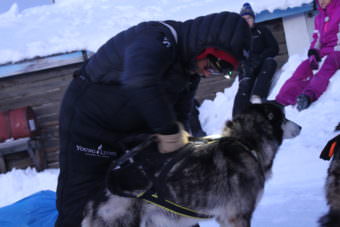
All around the parking lot that’s been converted to a dog yard, mushers are attaching bails of straw to their sleds. Some on the baskets. Others, like veteran Pete Kaiser, were piling it into trailers hitched behind the sled.

“This just gives a little extra room for some of these long runs between checkpoints where we’re gonna be stopping on the trail and camping, and requires a little more gear,” Kaiser said.

What will not be hauled in a trailer this year is dogs.

A controversial rule change bars mushers from carrying dogs in trailers, throwing a wrench in many people’s strategies from year’s past, which involved regularly rotating animals through rest along runs.

Many people are experimenting with a workaround, most notably, returning champion Dallas Seavey.

“Without being able to carry dogs in trailers, we had to find a way to bridge that gap,” Seavey said. “We just made a bigger sled.”

Seavey is standing over what looks like the Batmobile of dog-sleds.

It’s almost totally black, and instead of an external frame with a bag suspended from supports, this looks more like a plastic shell. It’s about 10 percent bigger than a regular sled.

He had it custom built from Kevlar and carbon-fiber, and mounted to the runners behind where the musher stands is another heavy duty cube that could hold supplies or dogs.

According to the rules, as long as it’s safe and fixed to the structure of the primary sled, you can use it for an animal.

“There’s many sleds here that have the ability to carry just as many dogs as I do in the same way, they just don’t have hard sides,” Seavey said. “I like the hard sides because it helps protect the dogs, so that if there’s just a piece of fabric between them and the great big world it’s a little less than carbon fiber and Kevlar. I’ve got them in a little cocoon in there.”

Hundreds of people took buses from the Carlson center to view the event at Pike’s Landing.

Spectators lined the long shoot clapping as mushers rushed below celebratory arches, down onto the Cheena River, and on toward Nome.


You can follow Alaska Public Media’s Iditarod coverage here, or listen to the Iditapod podcast below:

Teachable moments from Saturday’s avalanche near Eaglecrest

An experienced backcountry snowboarder had a very close call with an avalanche he triggered near Juneau’s Eaglecrest Ski Area on Saturday. It slid, rolled and bounced him hundreds of feet through a gully, though he was able to walk away from it.

The slope is known as Showboat.

“Front and center, right in front of the parking lot but it’s well outside our ski boundary,” said Brian Davies, who directs snow safety and the ski patrol at Eaglecrest.

Davies interviewed the backcountry snowboarder, who Alaska State Troopers identified as Ryland Buller, 28, a day after the avalanche.

Heading into the weekend, there had been several days of snow, with lots of nice, light powder accumulating.

The day of the avalanche, the skies were clear and cold.

“People think, ‘Oh, there’s no avalanches, it’s a bluebird day.’ But wind is the architect of avalanches,” Davies said. “It can move snow even when you’re not thinking about it and subtly create more hazard.”

All that light snow was “very portable,” Davies said,and as a leeward slope, snow naturally accumulates on Showboat.

Davies described Buller as an experienced backcountry boarder who got caught up in the excitement of the day and made some bad decisions.

“Going out, out of bounds is definitely a personal choice,” Davies said. “It’s a choice that comes with lots of responsibility. Knowing what the conditions are, having been educated about how to assess the conditions.”

“Having the proper tools, you know, beacon, shovel, probe, a pack to carry it in, emergency gear in that pack,” he said. “It’s always good to go with at least a partner, if not a couple of people.”

Davies said Buller had the right gear and even managed to make his own 911 call after coming to rest in a gully. But as he tumbled down, he had lost a lot of the gear from his pack.

“It sounds like where he was terrain wise, that he might have fortunately rolled up on the side of the gully, and the bulk of the snow went past him,” Davies said. “He was never totally buried or fully enveloped in the snow, but he did have snow moving around him.”

The path of the avalanche was almost 1,000 vertical feet, and Buller thinks he got caught in about half of that.

Buller was very lucky, Davies said. When searchers got to him, he was injured, but “ambulatory enough” to be escorted out.

The avalanche beacon, which helps others with similar devices locate each other in the snow, doesn’t do much good without a partner.

Buller was by himself, but had fortune of being spotted by ski patrol members and others from afar.

“He realized in the midst of that when it was happening, that, ‘Oops,’ yeah. Just a chain of decisions that ended up not going his way,” Davies said.

It was Buller’s second run down Showboat that day.

The snowboarder had actually unwittingly cut a slide on his first run, too, Davies said.

Buller was very humble about it, and wants to share his story in the future so others can learn from it, Davies said.

Davies, who’s worked with the ski patrol and snow safety for three decades, said someone was flushed into the same gully by an avalanche about 6 years ago and was also very lucky. He said the last time someone was caught and completely buried in an avalanche near Eaglecrest was in January 2008, just beyond the East Bowl Chutes boundary.

Eaglecrest Ski Area has shared this video about backcountry decision-making, and a checklist on its website for backcountry skiers.

Correction: An earlier version of this story conflated two separate past avalanches in the Eaglecrest area that affected skiers as if it were a single incident and has been corrected. 

Site notifications
Update notification options
Subscribe to notifications