Local Government

Effort to recall the North Slope Borough mayor is moving forward

A man speaks into a microphone in a legislative chamber.
Josiah Patkotak on his last day as the representative at Alaska Legislature. Patkotak represented District 40 before becoming the North Slope Borough Mayor. (Lex Treinen/Alaska Public Media)

The North Slope Borough clerk has issued a recall petition for the borough mayor, Josiah Aullaqsruaq Patkotak. It comes after months of efforts from residents over what they say were “lavish travel expenses” by the mayor and his family.

The petition authors said the mayor should be recalled for “misconduct in office, incompetence and failure to perform prescribed duties” because he used borough funds to pay for his family’s travel.

After several recall applications and a legal complaint from the group, the clerk, Sheila Burke, issued the petition on March 21.

Forrest Deano Olemaun, a former assembly president and one of petition sponsors, said public officials need to exercise transparency and honesty in how they treat public funds. He said the money used for the mayor’s travel could have been spent to support residents instead.

“It may not be much to those that already have, but it certainly is a lot to those that don’t have anything to begin with,” Olemaun said. “When you add it all up, it makes a huge difference.”

The borough assembly voted in December to allow officials to receive compensation for bringing their family on business trips. The prior code allowed for travel with family but did not specify whether the borough would pay for family travel costs.

However, Patkotak had already received compensation for taking his wife and children on at least 15 trips across the state and country, as well as overseas, before the code changed. Those travel expenses amounted to tens of thousands of dollars and included flying first class and staying at luxury hotels.

Patkotak did not respond to calls and emails asking for comment. Angela Cox, the borough’s director of government and external affairs and the mayor’s cousin, responded to questions about petitioners’ concerns last month via email. She said that former mayors also traveled on business with their families. Besides, she said, Patkotak has small children, and bringing them on trips is crucial.

A recall petition was also issued for Assembly President Crawford Patkotak, who is the mayor’s father. Petition authors said that when Crawford Patkotak voted to approve the ordinance allowing compensation for officials’ family travel, he did not disclose his personal interest in protecting his son.

Crawford Patkotak said in a phone call Thursday that traveling with family has been a common practice for borough officials. He also said that the assembly voted to simply clarify the code.

“We have tried our best to be transparent at the assembly level, working closely with the mayor and his staff,” Crawford Patkotak said. “We disclose through the process who we are, and the fact that our people, the voters of the North Slope Borough voted to put us in these positions.”

No other borough code in the state mentions compensating officials for bringing their family on business trips. Officials in at least eight Alaska boroughs are not allowed such practice, according to borough clerks. In most boroughs, officials are asked to use the most economical fare.

Residents filed their first application for a petition in February, but the borough denied it, stating it didn’t meet grounds for recall. After the authors filed their second application on March 4, the borough clerk Sheila Burke requested to adjust the petition to only keep the grounds that she deemed recallable. She said she issued the petition with those adjustments on March 21, though the group said they only received it this week.

The latest petition describes the mayor’s decision to use public funds on his family’s travel as improper and unethical. But the document omits some recall grounds the authors originally listed. Those include using the borough medevac plane for non-medical errands, approving too many nepotism waivers and misusing public funds to open an office in Anchorage.

Olemaun said the authors were disappointed the petition was edited but reluctantly accepted the changes.

Burke, the borough clerk, said residents have until mid-May to collect 371 signatures for the petition to recall the mayor, and 261 signatures to recall the assembly president. After that, the petition would be submitted to the assembly, and an election would be scheduled within 90 days.

Flood barriers are going up in Juneau. But it’s still unclear if they’ll be enough.

Admiralty Construction workers build HESCO barriers between Killewich Drive homes and Mendenhall River on April 2, 2025. (Photo by Alix Soliman/KTOO)

Listen to this story:

The low growl of machinery has been resounding through Juneau’s Mendenhall Valley for about two weeks, where dump trucks filled with sand rumble through backyards and the air smells of diesel. 

Robert Moore works for Admiralty Construction and spent his morning Wednesday inside HESCO barriers threading steel rods and coils through the metal cages that make up the growing flood wall. He said he’s grateful to be working on this project to protect Juneau neighborhoods from the annual glacial outburst flood. 

“I’m a carpenter by trade, so I want to protect those beautiful homes,” Moore said.

So far, crews have installed barriers on part of Riverside Drive across from Melvin Park, and have stacked them eight feet high along the river behind houses on Killewich Drive. The city plans for the levee to be done by mid-June — before a torrent of glacial meltwater is expected to release from Suicide Basin.  

The flood wall going up along Mendenhall River on April 2, 2025. (Photo by Alix Soliman/KTOO).

But plans might change. The U.S. Geological Survey just released revised estimates of the volume and speed of the water that raged through Mendenhall River during the 2023 and 2024 floods. 

The preliminary estimate was that 34,400 cubic feet per second (cfs) were released into the river last year. Now, the USGS estimates it was actually 42,700 cfs

Jeff Conaway, associate director for water, ice and landscape dynamics at the USGS Alaska Science Center, said it’s typical for the agency to publish preliminary results right after a flood and then update them later.

“The reason we have a new rating is because there’s higher flows and the channel is changing,” he said.

Scientists physically measure those changes in the months after a flood to recalibrate their estimates, then go through a peer review process to verify the numbers.

“We’re out there with meters measuring the velocity and the depth and the width of the channel” which have shifted with erosion, altering the “relationship of how the lake drains and how much flow is coming down the river,” Conaway said. 

Nate Rumsey, Juneau’s Engineering & Public Works deputy director, said that the inundation maps that were scheduled to be released at the end of March had been based on the preliminary results since the revision wasn’t available at the time. 

When the new numbers came out, “it was a large enough shift that we needed to go back and rerun our models,” he said. 

Critically, the maps will model how well the flood wall will perform. Rumsey said that while the city is prepared to adjust its plans depending on new information, “we do feel extremely confident that even though we’re deciding to go back and recalibrate the models, that the HESCO barrier will work as it is intended to work.”

The maps will include inundation scenarios for a flood height up to 20 feet. Last year, the river set a record of 16 feet. A litany of changing factors influence how high glacial outburst floods could get, and USGS researchers say they don’t know yet what the maximum could be. 

Rumsey said that modeling for a 20-foot flood seems practical for the next several years. 

“It doesn’t seem like there’s knowledge that an event higher than 20 feet is foreseeable based on what we know right now,” he said. 

The city plans to publish the new inundation maps by the end of April.

Telephone Hill residents in limbo as timeline for neighborhood redevelopment remains unclear

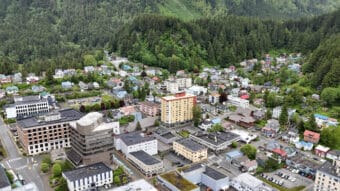
The Telephone Hill neighborhood in downtown Juneau on Thursday, April 3, 2025. (Photo by Clarise Larson/KTOO)

It’s been more than a year since the Juneau Assembly voted to move forward with a plan to demolish the downtown Telephone Hill neighborhoods’ historic homes and add more than 100 new housing units.

But since then, there hasn’t been much movement on the project. Residents say that has left them in limbo. 

Joe Karson rents an apartment on Telephone Hill. He’s been living there for two decades. 

Since the City and Borough of Juneau took over ownership of the neighborhood’s land about two years ago, he’s been checking his mailbox for an eviction notice. So far, nothing’s come.

“I don’t know if I could be evicted this summer or I could be here forever — I don’t know,” he said. “I have not heard from the city. Nobody has.”

The neighborhood is on roughly four acres of land on a hill that straddles the State Office Building downtown. It was state owned from the 1980s until 2023 when the city took it over. The state originally intended to build a new Capitol complex there, but that obviously never happened. 

Last year, the Juneau Assembly voted to redevelop the neighborhood to build denser housing there. Members said the decision was in response to Juneau’s severe lack of housing. 

But Karson said that same severe lack of housing is exactly why he — and many of his neighbors — haven’t looked for another place, despite knowing the city’s plan.

“I don’t really have a plan B to tell you the truth, given what the housing is. If I wasn’t living here, I’m not sure what I would do,” he said. “This is not a good time to find yourself without housing in Juneau, that’s for sure.”

Another Telephone Hill resident, Morgan Dufseth, said she’s stressed about finding a new place and also worried that any new units built in the area will be unaffordable for most residents.

“There are a lot of different things you could do with this, other than turn it into condos,” she said. 

Last year, the city put out a request for interest to developers who might want to take on the project. The deadline to reply was in late February and only one developer responded.

It’s a Washington and Idaho-based developer called Johnson & Carr. In its response to the city, the company says it wants to take on the project in spite of “significant economic obstacles.” 

It outlined a plan to build “no less than some combination of 40 affordable units for all income groups, modest-price single-level housing for seniors, and, likely, market-rate for-sale condominiums.” 

“It does take collaboration with the city to figure out the different financing vehicles that are available for different depths of affordability,” said Tyler Carr with the company. “Not to be vague, but at this level, it still has to be widely bracketed until we get further collaboration from the city and market analysis.”

Last year, the Assembly agreed to set a goal for the project to offer about a fifth of the new units at below-market rent. 

But there are no actual mandated requirements in place yet. If those come, they are likely to be discussed by the Assembly later down the line. Though some members, like Mayor Beth Weldon, have said they worry that adding any requirements might discourage developers from doing the project.

“My personal feeling is we should just let an outright bidding war happen and get as much money we can from Telephone Hill. It’s prime real estate. We would get prime costs,” she said during an interview last fall. “If we go that route of getting the most bang for the buck, then we don’t have to put any money into doing any project development or any landscaping or anything like that.”

City officials have warned that if the Assembly wants to mandate affordability requirements as part of the development, they can expect to have to pay for it. 

According to City Manager Katie Koester, the project still has quite a few steps to go before breaking ground.

“Telephone Hill will be redeveloped. However, we’re not evicting anyone without having real solid timelines and a plan for what that development looks like,” she said. “I know that there’s some uncertainty in that.”

Koester said Telephone Hill residents should be looking for other places to live in the meantime. The Assembly will likely get an update on the project in the coming months and decide how to move forward with redevelopment.

Juneau considers setting aside money to support Mendenhall Glacier Visitor Center staffing

The Mendenhall Glacier seen from the Mendenhall Glacier Visitor Center on Friday, Feb. 21, 2025. (Photo by Clarise Larson/KTOO)

With Juneau’s cruise ship season less than two weeks away, Juneau officials are proposing to set aside city money to hire staff for one of the city’s main tourist attractions: the Mendenhall Glacier Visitor Center.

The jobs were formerly filled by federal workers, and city leaders say the proposal would act as a safety net in the face of further uncertainty at the federal level.

Juneau’s Visitor Industry Director Alix Pierce asked the Assembly Finance Committee to set aside $200,000. The money could be used to fund positions at the visitor center from State Commercial Passenger Fees collected from cruise ship visitors if more federal employees are laid off. She’s hoping it won’t come to that, though. 

“This appropriation would be money to the manager’s office to use at the discretion of the City Manager, if there’s another issue affecting staffing, to try to create some level of continuity out there, given all the uncertainties,” Pierce said. 

In February, a wave of federal firings left one remaining staff member at the visitor center. In a typical summer, there are about a dozen on site at any given time to serve the one million visitors who come each year. 

Last month, the U.S. Department of Agriculture reinstated employees who were terminated because an independent federal board ruled that the firings were unlawful. It issued a 45-day stay on the positions, but thereʼs still uncertainty about what happens next. U.S. Forest Service officials say they can’t provide a staffing schedule or plan for the visitor center at this time. 

Pierce says about half of the visitor center staff took their jobs back. Others had already found jobs elsewhere. But even for those currently back at the glacier, the job is unstable. And, sheʼs heard from Forest Service staff that more cuts may be coming from the White House in the future.

“There is still some uncertainty,” she said. “There are discussions of another reduction in force. We don’t know what that looks like. We don’t know how it would impact operations here in Juneau.”

The city manager could use the money to pay other organizations that operate at the glacier to quickly hire some of the terminated staff. 

One of those is Discovery Southeast, a nature and science education nonprofit that already has a presence at the glacier.

Shawn Eisele is the director. He said the city funding is a good stop-gap, but he’s upset they have to step in at all. The Mendenhall Glacier Visitor Center was self-sustaining as it was before the Trump administration cut staff.

“It worked really well. It ‘s good paying jobs in our community. It worked great. It doesn’t make sense that it’s been kind of artificially collapsed right now,” he said. “Like, we’re not looking for a good solution. We’re just looking for the least pain in the short term to hopefully bridge a better solution in the long term.”

But Eisele said the organization is prepared to be a part of that bridge.

“If there’s an opportunity for us to step in in the short term and keep things going, we’re prepared to do this,” he said. 

The proposal will be introduced at Monday’s assembly meeting, and voted on at the next. 

‘We all fish right there’: Local concerns pause timber company’s plans for Haines

The log transfer facility and storage site would be a little over four miles outside of town, in Haines’ Lutak Inlet, pictured above on March 27, 2025. (Avery Ellfeldt/KHNS)

Four years ago, an Oregon-based timber company won a contract to harvest some 23 million board feet of spruce and hemlock outside Haines. Now, the company’s plan to get that timber out of Alaska – and into buyers’ hands – is sparking pushback.

That’s because the company’s local operator is seeking permits to build a log transfer facility and storage site in Haines’ Lutak Inlet, a popular spot for commercial and subsistence fishing.

“We all fish right there,” said Erik Lembke, a commercial fisherman in Haines.

The concern pushed the State Department of Natural Resources to make an about-face late Wednesday afternoon by temporarily closing the permit application’s public comment period. The period was originally set to end on Friday.

Tony Keith, a natural resource manager with the department, said the feedback the agency had received so far made it clear the public needs more information. In response, the agency will require the company to provide the public with more details, including a dive survey of the ocean floor.

“Then, once you’re finishing the log transfer facility, or if you’re trying to bring it back under review or anything, you’re able to do another dive survey and go out there and check bark accumulation and stuff like that,” Keith said.

The Chilkat Valley’s first major timber sale in decades

The so-called Baby Brown timber sale lies in the Haines State Forest, just over 35 miles northwest of town between Porcupine and Jarvis Creeks. The state first awarded the sale to a contractor in 2016 but later canceled it after conservation groups appealed the land use plan. Later, in 2021, the sale was awarded again, this time to an Oregon-based company named NWFP Inc.

State Forester Greg Palmieri said the company has been developing what he called a “responsible plan” for the project over the last several years. As he sees it, Baby Brown presents a “huge opportunity” for Southeast and the Chilkat Valley specifically, which used to be home to a booming timber industry – but hasn’t seen a major sale in decades.

Palmieri said 8 million board feet of timber were harvested in the area in 1995, and there were a few other, smaller sales until about 2000. But he added that the last time there was a sale around the size of Baby Brown, “it was probably around the mid-70’s.”

“If there’s no industry working in the area, there’s no potential for growth. So this sale was designed to encourage the development of the industry,” Palmieri said. “Conceptually, does it crack that egg? We’ll have to see. It has the potential to do that.”

The contractor’s local operator – NSEA Timber Inc. – submitted the permit application on March 11, according to Keith of the Department of Natural Resources. The company also needs permits from the borough and U.S. Army Corps of Engineers.

The application proposes a log transfer facility and storage area on a 12-acre site about four miles out of town, off Lutak Road. The property is in a borough-designated waterfront industrial zone near the Alaska Marine Lines dock.

The facility would include a slide to transfer log bundles into the water. A boat would then place each bundle into a floating log raft and tow the raft to a storage site close to shore. Later, they would be loaded onto ships, which would transport them to buyers.

“This is a fundamental step in that process to get the product to market,” said Palmieri.

This type of facility has been around for decades, said Charles Nash, who used to be employed by the contractor but is no longer associated with the sale. Nash has worked in Alaska’s timber industry for years.

“There used to be log transfer facilities all over Southeast, and they come in many types. Some are slides, some are cranes,” he said. “But that’s how, generally, how logs got in the water.”

Palmieri, the forester, said the facility is a conservative option that aims to reduce traffic and limit impacts on the inlet – and the fisherman who use it. He estimated the storage site would be about 1,700-feet long, roughly one-third of a mile.

Fishing concerns

But some worry about the log rafts affecting water quality and access to the inlet.

“The way that you fish Lutak Inlet, you know, you fish out from the shoreline,” said Rafe McGuire, a commercial fisherman in Haines.

He added that a log area close to shore would mean fishermen would lose access to that area and more because they would need to make sure their nets wouldn’t get swept closer by the tide.

“You can’t fish very close to it. So you’d lose most of that distance,” McGuire said.

Lembke, the other fisherman, said there could be up to 20 boats fishing the area during the sockeye run.

“I think if there was a lot of logs and a big ship, it would pretty much make it impossible to do that,” he said

Polly Johannsen – who signed the permit application for the local operating company, NSEA Timber Inc. – did not respond to multiple requests for comment. Nicole Zeiser, area management biologist with the state Department of Fish and Game, did not respond to an emailed request for comment.

Earlier this month, a separate lumber company confirmed it was temporarily shutting down a work site near Kodiak. The company attributed the decision to China’s pause on imports of U.S. logs in response to ongoing trade disputes.

Palmieri says he’s received no indication that the trade war has affected the sale. The permit application, for its part, says logging could begin as soon as this spring and run through 2028. The agency did not say when the dive survey will take place or what the permitting delay will mean for logging operations.

Juneau’s short-term rental task force only has one member who rents

Downtown Juneau on Wednesday, March 26, 2025. (Photo by Clarise Larson/KTOO)

For some people in Juneau, short-term rentals are an opportunity to bring in some extra cash or to make ends meet. But as the number of Airbnb and VRBOs increases, others feel they’re taking away housing desperately needed in the community. 

City data and different analyses suggest there are likely around 300 to 400 short-term rentals in Juneau, but that the number could be even higher. 

Short-term rentals are largely unregulated in Juneau, although the city did start requiring registration in 2023. But a new city task force is meeting regularly to decide whether there should be some firmer rules in place. 

But, there’s a problem with the group, Assembly member Alicia Hughes-Skandijs says — she’s the only member out of 11 who is a long-term renter. 

“We need to have people affected by the industry, and that would be renters, and that’s a demographic that sometimes is not represented,” she said. 

She said the makeup of the task force doesn’t fully represent the diversity of Juneau’s housing needs. According to the U.S. Census Bureau, about a third of residents are renters. That’s a starkly different makeup from the task force. 

“I don’t want to suggest that people can’t make really good civic contributions to a place they care about. But it is not marked by that sense of urgency, because they’re not affected in the same way,” she said. 

Both renting and owning in Juneau are expensive. The average single-family home costs more in Juneau than anywhere else in Alaska, and it ranks fifth in the state for the highest average rental costs for a two-bedroom.

The task force’s goal is to assess the short-term rental market and make recommendations that improve housing availability. Mayor Beth Weldon hand-picked the members of the group. 

She said, despite the lack of renters, she believes the group can still make decisions that represent the various viewpoints on short-term rentals in town. 

“Are we missing the people that are going to come and say, ‘I can’t find rental places?’ Yes. But are we still accounting for people there that want to regulate? I think that’s already represented,” she said. 

She noted that she did ask a handful of people who were renters to join the task force, but they declined. 

“Quite honestly, when you do a task force, it’s hard to get all the voices, but keep the group a manageable group,” she said.

The task force has been meeting biweekly since January. They plan to host two public meetings in the coming months to get feedback from residents on what kind of regulations they’d like to see. Hughes-Skandijs said it’s important that people, specifically long-term renters, go to those meetings and make sure their voices are heard. People can also submit comments and suggestions on the task force’s website. 

“That is a real opportunity to be heard. We would love to hear your thoughts on what you think we should do, how you think we should do it,” she said. “If people have strong thoughts about the process, then we would love to learn from that.”

Once the task force makes its recommendations, it will ultimately be up to the Assembly to decide how to implement them. 

If they pass regulations, Juneau wouldn’t be the first community in Alaska to do so. Communities around the state and country have already taken steps to curb the increase in their markets. 

In Sitka, short-term rental owners are required to live on the property for half of the year. And Wasilla only offers 75 short-term rental permits per year. Vacation destinations in states like  Colorado have also put into place similar laws.

Site notifications
Update notification options
Subscribe to notifications