Federal Government

Tribes and environmental groups sue to stop road planned for Alaska wildlife refuge

Brant fly over the water on Sept. 28, 2016, at Izembek Lagoon in Izembek National Wildlife Refuge. The refuge supports the entire Pacific population of black brant, a species of goose.
(Kristine Sowl/U.S. Fish and Wildlife Service)

Three tribal governments and several environmental groups sued the Trump administration on Wednesday to try to block a land trade that would allow a road to be built through a national wildlife refuge in southwestern Alaska.

The land swap, approved by the U.S. Department of the Interior last month, would open up a section of the Izembek National Wildlife Refuge.

Supporters argue that the road is needed to connect the community of King Cove, home to about 750 people, with a legacy military airstrip that can accommodate jets. That would give King Cove’s residents access to safer medical evacuations if needed. Opponents say the proposed road — to run 18.9 miles in total, most of that within what is currently refuge land — would damage world-class bird habitat that is in the heart of the refuge.

Wednesday’s challenges came in three lawsuits filed in U.S. District Court in Anchorage. All assert that the land trade and road development pose dire threats to migratory bird populations that use Izembek’s wetlands, including species with Endangered Species Act listings, and to the wider ecosystem. All say the trade and planned road violate the Alaska National Interest Lands Conservation Act and other federal laws.

The three lawsuits have their individual characteristics as well.

One of them, filed by tribal governments in the Yukon-Kuskokwim Delta villages, focuses on threats to traditional subsistence hunters who depend on the birds that use Izembek’s wetlands. The tribal plaintiffs are the Native Village of Paimiut, Native Village of Hooper Bay and Chevak Native Village.

“Izembek’s eelgrass wetlands are a lifeline for emperor geese, black brant and other birds that feed our families and connect us to Indigenous relatives across the Pacific,” Angutekaraq Estelle Thomson, traditional council president of the Native Village of Paimiut, said in a statement. “Trading away this globally important refuge for a commercial corridor devalues our lives and our children’s future. We are joining this lawsuit because defending Izembek is inseparable from defending our subsistence rights, our food security and our ability to remain Yup’ik on our own lands.”

The Center for Biological Diversity, an environmental organization, is also a plaintiff in the case.

A second lawsuit, filed by Friends of Alaska National Wildlife Refuges, Wilderness Watch, the Alaska Wilderness League and the Sierra Club, puts a special focus on the process used to achieve the land swap and what it may mean for all wildlife refuges.

“Trading the ownership of refuge lands that Congress designated for conservation is a terrible precedent for the privatization of public lands. Building a road will have tremendous impacts on fish and wildlife habitat and could also greatly increase both disturbance and sport hunting pressure on vulnerable species,” Marilyn Sigman, president of Friends of Alaska National Wildlife Refuges, said in a statement.

The third complaint, filed by Defenders of Wildlife, puts a focus on the wider environmental impacts.

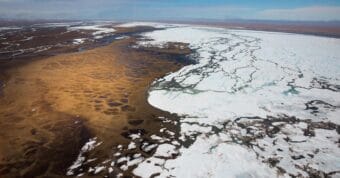
Green eelgrass appears at low tide in the vast wetlands of Izembek Lagoon, at the edge of Izembek Refuge. (Kristine Sowl/USFWS)

The planned road enabled by the land trade would “result in incalculable and irreversible damage” to myriad wildlife species, including marine and land mammals as well as migratory birds, that lawsuit says. The lawsuit alleges that the land deal violates both the National Wildlife Refuge System Improvement Act and the federal Wilderness Act.

“Under the Trump administration, the Interior Secretary entered into an illegal deal done in the darkness of a government shutdown: a sellout of one of our country’s largest and most pristine wildlife refuges and wilderness areas,” Jane Davenport, a senior attorney in Defenders of Wildlife’s Biodiversity Law Center, said in a statement. “Our treasured public conservation lands belong to all Americans. Defenders of Wildlife will stand up in court to hold this administration to account for recklessly and unlawfully trading them away.”

The Izembek Lagoon area, where the road is planned, holds the largest single stand of eelgrass in the world and the largest bed of seagrass along the North American Pacific Coast, according to the U.S. Fish and Wildlife Service. The entire Pacific population of black brant, a type of goose, uses the refuge’s lagoon area, feeding on the eelgrass. The refuge and its eelgrass support several other bird and mammal species; about half the world’s emperor geese use the refuge as a migratory stopover, according to biologists.

A Department of the Interior spokesperson declined to comment Wednesday on the lawsuits.

Last month, however, Interior Secretary Doug Burgum touted the land exchange and planned road as long overdue.

He spoke about the project during an event called “Alaska Day,” a gathering in Washington with Gov. Mike Dunleavy and the state’s three-member congressional delegation. The Izembek land exchange was one of the pro-development Alaska actions announced at the event.

“It just seems preposterous to me that somehow, it’s taken 40 years for us to put people first,” Burgum said at the event. “Because I know one thing as a governor of a state: You can actually do things like build 18 miles of gravel road and still take great care of wildlife.” Burgum was North Dakota’s governor before being appointed as Interior secretary.

The land trade he approved would convey a little less than 500 acres of refuge land, most of it designated wilderness, to the Native-owned King Cove Corp. The corporation would give 1,739 acres of its land to the U.S. Fish and Wildlife Service to be added to the refuge, and the federal government would also pay the corporation for the land.

The idea of a road linking King Cove to the World War II-era military runway at Cold Bay dates back decades. The legal and political battle over the proposal has also been long. Some of the plaintiffs in the new cases were plaintiffs in previous lawsuits over proposed land trades. The dispute was being considered by the 9th Circuit Court of Appeals, but that court in 2023 determined that the case was moot and dismissed it because the Biden administration was not pursuing the plan endorsed by the first Trump administration.

Green eelgrass appears at low tide in the vast wetlands of Izembek Lagoon, at the edge of Izembek Refuge. (Kristine Sowl/USFWS)

Fairbanks mother speaks on her 2-month detainment by ICE

Atcharee Buntow with Dmonhi, her two-year-old son, after her release from ICE custody on Oct. 2, 2025.
Atcharee Buntow with Dmonhi, her two-year-old son, after her release from ICE custody on Oct. 2, 2025. (Atcharee Buntow)

On a sunny afternoon in early August, Atcharee Buntow was running an errand for her mom’s Thai restaurant, topping off their supply of oyster sauce. But when an unmarked vehicle pulled her over on her way home, it became one of the worst days of her life.

A U.S. Immigrations and Customs Enforcement agent approached her car, and Buntow started taking a video of the encounter on her phone while frantically trying to text her family.

Buntow says she didn’t know what was happening until after the agent put her in handcuffs.

“They did not identify themselves until they had me in custody,” she said in an interview after her release.

Buntow said she was told that she was being detained for overstaying her visa and then taken to a holding facility in Tacoma, Washington. She said she was locked in a dorm with about 60 other women, where it was hard to sleep and meals didn’t come on time.

“Some nights, we didn’t get our dinner till 10:30 p.m., or 11,” she said. “The latest night I ever got dinner was at 2:30 a.m., so I just starved that night.”

She was released on bail about two months later, on Oct. 2.

Buntow, who turns 43 this week, was born in Thailand but has lived in the United States since she was 11. She said she wasn’t aware that there had been any issue with her immigration status, especially after she got married to her first husband, an American citizen.

She’s now married to a different American citizen and is the mother of six American children — four adults and two younger kids. She said the separation was hardest for them.

“My 12-year-old, he was in and out of the hospital for asthma attacks,” Buntow said. “Now that I’m back, he is fine.”

She also has a two-year-old son who relatives say would cry every night she was gone. 

Buntow stayed in touch with family with a tablet she shared with dozens of other women in the detention center. She said those brief calls were one of her only sources of comfort behind bars.

“I was depressed,” Buntow said. “You know, what are they going to do for Thanksgiving? I cook every year. Mac and cheese, sweet potato pie and the green bean casserole. The kids love that.”

Buntow said she feels like her arrest was pretty random. But she’s been convicted of a few nonviolent misdemeanors in Fairbanks over the last couple decades, as well as a felony for fraudulently applying for the Alaska Permanent Fund dividend, according to court records.

She pleaded guilty to falsely claiming U.S. citizenship on her PFD application in 2014. Buntow said that was a mistake she made while she was filling out the PFD paperwork for her children. Now, she’s trying to get the conviction vacated so she can stay in Alaska with her family.

Over the last couple months, Buntow’s friends and neighbors, Fairbanks officials, and state legislators advocated for her release. Fairbanksans held a protest in her honor, and her family was able to crowdfund over $20,000 for her bail.

Buntow said the fundraiser remains active to help cover her legal fees while she tries to secure a green card.

Fairbanksans protested federal Immigration and Customs Enforcement activity throughout the city and rallied to support detained Thai resident Atcharee Buntow on Aug. 23, 2025. (Shelby Herbert/KUAC)

Margaret Stock, an Anchorage-based attorney who is recognized for her expertise in immigration law, said she’s seen many people in Alaska face similar situations this year. And that while the Trump administration insists ICE agents are only picking up the worst of the worst, she sees a lot of collateral damage.

“What I’m seeing are a lot of people being picked up who don’t have a criminal record,” Stock said. “Or it’s something really minor, like they had an encounter with the police, but no charges were filed. In some cases, they’re picking up U.S. citizens.”

Stock said she’s even working with an Alaska military veteran to fight deportation proceedings. She said the majority of people she sees ICE detaining are eligible for a green card, and that she believes ICE is putting pressure on them to leave the country by putting them in detention centers.

But those proceedings can take years. And Stock said legal resources are stretched thin, especially in Alaska.

“It’s pretty hard to find help,” she said. “I mean, there are a few private lawyers, but we’re strapped thin. Right now, the immigration judges have more than 4,000 cases per judge. Getting a hearing with the judge can take a really long time, and you have to comply with a lot of technical rules, so it’s really difficult if you don’t have an attorney.”

That’s the route Buntow is trying to take. Buntow said she’s cautiously hopeful she won’t be deported to Thailand, which doesn’t feel like home anymore.

“I don’t know anything over there,” she said. “I’ve been living here all my life. Where would I live? Where would I go? What will I do without my kids, my husband? I’m happy that I’m back, I’m just scared of what’s going to happen next.”

Her husband, an American citizen who has never left the country before, is preparing to start his life over with her abroad if their worst fears come to pass.

Buntow remains grateful for the time she has with her family and the chance to celebrate her birthday and the holidays together. But her thoughts remain with the other mothers she befriended in the Tacoma detention center.

Buntow is still in touch with a fellow detainee named Paula, an immigrant from the Philippines who was born in Cambodia.

“I just heard Paula got sent to Louisiana, which is worse than Tacoma,” Buntow said. “She has eight children. She’s been in there for 18 months, and her immigration case is over. She was trying to appeal it, and they denied her appeal. I really feel very bad for her. Like, I cried when she told me her story.”

ICE did not respond to interview requests before press time.

Senators take first step toward reopening the government after historic shutdown

Sen. Tim Kaine, D-Va., speaks during a press conference following a vote on Capitol Hill on Sunday. The Senate convened for a rare Sunday session in an attempt to end the government shutdown.
Sen. Tim Kaine, D-Va., speaks during a press conference following a vote on Capitol Hill on Sunday. The Senate convened for a rare Sunday session in an attempt to end the government shutdown. (Anna Rose Layden/Getty Images)

A bipartisan group of Senate Democrats and Republicans reached a deal to reopen the government after the longest shutdown in U.S. history, voting on the first procedural step on the measure.

The agreement would fund the government through Jan. 30 and include full-year funding for a trio of appropriations bills, including full funding for the Supplemental Nutrition Assistance Program, or SNAP, through Sept. 30, 2026, or the end of the fiscal year.

The vote late on Sunday was 60 to 40, with seven Democrats and one independent joining with most Republicans to advance the measure.

It marked the first, but crucial, step towards passing the measure in the Senate. Once the bill cleared the 60 votes needed to overcome a filibuster, any remaining Senate votes need just a simple majority. However, the legislation still needs to pass the House before the shutdown would end, enabling air traffic controllers and other federal workers to get paid and federal food benefits to resume, among other things.

Senate Democrats had earlier voted against more than a dozen short-term spending measures in their fight to preserve health care subsidies. But as the pain of the shutdown continued to bite, some agreed to more modest changes in the latest framework.

The continuing resolution to fund the government until the end of January would also include language to reverse any reductions in force of federal employees that happened during the shutdown, as well as protections against further such layoffs through the end of the fiscal year, and backpay for all federal employees during the shutdown.

“I have long said that to earn my vote, we need to be on a path toward fixing Republicans’ health care mess and to protect the federal workforce,” Sen. Tim Kaine (D-Va.) said in a statement. “This deal guarantees a vote to extend Affordable Care Act premium tax credits, which Republicans weren’t willing to do.”

The agreement to reopen the government is also expected to include a Senate vote on health care by the second week of December, on a bill of Democrats’ choosing. That informal deal is not part of the legislative text.

Democrats are deeply divided about the compromise measure, which was opposed by Senate Minority Leader Chuck Schumer.

“I think it’s a terrible mistake,” Sen. Elizabeth Warren (D-Mass.) said of the deal. “The American people want us to stand and fight for healthcare.”

Democratic divisions over legislation

Several top Democrats in the House also vowed to vote against the bill.

House Minority Leader Hakeem Jeffries, D-N.Y., panned the agreement in a statement before the Senate vote.

“We will not support spending legislation advanced by Senate Republicans that fails to extend the Affordable Care Act tax credits,” Jeffries said in a statement. “We will fight the GOP bill in the House of Representatives, where Mike Johnson will be compelled to end the seven week Republican taxpayer-funded vacation.”

And Democrat Rep. Greg Casar of Texas called the deal a “betrayal” and a “capitulation” because it doesn’t reduce health care costs.

The House has not held a vote since Sept. 19, and previously passed a government funding measure without Democratic support.

The Senate deal on government funding comes after Democrats cruised to a series of electoral victories in the last week, giving some in the party newfound political confidence to continue to fight for health care extensions.

Many Democrats believed that keeping the government shut down gave them their only legislative leverage, with Republicans still in control of Congress and the White House.

Moderate Democrats defended their votes, with some telling reporters that it’s the best deal they could do.

Kaine, one of the Democrats who voted for the measure on Sunday, defended his support, saying Democrats would be able to put important health care legislation up for a vote.

“Lawmakers know their constituents expect them to vote for it, and if they don’t, they could very well be replaced at the ballot box by someone who will,” he said in his statement.

SNAP uncertainty drives up demand at Juneau food pantries even as limited relief arrives

People line up at the Southeast Alaska Food Bank on Nov. 6, 2025. (Photo by Yvonne Krumrey/KTOO)

Outside the Southeast Alaska Food Bank on Thursday afternoon, dozens of people lined up to receive food.

Inside, volunteers took the slips of paper saying how many adults, kids and pets were associated with each household. They filled bags with yogurt, bread and asparagus and sent them down to the other end of the food bank, where people picked them up. 

Shannon James was in line to get food for her family.

“I stress a lot about my grandkids,” she said. “I’m not so worried about myself. I can eat Top Ramen, but the kids need nutrients and vitamins.”

After a delay caused by the federal government shutdown, some Alaskans enrolled in the Supplemental Nutrition Assistance Program — also called SNAP or food stamps — have begun to receive half their monthly benefits this week.

Despite that, the delay has driven Juneau residents to worry that their next meal isn’t guaranteed, and local organizations are stepping up their efforts to fill the gap.

James received half of her SNAP benefits on Thursday, but it was a stressful week for her family, and she said she’s not sure when the rest will come. 

“The stuff I get from SNAP, then I go to the store and get what I didn’t get from the food bank,” James said. “Because the food bank, you kind of get the regular things, and not necessarily the basics like milk and eggs and stuff.”

This week, those basic groceries were harder to get without food stamps. 

In an email, the Alaska Department of Health’s Shirley Sakaye said she expects the rest of the payments to go out next week. But she said the state hasn’t received guidance from the federal government for December if the shutdown continues. 

In the meantime, the Southeast Alaska Food Bank has prepared for more need. Dan Parks is its executive director.

“Demand is up,” he said. “We’ve been busy. This is maybe the busiest week I’ve had since I’ve been here.”

He said double the usual number of volunteers were there for Thursday’s distribution. And people are finding other ways to help.

“The thing that we have seen increase the most in the last week is donations,” Parks said. “Which is amazing, and that’s really heartening to see such a huge outpouring of support.” 

It’s needed. Organizers say the food pantry at Resurrection Lutheran Church downtown ran out of food a few hours into opening on Tuesday. 

Speaking on KTOO’s Juneau Afternoon on Thursday, Karen Lawfer said the church is stepping up its weekly efforts by adding a second night to give out hot food to anyone who needs it. 

“If food insecurity is an issue, just come on in and meet your neighbors and meet the community,” she said.

There are food pantry hours throughout the week across Juneau. Resurrection Lutheran Church is hosting a telethon to raise money for food security Saturday from 6 to 10 p.m.

Sullivan votes to block Senate measure intended to preempt American bombing of Venezuela

Alaska Republican U.S. Sens. Lisa Murkowski and Dan Sullivan.
Alaska Republican U.S. Sens. Lisa Murkowski and Dan Sullivan. (Alaska Beacon file photos)

Alaska’s two U.S. senators split on a vote that would have allowed the U.S. Senate to take up a resolution that sought to prevent President Donald Trump from unilaterally ordering the bombing of Venezuela.

Fifty votes were needed in the Senate to take up the resolution, but only 49 senators — all the Senate’s Democrats, plus Republican Sens. Lisa Murkowski of Alaska and Rand Paul of Kentucky — voted in favor of the procedural action needed to force a vote.

Sen. Dan Sullivan joined a majority of Senate Republicans and voted against taking up the resolution, which was sponsored by Sen. Tim Kaine, D-Virginia.

Thursday’s vote, and the split decision by Alaska’s senators, was similar to a vote that took place last month, when the Senate declined to consider a resolution intended to curtail America’s killing of suspected drug dealers without trial.

Since September, the United States has killed 67 people aboard boats in both the Caribbean Sea and the Pacific Ocean, according to tallies kept by the New York Times and CNN. There have been 16 known military strikes since Sept. 2, each targeting a boat that the U.S. government claims was carrying drugs.

It is illegal for the U.S. military to intentionally kill civilians who are not actively taking part in hostilities against the United States.

In October, Murkowski joined Paul and all but one of the Senate’s Democrats in voting to take up a resolution intended to curtail the strikes. Sullivan joined the rest of the Senate’s Republicans, and Pennsylvania Sen. John Fetterman, D-Pennsylvania, in voting to support the strikes.

Since that vote, Trump has said that he has authorized covert CIA operations in Venezuela and is considering military strikes against the country, which is governed by dictator Nicolás Maduro.

The U.S. military has positioned large numbers of soldiers and aircraft near Venezuela’s coastline, possibly in preparation for attack.

In a statement after Thursday’s vote, Murkowski said she has “been briefed multiple times and reviewed classified documents that provide insight into the administration’s factual justification” for attacking Venezuela.

“Even with this additional context, I do not believe their case has met the standard of clarity and rigor that Congress needs to fully evaluate the legality and scope of these operations,” she said.

Devyn Shea, a spokesperson for Dan Sullivan, said by email after the vote, “In both Democrat and Republican administrations, Senator Sullivan has consistently voted against limiting the authority of the President as Commander-in-Chief to protect the national security interests of the country.”

Sullivan “believes that under Article II of the Constitution, President Trump as Commander-in-Chief has the authority to defend our homeland from Venezuelan narcoterrorists, just as President George H.W. Bush did when he ordered the full military invasion of Panama in 1989 to remove the drug-trafficking dictator Manuel Noriega,” Shea said.

Anchorage International, Sea-Tac among 40 airports forced to cut flights due to government shutdown

Passengers arrive at the Ted Stevens Anchorage International Airport on April 20, 2022, a day after masks became optional on flights. (Jeff Chen/Alaska Public Media)
Passengers arrive at the Ted Stevens Anchorage International Airport on April 20, 2022. (Jeff Chen/Alaska Public Media)

Ted Stevens Anchorage International Airport is among 40 airports across the country forced to slash air traffic by 10% starting Friday as the government shutdown becomes the longest in U.S. history.

U.S. Transportation Secretary Sean Duffy said Wednesday that traffic would be cut from the country’s busiest airports to maintain travel safety. Some air traffic controllers, who haven’t received a full paycheck in over a month, are calling out of work, he said, exacerbating staffing shortages and causing flight delays.

Airport officials confirmed by email Thursday that Anchorage International is included among the 40 airports where flights will be reduced. The Anchorage airport is one of the busiest cargo airports in the world. It’s unclear if passenger or cargo flights will be impacted, or both. Airport officials could not immediately be reached Thursday for comment.

In a statement, the state entity that manages the airport, the Alaska International Airport System, said its working to minimize impacts.

“ANC remains fully operational, and all safety and security functions continue without interruption. We are working closely with our federal partners and airline representatives to minimize any impacts to passengers and cargo operations,” said Teri Lindseth, development manager for the Alaska International Airport System.

Travel expert Scott McMurren, who writes the Alaska Travelgram newsletter, said he hasn’t seen this much uncertainty for airline passengers since the disruptions that followed the 9/11 terrorist attacks.

“When the Secretary of Transportation says he predicts ‘mass chaos,’ well, I have to plan for mass chaos,” he said. “That means a lot of flights may get through unscathed, but just because the flight gets through doesn’t mean the travelers themselves aren’t affected.”

Seattle-Tacoma International Airport, where many flights to and from the state connect through, is also on the list of airports forced to cut flights.

Alaska Airlines said that it canceled a limited number of flights in response to the Federal Aviation Administration directive, but international flights are not expected to be impacted. The airline said guests whose flights are canceled will be rebooked or get a refund.

Delta said it expects to operate the majority of flights as scheduled. The company is providing extra flexibility for impacted travelers to cancel their flights without penalty. In a statement, United said long-haul international and hub-to-hub flights wouldn’t be impacted by the reduction, but that reductions would impact regional and domestic flights.

Passengers with questions about specific flights should contact their airline.

Site notifications
Update notification options
Subscribe to notifications