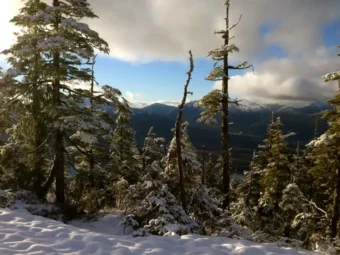
An aerial view of the City of Kodiak, April 9, 2025. (Brian Venua/KMXT)
U.S. Immigration and Customs Enforcement, commonly known as ICE, arrested a Philippine national in Kodiak last week, according to a post on X on April 16.
When contacted, the family declined to comment and asked for privacy so KMXT is not publishing his name. KMXT could not confirm his immigration status or if this was the only arrest made during the agency’s visit to the island.
Both Alaska State Troopers and Kodiak Police say ICE did not request any assistance for the arrest. The city’s police chief, Tim Putney, said that’s normal when federal agents plan arrests on the island.
“There are times they might need a patrol car to transport somebody,” he said. “But normally, they take care of all their logistics – so to speak – the paperwork and conducting the arrests.”
ICE presence is unusual for Kodiak though, and comes as the Trump administration has ramped up deportation activities. The agency also arrested a Mexican citizen in Sitka according to another post on X last month.
ICE posted on X that the Kodiak man was picked up over a previous conviction for sexual assault of a minor. According to court documents, he pleaded guilty after felony charges were filed in 2017. He was also a minor at the time and was in compliance with terms of his release per court records when he was picked up by ICE.
Margaret Stock, an Anchorage-based attorney and expert on immigration law, said it’s hard to get exact information about his particular case. But she said individuals picked up in these circumstances still have a right to a hearing with a judge and hire an attorney. Serious crimes are still a deportable offense even for legal immigrants.
“Ordinarily, when somebody gets charged with a crime in Alaska, after they finish their criminal case and they get out of criminal custody, at that point immigration steps in and tries to do the immigration court case – which is a civil matter,” Stock said.
The man is currently being detained at the Anchorage Correctional Complex, according to ICE’s website.
Sen. Lisa Murkowski smiles as she’s introduced to the room with a short biography at the ComFish convention in Kodiak on Tuesday, April 15, 2025. (Brian Venua/KMXT)
It was standing room only during Sen. Lisa Murkowski’s address at ComFish in Kodiak on Tuesday. Murkowski broke some of the tension with a joke about giving a talk to high schoolers, who she met with ahead of her remarks to the conference.
“My team that was with me said afterwards ‘Toughest interview ever,’ so questions from you guys? Gonna be easy peasy after your high school students,” Murkowski said.
Then she took a turn to talk about the elephant in the room since the Trump administration took over – tariffs.
“We don’t have the certainty that we would like with regards to the tariffs coming out of Washington, D.C. right now. I think the certainty that we know is that even without knowing, even without having the tariffs put in place, we’re already seeing and feeling the impacts on Alaska’s economy and really, the economy as a whole,” she said.
Murkowski said she’s aware that tariffs could increase the costs of consumer goods and how that can be exacerbated in rural places like in Kodiak.
“When we’re talking about the issues that you are all engaged with when it comes to Alaska – seafood and your ability to access and to compete fairly on the global markets – the reality is that tariffs just make everyday life more expensive,” she said.
Murkowski said she’s also concerned about the layoffs at NOAA, particularly as preparations are underway for the summer trawl survey for various species.
She said she’s reminding anyone who will listen why the National Oceanic and Atmospheric Administration’s fisheries departments are important.
Sen. Sullivan checks his notes during his talk at ComFish via zoom. The junior senator from Alaska attended ComFish in person in 2024. (Brian Venua/KMXT)
Sen. Dan Sullivan has faced criticism recently for not speaking with constituents amidst the federal changes. He called into ComFish via video conferencing this year, and focused on some of the Trump administration’s policies he believes are helping Alaska.
“What I keep doing is brandishing this executive order from the president on Alaska,” Sullivan said. “This thing is all about unleashing Alaska’s economy (and) resources, including fish and our fisheries.”
Sullivan, however, didn’t address the proposed cuts directly.
“I’ve been working with the DOGE guys, the leadership, and when they’ve made mistakes, particularly as it relates to anything in this executive order that’ll hurt Alaska’s economy, including our fisheries,” he said. “I have very strongly advocated for ‘Hey guys, you got to reverse some of this stuff. Can’t do stuff that hurts our economy.'”
He said he’s also trying to work with administration officials on how to provide some consistency for the seafood industry despite the president’s on-again-off-again tariffs. Sullivan said he wants to get fisheries included on a relief program available to farmers negatively affected by trade wars. Although, any efforts to get seafood related support into the farm bill have so far stalled in Congress.
Rep. Nick Begich III speaks at the podium at ComFish 2025. (Brian Venua/KMXT)
Alaska’s newest member of the congressional delegation, Rep. Nick Begich III, faced criticism during a telephonic town hall early in the Trump administration, and this time spent time in person at ComFish. He told the crowd he’s generally in favor of Trump’s changes and that one of his top concerns for fisheries is to improve domestic markets.
“When it comes to seafood exports, Alaska should have the advantage, not just the level playing field,” Begich said.
He also said he wants to see better representation of Alaska seafood in programs like school lunches and distinguishing Alaska-origin products in stores.
Begich echoed some of the same rhetoric on tariffs as Sullivan. He said it’s unfair for Russia and China to undercut Alaska and sell in U.S. markets.
“We’re looking at ways to harmonize those international standards and ensure that there is full reciprocity,” he said. “When folks want to enter our markets, we should be able to enter their markets on the same terms – that is the backdrop for this tariff discussion.”
Begich said he’s concerned about the national debt and applauded DOGE’s efforts to curb excess spending.
A group of Juneau residents rally for protection of due process and to bring Kilmar Abrego Garcia home, part of a pop-up protest on April 16, 2025. (Photo by Corinne Smith/Alaska Beacon)
A crowd of over 100 residents gathered in front of the Alaska State Capitol in Juneau on Wednesday, for a “pop-up” protest calling for due process and justice for a Maryland man mistakenly deported and imprisoned in El Salvador.
“Protect the Constitution!” the crowd chanted, and demonstrators held hand-made signs reading: “Uphold the rule of law!” “Due process matters,” and “Bring Kilmar home.”
Outrage has grown across the country, with protests and town halls, around 30-year-old Kilmar Abrego Garcia — who was granted asylum in the U.S. due to threats of gang violence in 2019 — his mistaken arrest and deportation to a maximum-security prison in El Salvador, and ensuing court battle to bring him home.
Last week, the U.S. Supreme Court ruled 9-0 that the government must “facilitate” Garcia’s return to the U.S., but stopped short of requiring it. On Tuesday, a federal district court judge in Maryland ordered the Trump administration to show how it has tried to secure the release of Garcia. So far, the judge said the record shows “nothing has been done.”
The White House maintains it has no power to ask El Salvador to release Abrego Garcia from the mega-prison, and that the judge overstepped her authority in ordering the administration to conduct foreign affairs.
At the protest in Juneau, demonstrators gave impromptu speeches denouncing the Trump administration, calling it a violation of due process rights. Speakers called for protection and support for Alaska-based immigrant families, some who received notices to “leave now” and self-deport, some sent in error. They urged Alaskans to continue speaking out, including calling on U.S. Sens. Lisa Murkowski and Dan Sullivan to do more in Congress.
“Sending immigrants to an El Salvador prison that is likened to a concentration camp or a gulag, is just reprehensible,” said Mary Hakala, a lifelong Juneau resident in an interview after the protest.
“(For) everyone in the United States, whether they’re an immigrant, a U.S. citizen, due process is what keeps us all safe,” she said. “And so if they are able to throw out and ignore the laws regarding the rights of citizens and immigrants, none of us are safe. It’s a very frightening time.”
El Salvador President Nayib Bukele, a key partner in the Trump administration’s new deportation and imprisonment effort, refused to assist with Garcia’s return in an Oval Office meeting on Monday. “Of course, I’m not going to do it,” he said. “The question is preposterous.”
At that meeting, President Trump expressed openness to deporting U.S. citizens convicted of violent crimes to El Salvador. “If it’s a homegrown criminal, I have no problem,” Trump told reporters. “We’re studying the laws right now… If we can do that, that’s good.”
The U.S. government is paying El Salvador to imprison immigrants, despite a federal law barring it from financially supporting foreign security forces facing credible allegations of gross human rights violations.
Jean Kashikov, a recent University of Alaska graduate, poses for a photo on April 13, 2025. Kashikov is one of four UAA international students whose visa has been revoked by the Trump administration. (Wesley Early/Alaska Public Media)
At least four international students in Alaska have had their student visas revoked, as the Trump administration’s immigration crackdown continues.
They are among hundreds across the country facing removal after losing their student visas.
One of them is recent University of Alaska Anchorage graduate Jean Kashikov.
Kashikov first visited Alaska in 2017 as a tourist from his home country of Kazakhstan.
“We took a cruise out of Whittier, and we did a bunch of regular tourist stuff,” he said in an interview Sunday. “And I felt like it’s a really nice place with really nice people.”
Kashikov decided to apply to UAA and began taking courses in 2019. He graduated last May with a bachelor’s degree in math, followed by an associate’s degree in aviation in December. Now 24 years old, he began working as a self-employed flight instructor in Wasilla in March.
“In the last four to five weeks that I’ve been doing this, I had a bunch of one-time customers where I gave them, you know, biennial flight reviews, which is something that every pilot needs every two years, no matter how small,” Kashikov said.
Kashikov is able to work in the U.S. under an optional practical training period. It allows international students to remain in the country for one year after graduating, so long as they’re working in the field they studied. The federal government tracks and documents the students’ activities with what’s called a Student and Exchange Visitor Information System, or SEVIS, record.
Kashikov’s training period wasn’t set to end until January of 2026. But on April 10, as he was eating breakfast at the Denali Family Restaurant, he received an email from UAA that his SEVIS record had been terminated.
“That basically means that starting this day, you are unlawfully present in the country,” Kashikov said.
In a statement, University of Alaska officials say a total of four UAA students, including one currently enrolled, received a similar revocation, without any prior notice. They added that no students from the Fairbanks or Southeast campuses have been impacted, so far.
“Our international students and scholars are vital members of our community, and we remain fully committed to supporting their success,” UA President Pat Pitney said in the statement.
Kashikov said he believes the U.S. isn’t following its own procedures and laws. At least one experienced immigration lawyer agrees.
Margaret Stock is an Anchorage-based attorney who is recognized for her expertise in immigration law. (Wesley Early/Alaska Public Media)
“This is, like, totally illegal,” said Margaret Stock, an Anchorage-based attorney and internationally recognized expert on immigration law. “Everybody, they know it’s illegal, but they’re figuring people aren’t gonna be able to fight it.”
Stock cited research from the National Association of International Educators, which found that more than 800 international students nationwide saw their visas revoked or their SEVIS records terminated in recent weeks.
“The president apparently set a goal internally at the White House of deporting 1 million people, and they haven’t been able to find enough people who are actually deportable in order to do that,” Stock said.
Instead, the administration is trying to get people to deport themselves by revoking their visas or telling them directly to leave the country, Stock said. There hasn’t been a consistent reason given to students for the termination of their visas, but officials have made vague references to criminal records checks, she said.
“So it sounds like they apparently went into some system and found the person had a ticket of some kind, or they got arrested for something, even if no charges were brought against them,” Stock said.
Kashikov admitted that he had been arrested before. It was three years ago, in Arizona, when he was arrested for blocking a public bus he says refused to pick him up, he said. He had no alcohol or drugs in his system, didn’t act violently, and the charges were dropped. He also has a pending speeding ticket in Georgia from August.
Neither incident is grounds to deport someone, but many people don’t have the resources to take on the federal government in court, Stock said
“Their strategy is to do things that are illegal,” she said, “because they think people are going to have to go into court, and they won’t be able to afford a lawyer, and they won’t be able to fight the government, because it costs a lot of money to sue people in federal court.”
Kashikov consulted with immigration attorneys who’ve basically given him three options, he said. One is to simply leave the country. Another is to try to get his SEVIS record reinstated, though Stock said the Trump administration is not approving reinstatements right now. A third option is to sue the federal government. Stock pointed to a ruling in Wisconsin from Monday, where a judge granted a temporary restraining order for a student, blocking the termination of their SEVIS record. The order allowed the student to stay in the country and continue to work as their federal lawsuit goes through the courts.
Kashikov said he’ll most likely just leave.
“They can technically come grab me at any time,” he said. “So I’m not willing to test them. I want to leave if I can’t find a better solution. And now there is no better solution on the horizon as of right now.”
Kashikov said he’s going to miss Alaska, and at least one of his flight instruction clients said they’re going to miss him, too.
Kenneth Groat lives in Palmer and said he looked for a flight instructor for more than a year to help him get his sport license, before he found Kashikov.
“He’s a good pilot to start out with, but a good instructor as well,” Groat said. “You know, he did maneuvers that I hadn’t done in a while, and it just worked out good having a good guy in the cockpit with me.”
Kashikov leaving throws a wrench in his plans, Groat said, but it also means the state will be losing a talented worker.
“It just seems like it’s hard to find young people to work these days,” Groat said. “And Jean just seemed, for his age, he seemed super motivated, you know, and headed in the right direction. I really wanted him to succeed.”
Though his future in Alaska seems to be coming to a close, Kashikov said he wanted others to learn from his experience.
“I want the voting public to know that, you know, six months later, or a year later, or whenever, when they come out on the news and say, ‘We deported, removed, etc, so many thousands of violent criminals and whatnot,’ they’re gonna claim that that’s what they’ve done,” Kashkov said. “And I just want people to know that that’s literally not what’s happening.”
Kashikov received an official notice from the State Department that his visa was revoked on Monday night. As of Tuesday afternoon, he remained in the country.
Officials with the State Department and the Kazakhstan embassy, which told Kashikov his visa was revoked, did not immediately respond to a request for comment.
A recent rockslide in November 2024 briefly closed down Skagway’s Railroad Dock. (Melinda Munson/KHNS)
Skagway was slated to be Alaska’s first recipient of grant funding under a Federal Emergency Management Agency program. But recent changes at the agency have put nearly $20 million in funding in question.
It’s a lot of money to lose for a community that hoped to use the funding to fix its unstable mountainside.
The title of the press release wasn’t encouraging: FEMA Ends Wasteful, Politicized Grant Program. That press release is how Skagway found out it likely won’t receive federal Building Resilient Infrastructure and Communities funding to mitigate rockslides above its busiest cruise ship dock.
FEMA is cancelling all BRIC grants awarded from 2020 to 2023. Skagway was recently approved for phase one of its grant in 2022. Borough Manager Emily Deach said she was just about to send a project bid to the Assembly. Phase one, which is $1.3 million from the federal government, is for project planning. Phase two is the actual construction.
“It looks like we may still get phase one funding, because it’s already been awarded and obligated,” Deach said. “But it seems as though phase two for construction is not going to be funded. And we’re sort of, we’re sort of waiting on this to get more information.”
In 2023, Skagway spent a little over $3 million installing safety mechanisms on its mountainside. Last year, it cost just over $1 million to mitigate the site. Deach estimates that this year, the municipality will spend $2 million.
The BRIC grant was meant to help the borough find a long-term solution.
What happens if phase two funding doesn’t come through?
“I don’t think there’s a need to panic at this point,” Deach said. “I think the project will be done. I think, if anything, maybe it will delay it a little bit because we’ll have to accumulate funding, or look at other options.”
Deach said that Skagway collects $13 per passenger on its two municipal docks and $8 per passenger on the privately owned Railroad Dock. That money goes into the vessel impact fee fund.
“We could potentially spend maybe a few years accumulating funding that would go towards this project,” Deach said.
But she acknowledged that losing the federal funding isn’t best case scenario, with all of the other capital improvement projects Skagway currently faces.
Lisa Murkowski at a 2022 conference in Anchorage. (Lex Treinen/Alaska Public Media)
Sen. Lisa Murkowski is urging Alaskans to speak out against changes the Trump administration is bringing to their lives and the government they’ve relied on.
“Keep calling. Keep the emails. Keep the social media going,” she told a conference of 500 nonprofit leaders in Anchorage Monday.
The event was organized by the Foraker Group, which advocates for nonprofits, a sector that in Alaska provides everything from water and electricity to human services. Some are trade associations, supporting the state’s largest industries.
Foraker President Laurie Wolf said nonprofit executives are unsure whether they can commit to their projects by purchasing equipment or hiring personnel, because even if they have funding now, they might lose it later.
And, Wolf said, some Alaskans don’t feel safe speaking out.
“What do you have to say to people who are afraid, or who represent people who are afraid?” she asked Murkowski on the conference stage.
“We are all afraid. Okay?” Murkowski said.
She paused for a full six seconds to let it sink in.
“It’s quite a statement,” she said.
Murkowski is one of the most outspoken Republicans in Congress against many of the Trump administration’s actions. Like Sen. Dan Sullivan and Alaska Congressman Nick Begich, Murkowski said she’s reaching out to the Trump administration behind the scenes to try to lessen the impact on Alaskans. But Murkowski is also openly critical of the administration.
“I’m oftentimes very anxious myself, about using my voice,” she said, “because retaliation is real.”
Among the programs and policies she’s worried about, she cited Medicaid, possible deportation of refugees, energy and housing programs and food assistance. As she described it, even things that sound like unfounded administrative horror stories can come true.
“I am operating off of rumors a lot of times,” she said. “And then you see some things that are just unnerving in their scope, and you realize, well, that rumor was actually real.”
Murkowski said Alaskans have come to her at airports and shed tears, over losing their jobs or fears for their safety net. She said she’s worried the chaos will cause her constituents to retreat.
“It’s important that the concerns continue to be raised, rather than allow the fatigue of the chaos grind you down,” she said. “Don’t let it grind you down.”
She said protestors should keep their statements “affirmative,” by saying why they want to keep government programs and services. For those who are protesting at her offices every week, she asked that they keep at it.
“It’s going to sound crazy coming from an elected official, but I’m going to continue to urge you to raise your voices,” she said.
Close
Update notification options
Subscribe to notifications
Subscribe
Get notifications about news related to the topics you care about. You can unsubscribe anytime.