Federal Government

Alaska Sen. Murkowski calls on Trump administration to protect Ukrainians who fled war

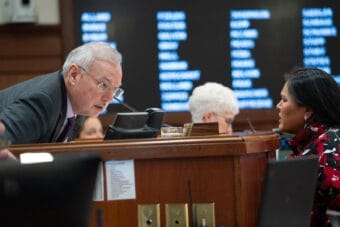
Sen. Lisa Murkowski, R-Alaska, speaks at a fisheries forum on Oct. 4, 2022. (Photo by Yereth Rosen/Alaska Beacon)

U.S. Sen. Lisa Murkowski, R-Alaska, is calling on the U.S. Department of Homeland Security to allow Ukrainians with temporary protected status to remain in the country, following reports people had received an email that their status was revoked and they had seven days to leave the U.S.

The agency has said the April 3 notice was issued by mistake, and the Ukrainians’ designation under what’s known as “humanitarian parole status” has not been terminated. They had been granted the status under the “Uniting for Ukraine” program.

But Murkowski penned a strongly worded letter on Sunday, with U.S. Sen. Jeanne Shaheen, D-New Hampshire, ranking Democrat on the U.S. Senate Foreign Relations Committee, to Homeland Security Secretary Kristi Noem condemning the move, even if it was “apparently an error.”

“Even if this message was sent in error, threatening the abrupt termination of humanitarian parole for Ukrainians is alarming and adverse to the U.S. national interest,” they wrote.

Humanitarian parole is a temporary immigration status granted to those fleeing humanitarian crises, and can be revoked at any time. There were 651,000 Ukrainians granted humanitarian parole in the United States last year. An estimated 6.9 million Ukrainians have been displaced since Russia invaded Ukraine in 2022.

“Ukrainians who have participated in the Uniting for Ukraine program have entered the U.S. lawfully, passed rigorous screening and vetting requirements,” the senators wrote. “These are individuals, including children, who have fled a war zone and followed a lawful process. Many are working in our states, paying taxes and contributing to local communities.”

Murkowski and Shaheen also requested a briefing on any future plans regarding the Ukrainians’ status.

“We urge the agency to provide immediate clarification to Ukrainians in the United States that their humanitarian parole has not been terminated, and that there are no plans to terminate the program while Ukraine is still under active attack by Russia,” they said.

The agency’s notice to those with humanitarian parole began: “It is time for you to leave the United States,” and the recipient’s parole would be terminated in seven days. “If you do not depart the United States immediately you will be subject to potential law enforcement actions that will result in your removal from the United States — unless you have otherwise obtained a lawful basis to remain here.”

Ukrainians have been the largest group of refugees arriving in Alaska over the last three years, according to Issa Spatrisano, the Alaska state refugee coordinator with Catholic Social Services Alaska, a resettlement agency. 

Spatrisano said she has received several reports of people in Alaska receiving the DHS termination notice, and the news spread secondhand very quickly. She said the effect was chilling.

“The email was very scary for Ukrainians living in Alaska and across the country,” she said. “Because they really are at the whims of at any point an announcement coming from DHS, and when that announcement is made, they’ll have to respond accordingly to what the announcement is.”

An estimated 1,500 Ukrainians have arrived since 2022, about 500 people per year, Spatrisano said. Many joined family members, communities, and the workforce, “really much needed jobs throughout the state,” she said. But the uncertainty takes a toll.

“A mental health toll,” she said. “It takes a serious toll on people’s well being, and that impacts on our state. There are Ukrainian families who are in the process of buying homes here in Alaska, you know, in the process of laying down roots, in the process of getting job training programs to advance in jobs that the state frankly needs really badly. And those are all investments in time and in energy and in resources that families are now wondering if they should do.”

Murkowski and Shaheen have asked for “an immediate explanation as to how these emails were sent in error” and “that there are no plans to terminate the program while Ukraine is still under active attack by Russia.”

Correction: This article has been updated to reflect that Issa Spatrisano is with Catholic Social Services Alaska, not Catholic Relief Services.

Mendenhall Glacier Visitor Center plans for limited staffing for first cruise ship on Monday

Mendenhall Glacier Visitor Center on Friday, Dec. 15, 2023. (Clarise Larson/KTOO)

The U.S. Forest Service says it has a plan in place to staff the Mendenhall Glacier Visitor Center this tourism season. That comes almost two months after dozens of staff were fired amid federal downsizing. 

In a press release Thursday, the Forest Service shared their staffing plan for the Mendenhall Glacier Recreation Area. Five staff will be ready to greet the first cruise visitors of 2025 on Monday and the area will continue opening intermittently throughout the month.

By May 4, the visitor center will be open and staffed from 10 a.m. to 5 p.m. on weekdays and Sundays.

Since February, the Trump administration has cut thousands of federal jobs across the nation, including all but one staff member at the visitor center in Juneau. In a typical summer, there are about a dozen on site. 

Some of the fired staff have been rehired. But there is a chance they may lose their jobs again or accept a deferred leave offer as the federal government continues its quest to downsize.

U.S. Forest Service spokesperson Paul Robbins said the visitor center will be staffed most days cruise ships come to Juneau, with the exception of April 26. 

The release says the Forest Service presence at the glacier will be made up of staff from the Forest Service’s offices in Juneau, and those staff will be supported by employees with partner organizations like the Central Council of the Tlingit and Haida Indian Tribes of Alaska and Discovery Southeast, who already have a presence at the glacier. 

In addition to Forest Service employees, the tribe’s cultural ambassador program will have eight staff at the glacier Monday through Friday. 

Between these three organizations, the release says staff will be able to manage crowds, provide for visitor safety, maintain trails and facilities and manage bear encounters. 

The Juneau Assembly is considering a proposal to set aside $200,000 to help those partner organizations hire more staff for the visitor Center. 

While the visitor center will only be open on certain days, the recreation area will be open as usual, from 6 a.m. to midnight each day. The portable bathrooms outside the visitor center will be open at all times, and the bathrooms by the visitor center parking lot will be open from 8 a.m. to 7 p.m. each day.

Trump administration says Alaska gas line investment could ward off tariffs

A man talks to reporters outside the White House
Treasury Secretary Scott Bessent spoke to reporters outside the White House on April 9, 2025. (Screenshot from C-SPAN2)

If countries want to keep the Trump administration from imposing tariffs on their exports to the United States, Treasury Secretary Scott Bessent suggests they invest in Alaska’s proposed Liquified Natural Gas project.

Bessent spoke Wednesday outside the White House, after President Trump announced he would pause reciprocal tariffs for 90 days to allow countries to negotiate. A reporter asked Bessent what it would take for a country to block the imposition of tariffs beyond three months.

That’s when Bessent raised the Alaska project as a possible deal-maker.

“These are trade negotiations, but if countries want to come and offer other things — so I talked about yesterday that we are thinking about a big LNG project in Alaska, that South Korea, Japan (and) Taiwan are interested in financing and taking a substantial portion of the off-take,” Bessent said.

A country’s investment and purchase of Alaska’s natural gas would help reduce its trade imbalance with the United States, he said.

The State of Alaska has tried for years to secure investment in the project, particularly from potential customers in Asia. Cost remains a high hurdle. It would take an estimated $44 billion or more to build an 800-mile pipeline from the North Slope to the Kenai Peninsula, with a processing plant at the north end and a liquefaction plant at the terminus. From there, LNG tankers would take the fuel across the Pacific.

Countries might have more incentive to invest in Alaska LNG with the threat of tariffs hanging over them. But Trump’s tariff announcements have caused global economic shocks, which could hinder investment in big projects.

Alaska Humanities Forum sounds alarm over targeting of federal funding by DOGE

Kameron Perez-Verdia is president and CEO of the Alaska Humanities Forum. (Wesley Early/Alaska Public Media)

The Alaska Humanities Forum faces a massive cut to its budget after the Trump administration’s slashing of the National Endowment for the Humanities.

The more-than-50-year-old organization uses federal money, combined with matching dollars from local grants and donations, to fund programs around the state aimed at bringing communities together.

Kameron Perez-Verdia is president and CEO of the Alaska Humanities Forum.

“Youth programs that are happening around the state,” Perez-Verdia said. “It’s programs that are doing language preservation. It’s grants that are doing historical projects.”

The forum received a letter April 2 from the National Endowment for the Humanities that its federal grant — totalling about $900,000 — was terminated, effective April 1.

Alaska isn’t alone. Last week, humanities programs in all 50 states that rely on the national endowment received notice that the White House’s Department of Government Efficiency aims to cancel roughly $175 million in grant funding that had not yet been disbursed.

The short notice is troubling, Perez-Verdia said, and his organization is exploring legal options to get its funding restored.

“We believe that this is an illegal action,” he said. “It’s funding that was already granted. Our organization, and all of these councils, are in charter. So these are in our U.S. law that our organization exists and gets funded.”

If the funding isn’t restored, it would be very difficult to raise local funds to make up the loss, Perez-Verdia said.

“To be able to raise this kind of money is going to be really challenging,” he said. “We as an organization would have to restructure significantly, and we would lose a lot.”

Representatives from the offices of Sens. Lisa Murkowski and Dan Sullivan and Congressman Nick Begich did not immediately respond to a request for comment. However, Perez-Verdia said the state’s congressional delegation has expressed support for the Alaska Humanities Forum.

““We believe we will ultimately win this fight. We have strong support from Alaska’s congressional delegation and from national partners,” Perez-Verdia said. “But it’s going to take time.”

Alaska Head Start programs in limbo after regional office closed by U.S. Health Secretary Kennedy

Students swing on a playground at Meadow Lakes Head Start in Wasilla, Alaska. It closed in 2024 due to funding and staffing challenges. (Image by Lela Seiler, courtesy of CCS Early Learning)

Alaska Head Start programs are reeling after the regional federal office was suddenly closed last week, leaving programs uncertain about grant administration and future funding.

Trump-appointed U.S. Department of Health and Human Services Secretary Robert F. Kennedy Jr. ordered the closure of five of the nation’s 12 regional offices, as part of an agency-wide consolidation that included cutting 10,000 employees. That included closing the Seattle-based Region 10 office serving Alaska, Washington, Idaho, and Oregon.

The office was a critical resource for Alaska Head Start programs, for grant administration and compliance, said Katrina Ahlfield, executive director for Kids’ Corps Inc., an Anchorage Head Start program. She also serves on the board of the Alaska Head Start Association.

“​​Thousands of children and families potentially are impacted in the longer term,” she said of the closures nationwide. “If this creates a delay in grant processing, or programs receiving the immediate support that they might need.”

The federal department did not respond to a request for comment on Tuesday.

Head Start provides early learning programs through schools and nonprofits that serve children from low-income families, from supporting pregnant mothers up to age 5. Foster youth, families who receive supplemental assistance like food benefits, and those who are experiencing homelessness are automatically eligible.

“We’re looking at some of the most vulnerable children and families in Alaska,” Ahlfield said.

Ahlfield said Kids’ Corps Inc. is one of four Head Start programs impacted directly, currently serving 1,076 children.

Ahlfield said the Alaska Head Start Association heard the news of the regional office closure on March 31 second-hand, and had no direct notice or further direction from federal officials.

That day, federal staff arrived to work in Seattle and were locked out, according to news reports, and staff were placed on immediate administrative leave until June, without warning.

With that office closed, Ahlfield said there’s a loss in administrative and technical support.

“They were your experts really on the Head Start performance standards and all of the compliance requirements that come along with operating any federal program,” she said. “So they were kind of your go-to as a director, or go-to for technical assistance and questions. They also help to process your grant applications.”

While there are no immediate cuts or closures, she said the loss of administrative support impacts her organization, as well as and also CCS Early Learning in the Matanuska-Susitna Valley, Thrivalaska in Fairbanks, and the Rural Alaska Community Program, or RuralCap, which serves children and families throughout Alaska.

Ahlfield said regional administrators would answer questions, or give advice related to health and safety requirements.

“These people had worked there for, you know, over 10 years, and really knew our programs well, and knew Alaska well,” she said.

“So right now, we don’t have anyone to contact about any of those kinds of questions or needs,” she added.

Kids Corps Inc. serves 189 children in the Anchorage area, and Ahlfield said she’s most concerned about their pending grant funding, which she expects to cover costs for the next six months.

“My most urgent concern is, is this going to create a delay in programs receiving grant approvals and funding on time in order to be able to continue providing services without a temporary, you know, delay and or needing to temporarily close?” she said.

She said there have not been Head Start funding delays reported in Alaska yet. But the uncertainty is difficult; any program cuts or closures would hit families and staff hard.

“We have an early-childhood and an educator crisis, where we don’t have enough people in the field already,” she said. “And so it just makes the situation worse for people. It definitely has the potential to create hard times.”

Alaska Head Start receives $68 million in federal funding each year, she said, with a 20% match totaling $13 million provided by the state through the Alaska Department of Early Education and Childhood Development. DEED provides state grants to 17 Head Start programs across the state, in classroom and home-based settings.

DEED did not respond to requests for comment on Monday.

Ahlfield said Head Start administrators and communities are calling on the Alaska congressional delegation to urge the Trump administration to reverse the cuts, or provide a clear plan.

“If it’s not possible to reinstate our regional office, and that would be our first preference, … then we really need and want a well communicated, coordinated plan on how this is going to work, so that it doesn’t impact these vital services,” she said.

‘It is chaos’: Trump dissolves agency that funds services for seniors, people with disabilities across Alaska

Seniors can access lunch for just $5 three days a week at the Haines/Klukwan Senior Center. (Avery Ellfeldt/KHNS)

There was a steady hum of chatter at the Haines/Klukwan Senior Center during a recent Wednesday lunch. On the menu: lasagna, apricot salad, bread and steamed veggies – all for just $5, for those who could afford to pay.

Lunch may be what brings seniors to the building three days a week around noon. But it’s far from the only draw. Haines resident David Kohlstaedt, who was sitting at a long table chatting with friends, said the space is a crucial social outlet.

“Three meals a week, I don’t have to cook,” he said. “I come almost an hour early every day, and we come around and shoot the breeze.”

Christal Verhamme, who manages the center for the Juneau nonprofit Catholic Community Service, says Kohlstaedt isn’t alone.

“A lot of them say this is the only thing that they do, their only outlet. Their only way to get rides,” she said. “And for some, it’s their only way to get a cooked meal.”

The Trump administration’s ongoing effort to downsize the U.S. government is fueling concerns over the future of this center – as well as other programs that serve people across Alaska.

At issue is the Administration for Community Living, a federal office that funds programs for older people and people with disabilities – including Catholic Community Service – from within the Department of Health and Human Services.

Or at least it used to. The Trump administration said late last month it’s dismantling the office and integrating its “critical programs” into other agencies. The announcement also said thousands of department employees would be cut, including many Administration for Community Living staff members.

The move is among several Trump policies fueling uncertainty for nonprofits and the people who rely on the services they provide, said Erin Walker-Tolles, executive director of Catholic Community Service, which operates 10 senior centers in Southeast Alaska.

“We’re just concerned that about additional cuts and lack of resources from the administration, because community need is only growing as the senior population continues to grow in Southeast,” she said.

Two Haines residents play Wii disc golf at the Haines/Klukwan Senior Center. (Avery Ellfeldt/KHNS)

So, what is the Administration for Community Living?

The Administration for Community Living was created back in 2012 to streamline federal efforts to support seniors and people with disabilities.

The office doles out grants to programs that run senior centers, provide rides and distribute millions of meals — including through Meals on Wheels. Catholic Community Service, for instance, received roughly $3 million from the office last year, much of which comes through tribal partners. That’s nearly 40% of the organization’s budget.

Walker-Tolles said that it remains unclear what the reshuffling will actually mean for programs, but that she assumes funding will be administered some other way. She added that she understands the importance of reducing costs and streamlining resources – but that the lack of clarity around these moves has consequences.

“As these changes come through, there is no plan that we are aware of to ensure that things are simpler. Instead, it is more work,” Walker-Tolles said. “It is chaos.”

That’s especially concerning in Southeast, where the population is older than most of the state. Haines specifically has long held the title of being Alaska’s oldest borough. The median age here is just under 50 years old, compared to about 37 statewide.

‘It’s very scary’ 

The Trump administration’s firings and program cuts at the Administration for Community Living – and to the broader department – won’t just affect seniors.

Southeast Alaska Independent Living, for instance, provides a bevy of services, including in Haines. Among them: loaning out walkers, crutches and wheelchairs, and supporting students with disabilities as they transition into adulthood. A report from last year says 20% of the organization is federally funded – at least some of which comes from the Administration for Community Living.

There’s also REACH Inc., a Juneau-based non-profit that supports people with disabilities. The group doesn’t get funding from the Administration for Community Living, said Naomi Studevan, the organization’s executive director. But it does get funding from another federal agency that focuses on medicaid and medicare, which reportedly lost 300 employeesto layoffs in recent weeks.

“There’s already a waitlist that is there when it comes to people accessing services in the first place. So to think that there’s going to be fewer people there to review applications, fewer people there to have oversight,” Studevan said. “It’s very scary.”

Donald Poling, above, said he and his wife Dottie rely heavily on the senior center. (Avery Ellfeldt/KHNS)

Back at lunch in the senior center, all seems normal. People eat, visit, participate in a book club and play disc golf on a Wii gaming system. But all it takes is one question about the administration’s recent moves to reveal lingering anxiety about the future of the senior center.

“We’re worried about it,” said Haines resident Todd Wagner, who comes to the center most days that lunch is served. “We don’t want it to get messed up where they don’t have it anymore. That could happen, we know that.”

Then there’s Donald Poling, who is 82 and has lived in Haines with his wife Dottie since the 1990’s. He said they heavily rely on the facility’s services, including for rides to the ferry and airport when they leave town to seek medical care.

Asked what he makes of the recent announcement, Poling took a swipe at Elon Musk, who has been spearheading White House efforts to downsize the government.

“It looks like President Musk is kinda taking the government apart,” Polling said. “And that means public services, services to poor people, services to seniors, even Social Security, Medicare and Medicaid.”

Site notifications
Update notification options
Subscribe to notifications