Politics

Moderate Alaska House and Senate candidates lead in fundraising a month out from election

Voters stand in line at Anchorage School District waiting to receive their ballot for Alaska’s primary election on Tuesday, Aug. 20, 2024. (Matt Faubion/Alaska Public Media)

Moderate candidates have a large fundraising advantage in state House and Senate races key to control of the Alaska Legislature, according to a new round of campaign finance data reported a month ahead of Election Day.

“Moderate to progressive people have figured out fundraising better than their Republican counterparts,” political consultant Jim Lottsfeldt, who has worked with centrist and left-leaning candidates, said in an interview.

Democrats, independents and Republicans open to a bipartisan caucus have raised a combined total of more than $2.5 million, according to an analysis of campaign finance data. Republicans who would only join Republican-led coalitions have raised about half that.

Moderate and left-leaning candidates have an especially large advantage in Anchorage-area races. Midtown Rep. Andy Josephson, a Democrat, is outraising Republican challenger Heather Gottshall by a more than four-to-one margin with nearly $140,000 in contributions. Democratic Sen. Matt Claman of West Anchorage has raised $190,000 to Republican Liz Vazquez’s roughly $11,000. Rep. Craig Johnson of South Anchorage, a senior member of the conservative Republican House majority, has raised $28,000, roughly half the funding of his more moderate Republican challenger, former Rep. Chuck Kopp.

In northeast Anchorage, Democrat Ted Eischeid has raised more than four times the total of Republican incumbent Rep. Stanley Wright. Eischeid chalked his lead up to the strength of his message.

“I think my three priorities of education, public safety and infrastructure really resonates with donors,” he said. Wright did not respond to an interview request.

In another closely watched Senate race, Kenai Peninsula Sen. Jesse Bjorkman, R-Nikiski, has raised $131,000, roughly twice as much as challenger Rep. Ben Carpenter, R-Nikiski, who is challenging him from the right. Savannah Fletcher, an independent candidate for the open Senate District R seat covering much of the Interior, has raised $120,000; Rep. Mike Cronk, R-Tok, the conservative candidate for the seat currently occupied by outgoing Sen. Click Bishop, R-Fairbanks, has raised $95,000.

But in another Fairbanks race, the dynamic is reversed: a Republican challenger is outraising a Democratic incumbent in the race for a state Senate seat. Leslie Hajdukovich, a former staffer for U.S. Sen. Dan Sullivan, R-Alaska, challenging Sen. Scott Kawasaki, D-Fairbanks, a member of the current 17-member bipartisan majority, has raised more than $196,000.

In an interview, Hajdukovich cast herself as more moderate than many Republican candidates. She said she would have voted to overturn Gov. Mike Dunleavy’s veto of a bipartisan education bill and said she’d be open to joining the Senate’s bipartisan coalition, which currently features nine Democrats and eight Republicans.

“I am a Republican, and I would hope for a Republican majority, but either way, the leadership in the Senate is going to be bipartisan the way the makeup is,” she said. “I would not join a Democrat-led coalition, but I would be open to a Republican-led coalition.” She said she saw the current Senate majority as a “slight[ly] Republican-led coalition.”

However, she opposes a return to a pension plan for state employees and told the Alaska Beacon she supports a bill proposed by Republicans last session that would ban transgender girls from girls’ sports. She said she is “personally pro-life.”

Hajdukovich has some notable major donors, including the CEO of Hilcorp, Luke Saugier, who donated more than $1,500 and Diane Bundrant, the wife of the late co-founder and majority owner of Trident Seafoods, who chipped in $2,500. Her largest single contribution, $4,435, comes from the Capital City Republicans in Juneau.

Just over half of Hajdukovich’s nearly 600 contributors list a Fairbanks address, according to campaign finance records, and 8% of her contributions come from out of state. Her average donation so far has been $336.14. Hajdukovich has spent nearly $160,000 as of this week.

Kawasaki, meanwhile, has raised roughly $166,000 and spent just $33,000, according to campaign finance records.

Like many Democrats and independents who support a return to a defined benefit retirement plan for state employees, Kawasaki has strong support from organized labor groups, including the AFL-CIO, the Alaska State Employees Association, the National Education Association and the International Brotherhood of Electrical Workers.

“We need to be competitive to keep teachers here in Alaska,” he said. “There is a high cost of living, and one of the ways that we can keep teachers is with a good public pension system like we used to have.”

Roughly a third of his contributions come from Fairbanks addresses, and about half are from donors with Anchorage addresses, including $11,000 from attorney Robin Brena and $7,000 from relatively new political contributor Justin Weaver. Brena has spent more than $80,000 on campaigns this cycle, and Weaver has contributed more than $100,000 to Democrats and moderate candidates.

Candidates for state House and Senate have raked in some $4.5 million in total contributions. But that amount is dwarfed by the war chests amassed by some independent expenditure groups: No On 2, opposing the repeal of ranked choice voting and open primaries, has raised $12.3 million and spent nearly $8 million. Yes On 2, supporting the repeal, has raised just over $100,000 as of late September. Two groups supporting Ballot Measure 1, which would increase the minimum wage from $11.73 to $15 an hour by 2027 and provide workers with sick leave, have raised $3.8 million.

Left-leaning and centrist independent expenditure groups also appear to have an edge in spending. Putting Alaskans First Committee, funded largely by union members, has spent more than $500,000 supporting left-leaning and moderate Republican legislative candidates. The American Leadership Committee, funded by the party-affiliated Democratic Legislative Campaign Committee, has outlaid nearly $140,000 supporting Democratic candidates. Americans for Prosperity has spent nearly $160,000 in support of conservative candidates, and Families of the Last Frontier, a Republican Party-affiliated group, has spent more than $326,000.

Matt Shuckerow, a political consultant who has worked extensively with conservative candidates, said voters should look closely at who donates to campaigns and consider their motives. But at the same time, he noted, spending does not always translate into electoral success.

“Fundraising is just one measure of the success of a campaign. Ultimately, it’s how you spend those resources,” he said.

Sunday is the deadline to register for the Nov. 5 election. Here’s what else to know about voting

Volunteers at Anchorage School District hand out ballots to voters during Alaska’s primary election on Tuesday, Aug. 20, 2024. (Matt Faubion/Alaska Public Media)

There’s less than a week left to register to vote in the Nov. 5 election. The deadline is this Sunday, Oct. 6.

Here’s what to know about voting for candidates for state and federal office next month.

Still have questions after reading this guide? Fill out the form at the bottom of this page and we’ll do our best to answer your questions. We’ll keep this page updated through Election Day.

What’s this election for?

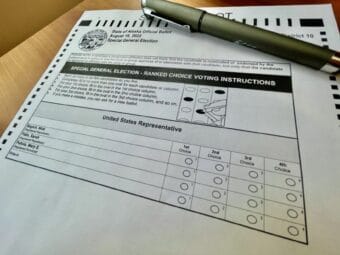
On Nov. 5, all voters across the state will have a chance to rank their choices for president and Alaska’s sole U.S. House seat. Plus, voters will also rank candidates in their local state House and Senate races.

Even beyond the presidency, it’s an election with high stakes — control of Congress and the state Legislature is up for grabs. Half of the state Senate is up for election this year, and all of the state House.

There will also be two propositions on the statewide ballot:

Where can I learn more about the candidates?

For a rundown of the candidates on the ballot, the nonprofit Alaska Beacon has a voter guide with candidate questionnaires and other resources. Candidates also file official statements with the Division of Elections, and you can read or listen to those at the division’s website.

The division also mails its Official Election Pamphlet with information about the candidates to “every voter household” ahead of Election Day. The pamphlets are also available online — look for “General Official Election Pamphlet.” (The digital pamphlets are specific to your Division of Elections region. Check this document to determine what region you’re in.)

For more on the U.S. House race, Alaska Public Media is hosting a debate between the top two candidates, incumbent Mary Peltola and Nick Begich III, at 7 p.m. on Oct. 10. There’s more information here on how to tune in.

How do I register to vote?

Alaska offers online registration, but voters have to register 30 days before the election for most races. (You can register on Election Day, but if you do, you’ll only be able to vote for president.)

This year, the voter registration deadline is Sunday, Oct. 6.

The easiest way for most people to register is by visiting voterregistration.alaska.gov. All you need is a current Alaska driver’s license or state ID card to register or update your information. Many people register online while applying for their Permanent Fund dividends at the beginning of the year. There’s no harm in registering more than once.

If you don’t have a state ID card or driver’s license, you can register using a paper form (read the instructions on the back!) and either mail it to the Division of Elections or register in person at a Division of Elections office, a Division of Motor Vehicles office, a city or borough clerk’s office, a public library, or some other state offices listed at the Division of Elections’ website. You must hand-write your signature if using a paper form — no e-signatures.

Division of Elections offices are open during regular business hours. They’re also open 10 a.m. to 4 p.m. on Saturday, Oct. 5, and 12 p.m. to 4 p.m. on Sunday, Oct. 6, the registration deadline, for people who would like to register in person.

To register, you must be a U.S. citizen, an Alaska resident and 18 years of age or older on Election Day. You must not be registered in another state, unless you’re willing to cancel your registration in that state.

You also must not have been convicted of a felony of “moral turpitude” — violent crimes, fraud and others that appear on a state-maintained list — unless your voting rights have been restored. The ACLU of Alaska has additional resources at its website for people convicted of crimes. Misdemeanor convictions do not disqualify you from voting.

How can I find my polling place or check on my voter registration?

The Division of Elections’ My Voter Portal allows you to look up your current registration information. Make sure you’re registered at your current address.

The portal also lists the name and address of your polling location. On Election Day, Nov. 5, polls are open from 7 a.m. to 8 p.m.

You can access the portal at myvoterportal.alaska.gov.

What do I need to bring to the polling place?

To vote, you need to bring an ID. That can include a driver’s license or state ID card, a military ID, a voter registration card, a hunting or fishing license, a birth certificate or a utility bill, government check, bank statement, paycheck or another government document that includes the voter’s name and current address, according to the Division of Elections.

Will I be automatically mailed a ballot?

No. You will not be mailed a ballot unless you request an absentee ballot.

This is different from municipal elections in communities that conduct elections entirely by mail, including Anchorage and Juneau. You will not be mailed a ballot for the Nov. 5 election unless you specifically request one.

How can I request a mail ballot?

Alaska is a no-excuse absentee voting state, which means voters don’t have to give a specific reason for voting by mail. Everyone can vote by mail.

If you have a valid Alaska driver’s license or state ID card, you can request an absentee ballot online at absenteeballotapplication.alaska.gov. Paper absentee ballot applications are available at the Division of Elections’ absentee and early voting page. Advocacy groups and campaigns also often mail applications to voters as a convenience as part of their get-out-the-vote effort; you only need to submit one absentee ballot application.

The deadline to request an absentee-by-mail ballot is Oct. 26. You must also be registered to vote by Oct. 6, the registration deadline.

Ballots are mailed to people who request them starting “approximately 25 days” prior to the election, according to the Division of Elections, but they may be mailed sooner. This year, 25 days before the election is Oct. 11.

Ballots must be postmarked at a post office or dropped off at a polling location by Election Day, Nov. 5.

You can check the status of your absentee ballot using the My Voter Portal at myvoterportal.alaska.gov.

Special provisions are made for military, overseas and other voters covered by the Uniformed and Overseas Citizens Absentee Voting Act. There’s more information about military and overseas voting at the Division of Elections’ website.

What about early voting?

Early voting starts 15 days before Election Day. This year, early voting starts Oct. 21.

In some locations, only a form of early voting called “absentee-in-person” voting is available. It is very similar to ordinary early voting.

A list of early voting and absentee-in-person voting locations is available at elections.alaska.gov/avo. The hours of operation vary by location.

When will we know the election results?

The first batch of results is expected around 9 p.m. on Election Day, with updates through the evening and possibly into the early morning hours as additional ballots are counted. The initial results will reflect voters’ first-choice votes.

Because absentee ballots can arrive as late as 15 days after Election Day, counting will continue as additional votes trickle in. The Division of Elections will post updated counts on Nov. 13, Nov. 15 and Nov. 20.

The Division of Elections plans to calculate the winners of the ranked choice election on the 15th day after Election Day, Nov. 20, once all ballots are counted. This is necessary to determine the winners of races where no candidate got more than 50% of the first-choice vote — it’s like an automatic runoff election.

The results will remain unofficial until they’re certified by the State Review Board. The target date for certification is Nov. 30.

Still have questions? Write them in the box below and Alaska Public Media will try to get them answered. 

Last updated: Oct. 1, 2024

Alaska on Trump’s mind: He endorses Begich and confuses Arctic refuge with Afghanistan air base

Donald Trump speaking at a campaign event in Michigan on Sept. 17. (C-SPAN)

Republican U.S. House candidate Nick Begich III has won the endorsement of former President Donald Trump.

Trump initially supported Lt. Gov. Nancy Dahlstrom for the seat, but she finished behind Begich in the primary and dropped out of the race. Two years ago, Trump endorsed former Alaska Gov. Sarah Palin and not Begich for Alaska’s sole seat in the House.

But in a social media post Tuesday Trump praised Begich as a successful small businessman who will help enact MAGA policies.

Also Tuesday, Trump seemed to confuse the name of an air base in Afghanistan with the controversy over whether to drill in the Arctic National Wildlife Refuge, or ANWR.

“We just have the best,” Trump said at a campaign event in Flint, Mich., referring to energy resources. “We have Bagram, in Alaska. They say it might be as big – might be bigger — than all of Saudi Arabia. I got it approved. Ronald Reagan couldn’t do it. Nobody could do it. In their first week they terminated. Check that one out: Bagram.”

About 30 seconds into his discussion on the subject, Trump seemed to realize his mistake and said “ANWR,” loosely linking the Arctic refuge to the U.S. departure from Bagram Air Base.

Trump’s style of speech has drawn attention in the campaign, especially now that he’s the oldest candidate in the race. He often jumps from subject to subject. He insisted Tuesday he doesn’t ramble.

“I give these long, sometimes very complex sentences and paragraphs, but they all come together,” he said.

Alaska’s presidential election allows voters to rank up to eight candidates

A ballot box containing absentee ballots dropped off at Anchorage City Hall is seen on Aug. 19, 2024. (Photo by Andrew Kitchenman/Alaska Beacon)

Alaska’s first ranked choice presidential election will include eight candidates, according to the final roster approved by the Alaska Division of Elections.

Because Alaska’s top-four primary election doesn’t apply to the presidential race, voters will be able to rank all eight options if they choose to do so.

The first ballots for the Nov. 5 general election are already being printed and are scheduled for mailing to international voters starting Friday.

On the front of the ballot are eight options for president:

  • Democratic candidate Kamala Harris
  • Independent Robert F. Kennedy Jr.
  • Libertarian Chase Oliver
  • American Solidarity Party nominee Peter Sonski
  • Independent Jill Stein
  • Constitution Party nominee Randall Terry
  • Republican candidate Donald Trump
  • Aurora Party nominee Cornel West

Kennedy announced in August that he would be suspending his presidential campaign and that he was endorsing Trump, but his campaign failed to remove his name from Alaska’s ballot after the August primary election.

Nationally, Stein is the Green Party’s presidential candidate; the Green Party of Alaska is unaffiliated with the national Green Party.

Alaska will be the second state to use ranked choice voting in a presidential election, following Maine’s experience in 2020.

But Maine’s experience is incomplete; its 2020 election didn’t need to use ranked choice tabulation because the winners of that election had at least 50% of the vote.

In Maine, as in Alaska, if a candidate earns more than 50% of the first-choice votes, they win without a need for ranked choice tabulation.

Maine distributes its Electoral College votes by congressional district and by statewide vote. In 2020, Democratic candidate Joe Biden won the statewide vote — worth two Electoral College votes — and one of the state’s congressional districts, while Republican candidate Donald Trump won the other congressional district.

In every one of Alaska’s presidential elections since 1992, the winner of the state has earned more than 50% of the overall vote.

Four years ago, Republican presidential candidate Donald Trump won Alaska’s three Electoral College votes after earning 52.8% of the state’s presidential votes. Democratic candidate Joe Biden had 42.8% of the vote here.

Four years before that, Trump earned 51.3% of the vote.

Back in 1992, independent candidate Ross Perot claimed 28.4% of the state’s presidential vote. Eventual winner, and Republican nominee, George H.W. Bush had 39.5% of the state’s vote.

The only other time that a candidate won with less than 50% of the state’s vote was in 1968, when Richard Nixon took 45.3% of the tally.

Alaska has voted for a Republican presidential candidate in every election since statehood except for 1964, when Democrat Lyndon Johnson won as part of a national landslide.

Alaska Supreme Court rejects Democrats’ attempt to remove candidate from U.S. House ballot

The Alaska Supreme Court is seen in session on June 27 in Boney Courthouse in Anchorage. (Photo by Andrew Kitchenman/Alaska Beacon)

The Alaska Supreme Court has affirmed the U.S. House candidacy of Eric Hafner, a Democrat imprisoned in New York state.

The court, in a split 4-1 decision, upheld Anchorage Superior Court Judge Ian Wheeles’ decision to dismiss a lawsuit by the Alaska Democratic Party that had challenged Hafner’s eligibility.

The decision means Hafner will appear on the November U.S. House ballot alongside incumbent Democrat Rep. Mary Peltola, Republican challenger Nick Begich, and Alaskan Independence Party challenger John Wayne Howe.

It also means that election preparations, including ballot printing and distribution, will continue on a previously published schedule.

“We would just thank the Supreme Court for issuing a decision on such short notice and preventing any disruption to the election,” said Solicitor General Jessie Alloway, assistant attorney general Thomas Flynn and assistant attorney general Kate Demarest, who opposed the lawsuit on behalf of the Alaska Division of Elections.

Under Alaska’s elections system, the top four finishers from the primary election advance to the general election. Hafner finished sixth, but two higher-finishing Republicans withdrew from the race, allowing Hafner to advance.

The Democratic Party sued, arguing that state law prohibited the elections division from replacing two withdrawn candidates.

The party also argued that Hafner was ineligible because the U.S. Constitution requires a candidate to be an inhabitant of the relevant state when elected to the House. Hafner is serving a 20-year prison sentence for threatening public officials in New Jersey and is not scheduled for release until 2036.

Wheeles rejected the party’s arguments, and the Democratic Party appealed the state-law issue to the Supreme Court, which took up the issue on an emergency basis.

The Alaska Republican Party intervened on the side of elections officials, seeking to preserve their decision to promote Hafner.

The court heard oral arguments Thursday morning and issued a summary decision hours later, stating that the lower court decision was correct. A full legal opinion will be published at a later date.

Democratic Party officials said they were disappointed with the outcome.

“Unsurprisingly, the Alaska Republican Party publicly supports the decision that a convicted felon who is running his campaign from a prison cell in New York should appear on Alaska’s ballot as a candidate for federal office,” said Mike Wenstrup, Chair. “This ruling sets a dangerous precedent and is embarrassing for our state.”

The issue may have implications for this year’s U.S. House race. The Alaska Democratic Party is supporting Peltola, and attorneys representing the party said in oral arguments that some voters could be confused by the presence of two Democrats on the ballot.

Peltola is believed to be in a close race with Begich, and some Democrats worry that Hafner could act as a spoiler by siphoning votes from Peltola.

Wheeles addressed and rejected that argument, noting that Alaska’s ranked choice general election allows voters to list multiple preferred options, and any voter who lists Hafner alone is making a deliberate choice.

In oral arguments in front of the Supreme Court, ADP attorney David Fox said the plain language of the state’s elections law allows only the fifth-place primary-election finisher to advance if a higher-finishing candidate withdraws after the primary.

That argument was rebutted by Demarest and attorney Richard Moses, representing the Alaska Republican Party.

Both said that the language of surrounding law, plus existing case law, makes it clear that the intent of the law is to allow the division of elections to fill the “final four.”

If a second candidate withdraws, the sixth-place finisher becomes the fifth-place candidate, and thus eligible for promotion into the final four, they said.

In a sworn affidavit, elections director Carol Beecher said that with draft ballots already printed and equipment undergoing testing, any ballot redesign would delay the mailing of blank ballots to international voters.

That mailing, required by federal law, must take place by Sept. 21. Because that’s a Saturday, the division must mail about 3,500 ballots by Sept. 20, officials said.

Additionally, about 700,000 ballots will be printed for the general election, a process that must begin early because it takes two and a half weeks.

Alaska Supreme Court considers legal challenge to imprisoned out-of-state Democrat’s U.S. House run

Case files for a legal matter referred to the Alaska Supreme Court are seen on Tuesday, Feb. 6, 2024, in Juneau. (Photo by James Brooks/Alaska Beacon)

The Alaska Supreme Court will hear oral arguments Thursday morning in a lawsuit seeking to remove Eric Hafner, an imprisoned, out-of-state Democrat, from the state’s November election ballot.

Under Alaska’s elections system, the top four finishers in the August primary election advance to the general election ballot. Hafner, who finished sixth, was promoted to the top four by the Alaska Division of Elections after two higher-finishing Republicans withdrew.

The Alaska Democratic Party challenged the division’s decision in court, and on Tuesday, a Superior Court judge dismissed the case, ruling strongly in favor of the Division of Elections.

Judge Ian Wheeles found that removing Hafner would require the division to redesign the election ballot, possibly delaying the federally mandated mailing of ballots to international voters.

That potential harm is greater than any harm caused by Hafner’s presence on the ballot, Wheeles said.

Wheeles concluded that Hafner, who is serving a 20-year prison sentence for threatening to kill public officials in New Jersey, has the Constitutional right to run for office, even if he is ineligible to serve.

For U.S. House candidates, the U.S. Constitution requires that a candidate be an inhabitant of the relevant state. Attorneys representing the Alaska Democratic Party argued that Hafner, who is not scheduled for release until 2036, cannot be an inhabitant as required.

After losing in lower court, the party filed an emergency appeal with the Supreme Court, which granted it Wednesday.

The Alaska Department of Law, representing the Division of Elections, is ready to defend the state again, a spokesperson said.

“The Superior Court found the Division of Elections correctly applied Alaska law and the U.S. Constitution. The Department of Law is preparing to defend this decision in the emergency appeal to prevent any disruption to the general election,” said spokesperson Patty Sullivan.

Alaska Democratic Party executive director Lindsay Kavanaugh said the party is pleased that the Alaska Supreme Court is acting quickly.

“Hafner is not our candidate and as a non-Alaskan incarcerated until 2036, he has no business being on Alaska’s ballot,” she said.

She said the state’s decision to print ballots with the issue unresolved is “another nonsensical decision made, and it’s a tired defense.”

“Election integrity also includes having candidates on the ballot that can actually take office and serve Alaskans,” she said.

The Alaska Republican Party intervened in the case on the side of the state. ARP chair Carmela Warfield did not immediately respond to a phone call seeking comment on Wednesday.

Hafner received less than 1% of the vote in the August primary, but some Democrats have expressed concerns that Hafner’s presence on the ballot could divert votes from incumbent Rep. Mary Peltola, D-Alaska. Peltola is believed to be in a close race against Republican challenger Nick Begich. Alaskan Independence Party candidate John Wayne Howe is also on the November ballot.

Site notifications
Update notification options
Subscribe to notifications