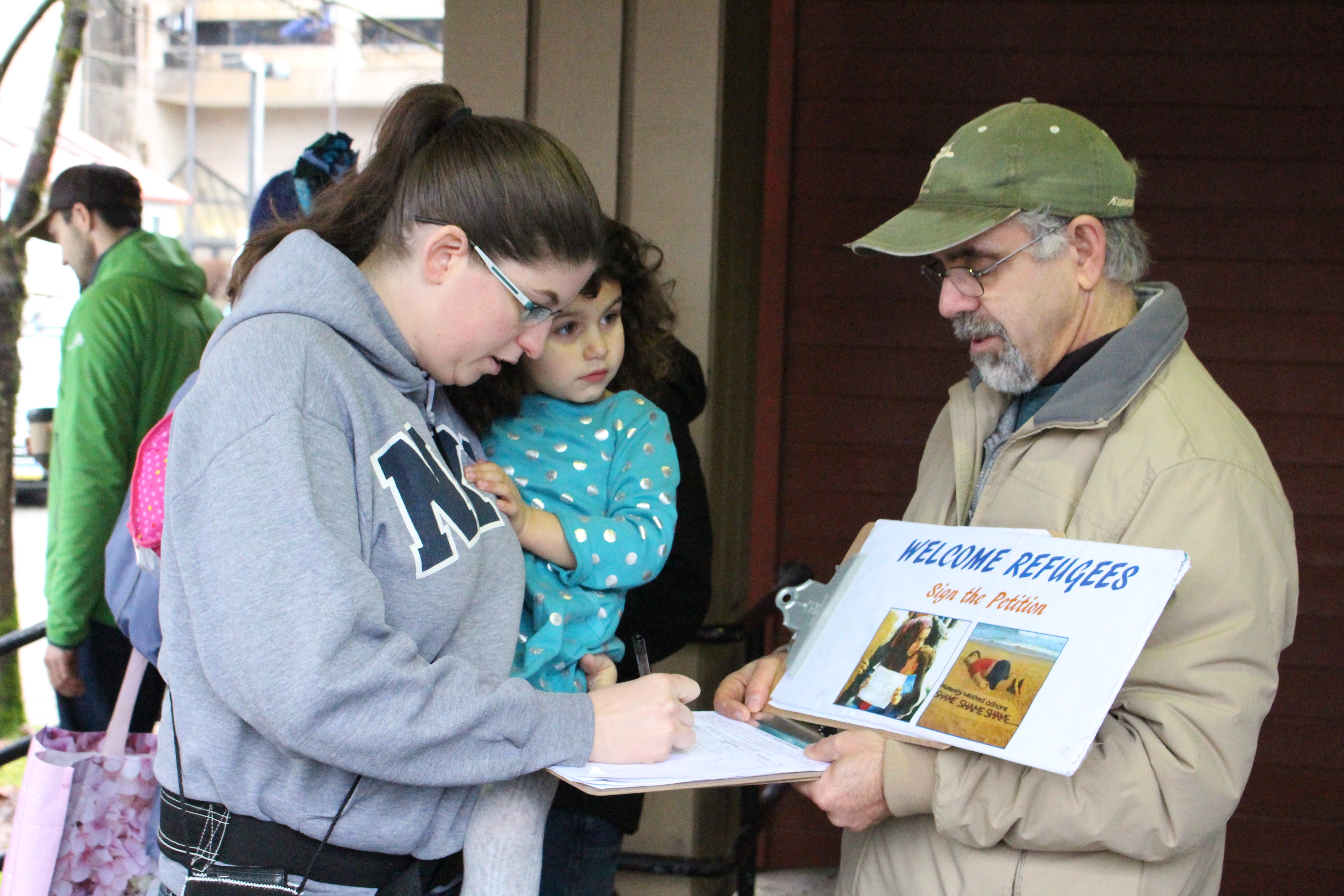
The petition is addressed, “To Alaska’s Elected Officials” and will be sent to the state’s congressional delegation in Washington, D.C. It reads:
“We, the undersigned, will not allow fear-mongering to drown out our compassion for those seeking refuge from war or violent conflict or our humanitarian obligation to ease their circumstances. Therefore, we urge our elected representatives to work toward resettlement of refugees to Alaska in a manner that is inclusive, humane, and expeditious.”
Volunteer Sarah Niecko said gathering signatures means talking to people of all opinions on the issue.
“We’ve had a lot of support which is nice to see and, more importantly, getting the dialogue started for even those people that maybe don’t support it. Just hearing their side, because we have to bring them all to the discussion table if we’re ever going to come up with creative solutions,” Niecko said.
About 120 refugees from around the world settle in Alaska every year. Catholic Social Services, which oversees the state’s refugee resettlement program, says there are no current plans to receive Syrian refugees.
Following the attacks in Paris a few weeks ago, Alaska congressman Don Young and U.S. Senators Lisa Murkowski and Dan Sullivan joined many other political leaders in calling on the president to suspend his plan to admit 10,000 Syrian refugees. Gov. Bill Walker did not take that stance.
Volunteers in Juneau will continue to gather signatures this week. Veterans for Peace and Juneau People for Peace and Justice plan to place an ad in the Juneau Empire that lists as many names of people who signed the petition as can fit.
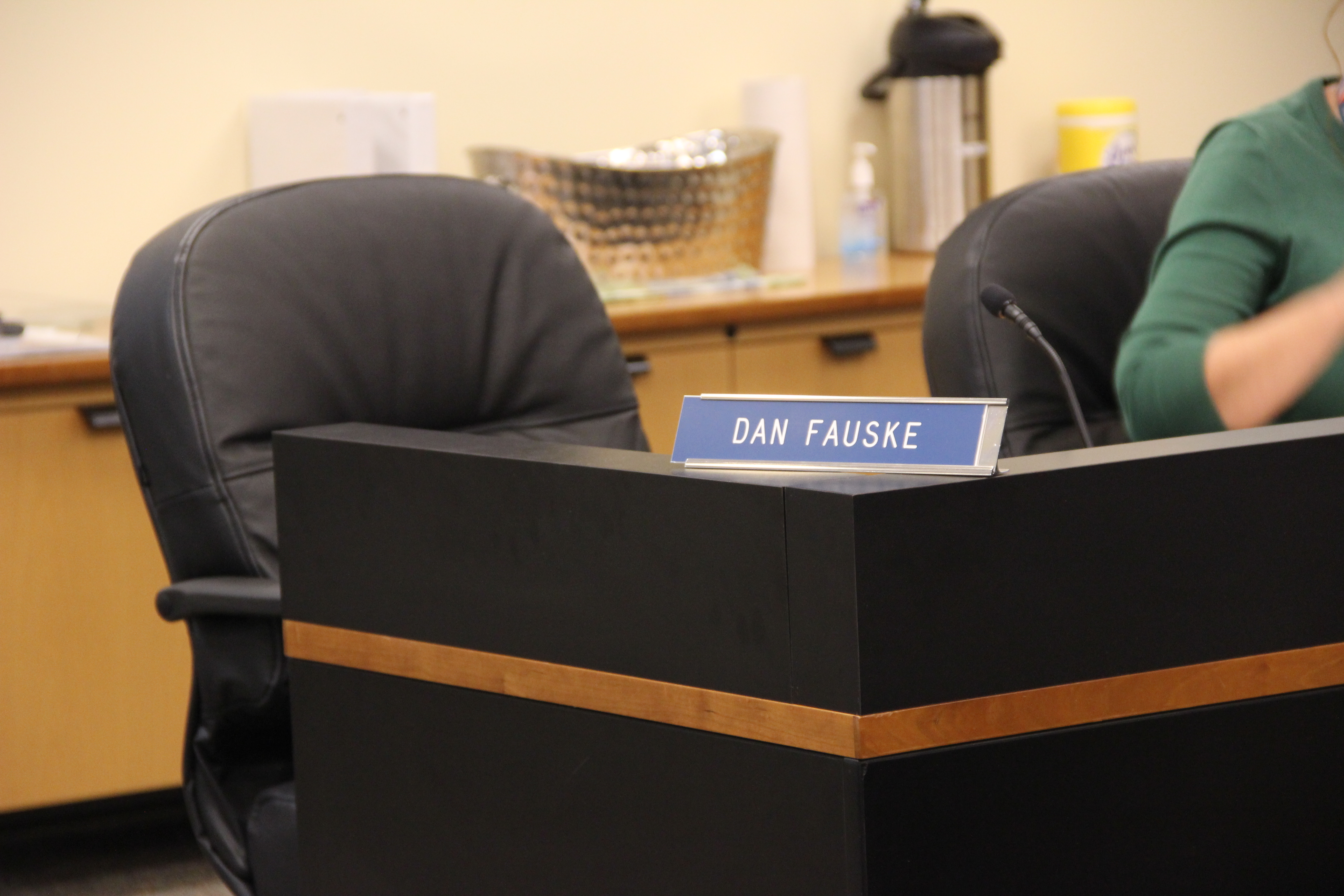
Dan Fauske’s chair was vacant at the Saturday morning meeting of the AGDC Board. (Photo by Rachel Waldholz/APRN)
Dan Fauske has resigned as president of the Alaska Gasline Development Corporation, which represents the state in the proposed $45 to $65 billion project to bring natural gas from the North Slope to Cook Inlet for export.
The resignation was announced at an early morning meeting of the AGDC board on Saturday, and accepted in a unanimous vote.
The board had gathered for a final vote to authorize the buyout of TransCanada from the Alaska LNG project. That buyout passed 6-0, with no discussion.
Fauske gave no reason for his departure in his resignation letter, dated Friday. But in a press conference Saturday afternoon, Gov. Bill Walker said he had made it clear he wanted new leadership at the corporation — someone with more natural gas experience.
“I let them know that I think we need to have a person there with different qualifications. There’s no question about that,” Walker said. “Did I give a directive that they must do that? No, I don’t give directives. But they certainly knew my belief.”
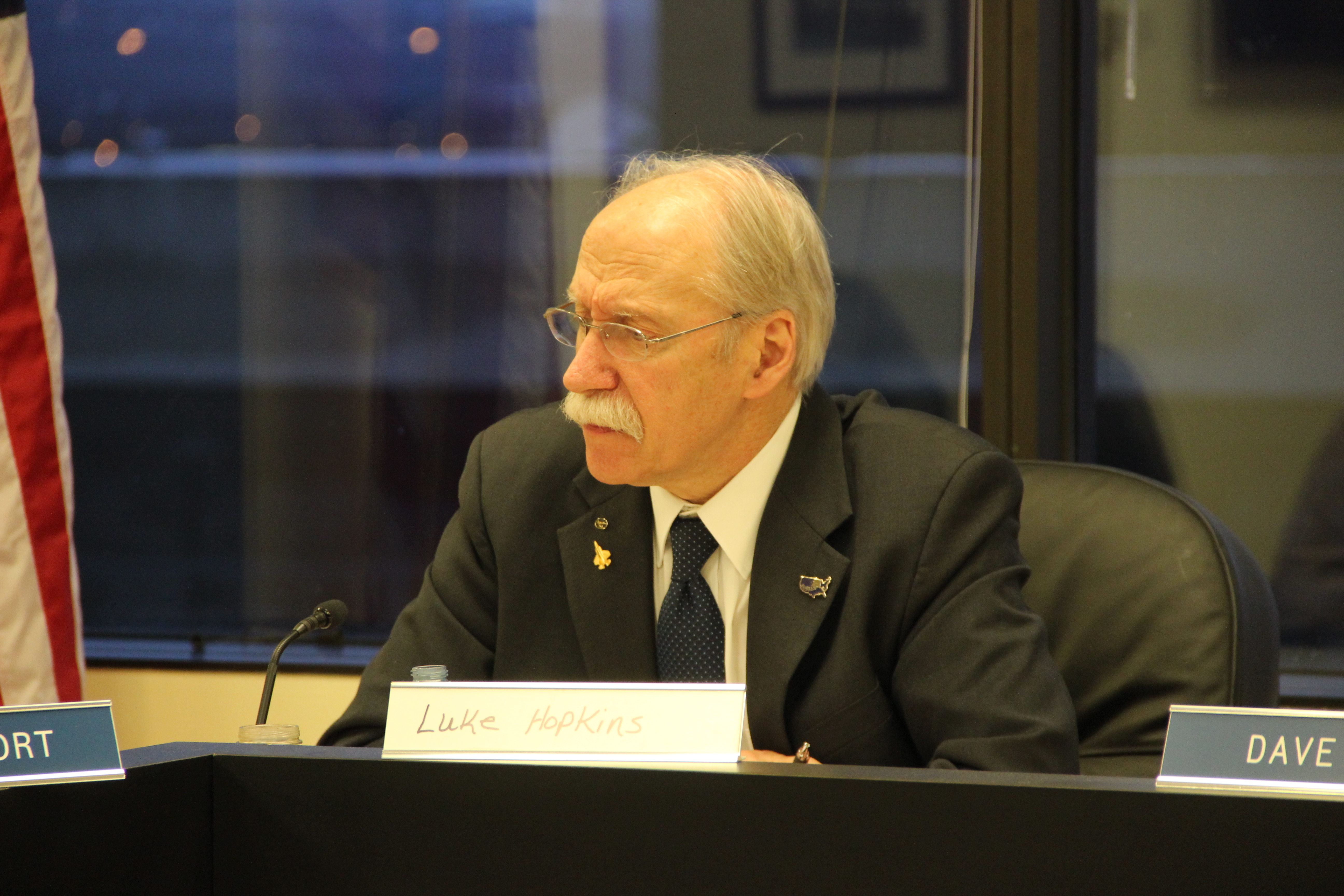
Former Fairbanks North Star Borough Mayor Luke Hopkins was appointed to the board of the Alaska Gasline Development Corporation on Friday, Nov. 20. (Photo by Rachel Waldholz/APRN)
Fauske’s resignation came a day after the governor removed the board’s chairman and replaced another member. On Friday, Walker named former Fairbanks North Star Borough mayor Luke Hopkins to replace chairman John Burns, who served as attorney general under former governor Sean Parnell.
Walker also appointed Transportation Commissioner Marc Luiken to replace Commerce Commissioner Chris Hladick. The board has seven seats, two of which are reserved for state commissioners.
Fauske had led the gas line development corporation since its founding in 2010. He was previously head of the Alaska Housing Finance Corporation.
“Mr. Fauske has done a very good job of getting us to where we are, and I appreciate that profoundly,” Walker said. “But now we move into another stage.”
Fauske’s resignation is effective Jan. 1, but he will take personal leave until that date. Board vice chairman Dave Cruz said he will serve as acting president of the corporation until an interim replacement can be named.
Cruz is now the only remaining board member originally appointed by Parnell. He was reappointed by Walker in September.
The board postponed a second vote scheduled for Saturday, on whether to continue the Alaska LNG project for another year. The state and its three partners, Exxon Mobil, BP and ConocoPhillips, all must vote by Dec. 4 on whether to commit to another year of work.
Walker said the state should not formally approve more work until it has reached a “withdrawal agreement” with its partners. The governor wants assurances that should any of the three major producers pull out of the project, they will not withhold gas they control from a pipeline, if one is built.
“By approving the work plan and budget today, there’s no incentive for us to receive those assurances,” Walker said.
Board members will take up that issue on Dec. 3.
Republican legislators expressed unease about the changes, and the delay.
“The clock is ticking and now we have to bring two more members up to speed without a proven leader. This is a troubling move,” said House Speaker Mike Chenault, in a statement released Saturday. “We’re watching, Governor, and we don’t like what we’re seeing.”
Editor’s Note: This story has been updated to include comments from the governor and other reaction.
As the state prepares to take a larger role in the Alaska LNG gas line project, its leadership team is once again in flux.
The changes are bringing new attention to the salaries involved — including one negotiator who has been paid about $120,000 a month since June.
Rigdon Boykin is a South Carolina-based attorney who has been serving as the state’s lead negotiator on the Alaska LNG project. In that role, he has overseen discussions with the state’s three main partners, Exxon Mobil, BP and ConocoPhillips, and coordinated among the alphabet soup of state agencies involved in the gas line.
Boykin isn’t a state employee. As a consultant with the Alaska Gasline Development Corporation, his contract called for a salary of $120,000 a month from June through October — and $100,000 for the month of November.
The contract is capped at $850,000.
In an interview last month, Gov. Bill Walker said that’s the price the state has to pay for expertise.
“We’re negotiating a contract that Alaska will be bound to for probably 25 years,” Walker said. “There will be billions of dollars moved back and forth across the table. We have to bring our A-team.”
But now, it seems, Walker is reshuffling his A-team.
After the Alaska Dispatch News reported last week that Boykin was sent home to South Carolina, Walker released a statement saying he would recommend AGDC use Boykin “in a different capacity going forward.”
It’s not clear who, if anyone, will take his place.
“Our understanding is the administration wants to move back from a lead negotiator approach to having the attorney general’s office, the Department of Law, the Department of Revenue and the Department of Natural Resources collectively working on those agreements,” said Miles Baker, AGDC’s vice president for external affairs.
As for Boykin’s pay, Baker said the contract isn’t the norm for the state-owned corporation.
“I would say this is at the very high end of the pay scale,” he said.
AGDC President Dan Fauske is slated to make $366,000 plus benefits this year. For comparison, the governor makes $145,000 a year.
Boykin’s contract was negotiated by the governor’s office. Spokesperson Katie Marquette said in an email that the rate is comparable to what past consultants on the gas line have made.
Reached by phone, Boykin said he’d rather not comment.
Meanwhile, the state has ended its contract with another highly paid contractor, Texas oil and gas consultant Audie Setters.
Setters was tasked with advising the state on the natural gas market and reaching out to potential buyers. The Department of Natural Resources estimates Setters’ compensation at about $587,000 for 14 months of work.
A department spokesperson said via email that the state has decided it needs a permanent employee in the role. The legislature approved funding for that position during the recent special session.
The estimated salary? About $1.1 million a year, plus benefits.
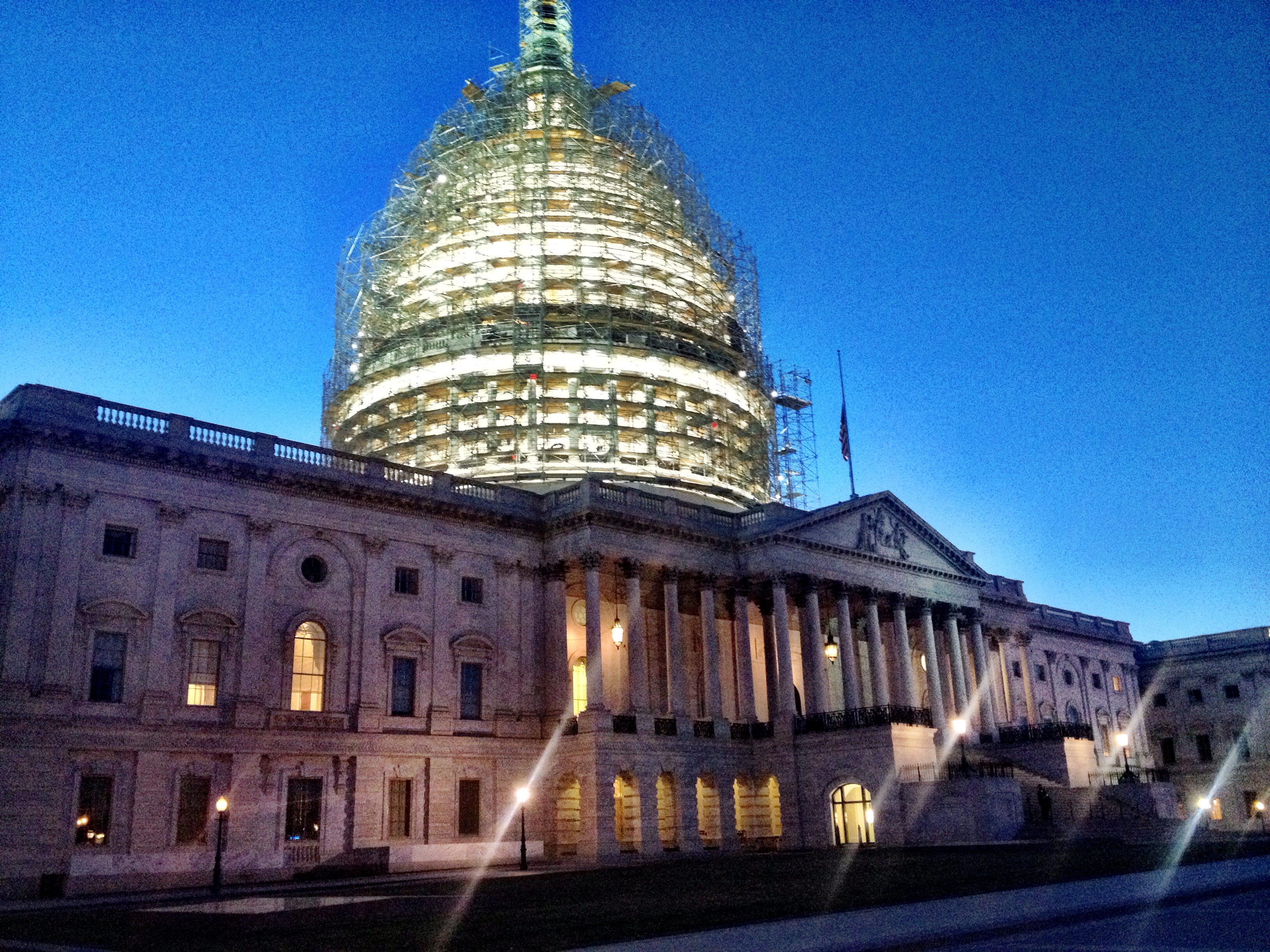
The U.S. Capitol building. (Photo by Liz Ruskin/APRN)
Alaska’s congressman and U.S. senators are among the chorus of political leaders calling on President Obama to suspend his plan to admit 10,000 Syrian refugees.
Sen. Lisa Murkowski said she wants a moratorium, a pause to give Congress and the public a chance to evaluate the vetting process. Murkowski said she knows screening a refugee family can take up to two years, but she isn’t clear on what it entails.
“And so until I know, I’m saying let’s put a stop on this right here, right now until we can ascertain what the process is in place,” she said.
Murkowski said the United States has history of offering safety to refugees, and she doesn’t want that generosity to disappear. But the senator said the phones in her office have been ringing off the hook with Alaskans concerned that if the U.S. accepts Syrians, a terrorist might be hiding among the innocent.
“I think that’s fair, because as generous and hospitable as we want to be for others, we also want to be able to ensure the safety of the families here at home,” she said.
Hundreds also weighed in on her Facebook page. Many were adamantly anti-refugee and showed no hint of hospitality. Murkowski says she understands that reaction too, after watching the horrible events in Paris on Friday.
Over the past 24 hours I have heard from Alaskans who are fearful that the United States intends to imminently admit…
“I think there is that very, very visceral response that we have, saying ‘This should not be allowed,’” she said.
Murkowski said she knows of no plan to settle Syrian refugees in Alaska. The state was not a destination for the 1,854 refugees that have been admitted to the U.S. since 2012.
President Obama, in a speech in Turkey, said the refugees are also seeking security from terrorism.
“Slamming the door in their faces would be a betrayal of our values,” he said.
Sen. Dan Sullivan said in a Facebook post that the government needs a rigorous system to verify identities of asylum seeker before the U.S. can accept any Syrian refugees.
I’ve been asked about whether or not we should be accepting Syrian refugees into this country. The short answer is no….
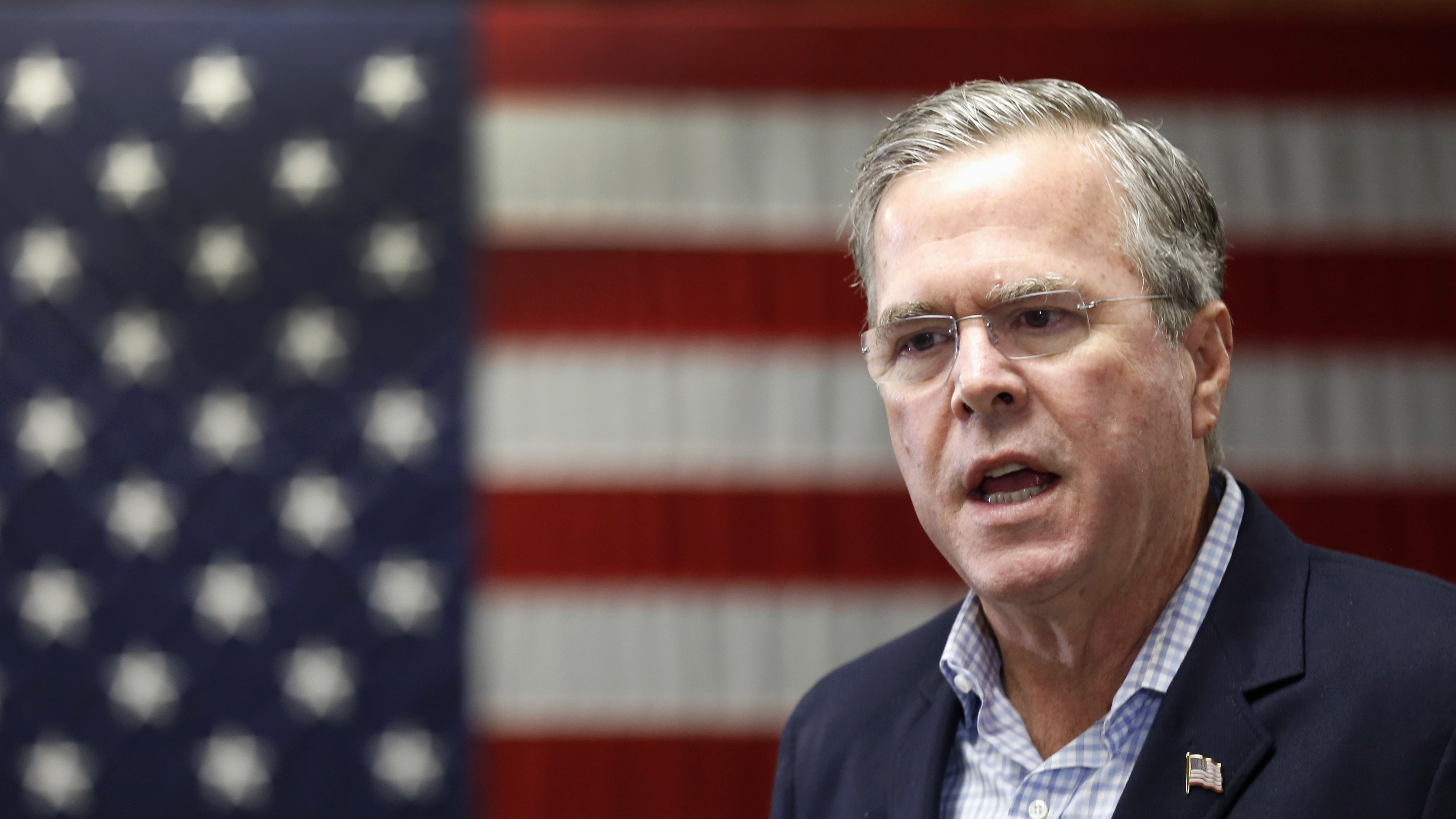
Republican presidential candidate and former Florida Gov. Jeb Bush speaks during a campaign stop in Franklin, N.H., on Friday, Nov. 13. He’s said the focus should remain on helping Christian refugees from Syria. (Photo by Jim Cole/AP)
Updated at 5:45 p.m. ET
One of the suicide bombers who struck Paris on Friday has been identified as a Syrian who passed through Greece as an asylum-seeker this year and registered with European authorities.
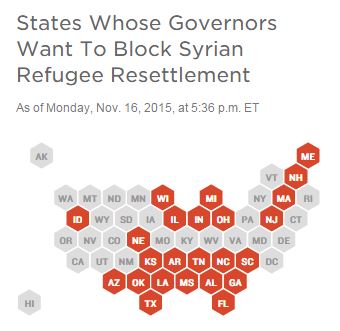
(Graphic by NPR)
That fact has spurred a strong reaction from many politicians here in the United States over the resettlement of Syrian refugees, with swift opposition from many Republican governors, and one Democrat, to further resettlement of Syrian refugees in their states.
So far, 24 governors have asked the federal government to block Syrian refugees from entering their states. Those include: Alabama, Arizona, Arkansas, Florida, Georgia, Idaho, Illinois, Indiana, Kansas, Louisiana, Maine, Massachusetts, Michigan, Mississippi, Ohio, Oklahoma, Nebraska, New Hampshire, New Jersey, North Carolina, South Carolina, Tennessee, Texas and Wisconsin.
In Texas, Gov. Greg Abbott sent a letter directly to President Obama on Monday. He said, “I write to inform you that the State of Texas will not accept any refugees from Syria in the wake of the deadly terrorist attack in Paris.”
Abbott cited several threats from ISIS he says the state has seen in recent years, including a May shooting in Garland, Texas, at the site of a contest for drawings of the Prophet Muhammad.
New Hampshire Gov. Maggie Hassan is the sole Democratic governor to make this call. Hassan’s spokesman, William Hinkle, said in a statement, “The Governor believes that the federal government should halt acceptance of refugees from Syria until intelligence and defense officials can assure that the process for vetting all refugees, including those from Syria, is as strong as possible.”
Hassan is a candidate for the U.S. Senate from New Hampshire in 2016, challenging incumbent Republican Kelly Ayotte. Ayotte made a similar statement regarding refugees on Monday.
So far the U.S. has brought in only about 2,000 Syrian refugees, mainly due to the arduous security procedures. The U.S. has faced pressure to take more refugees as Europe has been flooded by hundreds of thousands from conflict zones in the Middle East and Africa.
State Department spokesman Mark Toner said Monday, “There’s been a lot of missed perceptions over the last few days surrounding the issue of refugees.”
“We take their concerns seriously,” Toner added. “We believe it’s incumbent on us to sit with them, consult with them, explain to them the process, the stringent — stringent security review that goes into the — accepting these refugees.”
At least two governors said Monday they would continue to accept refugees, Democrats John Hickenlooper of Colorado and Tom Wolf of Pennsylvania.
Just two months ago, the Obama administration announced a plan to resettle 100,000 refugees from conflict zones around the world, with a plan to bring in 10,000 from Syria in the next year. At the time, Secretary of State John Kerry addressed security concerns.
“One of the reasons it’s difficult is that post-9/11, we have new laws and new requirements with respect to security background checks and vetting, so it takes longer than one would like,” Kerry said. “And we cannot cut corners with respect to those security requirements.”
Still, many Republican presidential candidates have raised serious concerns about the security risk of bringing Syrian refugees into the country.
Sen. Marco Rubio, R-Fla., questioned the ability of the federal government to conduct proper screenings. He told ABC’s This Week, “There is no background check system in the world that allows us to find that out because who do you call in Syria to background check them?”
In an interview with CNBC on Monday, Donald Trump said of Syrian refugee resettlement, “It would be one of the great Trojan horses.”
Democratic candidates were asked about refugees during their debate on CBS Saturday night. Former Secretary of State Hillary Clinton said proper screening is the “No. 1 requirement.” She added, “I also said that we should increase numbers of refugees.” Instead of the 10,000 that the Obama administration has promised to bring in over the next year, Clinton and former Maryland Gov. Martin O’Malley said the number should be 65,000.
Ohio Gov. John Kasich, also a GOP candidate for president, has also called for blocking refugees from entering his state. “It would be incumbent on people to prove who they are so that we would be certain because we can’t be in a position of inviting the enemy in,” Kasich told Fox News on Sunday.
New Jersey Gov. Chris Christie was quoted as telling talk radio host Hugh Hewitt on Monday evening that not even “3-year-old orphans” should be let in among Syrian refugees.
South Carolina Sen. Lindsey Graham called for a “timeout” on Syrian refugees Monday. He previously spoke of solving the humanitarian crisis in Syria. “The good people are leaving because they’re being raped and murdered and some terrorists are trying to get in their ranks,” he told CNN. “The best thing the world could do for Syrian people is to create a safe haven within Syria, a no-fly zone.”
Former Florida Gov. Jeb Bush had a similar stance Sunday on NBC’s Meet The Press. “The great majority of refugees need to be safely kept in Syria, which means the safe zones need to be serious. We need to build a coalition that can fight both Assad and ISIS and give people safe haven,” he said.
Bush added, “I think our focus ought to be on the Christians who have no place in Syria anymore. They’re being beheaded, they’re being executed by both sides. And I think we have a responsibility to help.”
That comment is similar to remarks Sen. Ted Cruz made on the trail in South Carolina on Sunday. “There is no meaningful risk of Christians committing acts of terror,” Cruz asserted.
President Obama rebuked those comments during a news conference in Antalya, Turkey, on Monday.
“When I hear political leaders suggesting that there would be a religious test for which person who’s fleeing from a war-torn country is admitted, when some of those folks themselves come from families who benefited from protection when they were fleeing political persecution, that’s shameful,” Obama said, apparently referring to the fact that Cruz’s father fled Cuba in the 1950s after fighting the regime of dictator Fulgencio Batista.
In 2014, Cruz told Fox News that the U.S. should admit refugees, given the country’s history as a nation of immigrants. “We have to continue to be vigilant to make sure those coming are not affiliated with the terrorists, but we can do that,” Cruz said at the time.
Dr. Ben Carson said during a news conference on Monday that there should not be a religious test, but an “ideological test.”
During an appearance on Fox News Sunday, Carson had said that it’s a mistake to let Syrian refugees in “because why wouldn’t they infiltrate them with people who are ideologically opposed to us? It would be foolish for them not to do that.”
In speaking of how foolish he believes it is to allow Syrian refugees into the U.S., Carson added, “You know, the reason that the human brain has these big frontal lobes as opposed to other animals, because we can engage in rational thought processing… Animals, on the other hand, have big brain stems and rudimentary things, because they react. We don’t have to just react, we can think.”
On Monday, Carson sent letters to Senate Majority Leader Mitch McConnell, R-Ky., and House Speaker Paul Ryan, R-Wis., urging them to end all funding for federal programs to resettle Syrian refugees.
There was more reaction from Congress, as the chairman of the House Homeland Security Committee, Rep. Michael McCaul, R-Texas, raised security concerns and asked President Obama to temporarily suspend admission of Syrian refugees.
Congress is currently in the process of passing appropriations bills to keep the government funded past Dec. 11. They could use those bills to cut funding for resettlement, or pass separate legislation on the matter.
House Speaker Ryan has received requests from various governors and presidential candidates to do what he can to stop refugee resettlement.
Copyright 2015 NPR. To see more, visit http://www.npr.org/.
Read Original Article – November 16, 2015 4:20 PM ET
Hillary Clinton entered the second debate of the campaign for the Democratic presidential nomination with far less to prove than she had in the first, and, in the end, she probably achieved far less as well.
But for the time being, at least, she may be able to afford it.
The first debate, in October, corresponded with a time of stress for her candidacy, besieged by various legal and political investigators and drifting downward in voter-preference polls. But Clinton did so well and struck such a blend of competence and charm in the October debate on CNN that she was widely acknowledged to have rescued her fortunes — or at least strengthened her hand.
This latest debate on CBS News and staged at Drake University in Des Moines, Iowa, was never likely to have as great an impact. The likely audience was limited. It was staged on a Saturday night, competing with various sports and entertainment programs. This weekend, in particular, it was overshadowed by the tragedy unfolding in Paris, where at least 129 people died in terrorist attacks Friday night. The group known as Islamic State claimed responsibility for the coordinated attacks by teams of gunmen and suicide bombers.
The debaters observed a moment of silence for the victims in Paris and devoted the first quarter of the debate to discussing the attacks and the proper response from the U.S. and its allies. All agreed the U.S. had a major, leading role to play in battling the terrorists, but all also agreed that U.S. allies needed to respond with greater commitment as well.
Sen. Bernie Sanders of Vermont noted that the struggles in the Middle East amounted to “a war for the soul of Islam,” implying it was a contest beyond the power of the U.S. government to resolve. But Sanders also explicitly assigned responsibility for the current turmoil in the Middle East to the administration of George W. Bush, whose invasion of Iraq in 2003 was responsible for “all this instability,” he said.
Sanders made the point that he had opposed the invasion on the Senate floor, where Clinton had voted in support. Clinton has since called that vote a mistake.
But the most difficult part of that first segment of the debate for Clinton came when CBS News debate moderator John Dickerson asked whether her prescriptions for the fight against the group called Islamic State suffered for her association with President Obama, who has been downplaying, or underestimating, the strength of the group. As recently as this week, the president had said the group had been “contained,” at least in its territorial ambitions in Iraq and Syria.
On this, Clinton distanced herself from the president somewhat, saying she had advised more involvement in the region after the withdrawal of U.S. troops from Iraq — a shift she said was mandated by the agreement struck with Iraq by the last Bush administration. She had said she warned that “extremist groups might fill the vacuum.”
Sanders said several times that the Department of Defense budget was already $600 billion and that the U.S. should be hesitant to increase that greatly without knowing what it was expecting to accomplish with more military hardware.
A self-described Democratic Socialist, Sanders also contrasted his reliance on small donors with the Clinton campaign’s donations from the wealthy of Wall Street: “Maybe they’re stupid about what they’re going to get [in return], but I don’t think so.”
Clinton then insisted on a chance to respond, because Sanders had “impugned my integrity.” That drew an audible sound of anticipation from the crowd, which may not have expected even this degree of confrontation between the candidates after the harmony of the first debate.
Clinton then said she had many thousands of donors, most of them not rich, and 60 percent of them women. Although not directly responsive to the Wall Street thrust from Sanders, Clinton’s reference to gender prompted applause and cheers from the crowd. This was her best moment of the debate, according to people following the proceedings on social media such as Twitter.
Clinton went on to suggest her contributions from Wall Street stemmed from appreciation for all she had done to help the Lower Manhattan financial industry recover from the terror attacks of September 2001. That rationale drew a decidedly mixed response from the audience in the hall and on social media, with many questioning whether it fully explained the generous contributions she still receives from the financial industry more than a dozen years later.
.@HillaryClinton vehemently offers support for Wall Street as post-911 recovery effort. Does that fly?
Sanders said Clinton’s plan to increase regulation of the financial industry was “not good enough,” and he had corroborating support from third-place challenger Martin O’Malley, the former governor of Maryland, who called the Clinton plan “weak tea.”
The candidates revisited a divide on gun violence, with Sanders saying he was willing to reconsider his past opposition to legislation stripping gun manufacturers of their liability when their products were used in the commission of crimes. O’Malley sided with Clinton on this issue, only moments after favoring Sanders’ point of view on banking regulation.
But, in general, the candidates were largely in agreement on major issues. They agreed that President Obama had been right to offer a path to citizenship for young people brought to the U.S. illegally while still minor children. “The symbol of America is the Statue of Liberty,” said O’Malley, “not a barbed-wire fence.”
O’Malley also won cheers from the crowd for his reference to “that immigrant-bashing carnival-barker Donald Trump,” a reference to the candidate leading most polls among Republican candidates for president.
All three candidates supported greater access to a college education, with Sanders saying all public universities and colleges should be tuition-free. Clinton said she did not think taxpayers should pay for Trump’s children to go to college, as he is a billionaire. O’Malley noted that he had held the line on tuition increases at state schools when he was a governor.
And neither Sanders nor O’Malley took the bait when asked whether Clinton’s private e-mail server should have been used for any kind of government business. Sanders in particular refused the chance to criticize her on the issue, saying he was still “tired of her emails,” as he had said in the first debate.
Dickerson then asked Clinton if there were “other shoes to drop” as multiple investigations proceed into her time in office and the activities of her aides. Clinton alluded to her 11 hours of testimony before a House investigative panel last month as an indication to the contrary.
Overall, the debate did not seem likely to affect Clinton’s standing in the primary field. Despite moments of vulnerability and dubious reaction to her defenses regarding Wall Street contributors, she remained the strong center of the cast on stage. She had 40 percent of the total speaking time, with 35 percent going to Sanders and 25 percent to O’Malley. But as she had arrived at this juncture of the campaign as not only the leader but an increasingly dominant leader, Clinton had little room to improve.
Dickerson also invited favorable comparison to his predecessors in the role of debate moderator. His questions were crisp, to the point and frequently challenging — but without the argumentative tone that has brought criticism from participants in earlier debates on the Republican side.
Copyright 2015 NPR. To see more, visit http://www.npr.org/.
Read Original Article – Published NOVEMBER 15, 2015 10:39 AM ET

9(MDEwMjQ0ODM1MDEzNDk4MTEzNjU3NTRhYg004))

9(MDEwMjQ0ODM1MDEzNDk4MTEzNjU3NTRhYg004))
 Read Original Article – Published NOVEMBER 15, 2015 10:39 AM ET
Read Original Article – Published NOVEMBER 15, 2015 10:39 AM ET