Politics

Hillary Clinton’s Mixed Record on Wall Street Belies Her Tough ‘Cut it Out’ Talk

Hillary Clinton in Coralville, Iowa
Hillary Clinton in Coralville, Iowa, Nov. 3, 2015. (Creative Commons photo by Barbara Kinney/Hillary for America)

This story was co-published with The Daily Beast.

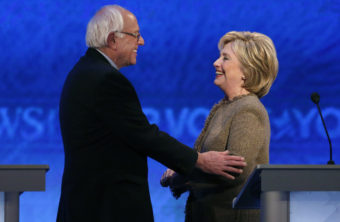
During the Democratic debate last month, Hillary Clinton assured viewers she would be a president at least as tough on Wall Street as her main opponent for the nomination, Sen. Bernie Sanders. She cited her history as “a progressive who likes to gets things done.” Sanders and others, she added, might be “missing the forest for the trees” by aiming at big banks alone and not the more risky shadow banking system.

Clinton also proudly recalled that while serving as U.S. senator from New York she warned bankers early in the financial crisis about their dangerous practices.

“I went to Wall Street in December of 2007 — before the big crash that we had,” Clinton said. “I basically said, ‘Cut it out! Quit foreclosing on homes! Quit engaging in these kinds of speculative behaviors.’ ”

An examination of her remarks to Wall Street in December 2007 and Clinton’s actions as a senator — a period when she had the best opportunity to translate her words into deeds — presents a more mixed picture of her record on the banking industry.

Clinton steered a middle ground in a 28-minute address to business executives gathered at an office of the Nasdaq stock exchange in New York’s Times Square on Dec. 5, 2007. In the event, she presented a detailed analysis of the burgeoning dangers in the housing market and its threat to the economy. (ProPublica obtained a video of the speech, which hasn’t previously been posted.)

Clinton gave a shout-out to her “wonderful donors” in the audience, and asked the bankers to voluntarily suspend foreclosures and freeze interest rates on adjustable subprime mortgages. She praised Wall Street for its role in creating the nation’s wealth, then added that “too many American families are not sharing” in that prosperity.

She said the brewing economic troubles weren’t mainly the fault of banks, “not by a long shot,” but added they needed to shoulder responsibility for their role. While there was plenty of blame to go around for the spate of reckless lending, and while Wall Street may not have created the foreclosure crisis, it “certainly had a hand in making it worse” and “needs to help us solve it.”

Finally, Clinton said, if the banks didn’t take the voluntary steps she proposed, “I will consider legislation to address the problem.”

The lenders did not adopt Clinton’s proposals. During 2007 and 2008, when the housing market collapsed and while she was also running for president, the Democrats controlled the Senate. Of the 140 bills Clinton introduced during that period, five were related to housing finance or foreclosures, according to congressional records. Only one of those five secured any co-sponsors. No Senate committee took action on any of them and they died without any further discussion.When a broad housing bill finally became law in 2008, Clinton was not among the more than dozen senators credited by party leaders as playing a key role.Clinton also introduced a bill in 2008 to curb compensation of corporate executives. It too died without any co-sponsors.

In dealing with Wall Street, Clinton faced the same challenge as any lawmaker representing New York, where the financial industry includes not only constituents but campaign donors. Wall Street executives were the largest donors to both her 2006 Senate re-election bid and her 2008 presidential race; employees of just eight banking firms gave $2.67 million to those campaigns, according to data compiled by the Center for Responsive Politics, a non-profit research group.Clinton in 2007 publicly decried a tax break for hedge-fund and private-equity executives — and continues to do so in her current campaign. But she didn’t sign on as a supporter of a Senate bill that would have curbed the break.

As a senator, Clinton also had a brush with the shadow-banking world that she now describes as a continuing threat to the financial system. When AIG, the giant insurance company and poster child for lightly regulated finance, began to implode in September 2008, Clinton reached out to Treasury Secretary Henry Paulson, who was involved in talks to rescue the firm with government funds. Her little-noticed overture came on behalf of some wealthy investors who stood to lose millions and had hired two longtime associates of the Clintons to represent them.

Brian Fallon, a spokesman for the Clinton campaign, declined to comment for this story. The Clinton campaign has issued a fact sheet detailing her record with Wall Street as a senator.

‘Doesn’t Run Amok’

In Iowa last month, Clinton underscored the difference between fiery speeches and results when she told Democrats, “It’s not enough to just rail against Republicans or the billionaires.”

During the debate she had called for stronger regulatory oversight of the financial system and addressed the theme of income inequality that has powered the campaign of Sanders, who identifies himself a democratic socialist. “It’s our job to rein in the excesses of capitalism so it doesn’t run amok and doesn’t cause the kind of inequities that we’re seeing in our economic system,” she said.

Clinton’s campaign referenced her Senate record in the fact sheet issued a few days before the debate titled, “Wall Street Should Work for Main Street.” It cited one bill — the executive compensation legislation that died. It also mentioned four press releases or speeches from 2007 and 2008 — including a March 15, 2007, talk in which she proposed a series of housing initiatives and her call later that year for higher taxes on hedge fund executives.

Clinton had already hit the tax break in her new campaign. In April, during her first official appearance as a presidential candidate, she told students in a classroom for auto technology at an Iowa community college: “There’s something wrong when hedge fund managers pay lower taxes than the nurses or the truckers that I saw on I-80 as I was driving here.”

Her aides then told reporters she was referring to the so-called carried-interest loophole, which taxes compensation earned by private equity partners and hedge fund managers at a lower rate than ordinary earned income.

What they didn’t say was that Clinton never signed onto the bipartisan June 2007 bill that would have curbed the break. Her rival for the nomination, then-Sen. Barack Obama, became a co-sponsor on July 12. The next day Clinton gave a campaign speech criticizing the tax provision. Yet she still didn’t put her name to the legislation, according to records.

During Clinton’s first presidential campaign, her official campaign website gave short shrift to financial or housing matters. In April 2008, the section of the website called “Hillary on the Issues” listed 14 topics; none involved housing, mortgages or Wall Street.

The bills she introduced dealt with some of the issues she raised in her speeches — including one aimed at making it easier for homeowners facing foreclosure to get their loans modified — but none of them advanced, records show. The only co-sponsor who joined any of them was fellow New York Sen. Charles Schumer, who signed onto a bill that would have helped veterans refinance their mortgages. That bill also died in committee without any action taken.

Meanwhile the Senate moved forward on other bills with wider support. They eventually led to a sweeping housing and mortgage law signed by President Bush in July 2008. That legislation was voted on three times in the Senate in 2008, in addition to a few procedural votes related to the bill. Clinton missed votes in February and April, when she was running for president, but also missed votes in late June, after she had dropped out of the contest. On July 26, when the bill passed, Clinton was there to vote in support.

The bill’s main sponsor, Sen. Christopher Dodd, a Connecticut Democrat, summarized the bill’s journey and, in a floor speech, praised 13 other Senators for their help. Clinton’s name wasn’t among them.

‘Closed Door Meetings’

At the debate last month, Clinton said her campaign plan for Wall Street oversight was tougher than the one proposed by Sanders, in part because it would go beyond making sure banks aren’t too big to fail. “We also have to worry about some of the other players — AIG, a big insurance company; Lehman Brothers, an investment bank. There’s this whole area called shadow banking. That’s where the experts tell me the next potential problem could come from,” she said.

Clinton didn’t need an expert to tell her about AIG.

On Sept. 18, 2008, as the government grappled with collapsing markets, Clinton took to the Senate floor. “After years of laissez-faire policies for the middle class, the Bush administration has acted on behalf of Wall Street, with the largest and most significant Federal interventions in the history of our modern financial system,” she said. “The largest banks in the world could have closed-door meetings with the White House and the Federal Reserve and Treasury Department to discuss their bailout options, but millions of homeowners with mortgages worth more than their homes, or who are facing default and foreclosure, don’t have the same opportunity.”

A day before that speech, Clinton had quietly reached out to Paulson, Bush’s Treasury secretary, on behalf of some wealthy investors in AIG. The giant insurer had made bad bets on the mortgage market, couldn’t pay its debts and faced imminent collapse. Shareholders were poised to lose billions if the company went bankrupt or was taken over by the government.

A review of Paulson’s calendars shows that he and Clinton talked on Sept. 17 and 20. In his book about the financial crisis, Paulson mentions just the first conversation, saying that Clinton called on behalf of Mickey Kantor, a lawyer, who represented a group interested in staving off AIG’s imminent collapse. The group’s investment banker, according to news accounts at the time, was Roger Altman. Kantor and Altman are long-time friends of Hillary Clinton and served as senior officials in her husband’s administration. Altman headed a secret energy task force for Clinton when she was in the Senate.

In Paulson’s account of his conversation with Clinton, Kantor represented a group of Middle East investors who were considering a bid for the insurer.

Paulson quoted Clinton as saying the investors hoped to save the government from having to “do anything,” but Paulson said he told her any private solution would have to guarantee AIG’s billions of dollars in liabilities, a huge, if not impossible, hurdle.

But in an interview with ProPublica, Kantor said Paulson didn’t have it quite right in the book. Kantor said he was working on behalf of “major shareholders” in AIG, not Middle East investors. The shareholders he represented owned about 30 percent of AIG’s shares — one of them was Eli Broad, a Los Angeles billionaire, philanthropist and friend of the Clintons. Kantor said he couldn’t remember whether he had sought Clinton’s help but said it was possible given their 40-year friendship. Kantor said he hoped to persuade Treasury his clients could raise enough money to “put the ship in order” but by the time Paulson and Clinton talked the Federal Reserve had concluded a private rescue, at a cost of at least $75 billion, was not feasible.

With its stock in free fall, there was no private solution to AIG. The Treasury and the Fed feared that if AIG defaulted, the ripples might bring down the international banking system.

By Sept. 22, the Federal Reserve Bank of New York was completing a rescue package that gave the government almost 80 percent of the company in return for a loan of $85 billion. As a result, private shareholders, including Kantor’s clients, lost most of the value of their stock holdings. The U.S. eventually earned a profit of almost $23 billion on its investment.

Paulson declined to comment, Altman did not return a phone call and a spokesperson for Broad and his foundation didn’t respond to emails or phone calls.

More Bailouts

The most important action Clinton took related to the financial crisis may have been her vote in favor of the $700 billion bank stabilization plan, essentially a bailout of Wall Street. After a short but tumultuous debate the Senate approved the Bush administration’s plan, known as TARP, on Oct. 1, 2008. Nine Democratic senators, 15 Republicans and one independent (Sanders) voted no.

Clinton told the Senate during the debate:

“For two years, I and others have called for action as wave after wave of defaults and foreclosures crashed against communities and the broader economy.” She called for an end to the “culture of recklessness in our financial markets endorsed by an ideology of indifference in Washington.”

The next day Clinton spoke to a New York City radio host and expanded on her support for TARP.

“I think that the banks of New York and our other financial institutions are probably the biggest winners in this,” she said, “which is one of the reasons why, at the end, despite my serious questions about it, I supported it.”

Related stories: For more coverage of politics and lobbying, read ProPublica’s previous reporting on how Congress explains its absences, the insurance lobby’s pivot to Democrats and an FDA fix that may cure the drug industry more than the patients.

Like this story? Sign up for our daily newsletter to get more of our best work.

Read Original Article – Published Nov. 13, 2015, 5 a.m.
Hillary Clinton’s Mixed Record on Wall Street Belies Her Tough ‘Cut it Out’ Talk

Walker’s appointee for top DC job: No one

Bill Walker, Barack Obama and Air Force One
Gov. Bill Walker and President Barack Obama disembark from Air Force One, Aug. 31, 2015. (Photo courtesy Alaska Governor’s Office)

Gov. Bill Walker cites finances, not job performance, as the reason he fired most of his Washington, D.C., office, and then decided to keep associate director Nathan Butzlaff, on the job.

“Well, we are in the biggest fiscal deficit we’ve ever been in as a state, and we’re looking at everything, as far as what changes can we make from a fiscal standpoint that make sense for Alaska and to be able to cut the budget where we can,” Walker said in a phone interview. “And so it’s in  that vein we have looked at ways to handle the D.C. office differently than we have in the past.”

Shrinking the Washington staff saves $400,000 a year. Butzlaff  will keep the associate  title but will get a 10 percent raise, to just over $167,000 a year. Kip Knudson, whose last day as director of state and federal relations is today, made more than $200,000 a year. The office, which until recently had five positions, now has two.

Walker says he, the lieutenant governor, and senior cabinet members will visit more to supplement the efforts of the smaller staff. Walker says they’ll still have the manpower to do the detailed work of the office, like discussing technical points with federal staffers as they draft permits and regulations.

“We will continue to evaluate our fiscal situation and see if there’s more we can do with our D.C. office than our current plan right now,” Walker said, although he also said he does not consider the current plan an interim solution.

The newly unemployed Knudson says he’s happy for Butzlaff, and researcher Amy Dobson who is also staying on. But Knudson says it won’t be easy.

Kip Knudson
Kip Knudson. (Photo courtesy State of Alaska)

“The governor’s going to have to prioritize because it’s impossible to cover D.C. with five staff,” Knudson said, “and it’s certainly a lot harder with two.”

Most governors do have an office and their own representative in Washington. Back when Congress doled out earmarks, the offices did a lot of their work with Congress. Now, with less legislative action on Capitol Hill, the focus has shifted to the White House and the agencies.

Washington lobbyist C.J. Zane, a former chief of staff to Alaska Congressman Don Young, says with the Obama administration heading into its final stretch, it’s a critical time for Alaska.

“The last year (or) year and a few months, of any administration, things start to change. There becomes a priority to try to get things done before the administration is finished,” Zane said in an interview last month. “So it creates this circumstance where both good things, beneficial things, can happen — because people want to have that be part of their legacy, for instance. But it’s also a time when really bad and crazy things can happen if you’re not fully engaged.”

Alaska always has a raft of natural resource issues pending in the agencies, and some Alaskans fear Obama might create a national monument in the state on his way out the door.

Walker, from the start of his term, made it a point to engage with Washington in person. He had an Oval Office sit-down with Obama within days of becoming governor, and multiple meetings with Interior Secretary Sally Jewell. And when Obama came to Alaska this summer, Walker flew with him on Air Force One. Walker also paid $50,000 to consult with former Obama aide Pete Rouse to prepare for his time with the president.

Larry Persily, who worked as an associate director in the Washington, D.C. office when Sarah Palin was governor, says previous Alaska governors relied heavily on lawsuits to deliver their message to the feds.

“Walker’s made it clear he wants to get away from constant litigation and wants to see what you can get by getting a more positive relationship with the executive branch, with the admin, with White House officials,” Persily said.

As for Knudson, he says he doesn’t know what his next job will be, but he planned to spend his first day of unemployment on the golf course.

AMP test under fire due to delays, concerns over usefulness

Education Commissioner Mike Hanley
Alaska Department of Education and Early Development Commissioner Mike Hanley in February. (Photo by Skip Gray/360 North)

According to the Alaska Measures of Progress test results, less than half of Alaskan students meet educational standards. But distress over those numbers is just one part of AMP’s troubles.

Reporting delays and issues with the test’s format have some superintendents and lawmakers calling for an end to the new annual test, and the state’s Department of Education isn’t happy either.

On Monday, Alaska Education Commissioner Mike Hanley framed the less-than-stellar AMP scores as a helpful new baseline that raises the bar for Alaska students. But when asked about the way the test was administered, his answer was not so rosy.

“I’m not happy. I’m not satisfied with the way the data was rolled out,” he said.

The state has a five-year, $25 million contract with the Kansas-based Achievement and Assessment Institute, or AAI, to develop and score the new AMP tests.

Reporting glitches caused weeks of delays in getting scores out this fall. AAI said recently that that some of the problems are related Alaska-specific challenges and the switch from paper-and-pencil to online testing, and that they should’ve been better prepared.

But from Hanley’s end, the delays have added to overall lack of confidence in AMP.

“After going through the process, you pick the vendor you think is going to work the best,” said Hanley. “We have to look and see if that’s still the case. Is this the best vendor, and how do we move forward?”

The technical glitches are one thing, but other concerns are being raised as well. In October a group of 20 superintendents wrote the state board of education, questioning the usefulness of the test itself.

“The test results don’t tell us enough to work with students,” they wrote.

Dillingham Superintendent Danny Frazier was one of the 20 who signed. Frazier said the AMP results don’t give teachers detailed enough information about their students’ learning.

“Say that a child was having difficulty in reading,” said Frazier. “Well, where are they having difficulty? Is it comprehension? It is word recall? Is it phonetics? We’re just unable to tell from the test how we could remediate a student and help them learn better.”

Frazier said another letter is in the works in which he believes superintendents will call for abandoning this test altogether.  If so, that will be in line with a bill that Rep. Jim Colver, R-Palmer, says he’s drafting, calling for the repeal of AMP.

Rep. Jim Colver
Rep. Jim Colver addresses the Alaska House of Representatives, Feb. 2, 2015. (Photo by Skip Gray/360 North)

“In other words, quit doing this, it’s too expensive, we don’t get usable data, and it’s burning up a lot of instruction time and admin expenses for little value,” said Colver. “All we’ve done is said to our districts that a little more than half of them are doing a good job. How does that empower? How does that move us forward?”

Colver said he’d like to see AMP replaced with a nationally standardized test, such as the Measures of Academic Progress tests used currently in some districts and elsewhere as a benchmarking tool.

Commissioner Hanley said making changes isn’t so easy.

“I’m not sold on this vendor, I’m not sold on having one test for everybody,” said Hanley. “But we do have to follow the laws that are in place.”

Annual testing is required by law. If the state were to shop for a new vendor, working through the procurement process could leave Alaska schools without a test next year. That would be complicated, said Hanley.

“Federally, we’re required to have a test,” explained Hanley. “So, what would that mean? I’ll also be talking to U.S. Department of Education to say, ‘We need to make a change, we’re in a tough spot, we need a waiver for a year,’ to see if we can get that without putting our federal money at risk.”

The easiest thing, Hanley said, would be to make sure AMP gets fixed. He said he plans to meet with the AAI, the contractor, to discuss soon. Separately, Hanley said he’ll be meeting with a working group of concerned superintendents next week to talk over the other options.

Defense bills clear U.S. Senate with Alaska projects

The Senate's side of the Capitol Building in Washington, D.C.
The Senate’s side of the Capitol Building in Washington, D.C. (Creative Commons photo by Scrumshus)

The U.S. Senate has passed two bills to keep the military running, and they include several provisions specific to Alaska.

The National Defense Authorization Act passed Tuesday with amendment by Sen. Dan Sullivan that requires the Pentagon to write an Arctic strategy report within a year. Sullivan hopes the report, which will identify needs and gaps, can help reverse the Army’s decision to reduce forces from Fort Richardson. The bill now goes to the president, and his spokesman said he’ll sign it.

A separate bill to fund military construction includes two big projects for Eielson Air Force Base. It has $37 million for an F-35 simulator building at the Fairbanks base, plus $34 million for the Eielson power plant. It also has nearly $8 million for a running track at Fort Greely, according to Sen. Lisa Murkowski, who sits on the appropriations subcommittee that drafted the legislation. The appropriations bill next goes to a conference committee to resolve differences with the House version.

Congress mostly resisted calls from the Pentagon to rein in military benefits. The defense authorization bill will slightly increase the co-pay to fill some prescriptions under Tricare, the insurance program for service members and retirees. It would also gradually trim the housing allowance for military families, to 95 percent of estimated costs. Meanwhile, it holds the troop pay increase to 1.3 percent.

Senate votes to buy out TransCanada

The Alaska Senate voted 16-3 on Tuesday to buy out TransCanada and take a larger stake in the Alaska LNG gas pipeline.

The vote is a win for Gov. Bill Walker, whose administration has argued that keeping TransCanada as a partner did not make financial sense, and a buyout would give Alaska more control over the proposed megaproject, which the state is developing along with ExxonMobil, BP and ConocoPhillips. The buyout must still be approved by the House, which is expected to vote later this week.

Sen. Pete Kelly
Sen. Pete Kelly in March 2014. (Photo by Skip Gray/360 North)

Fairbanks Republican Pete Kelly, co-chair of the Senate Finance Committee, said he arrived in Juneau 11 days ago opposed to the bill. But, he said, he was convinced that TransCanada itself wanted out of the partnership, and that the buyout would ultimately cost the state less than keeping the company in.

“Another thing that it gives us, beside some of the financial advantages, is that we are closer to the project, we have a seat at the table, we are involved in decisions as we go forward, and that is of great value as we contemplate a project of this magnitude,” Kelly said.

Sen. Bill Wielechowski speaks on the floor of the Senate, Jan. 25, 2013. (Photo by Skip Gray/Gavel Alaska)
Sen. Bill Wielechowski in January 2013. (Photo by Skip Gray/360 North)

Anchorage Democratic Sen. Bill Wielechowski said he favors the buyout for the same reasons he opposed the original deal, under former Gov. Sean Parnell. That deal in 2014 ended the state’s partnership with TransCanada in the Alaska Gasline Inducement Act, or AGIA, and brought the company into the current Alaska LNG project.

“But the deal that was struck by the prior administration was not a good one,” Wielechowski said. “When the time came to strike a bargain, TransCanada bargained hard. They did what they were supposed to do for their shareholders, and they got a good deal. Unfortunately that deal came at the expense of the people of Alaska.”

Mike Dunleavy and Click Bishop 2015
Sen. Mike Dunleavy in March 2015. (Photo by Skip Gray/360 North)

Meanwhile, Wasilla Sen. Mike Dunleavy, one of the three no votes, said that after a week and a half of hearings, he still wasn’t convinced the administration has a clear plan for the gas line going forward. He said it seems like different state agencies are working against each other.

“But as I stand here today and I speak to this body, I have serious concerns,” Dunleavy said. “I believe that there were questions that went unanswered. I believe the onus was on the administration to prove to me that we’re headed in the right direction, and personally I think it came up short.”

Dunleavy said he hoped his vote would send a message to the administration on “getting its act together.”

The bill would allow the administration to spend about $157-million to buy out TransCanada, continue work on the project’s early planning phase, and fund state agencies. It’s about $600,000 less than the administration originally asked for, after agencies revised their request.

U.S. Senate witnesses describe dark side of Russia

Vladimir Putin at U.N.
Russian President Vladimir Putin addresses the United Nations’ General Assembly, Sept. 28, 2015. (Creative Commons photo by Cia Pak/UN Photo)

Russia is still on good terms with the U.S. in the Arctic, where their coast guards cooperate. But since Moscow annexed Crimea, Americans have been warily eyeing President Vladimir Putin’s military buildup in the far north.

At a U.S. Senate hearing Tuesday, witnesses described Putin more as a cunning bully than a good neighbor. The hearing in the Foreign Relations Committee was all about Europe, not the Arctic. Specifically, it was about Putin’s propaganda strategy. But a portrait of Putin emerged from the Russia experts who testified, and the image has fangs.

As they described it, Russia uses its English-language RT news channel, among other platforms, to pollute the information sphere with all kinds of partial truths and hoaxes. The goal is to feed conspiracy theories and sow doubt.

“They’re not trying to get Putin’s (polling) numbers up. They’re just trying to erode faith in democratic systems elsewhere,” says Peter Pomerantsev is a fellow at the Legatum Institute, a London-based think tank.  “Putin doesn’t want to be loved internationally. He wants to be feared. That’s a very very different kind of process.”

He says Putin is trying to sully America and all it stands for, both in the information realm and on the ground.

“The aim is never Crimea or Syria. Their aim is you,” Pomerantsev said, pointing his finger at the senators behind the dais. “They’re after you. They want to psychologically prove that America is impotent. Therefore Pax Americana … is pointless, and therefore why don’t we be more corrupt, more violent?”

A senator on the panel asked about Putin’s popularity at home. Pomerantsev says it’s hard to measure such things in an authoritarian regime.

“But without a doubt, there’s been an emotional, you know, catharsis from the Crimean experience,” he said, adding that it’s unclear how long the feeling will persist in Russia. “So I think that’s what we’re all asking ourselves: Is this a momentary high? Or is this something more long-term and much more frightening?”

Heather Conley, a Europe and Arctic expert at the Center for Strategic and International Studies, said information infrastructure is at risk, too. She said Russian submarines have been examining the locations of Europe’s undersea fiber optic cables. Severing those, Conley says, could disrupt Internet service, essential commerce and military command and control.

“In fact, this summer, a Russian vessel continually harassed a Swedish research vessel, which was laying a new fiber optic cable, connecting Sweden to Lithuania,” she said.

She contends America needs to re-engage in civil life in Europe, to be as omnipresent as it was on the continent before the European Union and the expansion of NATO. Conley warned it won’t be an easy sell to taxpayers.

“But that’s about how we build the antibodies to growing Russian influence,” she said, “Because if we’re not there, Russia will step in.”

Conley also believes the U.S. and Russian coast guards should continue to cooperate in the Arctic, in part to keep the channels of communication open.

Site notifications
Update notification options
Subscribe to notifications