
The Ketchikan Pioneer Home is one of six in Alaska caring for older residents. (Photo by KRBD)
More than a dozen people have tested positive for COVID-19 in an outbreak at Ketchikan’s Pioneer Home. State health department spokesperson Clinton Bennett said in an email Thursday that 11 residents and two staff members had been diagnosed with the disease, with the latest testing positive on Wednesday.
Bennett says the outbreak has affected both residential floors of the 45-bed, state-run assisted living facility. He says visitors are allowed inside the facility but are limited to residents’ rooms.
Bennett says the first case in the outbreak was identified on Monday and that none of the positive patients have been hospitalized or died from the disease. The health department spokesperson says Pioneer Home staff are continuing to monitor the situation and testing any resident or staff member with symptoms for COVID-19.
Juneau Douglas High School Yadaa.at Kalé has reported more than 30 cases since its prom was held at Eaglecrest on Saturday, May 7. (Photo by Bridget Dowd / KTOO)
Juneau’s two public high schools saw an increase in new COVID-19 cases following their proms. Masks were optional at both events.

Juneau Douglas High School Yadaa.at Kalé has reported more than 30 cases since its prom was held at Eaglecrest Ski Area on Saturday, May 7.
But Juneau School District Superintendent Bridget Weiss says there’s no way to know for sure if that event caused the spike.
“There’s a lot of end of the year activities,” Weiss said. “We had prom on May 7, but we also had a lot of teams traveling for sports right about the same time.”
Weiss says there was more of a noticeable spike at Juneau Douglas High School, which could be due to it having a smaller venue. But Thunder Mountain High School’s prom was held a week later on May 14th on campus. There have been nine reported cases at the school since then.
“The JDHS cases really came pretty quickly following that prom,” Weiss said. “Like we started to see the cases as early as Tuesday (May 10). We have not seen the exact same result from the Thunder Mountain prom, although it could happen.”
Weiss says the schools are doing their best to make sure students can keep their end-of-year traditions and those events always come with risk. Graduations for both schools are expected to be indoors with masks highly encouraged, but not required, on May 29.
Passengers disembark from the Serenade of the Seas in Haines on May 12, 2022. It was the first ship to visit Haines since 2019. (Photo by Corinne Smith/KHNS)
On May 12, Haines welcomed its first large cruise ship since September 2019. It marks the start of what could be a record-breaking cruise season for upper Lynn Canal communities. But with little public data about COVID-19 cases on ships, some community members worry that the ships could also bring a surge in coronavirus cases.
The town’s deputy mayor Cheryl Stickler welcomed passengers as they got off the Serenade of the Seas.
“You’re the first large cruise ship we’ve been able to host since September 18, 2019. That’s only 967 days,” she said laughing. “Or two years, seven months and 27 days.”
The ship’s captain, Kjell Nordmo thanked borough officials as they exchanged gifts: a model of the ship and a plaque commemorating the Serenade’s first-ever visit to Haines.
“Thank you for your warm welcome and hospitality, during this inaugural call to Haines,” he said.
Haines book store owner Amy Kane says after two years of pandemic and no large cruise ships it’s a much needed boost to small businesses like hers.
“So, it was challenging to build up for it and to find staff for it. But I’m glad I made it. I feel like I just made it to the starting line really after two years,” she said.
But Kane says she’s concerned that cruise passengers could bring a surge in COVID-19 cases to small communities like Haines.
“It’s definitely nerve-racking,” she said. “Because, yeah, people I mean, just travelers in general, pose a higher risk. Having more people here, having the town size, or population double in one day or whatever, depending on how full the ships are, is a lot. I do feel like we’re gonna see a spike in numbers.”
A Royal Caribbean spokesperson said in an email that the cruise line requires passengers ages 12 and older to be vaccinated, and show a negative PCR test before sailing. Children younger than 12 are required to test twice. And all crew are required to be vaccinated.
But that doesn’t mean the ships are COVID-free.
Jim Goettler of Washington state was on the Serenade of the Seas. His son and daughter-in-law tested positive for COVID-19 during their trip. He and his wife tested positive after the trip.
He said he and his family were vaccinated and completed a proctored antigen test prior to sailing but no one from the cruise line checked their results before boarding. He says he saw very few COVID mitigation measures like masks on the ship, and there was crowding, such as in elevators. He says the cruise line should offer rapid testing before disembarking to avoid spreading COVID to small Southeast communities.
“You’re having people walk around town, who are probably, large numbers are infected. And even if you have a minor case, we all know, you’re still very contagious,” he said. “So it’s like, come on, guys. Let’s get this together. Let’s test before we get off the ship. It only takes a few minutes.”
Goettler says his son reported his positive results to the cruise line and Royal Caribbean offered to reimburse COVID positive passengers for meals after their cruise up to $100 dollars per day, not exceeding ten days. Royal Caribbean did not respond to requests for comment.
Haines tourism director Steven Auch says the cruise lines have agreements with port communities that includes COVID protocols, sanitation requirements, and a commitment that if there is an outbreak, passengers would be medevaced to Seattle.
Auch says Haines does not have COVID requirements but local businesses and residents can take precautionary measures.
“If you look at tour operators, a lot of them require masking on the buses for transportation. So, you know, every business has its own opportunity to take whatever steps it feels is necessary,” he said.
Auch echoed state public health officials who recommend COVID vaccinations, masking indoors, and social distancing where possible.
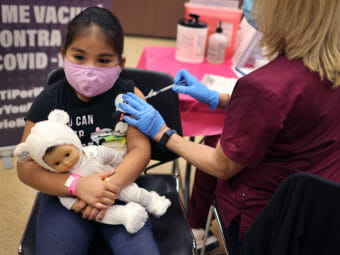
First grade student, seven-year-old Rihanna Chihuaque, receives a covid-19 vaccine at Arturo Velasquez Institute on November 12, 2021 in Chicago, Illinois. (Photo by Scott Olson/Getty Images)
The Food and Drug Administration Tuesday authorized the first COVID-19 vaccine booster for children ages 5 to 11.
The authorization makes all children in that age group who received their second shot at least five months ago eligible to receive a third shot of the Pfizer-BioNTech vaccine.

The companies requested the authorization based on a small study that the companies and FDA said demonstrated a third shot is safe and can significantly boost antibody levels, countering waning immunity and providing added protection against the virus, including the more contagious omicron variant.
Until now, only children ages 12 and older and adults were eligible for a booster.
“While it has largely been the case that COVID-19 tends to be less severe in children than adults, the omicron wave has seen more kids getting sick with the disease and being hospitalized, and children may also experience longer term effects, even following initially mild disease,” said FDA Commissioner Robert M. Califf in a statement.
“The FDA is authorizing the use of a single booster dose of the Pfizer-BioNTech COVID-19 Vaccine for children 5 through 11 years of age to provide continued protection against COVID-19,” Califf said. “Vaccination continues to be the most effective way to prevent COVID-19 and its severe consequences, and it is safe.”
Many doctors and parents have been hoping for the authorization, saying it’s important to provide children with as much protection as possible, especially as the number of people catching the virus is rising again and so few people are now wearing masks.
“Since authorizing the vaccine for children down to 5 years of age in October 2021, emerging data suggest that vaccine effectiveness against COVID-19 wanes after the second dose of the vaccine in all authorized populations,” said Peter Marks, director of the FDA’s Center for Biologics Evaluation and Research, in a statement.
“The FDA has determined that the known and potential benefits of a single booster dose of the Pfizer-BioNTech COVID-19 vaccine for children 5 through 11 years of age at least five months after completing a primary series outweigh its known and potential risks and that a booster dose can help provide continued protection against COVID-19 in this and older age groups,” Marks said.
But others are skeptical, saying two shots are still providing strong protection against serious disease and death, and the it remains unclear how much added protection a third shot will provide or how long it will last.
The FDA didn’t ask its outside advisers for input on the decision because the agency said the committee had previously discussed the issues and no new questions were raised.
The Centers for Disease Control and Prevention’s advisers on vaccine practices will meet Thursday and are expected to discuss implementation of a booster dose for this age group.
Copyright 2022 NPR. To see more, visit https://www.npr.org.
The first passengers of the 2022 cruise ship season walk off the Norwegian Bliss and into Juneau on April 25, 2022. (Photo by Paige Sparks/KTOO)
One passenger on a recent Carnival cruise bound for Seattle claimed there were about 200 people sick with COVID-19 on board, and that the crew were overwhelmed. Carnival downplayed the situation with Seattle press, but wouldn’t disclose the case count.
That ship, the Carnival Spirit, is now cruising between Seattle and Southeast Alaska for the summer. If its crew are following protocol, the Centers for Disease Control and Prevention, the U.S. Coast Guard and the Alaska Department of Health and Social Services should all have good data about the COVID situation on board on any given day. But very little of that information is available to the public for the Spirit, or any of the ships operating in Alaska this summer.
This year, the cruise lines operating all of the big ships in Alaska committed to regularly report illness data by opting into the CDC’s COVID-19 Program for Cruise Ships. They’ve agreed to fill out and send a form every day for every ship so the CDC can track COVID-19 cases on board.
Individuals’ health information is protected. That hasn’t stopped state health authorities from publishing individual communities’ overall case counts, hospitalization figures, hospital capacity, deaths or other stats helpful for gauging COVID-19 risk. But the CDC isn’t doing that for cruise ships.
The CDC does publish and update daily a color-coded cruise ship status on its website for each ship. Green means they have no cases of COVID-19 or COVID-like illnesses.
The Carnival Spirit has been in the orange category. That could mean as few as seven passengers are sick — or it could be hundreds. The majority of the ships sailing right now are in that category.
“To be expected, I would say. COVID is kind of prevalent everywhere right now,” said Juneau Deputy City Manager Robert Barr. Nowadays, hospitalization rates are a key metric he’s keeping an eye on. “And thankfully, we’re not seeing hospital impact significantly, locally or more broadly.”
The CDC’s most severe category for cruise ships is red, which indicates the medical capacity onboard is overwhelmed. Some of the Spirit’s recent passengers described a poorly managed COVID-19 outbreak that did overwhelm the crew. However, Carnival told Seattle press that there were no serious health issues and that it maintained its health and safety protocols.
The CDC has not made anyone available for an interview about its cruise ship program.
Like last year, the cruise lines have made a lot of commitments to Alaska port communities to reduce the spread of COVID-19 and to manage cases themselves. Cruise passengers and crew aren’t supposed to burden local health care systems. Barr said the agreements this year say that medical facilities in the bigger ports like Juneau, Ketchikan and Whittier could help out if the need arises.
“But occasionally, occasionally we can assist,” Barr said. “In the event that we can’t, then each line is required in the agreement to transport impacted passengers and/or crew to Seattle.”
The CDC’s description of its cruise ship program also says the Coast Guard is supposed to get the most timely information about illness before ships arrive in a port. The Coast Guard has not made anyone available for an interview about this.
That leaves the Alaska Department of Health and Social Services. It’s been regularly publishing COVID-19 data statewide on online dashboards of its own since the pandemic began. The data can be narrowed to specific Alaska regions and communities. But it’s not helpful for teasing out cruise ships.
Department spokesperson Clinton Bennett said lots of factors affect how cases identified aboard a cruise ship operating in Alaska get published. And there is potential for cruise ship cases to cause spikes in different communities’ COVID-19 data that don’t reflect higher risk.
For example, a cruise ship passenger could spend a day in one community, get back on board, test positive at sea, then end up in the case counts for the next port of call — even though they would stay quarantined aboard the ship.
Bennett said cases caught in Alaska waters could also be geographically tagged as “at sea,” which isn’t searchable.
“Our overall takeaway,” Bennett wrote in an email, “is that the dashboard case counts announced in relation to the cruise industry shouldn’t be relied upon alone in understanding impact to local communities or the total size of an outbreak on a vessel.”
When Sue Schrader heard that, she was dismayed. She’s a longtime Juneau resident who’s been concerned about cruise ship labor practices, the industry’s impact on Juneau and the environment.
“For those of us living in the community who maybe want to avoid going into busy shops downtown when we’ve got a four or five cruise ship day because of potential exposure, you know, we don’t have the information necessary to make those decisions,” she said.
Schrader said the anecdotes she’s read suggest passengers and crew are in the dark about COVID-19 outbreaks too.
The industry group Cruise Lines International Association Alaska said its member lines are voluntarily complying with the CDC’s program and protocols.
“Much like last year, we anticipate a successful season where we do not burden shoreside facilities and ports we visit,” said Renée Limoge Reeve, vice president of government and community relations for the CLIA, in an email.
Schrader is skeptical.
“This lack of transparency — you know, I’m sorry, but for CDC to expect the cruise ships to honestly report? … These are the same ships in many cases that have polluted our waters and falsified their pollution records,” she said.
“And we’re supposed to now believe them that they’re going to report how many potential crew and passengers have COVID?” she said.
For the state’s top health officials, the answer appears to be yes. Health Commissioner Adam Crum and Chief Medical Officer Dr. Anne Zink recently described the cruise lines as good stewards in protecting public health on board and in the communities they visit. They say the industry has demonstrated its desire to be transparent, good partners.
Pews were marked off to encourage social distancing at a funeral home in Temple, Penn., in March of 2021, around the time the Delta variant began to take hold in the United States. (Photo by Ben Hasty/MediaNews Group via Getty Images)
On a humid August afternoon in 2020, two caskets — one silver, one white — sat by holes in the ground at a small, graveside service in the town of Travelers Rest, S.C.
The family had just lost a mom and dad, both to COVID.
“They died five days apart,” says Allison Leaver, who now lives in Maryland with her husband and kids.
When Leaver’s parents died that summer, it was a crushing tragedy. And there was no life insurance or burial policy to help with the expense.
“We just figured we were just going to have to put that on our credit cards and pay it off, and that’s how we were going to deal with that,” the public school teacher says with a laugh of resignation.
But then, in April of 2021, FEMA offered to reimburse funeral expenses — up to $9,000, which is roughly the average cost of a funeral. And it was retroactive.
Leaver applied immediately.
“If this horrible thing had to happen, at least we weren’t going to be out the cash for it,” she says.
A year into the program, the federal government has paid more than $2 billion to cover funeral costs for COVID victims. More than 300,000 families have received reimbursement, averaging $6,500. But fewer than half of families have started applications.
Many surviving family members have run into challenges or still don’t know the money is available.
For those who know
FEMA launched a big call center, hiring 4,000 contractors in Denver. Survivors must call to initiate the process, as applications are not accepted online. FEMA received a million calls on the first day, leaving many waiting on hold.
Once Leaver talked to a representative, she started assembling the death certificates and receipts from the funeral home and cemetery. She uploaded them online — and heard nothing for months.
Eventually, she called and learned the receipts she submitted had different signatures — one from her husband, another from her sister. That was a problem. Even though it was a joint funeral, in order to get the full amount per parent, the government required separate receipts. Leaver says she was frustrated, but determined to get it done “come hell or high water.” Plus, she says, it was summer break, and she had time.
But many haven’t applied or don’t have time.
Clerical challenges have discouraged some participation, especially for those whose loved ones died early in the pandemic, says Jaclyn Rothenberg, FEMA’s chief spokesperson.
“Some people with death certificates didn’t necessarily have COVID listed as the cause of death,” she says. “We do have a responsibility to our taxpayer stewards to make sure that that is, in fact, the cause.”
Rothenberg says FEMA is trying to work with everyone. Even though the agency has spent the $2 billion initially budgeted, she says there’s a new pot of stimulus funding from the American Rescue Plan Act.
For those who don’t know
NPR analyzed FEMA’s data compared to official COVID fatalities through March 15, 2022. Washington, D.C., led the nation with applications for 77% of deaths. States clustered in the South had the highest participation rate in the program, with North Carolina approaching applications for two-thirds of deaths. Other states remain well below a 50% participation rate. In Oregon and Washington, less than one in three deaths resulted in an application.
It’s generally not a question of eligibility. There are no income limits, and life insurance does not preclude participation. And there is still no deadline. One of the few disqualifiers (detailed here) is if a funeral was pre-paid.
“We need people to continue helping us get the word out,” Rothenberg says. “We know we have more work to do.”
FEMA is launching an outreach campaign to promote the program since there’s plenty of money left. The agency is focusing on the populous states of California, New York, Pennsylvania and Texas, and efforts are targeting vulnerable populations.
The government is also leaning on community groups connected to those who most need to know about the money.
“We were able to connect people to some of the survivors that had been through that process already just to help them walk through it,” he says.
Many just need someone to complete the application for them.
Stephanie Smith of Carlisle, Kentucky, lost her father to COVID. Her mother, who was 83 at the time, had no chance.
“She’s a very smart, spunky lady, but she’s never used a computer,” Smith says.
At a minimum, applying requires scanning or faxing.
“She probably would not have attempted to do it because the whole process would have been overwhelming for her,” she says.
But Smith was able to jump through the hoops without much trouble. And $9,000, she says, is enough to make life considerably easier as her mom adjusts to being a COVID widow.
This story comes from NPR’s health reporting partnership with Nashville Public Radio and Kaiser Health News (KHN).
Copyright 2022 WPLN News. To see more, visit WPLN News.
Close
Update notification options
Subscribe to notifications
Subscribe
Get notifications about news related to the topics you care about. You can unsubscribe anytime.