Health

How major cuts to Medicaid could be ‘catastrophic,’ even for Alaskans with private insurance

Alaskans protest potential federal and state funding cuts March 4, 2025 in Anchorage. (Matt Faubion/Alaska Public Media)

Congress is contemplating huge cuts to Medicaid, the government-funded health insurance program that covers nearly 40% of Alaskans. If federal funding is substantially reduced, many Alaskans could lose their insurance and the strain would be felt throughout the health care system, potentially reducing services and raising costs for Alaskans with other types of insurance, too.

What is Medicaid?

It’s an insurance program for low-income Americans and those with disabilities. The costs are split between the federal government and the state, 50-50 for the regular medicaid program. A few programs, like for pregnant women, have a higher federal match.

As part of the Affordable Care Act, Congress expanded Medicaid to serve people whose income is slightly higher. Alaska adopted the program in 2015. Medicaid expansion now covers 76,000 Alaskans. It has the highest federal match of all Medicaid programs in the state at 90%.

The Childrens’ Health Insurance Program, CHIP, is Medicaid for kids, and in Alaska it’s called Denali KidCare.

How many Alaskans have health insurance through Medicaid?

About 38% of Alaskans, 279,000 people, were on Medicaid in 2024, according to the state’s Department of Health. That includes 57% of Alaska children, 35% of Alaska adults and 15% of Alaska seniors.

Alaska is heavily dependent on the program. Last year, only New Mexico had a greater percentage of its population on Medicaid, and Alaska was a close second.

More than 1 in 3 births in Alaska were covered by Medicaid in 2024, according to the state vital statistics report. That’s partly because of increased eligibility for pregnant and postpartum women.

Most beneficiaries (64%) live in Anchorage, the Mat-Su Borough and in the Interior combined. 36% live outside of those most-populated areas.

How much money does Medicaid in Alaska cost the federal government? 

Medicaid spending is a substantial pillar of Alaska’s health care funding. Total spending was $2.7 billion for health care services in Alaska last year, and the state paid just 24% of that, or $634 million. Medicaid costs in the state are also projected to increase over the next two decades.

Jared Kosin, president and CEO of the Alaska Hospital & Healthcare Association, said if Congress makes substantial cuts to Medicaid, the impact on people who use Medicaid in Alaska, as well as the hospitals and providers that serve them, would be enormous.

“It would be catastrophic, not only for the health care system, [but] for Alaskans across our entire state,” Kosin said recently on KFSK in Petersburg.

Almost every corner of the health care system in the state relies heavily on Medicaid. That includes hospitals, clinics and private practice offices, and the Tribal health care system.

If Medicaid is cut, what happens to the Alaska beneficiaries?

Depending on how the cuts are rolled out, the state could disenroll categories of people, leaving them without coverage. Or the state could make up the funding difference, but that would be an enormous hit to the state budget, which is already strained. There is no simple way to cut the state’s Medicaid budget without increasing health care costs for the state down the line.

One way to cut the funding that’s been floated is that the expansion program could change from a 90% federal match to a 50% match, the same as regular Medicaid.

Kosin said just that one cut would cost the state millions.

“So if the Feds say, ‘Hey, we’re going to roll this back, and we’re going to only cover half of Medicaid expansion. You cover the rest,’ that means we’d have to come up with $330 million,” Kosin said.

The latest numbers show the expansion program covers 76,000 Alaskans, over a quarter of the Medicaid population in the state. The expansion population includes a wider swath of Alaskans, including single people and those with incomes slightly above cutoffs for regular Medicaid. Since Alaska introduced the program in 2015, the state has seen unpaid hospital bills decline by almost half.

With major federal cuts, the expansion population could lose coverage entirely. But Kosin said leaving more Alaskans uninsured would be more costly long term. Kosin said all Alaskans would feel the result of those uninsured residents. Wealthier Alaskans may still have a choice of care, but for the uninsured who can’t afford to pay out-of-pocket, their only choice will be ER care.

“Hospital emergency rooms will always serve you,” Kosin said. “We’re required by law to do so.”

He said the ER is the most expensive place to receive medical care. Average emergency room bills run in the thousands of dollars, compared to hundreds of dollars for most urgent care or doctors’ visits. And if people can’t afford to pay those bills, they just won’t, driving up the cost of care for all Alaskans, even those with private insurance.

What else might be cut?

The state could cut so-called “optional” Medicaid services, like dental care, vision care or in-home care.

Monique Martin, vice president of intergovernmental affairs for the Alaska Native Tribal Health Consortium, said the services aren’t really optional and cutting them won’t save the state money in the long run.

“Most ‘optional services’ are offered in lieu of a much more expensive mandatory service,” she said.

In-home care, for instance, allows more rural Alaskans to stay in their home towns or villages, instead of having to move to urban areas for live-in care.

Lawmakers have also talked about adding work requirements to Medicaid, which would be a default way to force some people out of the program. But if people aren’t well enough to work and they can’t get health care to get well, it could keep them out of the workforce indefinitely, or, again, keep them from getting care until it’s an emergency.

“If we want people to be productive, we should provide health coverage,” said Valerie Davidson, a former state health commissioner who championed Medicaid expansion under former Gov. Bill Walker. “Because if people can’t work, they can’t hunt, they can’t fish, and they can’t learn if they’re not healthy enough to do so. Being healthy is a prerequisite to being able to be productive.”

The Trump administration has also discussed incentivizing states to switch to using “block grants” as a way to cap Medicaid spending by state. Davidson said that won’t work well for Alaska because the state doesn’t have a robust and well-established health care infrastructure. And she said rationing care through block grants would cause all the same issues as the other possible cuts, making health care more expensive for all Alaskans in the long term.

Why is Congress considering cutting the program, and what exactly would lawmakers cut?

The U.S. House passed a budget blueprint that calls for cutting a lot of money — $880 billion — from a section of the budget that includes Medicaid. Budget experts say there’s no way to slice that much out of spending without cutting into Medicaid. But we don’t know exactly where the cuts will come from.

It’s worth noting that President Trump and other Republicans have said they won’t cut Medicaid, but that seems to conflict with the House-passed budget resolution.

Is it true that Republicans in Congress are trying to cut Medicaid so that wealthier people can get a tax break?

That’s one way to frame it. The Republicans are trying to enact many of President Trump’s priorities. Among them is the continuation of the 2017 tax cuts, which are about to expire. Extending them increases the deficit by $4.5 trillion. Republicans are looking to make cuts elsewhere to partially offset the cost. The House budget, as written, would still increase the deficit by about $2.5 trillion.

How might major Medicaid cuts impact the whole health care system in Alaska?

The entire health care system in Alaska is dependent on Medicaid funding. For Providence Alaska, it’s 25% of the revenue. At Anchorage Neighborhood Health Clinic, it’s 34%, and the Alaska Native Tribal Health Consortium gets about 40% of its income from Medicaid.

Medicaid is hugely important for the tribal health care system, too.

The Indian Health Service provides less than 15% of ANTHC’s funding, Monique Martin said. Medicaid and Medicare together provide about 70% of payments.

So, in the long term, while experts say big Medicaid cuts likely wouldn’t shut down Tribal health care, it would be a huge financial blow.

And if hospitals with emergency rooms have to treat a lot more uninsured patients, they also may not be able to survive.

What are the larger economic ramifications of major Medicaid cuts?

Medicaid covers travel expenses for in-state, and occasionally out-of-state care. Losing that would ripple through the economy.

“It impacts airlines. It impacts transportation. It impacts every aspect of hospitality, hotels, restaurants, etc.

Small businesses and seasonal businesses that don’t offer health insurance might also find it harder to hire. Some of their employees can only afford to work there because of the Medicaid expansion. If Congress does away with the expansion, those employees might have to choose jobs at larger companies with health care benefits.

So, how could Alaska cut Medicaid spending in an economically-healthy way? 

The state has been working to reduce Medicaid spending overall, and it’s made some progress, keeping spending below estimates. Monique Martin said it’s important to lean on the state’s research to identify ways to safely reduce spending. She says cutting spending in a sustainable way takes time.

Juneau turns out to support queer and trans people in the wake of Trump policies

Daaljíni Mary Cruise, who helped organize the Unity for the Queer Community event, addresses those gathered on March 9, 2025. (Photo by Yvonne Krumrey/KTOO).

Members of Juneau’s LGBTQ+ community and the people who support them gathered in droves over the weekend to protest the Trump administration’s policies and language surrounding queer and trans people.

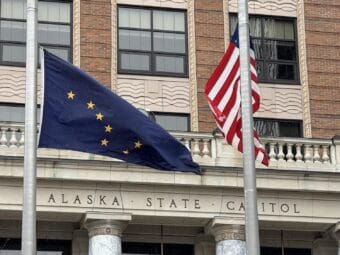
Over 200 people gathered at the Alaska State Capitol steps on Sunday to show their support for Juneau’s LGBTQ+ community with pride flags draped over shoulders and signs that said things like “Gender affirming health care is life-saving.” 

Organizer Daaljíni Mary Cruise said the event was planned to show Juneau’s young people that their voices matter, that they matter. 

“That’s the way we all need to be with our children,” she said. “We need to teach them it is okay to speak up against injustice.” 

Cruise said living as an out queer person, teaching Lingít and raising her kids to be accepting has felt like her way to support her community. But recently that’s changed. 

“That’s not enough anymore,” she said. “And it’s at this point where I feel like we have to stand up and we have to fight. We are going to have to fight hard, just like our ancestors who came before us.”  

She’s talking about policies and rhetoric pushed by President Donald Trump that endanger LGBTQ+ people across the country. Within 10 days of his return to the White House, Trump banned gender-affirming health care for youth, against recommendations by the American Academy of Pediatrics.

The administration’s moves have left queer and trans people in fear. 

But as the demonstrators prepared to march through downtown to Elizabeth Peratrovich Hall, Cruise said she wanted this event to be fun, too – to shine a light on the community.

“I just want to bring joy to some of the darkest days of our lives right now,” she said. 

Sa.áax’w Margaret Katzeek, who works in mental health support, says coming together in times like this is necessary. 

“We heal in community. This is where the healing comes from – showing up for each other,” Katzeek said.

Wendi Siebold, her partner Ray Romberg, and their child marching at a demonstration to support Juneau’s queer and trans community on March 9, 2025. (Photo by Yvonne Krumrey/KTOO)

Wendi Siebold marched with her partner and daughter. She said they especially wanted to show up for Juneau’s transgender community, which she says is being “directly targeted” by Trump’s policies.

“I feel like Juneau as a whole understands the importance for protections for everyone,” she said.

The march through downtown was followed by drag performances. At Elizabeth Peratrovich Hall, booths full of resources and pride flags awaited the demonstrators.

Kids like Silje Haven Marr waited in line to have their faces painted with glitter. 

“We’re all people and like, if we’re different, like, it’s not a big thing to be different,” Haven Marr said. “And this is an event to show people that it’s normal to be you, and it’s normal to be gay and stuff.” 

The Has Du Eetíx’ X’aakeidíx̱ Haa Sitee dance group performs for the Unity for the Queer Community event at Elizabeth Peratovich Hall in Juneau on March 9, 2025. (Photo by Yvonne Krumrey/KTOO).

Elizabeth Giudice, with the Southeast Alaska LGBTQ+ Alliance or SEAGLA, was standing on the other side of the line of booths. They said that anti-trans and anti-queer policy proposals aren’t new, but the political climate feels different now.

“Now that things are sort of in the forefront, people are afraid, because it seems like things are actually actionable,” Giudice said. 

But they said events like this one show that Juneau’s queer community won’t go into hiding. 

“When we get together, we see just how far we’ve come, just how close we can all be, and how out and how proud we can all be, and know that we don’t have to be as afraid as we have been,” they said. “And that’s progress.” 

A mostly youth dance group called Has Du Eetíx’ X’aakeidíx̱ Haa Sitee took the stage to perform songs, including one that Cruise wrote for this event. 

Lingít drag performer Lituya Hart Monroe joined dancers in an ermine pelt headdress, holding a pride flag.

The song is called “Ḵusax̱án Ḵusax̱ánx̱ Sitee” – love is love. 

“Through love, we will succeed,” the group sang in Lingít. “We have existed forever.” 

Lituya Hart Monroe dances to “Ḵusax̱án Ḵusax̱ánx̱ Sitee,” or Love is Love, written by Daaljíni Mary Cruise for the Unity for Queer Community event the on March 9, 2025. (Photo by Yvonne Krumrey/KTOO)

Expert predicts 4.7% average annual increase in Alaska Medicaid costs over the next 20 years

Application for Medicaid for Alaska Residents. (Rachel Cassandra/Alaska Public Media)

Alaska did a good job of keeping its Medicaid costs in check in past years, but the state faces pressures that will increase costs in the next 20 years, an expert told state lawmakers on Monday.

Alaska’s Medicaid costs are expected to increase by about 4.7% a year through 2045, Ted Helvoight, president of Oregon-based Evergreen Economics, told the House Finance Committee.

Total Medicaid costs in Alaska are expected to be about $3 billion this year, with the federal government picking up about three-quarters of that, he said in his presentation. By 2045, the total cost is expected to be about $7.4 billion, despite some past state successes at keeping those costs in check.

“It’s still going to be growing quite a bit over the next 20 years,” Helvoigt told the committee.

Helvoigt was presenting findings from an annual forecast he and his company have prepared for the Legislature since 2006. The forecasts make 20-year projections; last year’s forecast projected an average annual increase of 4.4% over the 20-year period.

This year’s forecast does not take into account any of the drastic cuts being contemplated in Congress to pay for Trump administration priorities. Those proposed cuts have alarmed state lawmakers.

Helvoigt said national budget cuts are creating uncertainty for all states’ Medicaid programs, and it is unclear what the ultimate effects will be.

In response to a question from Rep. Andy Josephson, D-Anchorage and co-chair of the committee, Helvoight was able to make one quick calculation for costs to Alaska if federal Medicaid contributions were to be cut.

For the segment of the population that joined Medicaid when the program was expanded under the Affordable Care Act, the state’s costs would increase by $4.6 million for every percentage point reduction in federal contribution, he said. The federal government currently covers 90% of the costs for the expansion population and 52% for other Medicaid recipients.

But federal cuts of the scope being contemplated would likely affect a far wider segment of Medicaid recipients than just those who joined during expansion of the program, he said, as well as placing much heavier fiscal burdens on the state.

As for total Medicaid costs, the biggest driver for future increases no matter how the cost burden is shared between the federal and state governments, will be increases in reimbursement payments to providers who care for covered patients, Helvoigt said.

Those reimbursement rates have lagged the very sharp increase in costs of medical services, he said.

From 2017 to 2024, medical costs increased by 44%, but reimbursement rates to providers increased by only 27%, Helvoigt said. And those increases for providers came after a decade-long stretch of flat reimbursement rates, he said.

The reimbursement rate increases, which started in Alaska in fiscal 2021, “quite honestly, had to happen,” he said.

He said he expects increases in reimbursement rates to continue to lag increases in medical price inflation, but only slightly so. Having reimbursement rates at least close to actual costs will be important, he said.

Average annual Medicaid spending per recipient in 2024, as calculated by Evergreen Economics. Recipients with no chronic conditions had average annual per-patiend costs of $4,581, while those with eight or more conditions had average annual per-patient costs of $84,281.The Oregon-based company makes reports each year to the Alaska State Legislature on costs, enrollment and projections into the future. (Graph from March 3, 2025, presentation by Evergreen Economics President Ted Helvoight to House Finance Committee)
Average annual Medicaid spending per recipient in 2024, as calculated by Evergreen Economics. Recipients with no chronic conditions had average annual per-patient costs of $4,581, while those with eight or more conditions had average annual per-patient costs of $84,281.The Oregon-based company makes reports each year to the Alaska State Legislature on costs, enrollment and projections into the future. (Graph from March 3, 2025, presentation by Evergreen Economics President Ted Helvoigt to House Finance Committee)

“I don’t see providers being able to operate without those increasing rates over time,” he said.

Josephson, in comments during the hearing, also said that the statistics suggested that increased reimbursement rates have been necessary.

“Providers in the last seven years have been disincentivized, to some degree, to have this population of patients. But in the three years of 2021 to 2023, they were perhaps incentivized,” he said, naming the years when reimbursement rates in Alaska began to increase.

Helvoigt said another important driver of future Medicaid cost increases is Alaska’s changing demographic mix.

State projections are for a future decrease in overall population, with far fewer children and far more elderly residents, he said.

While children under 15 make up the largest group of Medicaid recipients, they are the least likely to have the type of chronic health problems that drive up costs.

But the proportion of patients with chronic conditions like mental health problems, drug or alcohol abuse, cardiovascular disease or tobacco use, are higher in each subsequent age group, he noted.

“Age itself doesn’t mean your spending is going to be high,” he said. “But your likelihood or your probability of getting a chronic condition and then getting a second chronic condition and then a third and fourth is increasing with age. So, the longer time you spend on this earth, chances are you’re going to get one or more chronic conditions.”

According to Evergreen Economics’ calculations, the presence of two or more chronic conditions makes a big difference in Medicaid costs.

The least healthy 1% of recipients accounted in 2024 for 22% of Medicaid spending, he said. The 10% of recipients with the highest costs accounted for two-thirds of the spending, he said. Meanwhile, the 50% of recipients with the lowest costs accounted for only 4% of spending, he said.

“So that’s a big deal,” he said. “Simply reducing the number of individuals on Medicaid is not going to really drive down costs. There’s a relatively small number of individuals who are driving the spending in Medicaid.”

Alaska legislators predict dire effects if Congress cuts Medicaid funding

Rep. Genevieve Mina, D-Anchorage, speaks in favor of a budget amendment on Thursday, April 6, 2023, in the Alaska House of Representatives. (Photo by James Brooks/Alaska Beacon)

A budget resolution passed late Tuesday by the U.S. House of Representatives is sparking concern in Alaska, worrying state legislators who say it will lead to steep state budget deficits and tens of thousands of Alaskans without health care.

“That vote is insane,” said Rep. Zack Fields, D-Anchorage.

The House’s resolution is the first step toward a budget plan that calls for $4.5 trillion in tax cuts and $2 trillion less in federal spending over a decade. Alaska Congressman Nick Begich III joined fellow Republicans in support of the resolution, which passed 217-215.

Within the resolution is a directive that the House Committee on Energy and Commerce cut $880 billion over 10 years from the section of the federal budget it oversees.

That section includes Medicare, Medicaid, and some smaller programs. But as a New York Times analysis showed, even if the committee were to cut everything that isn’t health care in its section, it would still be more than $600 billion short of its goal.

“The only place those cuts can come is from Medicaid,” said Senate Majority Leader Cathy Giessel, R-Anchorage.

Medicaid, a joint federal-state program, is the primary form of health coverage for lower-income Americans and the largest payment source for long-term nursing care

The resolution is only the first step in the budget process — the Senate will need to agree with the resolution, then Congress will have to draft and pass legislation to implement it — but the sheer size of the cuts make it all but certain that Medicaid and Medicare will be affected if the resolution advances in its present form.

That’s a big deal for Alaska, where one-third of all residents receive health care through Medicaid. Medicaid payments fund hospitals, clinics and pharmacies, and 12% of all jobs in the state are related to health care.

“Seven in nine Alaskan seniors in our nursing homes are on Medicaid. Medicaid helps seniors and disabilities live independently, and it also strengthens our tribal health system and ensures that there’s health care access in rural Alaska,” said Rep. Genevieve Mina, D-Anchorage and chair of the House Health and Social Services Committee.

Alaska is spending $2.8 billion per year on Medicaid, according to the budget enacted last spring by the Legislature and Gov. Mike Dunleavy. About $2.1 billion of that total is paid for by the federal government, and the state contributes about $730 million.

Speaking on the Senate floor, Giessel — a licensed nurse — advised her colleagues to pay attention.

“We need to be aware of this as we consider our budgets,” she said.

Mina, speaking on the House floor, said, “these current cuts risk creating an at least $115 million hole in our state budget.”

Rep. Andy Josephson, D-Anchorage, suggested that the state could lose $1.15 billion in federal funding, “and that as many as 60,000 Alaskans — and I suspect more — would fall off the rolls.”

“So I have a request — and that is to our senators, because our congressman has already begun the process of adopting this policy — and my request to our U.S. senators is, don’t forget Alaska. Don’t forget Alaska,” Josephson said.

Earlier this month, Begich spoke to the Legislature in support of work requirements for federal aid. This week, Mina said that if the congressional budget proposal includes those requirements, the state should be prepared to spend more in order to implement those requirements.

She predicted dire consequences if Congress goes forward with the planned cuts.

“We are going to be hearing a lot from seniors and from people with disabilities and from a lot of working people who rely on Medicaid. And it is not an exaggeration to say that these cuts would cut a lot of people and push them into medical bankruptcy,” Mina said. “It will worsen our health care options drastically. It will really destroy our own state budget, and it will cause a collapse in our health care system.”

Juneau hospital staff report lack of confidence in leadership, higher rates of burnout

Bartlett Regional Hospital Human Resources Director Chad Brown presents to the board of directors on Wednesday, Feb. 19, 2025. (Photo by Clarise Larson/KTOO)

A survey of Juneau’s Bartlett Regional Hospital staff last year shows they lack confidence in management and leadership and are experiencing higher rates of burnout and turnover.

The city-owned hospital’s board of directors reviewed the survey’s results at a meeting on Wednesday. Chad Brown, Bartlett’s director of human resources, explained the results to the board. 

“It’s similar to our financial situation. We’ve made some strides, but we still have a long way to go,” he said. 

According to the survey taken last fall of about 330 employees, less than half of the staff said they had confidence in the senior management and leadership at the hospital. That’s drastically lower than what the average health care employee reported nationwide, but it’s actually higher than the level of confidence Bartlett employees reported in 2023.

The hospital has seen significant turnover in leadership in the past few years.

The annual feedback follows a tumultuous financial year at the hospital. Hospital leaders faced a multimillion-dollar budget deficit that threatened to close the hospital’s doors. 

The hospital’s board was able to correct its course by cutting back on staff and closing programs. But the survey shows those decisions didn’t come without significant effects on its employee’s mental health and well-being. 

Staff reported issues like the hospital’s ongoing staffing shortage, lack of training and not making enough money as increasing feelings of stress and burnout. And that’s leading to turnover. Right now, about 10% of its staff are contract employees, which cost more. Management says that’s unsustainable. 

Public perception and increased competition also seem to be taking a toll on employees. 

Bartlett’s largest competitor in the health care industry is SouthEast Alaska Regional Health Consortium. The Alaska Native-run health consortium has rapidly absorbed many small practices in recent years as it expands its reach in the region.

In the past two years, it acquired Juneau Youth Services, Juneau Obstetrics and Gynecology, Southeast Medical Clinic and more.

Brown told board members staff loyalty is increasing, but a significant number of employees would consider going somewhere else. 

“There’s 12% of our staff that would consider leaving if they were offered a position,” he said. “That’s a lot of people, and there’s another 20% that are on the fence. That’s 40%.”

Overall the responses were more positive than the year before. Most workers say they trust the people they directly work with and that they provide high-quality care and services. Nearly all staff said they feel their work is meaningful and makes a real difference.

A cannery in Southeast Alaska is at the forefront of America’s tinned fish renaissance

Owner Mathew Scaletta stands in front of Wildfish Cannery in the village of Klawock on Prince of Wales Island. (Bethany Sonsini Goodrich)

Wildfish Cannery was founded in Klawock, Alaska in the late 1980s by a school teacher named Phyllis Mueller. Her grandson Mathew Scaletta is at the helm these days.

Scaletta is passionate about food. He spent summers cutting fish at the cannery as a kid and then cut his teeth in the culinary world in Chicago and Portland. While working everywhere from bars to fine dining restaurants, he noticed something.

“Places were importing Spanish and Portuguese canned fish. It was kind of quietly becoming a thing,” Scaletta said. At the time, he said, canned salmon stateside was cheap – probably better for stocking a fallout shelter than a charcuterie board.

Then, Scaletta said he saw something that changed everything: an episode of Anthony Bourdain’s show “No Reservations.”

In the episode, Bourdain visits Espinaler Taverna, a tavern in the Spanish seaside town of Vilassar de Mar. The bartop is lined with dozens of bowls of oily little fish, smoked oysters, and cured seafoods.

Bourdain samples a can of razor clams that his guide tells him costs more than $150 USD.

‘Rest assured this stuff bears no resemblance to the can of smoked oysters you ate stoned and desperate back in college,’ Bourdain narrates over the din of the packed tapas bar. ‘This is the world’s best seafood and here’s what’s so mind blowing: it only gets better in the can.’

“It kind of blew my mind to see that, right? And it stuck with me,” said Scaletta.

In 2015, Scaletta’s grandmother Phyllis was diagnosed with cancer. He came home to Alaska and took over the cannery.

Scaletta said he saw a hole in the market.

“So I set out to be the first U.S.-based highend craft cannery. And we’re still there,” he said. “I’m still working on that.”

Wildfish’s garlic sumac rockfish or smoked coho go for about $10-$14 a can. The most expensive offering is a $40 can of fried king salmon cheeks. Since Scaletta started smoking salmon for the slightly spendier masses, tinned fish is officially on the map in the U.S. But he doesn’t take credit for that.

“There were other companies who came in after us, who, frankly, just had a lot more money,” he laughed.

According to Scaletta, the business – and tinned fish in general – really took off in the United States in 2020. The Wall Street Journal reported that in 2022, U.S. sales of canned seafood rose by nearly $3 billion and are still growing annually. Scaletta said he hopes to soon expand to a second cannery in Klawock. He said it’s hard to keep his more popular products in stock, nowadays, maybe partly due to some significant national attention on his company.

Marguerite Preston edits the kitchen section of Wirecutter, a product review outlet from the New York Times. As the editor, Preston doesn’t normally do the actual reviewing, but she said she really wanted to write a guide to tinned fish.

“Obviously, tinned fish has been around in all kinds of forms for centuries. In many cultures, it’s never gone out of style. But in America, it’s becoming trendy,” she said, adding that she’d been seeing sleek new brands of canned seafood everywhere. “I would say in the past maybe three years, maybe a little bit longer, we’ve just seen this growing interest, these trendy new brands, this beautiful packaging.”

Preston and her team collected over 100 different tins, jars, and cans of fish from Europe, Asia and the U.S. and laid them all out on the counter of their office in Brooklyn. They grouped the fish into categories and split up the tasting over three days.

“And then we just kind of went at it and felt really pretty ill at the end of each day to be honest,” she laughed.

Preston published her findings on Wirecutter’s website in December. The guide is like an Olympics for tinned fish, with each category crowning a world champion. Preston said when it came to sampling salmon, the unanimous favorite was Wildfish Cannery.

“I think the thing that stood out the most was the texture, it just had the most buttery, meaty, succulent texture. And then the flavor was really good too – the level of smoke. You can tell just by looking at them. They have this beautiful, kind of burnished look on top,” Preston said of Wildfish’s smoked king and sockeye salmon.

Scaletta said it was thrilling to see his small cannery getting national press. The art of canned fish isn’t a “new trend” to an Alaskan though. The state’s culture of home canning was a major inspiration for Wildfish.

“One of the most precious things an Alaskan has in your pantry is your home-pack – like your smoked and jarred salmon, right?” Scaletta said. “This is about taking what we already had, which was this culture of home-pack, and the idea of a jar of smoked salmon being elevated, and kind of bringing that to the masses.”

As tinned fish solidifies itself as a high class snack, Wildfish is going to continue to do what Alaska canneries have always done according to Scaletta – buying high-quality fish from local fishermen and canning it for the masses.

Site notifications
Update notification options
Subscribe to notifications