Health

Alaska corrections officials testify on in-custody deaths, mitigation efforts

Dr Robert Lawrence, Alaska chief medical officer (left), Travis Welch, director of corrections health and rehabilitation services (center), and Dr Tim Ballard, DOC chief medical officer (right) present before the House State Affairs Committee on March 4, 2025. (Gavel Alaska)

The Alaska Department of Corrections has had at least 67 people die in-custody of state prisons and jails since 2020, with at least 17 deaths reported as suicides, according to the department.

There were at least 14 deaths last year. Two deaths were reported so far this year, with one investigated by the Alaska State Troopers and reported as a suicide.

On average, 4,500 people are incarcerated each year in Alaska’s 13 facilities, which includes individuals under arrest and awaiting trial or sentencing, known as pretrial, and those who are serving sentences. Of those in custody, an estimated 42% of men and 60% of women are pretrial, according to state data.

Alaska state medical and corrections officials pointed to “natural causes,” including acute and chronic disease and illnesses, as the leading cause of in-custody deaths – or 68% of reported deaths since 2015.

State officials gave a presentation to lawmakers with the House State Affairs Committee on March 4, describing causes of death from 2015 to 2024, as well as demographics and mitigation efforts.

“We do see a higher number of people who may have never seen a doctor,” said Travis Welch, director of the Division of Health and Rehabilitation Services for the Department of Corrections.

As a result of mental illness or substance use disorder, they may “lack the ability to make a doctor’s appointment and go in and see a doctor or a dentist. So the population that we’re serving is acute, and probably one of the more acute populations within the state of Alaska,” Welch said.

Causes of Alaska in-custody deaths, 2015 – 2024 (Screenshot of Alaska Department of Corrections presentation)

Officials presented data on the causes of in-custody deaths. Of the 68% of in-custody deaths reported as natural causes, 43% were reportedly from heart or lung diseases, 22% cancer, 13% infectious disease, 10% unknown, 6% liver disease, 4% kidney disease, and 2% substance related.

The health issues within state prisons mirror Alaska’s health trends, Welch said. “When we have high rates of heart disease, for example, in the state of Alaska, we’re going to see a concentrated amount of heart disease within our facilities and those we’re caring for,” he said.

Rep. Kevin McCabe, R-Big Lake, asked about expedited release processes for those who are sick or nearing end of life, like medical parole. Welch said that is ultimately up to the courts.

“We always try to house people in the least restrictive environment,” Welch said. “And when people are towards the end of their life, statute does allow for people to be released if they meet certain statutory requirements… we’re the information providers to the courts, and then the courts actually make the decision on people being released.”

There have been at least 114 deaths from 2015 to 2024, according to department data. According to the department, 78 were due natural causes, 30 were suicides, four due to accidental causes, two were homicides, and one cause of death from 2024 is still pending.

Of those, DOC reports 102 men, and 12 women died in custody, reflecting the larger statewide prison demographics. According to department data, 47% were white, 37% Alaska Native, 7% Black, 4% Native American, 2% Hispanic and 2% Asian.

“Every year, there are anywhere from four deaths up to 18 deaths,” said Dr. Robert Lawrence, Alaska’s state chief medical officer, who was the former chief medical officer for the Department of Corrections. “There’s somewhere between 11 and 12 individuals who will die during the period that they are in custody. That average has not changed. What has changed over time are the causes of death.”

Lawrence said that prior to 2015, about a quarter of deaths were due to overdose or related to symptoms of substance withdrawal. He said after the department deployed new screening and withdrawal treatment protocols, those deaths decreased substantially. “From 2017, for the next five years, there were zero deaths in that early withdrawal period,” Lawrence said. “Because of identifying the problem, coming up with a mitigation strategy, and then training staff to address that.”

He said fentanyl is still a problem in the prison system, “but even still, those numbers (of deaths) remain quite low.”

In 2022, a record 18 reported deaths sparked public outcry, an investigation by the ACLU of Alaska, and a wrongful death lawsuit against the department. Seven of the 18 deaths were reported as suicides.

Rep. Ashley Carrick, D-Fairbanks and state affairs committee chair, asked whether the department sees suicide rates also increasing.

Dr. Tim Ballard, current chief medical officer for DOC, said the suicide rate has been going down “slightly,” and that staff training and awareness for suicide prevention is ongoing.

Adam Rutherford, deputy director for health and rehabilitation services with the Department of Corrections testifies on mitigation efforts to prevent in custody deaths on March 4, 2025. (Gavel Alaska)

“One of the key things that we looked at was training, and what can we do to better prepare our staff to identify folks that may be at risk, and how to respond and do appropriate referrals,” said Adam Rutherford, deputy director for health and rehabilitation services. “We also increased scenario-based training within our facilities as well. We use tools to replicate suicide attempts and how to respond appropriately from both the security side of the house and medical side of the house as well.”

Rutherford listed mitigation efforts, including adding medical bags and more cameras across facilities; installing jump barriers; and implementing larger windows for “segregation” units or solitary confinement, for suicide watch.

“So we want to be able to see folks. We want visibility. We want folks to be able to see out. We don’t want them to feel like they’re enclosed,” he said.

Rutherford said aging prison facilities are also an issue. “Our facilities are old, and let’s face it, corrections (facilities) nationally weren’t built to be behavioral health treatment facilities, and that’s really what our systems have become,” he said.

In the presentation, officials reported that 65% of the prison population are living with a mental illness, and 80% have a substance use disorder.

Rutherford said the department reviews each in-custody incident, either suicide attempt or death, in order to make improvements. “And it really is a process of looking at that continuous quality improvement, what changes can we make, and encouraging our staff to have that input and that feedback. And that’s had a significant impact,” he said.

Carrick asked about the protocol for notifying loved ones of those who have died, citing complaints from bereaved family members. “A lot of times people feel like it was a void,” she said. “They didn’t know what was going on. They didn’t know there was a problem, and then all of a sudden, their loved one is gone.”

“Full transparency, we often struggle because we often don’t necessarily have a point of contact,” Rutherford said, and that the department has to adhere to the federal Health Insurance Portability and Accountability Act privacy laws.

“It’s very difficult to make sure that we can navigate through what we’re legally allowed to disclose and what we can’t,” Lawrence added.

Rep. Andi Story, D-Juneau, emphasized it would be good practice for the department to have contact information for family members and release of information agreements in place. “If that is not a standard practice, can that be a standard practice?” she asked.

Lawmakers had more questions around suicide watch, solitary confinement, detoxification protocols, and other issues as the hourlong hearing time ended, and planned to submit those questions to the department.

“It is a very sensitive subject, and very, very close to home for a lot of Alaskans,” said Carrick in a phone interview after the hearing. “And I was grateful we were able to talk about it respectfully, and to have the Department of Corrections in front of us.”

Carrick said she sees deferred maintenance and facilities upgrades as a priority for improving prison conditions, safety and mental health services.

“Inmates have access to certain mental health services, and they have rights for health care while they’re in custody,” Carrick said. “However, that pretrial population doesn’t necessarily have any established, ongoing, mitigating mental health care.

“It’s unclear to me how accessible to the sentenced population, even long-term ongoing mental health services are,” she said. “I think the department is trying to offer what services it can, but I do think that our budget’s not reflective of the number of staff we need” to provide needed services.

Carrick said she’s concerned about the high number of suicides, and support services available.

“I don’t think any person in state custody should ever be dying of suicide,” she said.

Carrick noted that Department of Corrections health care costs are expensive, and she wants to see better management of those services to meet prison population needs.

“I think the public should be aware of what the real costs are for incarceration,” she said. “And at the same time, I’m someone who firmly believes that taking care of every individual that is in state custody is the state’s responsibility, and we should not have lacking medical or mental health care for these individuals while they are incarcerated.”

The hearing took place one day after another in custody death was reported on March 3: 42-year-old Reginald Childers Jr. of Kodiak was found dead in his cell at the Anchorage Correctional Complex. The Alaska State Troopers announced the death was a suicide.

State officials did not address any individual death incidents, investigations or outstanding lawsuits against the department at the hearing.

Carrick said she plans to hold more hearings with corrections officials on in-custody deaths, and contributing issues across the state’s prison system, like prison wages, living conditions, “access to meaningful activities or employment while in corrections, access to other services, like class services, visitation services,” she said. “A lot of these are major challenges in an understaffed and overcrowded prison system.”

Carrick said there are clear improvements to be made across facilities, and the department.

“I want folks that are incarcerated to actually come out of that experience with the tools and the skills needed to productively reenter society,” she said. “We’re not really setting any trends for extraordinary success right now, and I’d really like to see us, even potentially in the future, be a leader in what successful rehabilitation and reentry can look like.”

Report on missing Native people removed from federal websites

Violet Sensmeier, Michelle Demmert, and Charlene Aqpik Apok at a hearing held by the Not Invisible Act Commission in downtown Anchorage in April 2023. Residents shared stories about their loved ones who are missing or were murdered. (Courtesy of Charlene Aqpik Apok)

A report that highlighted the crisis of missing and murdered Indigenous people was removed from several federal websites last month, to the disappointment of some Alaska Native advocates.

The final report by the Not Invisible Act Commission was a joint effort of the U.S. Justice and the Interior departments completed in November 2023. It focused on the disproportionate rates of assault and murder in Indigenous communities across the country – as well as unique issues faced by Alaska Native people. President Trump signed the law that mandated the report during his first term.

In February, the report’s authors and advocates noticed that the link had been deleted from several federal websites, including the Department of Justice website. The reason for the removal wasn’t immediately clear, though some federal agencies have acknowledged scrubbing material to comply with Trump’s executive orders to remove “diversity, equity, inclusion, and accessibility policies.”

Michelle Demmert, a longtime tribal judge and the University of Alaska Fairbanks professor, was one of the report’s commissioners. Demmert, who is Tlingit and Haida and a member of the Klawock tribe, said she was deeply disappointed with its removal.

“It’s like a slap in the face,” she said. “It just really saddens me to have the report removed like it doesn’t even exist.”

Over 18 months, the commission heard from people across the country, including in Anchorage, Bethel and Emmonak. Those stories were included in the final report.

Demmert said that more people showed up in Alaska than in other areas.

“People traveled far and wide to come give testimony about situations that involve their loved ones,” she said. “They trusted us with their stories, even though it was painful for them to have to retell these stories. But they felt like this might be the one opportunity that someone hears them and takes action, and for that to not have happened in any meaningful manner is really disappointing.”

Garments were placed on the backs of empty chairs to represent missing and murdered Indigenous people during the hearing in downtown Anchorage in April 2023. (Photo courtesy of Charlene Aqpik Apok)


Charlene Aqpik Apok, the executive director of the non-profit Data for Indigenous Justice, attended the commission hearing that was held in Anchorage. She said she liked that the commission did not limit the time for comments, allowing people to share their stories without interruption.

Apok also said she appreciated the report’s specific recommendations for Alaska. She said they spoke to historic violence against Alaska Native women, the landscape and structure of rural communities, and challenges with legal and public safety systems.

“They saw how Alaska stood out,” she said. “They had to make different recommendations that were situated for us.”

Apok, who is Iñupiaq, said she found it unsettling that the report was deleted from several websites, but she doesn’t want people to be discouraged. She said that organizations like Data for Indigenous Justice will continue to document and track cases of violence against Indigenous people in Alaska.

“We still know what was said,” she said. “We still know our stories, and they can’t take that away from us. Our knowledge and our truth is something that cannot be erased.”

Disability advocates rally in Juneau to push for better services

Rally participants stand on the front steps of the state Capitol in Juneau on Wednesday, March 19. 2025. (photo by Jamie Diep/KTOO)

Listen here:

Outside the Alaska State Capitol on Wednesday, nearly 150 people from around the state demanded improved services for disabled Alaskans. 

Many were part of the Key Coalition, a nonprofit advocacy organization in Alaska that supports people with disabilities.

Key Coalition Director Michele Girault said they advocate for the community as a whole since anyone can develop a disability at any point in their life.

“It’s not just today, it’s tomorrow,” Girault said. “So let’s prepare and have services and accessibility for everyone, whenever the need occurs rather than having to wait for a service.”

This year’s priorities include improving the state’s Infant Learning Program, which supports infants with disabilities and developmental delays. Girault said Alaska is one of the only states in the country where the eligibility threshold for services is a 50% developmental delay.

“We want to reduce that to 25% to support more children, and in the end, it saves more money because if you intervene early, then those kids don’t need special education,” she said.

Nikki Bass co-owns TIDES, a Juneau-based agency that provides care to people with disabilities. She said the coalition is also working to improve wages for care providers.

“Everyone in their lifetime is going to need caregiving at some point and we have a whole network of strong, passionate care providers, so we’re here to support them as well and ask for a living wage and to continue supporting Medicaid,” she said.

Kim Champney, one of the rally speakers, is executive director of the Alaska Association on Developmental Disabilities. She said legislators want to hear from more than just service providers.

“It’s really the voices of people, the family members of the people that rely on the services with us in partnership,” she said. “We work together and share our story, and that’s how we build the system that we need in the future.

Advocates spent the afternoon after the rally meeting with legislators and sharing their experiences.

Alaska Senate bill would lower age of consent for therapy to 16

The Alaska State Capitol on March 25, 2024. (Eric Stone/Alaska Public Media)

Alaskans ages 16 and 17 would be able to consent to talk therapy under a bill introduced in the state Senate in February that would lower the age of consent from 18.

A parent or guardian would still need to consent to any medications.

Anchorage Republican Sen. Cathy Giessel, an advanced practice registered nurse, sponsored Senate Bill 90. She screens Anchorage children and teens for mental health issues and said only a third of parents typically consent when their kid requests therapy.

“I believe that students have a real understanding of their need for assistance, their need for counseling, their desire to talk to someone about the struggles they’re having,” Giessel said.

Typically, she said, major mental health challenges start around age 14, and when kids are struggling, they sometimes turn to harmful coping strategies like using nicotine, alcohol or drugs.

“By helping them early, we can head off more advanced issues later in their teen years, or even adult years,” Giessel said.

Most states allow minors to consent to mental health care. Several allow kids to consent at age 14, and two states at age 12.

Critics of the bill worry that therapists working with younger children will encourage them to identify as transgender, without parental knowledge. But peer-reviewed research has shown that kids do not identify as transgender because of so-called “social contagion.”

Meanwhile, experts say the United States is in the midst of a youth mental health crisis. Giessel said she sees that in her work, especially after the COVID-19 pandemic.

“Prior to COVID, I rarely had a student share significant anxiety, depression or even suicidal ideation,” she said. “During and after COVID, it has increased significantly more, and I think it’s a reflection, really, of what’s going on in our society. But I also think that parents are becoming less and less engaged with their kids.”

Parents and guardians are still the best people to talk to their kids about mental health struggles, and the bill is designed to include them, Giessel said. As written in the bill, therapists would be required to notify parents and guardians of the therapy after five sessions, unless the therapist and youth decide it’s unsafe or will threaten their care.

The bill is expected to head to the Senate Health and Social Services Committee within the next two weeks, where there will be an opportunity for public comment, Giessel said.

Juneau MMIP advocates mourn together in wake of murdered Indigenous teen in Arizona

The family of Tracy Lynn Day, a Lingít woman who has been missing since 2019, at a Missing and Murdered Indigenous Peoples vigil on March 13, 2025. (Photo by Yvonne Krumrey/KTOO).

Juneau community members gathered for a candlelight vigil for Missing and Murdered Indigenous People on Thursday.

It was a space for healing after the remains of a missing Indigenous teenager were found in Arizona last month. That loss touched an emotion that crosses state boundaries — the loss that Indigenous communities everywhere feel about their relatives who were victimized by violence.

“We will never stop saying their names,” said Xeetli.éesh Lyle James, Lingít advocate and leader.

A fire crackled as dozens of people gathered under a lunar eclipse at the Kaasei Healing Kootéeyaa, a totem pole that represents healing from gender-based violence. James read the names of Indigenous women and children who have been murdered, or disappeared.

“The most recent: repeat after me, Emily Pike. Say her name,” James said.

Emily Pike was 14 years old when she went missing from her group home in Arizona in January. Her dismembered remains were found a month later.

This tragic story isn’t an uncommon one. Indigenous women and girls in the United States are three times more likely to be murdered than white women and girls. For that reason, the news touched members of the Juneau community, who gathered to honor, remember and heal.

Advocates and community members gather to mourn recent and ongoing cases of Missing and Murdered Indigenous Peoples at a vigil on March 13, 2025. (Photo by Yvonne Krumrey/KTOO).

“We’ve always known this: that when we speak their names, they’re standing with us,” James said.

James also named Ashley Johnson-Barr, a 10-year-old girl who was kidnapped and murdered in Kotzebue in 2018, and Tracy Day, a Lingít woman who went missing in Juneau in 2019.

Kaelyn Schneider is Day’s daughter. She said the kootéeyaa is a space for the families of missing and murdered Indigenous people who don’t have answers.

“There are so many family members that, like my mom’s case, we don’t have a grave site,” she said. “We have nowhere to mourn our loved one, you know. So I think this is really special.”

She said hearing her mother’s name lets her know that people in Juneau haven’t forgotten about her.

James introduced a song called “I x̱’ádudlitseen” – it means “you are precious.”

“All of you standing here this evening are precious,” he said. “All our loved ones that we lost too early, they are precious.”

Attendees holding drums got ready for the song, and he taught the words before it started, so the group could sing loudly together. He invited all to dance.

“And when you dance, stomp it into the ground, because we are tired of all our relatives disappearing and no explanation, no justice for our loved ones,” James said. “We are their voices. You are their voices. You are their strength.”

The kootéeyaa was carved by Master Carver Wayne Price. It was raised in 2022 at Twin Lakes to be a symbol of healing from domestic violence and child abuse.

“It’s a totem that probably shouldn’t ever have to be built,” Price said Thursday.

Corlé LaForce puts a cedar chip in the fire at a Missing and Murdered Indigenous Peoples vigil on March 13, 2025. (Photo by Yvonne Krumrey/KTOO).

Later, people burned cedar chips in a small fire. Price carved the chips out of a dugout canoe. Organizers said each one represents a victim of violence. He said the fire was meant to heal the community — and he said he thinks it will.

“You know, that’s why we’re here, because we believe it’s going to work,” Price said.

Potential Medicaid cuts could be ‘devastating’ to Alaskans, protesters in Juneau say

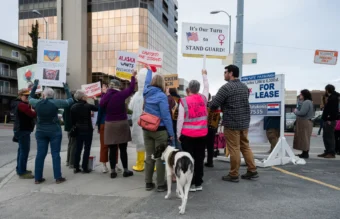
Protesters gather outside the Alaska State Capitol to advocate for Medicaid on Wednesday, March 12, 2025. (Photo by Clarise Larson/KTOO)

There have been a lot of protests at the Alaska State Capitol lately. 

Janet Lopez, a retired teacher in Juneau, says she’s attended several because of big shifts at the federal level.

“We’re in trouble, we’re in a lot of trouble,” she said while sitting on a bench outside the Capitol on Wednesday. 

She and dozens of Juneau residents were at it again as Congress considers drastic funding cuts to Medicaid, the government-funded health insurance program for low-income families and people with disabilities. 

The cuts could jeopardize health care coverage for thousands of Alaskans and put rural hospitals at risk of reducing services – or closures.

Standing in a crowd of protesters, Tammalivis Salanoa said Medicaid cuts could be devastating for her family. 

“If these cuts happen, I will have to start planning funerals,” she said. 

Her mom has stage four kidney failure and her dad has Parkinson’s disease. She’s been taking care of both since she was in high school. She said Medicaid is a lifeline for her family. 

“I will have to start either working more than two jobs I already do. I will have to figure out something else,” she said. “If I’m not able to provide for them, if there’s no other way, then it’s gonna be the final nail in their coffin.”

Tammalivis Salanoa holds a sign during a protest against cuts to Medicaid funding outside the Alaska State Capitol on March 12, 2025. (Photo by Clarise Larson/KTOO)

The spending bill comes from Republicans in Congress as a means to finance tax cuts proposed by the Trump Administration. 

At stake is health care coverage for millions of Americans — including children — who rely on the program to get critical care. Joelle Hall, president of the state’s largest labor union, said the cuts could have an outsized impact in the state.

“This is Alaska to the core — we have the most expensive health care in the world,” she said.

Alaska has consistently ranked among the top states in the country for the highest health care costs per person, according to a 2022 study published by Health Affairs. Medicaid covers almost 40% of Alaska residents. It also helps fund tribal health care and is critical to keep rural hospitals afloat.

Cuts to the program could force the state to decide whether to maintain programs and shoulder the additional expense or leave people without coverage. 

Sen. Forrest Dunbar, D – Anchorage, is chair of the Health and Social Services Committees in the state Senate. He called on Alaska’s congressional delegation to stop that from happening. 

“It’s not just a question of economics. It’s also a moral question, because they’re not doing this so that they can lower the debt. They’re not doing this so they can fund other programs,” he said. “They’re doing this to fund a tax cut for billionaires, and that is morally wrong.”

U.S. Rep. Nick Begich voted in favor of a spending blueprint last month that would significantly cut down on government spending. President Donald Trump has said the cuts won’t affect Medicaid, but budget experts say it’s impossible to make such significant cuts without reducing health care coverage.

In a speech to the Alaska Legislature last month, Begich said he supports adding work requirements to Medicaid.

U.S. Sen. Lisa Murkowski has long been a defender of Medicaid and has been talking to Senate leaders about the impacts to Alaska if programs are cut. 

Last week, U.S. Sen. Dan Sullivan told the Anchorage Daily News it was too early to comment on what could happen to Medicaid, but he did introduce an amendment to a Senate resolution aimed at improving Medicaid for the most vulnerable populations. 

Site notifications
Update notification options
Subscribe to notifications