Health

King Cove residents make their case for Izembek road

Senators Mark Begich and Lisa Murkowski held a press conference  with residents of King Cover to push their support for the road.
Senators Mark Begich and Lisa Murkowski held a press conference with residents of King Cover to push their support for the road.

The saga has been going on for decades, and Wednesday evening, the dozen or so residents in D.C expected nothing more than a photo-op with Secretary Salazar.

They were pleasantly surprised Thursday morning.

“We’re closer now than we ever have been,” said Stanley Mack, mayor of the Aleutians East Borough.

By Mack’s count, he’s been fighting for a connector road from King Cove to Cold Bay for thirty years.

Standing outside the Interior Department Thursday morning, Mack called the meeting with Salazar excellent, saying he’s confident Secretary Salazar will reevaluate a Fish and Wildlife decision that blocked the land transfer.

It’s not certain he’ll reverse the decision. Mack called Salazar a hard negotiator, and even harder to read.

Della Trumble said Secretary Salazar needed to hear the human factor; that the environmental review had not taken lives into consideration.

She said she’s more optimistic now, if for no other reason, the meeting went longer than planned.

“We initially had half an hour meeting, but he did allow us a little over an hour,” she said. “And I feel, just optimistic, that hopefully he’ll take a closer look at this issue. He said he understands it a lot better from us being here.”

The Borough and city of King Cove paid for the trip to Washington.

The state would cede 41,000 acres, and the King Cove Corporation would cede 16,000 more. In exchange, they’d receive a 200 acre easement in the wildlife refuge. That easement would allow for the construction of a ten mile, one lane, gravel road.

Residents say they need it for emergency medical services; that flying in and out of King Cove is too dangerous and too often cancelled.

Trisha Trumble’s point, another King Cove resident in D.C., said weather in the Aleutians can change on a dime, making one flight safe, and the next dangerous. She recounted to Secretary Salazar the crash she survived in 2010.

“The pilot stated that we were coming in and getting ready for landing. We were going about 60, we hit an air pocket and it dropped, it made the whole plane drop, he looked at the speedometer and we’re going 120. He was lucky enough to bring it up and crash that plane perfectly on the runway which then turned sideways. We went down the runway sideways,” she said.

She drove the point home by stressing how close death was.

“And then there was fuel shooting out, and if we didn’t have a gravel runway and it was pavement, any spark would made the plane blow up.”

The residents would be allowed to use the road for everyday use, but it could not be used for commercial purposes. There would be a cable barrier preventing people from driving off road on ATV’s to hunt birds.

Nicole Whittington-Evans is the Alaska Regional Director for the Wilderness Society.

King Cove Road map
King Cove, Cold Bay and Izembek National Wildlife Refuge

“A one lane gravel road with a 10, 15, maximum 20 miles per hour limit on it, from King Cove to Cold Bay will be approximately 35-40 miles, it’s going to take an hour and a half to two hours for a person to drive that road, in good weather,” she said by phone Thursday afternoon.

She said the federal government paid for a hovercraft that could take residents from King Cove to Cold Bay in twenty minutes. The Borough stopped operating the hovercraft in Cold Bay, and moved it to Akutan.

Mayor Stanley Mack said the hovercraft cost more than $1 million dollars per year, and it was unsafe in high seas and strong winds.

“The 1.2 million hovercraft was just the sporadic operation of the hovercraft. We could not operate it. It was costly and unreliable – totally,” he said.

The Department of Interior will not decide the fate of the road before Salazar’s 30 day public interest review deadline of March 18th.  He could resolve the issue before the Senate confirms his successor, Sally Jewell.

Senator Lisa Murkowski, who supports the road, met with Ms. Jewell Wednesday morning, a normal part of the confirmation process.  Senator Murkowski said she did not ask for any assurances on the land transfer.

“I want Secretary Salazar to do the right thing, plain and simple. I don’t think he should let this hang over and let … He needs to right this wrong that his agency has put forward. And I want him to correct that,” she said. 

Even though she puts the onus on Secretary Salazar, Ms. Jewell could feel the punishment. If Secretary Salazar does not override the decision before stepping down, Senator Murkowski threatened to hold up the nomination of Ms. Jewell.

Parliamentary rules allow any Senator to stall any proceedings.

Della Trumble said even though she’s optimistic after the meeting with Secretary Salazar, she’s prepared to continue fighting.

“We’ve always maintained, before you make a decision on this, please, please talk to us,” she added. “And the other point is, we can send a plane load this large every week, because there are so many stories about why this road is so important.”

They’re unlikely to get another meeting with the Interior Secretary.


Fundraiser puts Juneau’s Empty Chair project near goal

Empty Chair Big Check
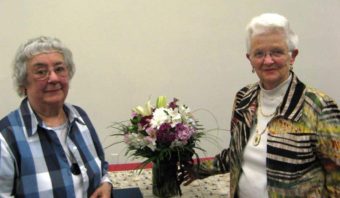
The Gastineau Channel Historical Society presents a $5,000 check to organizers of the Empty Chair project in Juneau. On the far right are sisters Mary Tanaka Abo and Alice Tanaka Hikido, whose brother John inspired the proposed memorial to Juneau’s Japanese American internees. Photo by Casey Kelly/KTOO.

A proposed monument in Juneau to Japanese Americans interned during World War II got a big boost last weekend.

The Gastineau Channel Historical Society donated $5,000 to the Empty Chair Project, and a fundraising concert raised nearly $2,000. Organizers have been collecting funds for about a year and need about $6,000 more to meet their $40,000 goal.

Third generation Japanese American violinist Steve Tada and pianist Nancy Nash performed several compositions, including Michio Miyagi’s “Haru no Umi” at the Empty Chair benefit concert on Saturday.

Sisters Mary Tanaka Abo and Alice Tanaka Hikido sat in the front row as honored guests. Alice Tanaka was nine-years-old in 1942 when the entire family was taken from Juneau and placed into internment camps.

“We were identified with the enemy when we were not the enemy at all,” she said.

Brother John Tanaka, who died several years ago, inspired the Empty Chair project. He was valedictorian of Juneau High School’s class of 1942, but could not attend graduation after the family was taken from the Capital City. The school set up an empty chair at the ceremony to acknowledge that John Tanaka was not there.

The memorial will be a slightly larger than life-size bronze replica of the empty chair at Juneau’s Capital School Park, located next to the old Juneau High School. Project organizer Margie Shackleford has been friends with Mary Tanaka since childhood.

“We can’t always redress everything, but we can at least acknowledge that an injustice occurred,” Shackleford said.

The Tanakas’ father, Shonosuke, operated the City Café in downtown Juneau for more than 50 years. In the early 1940s, the territorial capitol was home to about 6,000 residents, and the restaurant was open 24 hours a day to serve miners, fishermen and other laborers.

Alice recalls that federal agents came for her father just a day after the Japanese attack on Pearl Harbor in December 1941.

“They took all the men, actually. It wasn’t just my father, but all the immigrant-born men,” she said. “Then shortly after that they were taken away from Juneau. We didn’t know where they were going to be taken to, so, there was a lot of unknown.”

While their father was interned in Santa Fe, New Mexico, the Tanaka children and their mother were sent to Camp Minidoka in Idaho, where they would spend the next three years.

“It was a small room that we shared with a pot-bellied stove, and that was our home for the duration of the war,” Alice Tanaka Hikido said.

“And then we had all of our meals in the mess hall, did all of our showering and bathroom needs in what they called the laundry room. So, it was kind of communal living.”

Violinist Tada, whose family lived in the Seattle area, had relatives taken to Camp Minidoka as well.

“They published what was called a ‘Memory Book’ and it has group photos of everybody’s family in front of their barracks,” he said. “And it kind of reads like a school yearbook. They had social clubs, they tried to have dance bands, and morale builders, and they even had Boy Scout troops.”

After the war, the Tanakas returned to Juneau, where Alice says her father re-opened the City Café with community support.

“He had to take a loan out from the bank, and the bank gave him the loan unconditionally,” she remembers. “And suppliers were family friends who told my father that he didn’t have to pay his bills until he had a cash flow that made it possible.”

Seattle artist Peter Reiquam has a design concept for the Empty Chair memorial. Shackleford says it will include the names of all the Japanese Americans taken from Juneau during World War II.

“Plus a Japanese symbol for remembrance and memory, and a text telling a story of the empty chair,” Shackleford said.

With the funds raised at the benefit concert, organizers are confident they’ll be able to dedicate the memorial in the summer of 2014.

Link:
Juneau Empty Chair Project website

Association of Village Council Presidents wants change in VAWA

The Association of Village Council Presidents would like its tribes to be able to prosecute non-tribal members in their local courts.

The Violence Against Women’s Act that is making its way through Congress has the support of AVCP for the most part. However, the Native non-profit organization which represents 56 tribes in the Yukon-Kuskokwim Delta is opposing part of the legislation, the part that doesn’t allow Alaskan tribes to prosecute non-tribal members.

That’s a sticking point for AVCP President Myron Naneng.

“Why do they always have to have an exclusion for non-tribal members?” Naneng said. “The tribal court should be able to deal with all people who live in the village,” Naneng says.

Reauthorizing VAWA has passed the Senate and will be considered by the House next. It does allow tribes on reservations to prosecute non-tribal members for domestic violence that occurs within their boundaries. However, in Alaska, there is only one reservation–Metlakatla in South East– so other tribes in the state would not have that right.

Senator Lisa Murkowski voted for the bill, saying she made sure Metlakatla was treated no different than other reservations in the country. She said for the state’s other tribes, she focused on language that confirms that they have the power to issue domestic violence protective orders against their own members.

“So, what this does is simply maintain the status quo,” Murkowski said.

Murkowski also included language to re-establish the Alaska Rural Justice and Law Enforcement Commission, which has the tribes, state, and federal governments working together on rural safety issues.

In the Y-K Delta, there are about 20 tribal courts, but the state court still deals with most crimes region-wide. Naneng says access to state courts is difficult for some villages because they are so remote, sometimes hundreds of miles away.

“How much does it cost to go from one of the villages to Bethel to go to court, especially from Lower Yukon?” Naneng said. “It’s probably over $1,000 round trip.”

Giving tribal courts more leverage to deal with crimes would help, he says.

Tribal courts can use traditional forms of resolution such as peace circles or banishment, a form of punishment for people who consistently cause problems in a community. Naneng says tribes should be able to exercise that with non-tribal members as well.

“I think that the village should have the ability to ban these people from their communities which has been done and is still going on today,” Naneng said.

Naneng says AVCP would like to see changes made to the VAWA legislation in the House and they plan to work with other tribes in Alaska to lobby for that.

One In Three Fish Sold At Restaurants And Grocery Stores Is Mislabeled

Escolar, right, is often substituted for more expensive Albacore tuna (left), a report on mislabeled seafood found. Yoon S. Byun/Boston Globe via Getty Images

There are so many fish in the sea. But from a diner’s viewpoint, peering down at a sliver of white fish atop a bed of sushi rice, a lot of them look the same.

Now a report from the ocean conservation group Oceana confirms that there’s a pretty decent chance that fish on the plate or on ice in the seafood case is not what it’s labeled to be. That means that seafood wallet cards designed by conservation groups to help steer consumers towards sustainable choices may not be doing much good.

Between 2010 and 2012, Oceana took 1,215 seafood samples from 674 retail outlets in 21 states. When they tested the DNA, they found that 33 percent were mislabeled. Sushi vendors and grocery stores were the most likely outlets to sell mislabeled food, though Oceana says the fraud can happen before it reaches them.

Earlier investigations by Oceana and the Boston Globe revealed that seafood mislabeling is common in cities like New York and Boston, where people eat a lot of fish. But the report out Thursday shows it’s happening across the country, and is as bad or worse in places like Texas and Colorado. Some 49 percent of the retail outlets sampled in Austin and Houston sold mislabeled seafood, while 36 percent in Colorado did so.

So what’s the big deal with fish sold under a pseudonym? Well, for one, it’s often just a form of swindling – a cheap fish like tilapia sold as red snapper. But Oceana says the practice also can put consumers at health risk when species like king mackerel, which is high in mercury, or escolar, which contains a naturally occurring toxin than can cause gastrointestinal problems, are marketed as grouper and white tuna, respectively.

Oceana’s also concerned that substituting cheaper, easier-to-find fish for rarer, more valuable ones gives consumers a distorted sense of the market. Of the fish types most heavily sampled by Oceana, those sold as snapper and tuna had the highest mislabeling rates — 87 and 59 percent. Only seven of the 120 samples of red snapper purchased nationwide were actually red snapper, the report found.

“The majority of fraud is various fish standing in for snapper – it’s used as catch-all name for all kinds of white fleshed fish,” says Oceana senior scientist Kimberly Warner. “But there are real conservation concerns when you slip in things in place of the real thing. People think snapper must be doing great because it’s everywhere, but it’s overfished.”

Consumers using wallet cards from groups like the Monterey Bay Aquarium and NRDC could end up buying exactly the species they’re trying to avoid, Warner says, because mislabeling is so prevalent.

One reason mislabeling has gotten so rampant is that the U.S. now imports 90 percent of its seafood and less than 2 percent is inspected for fraud. That means would-be fraudsters have a lot new options for substitutions.The Food and Drug Administration regularly updates its list of seafood approved for sale – in 2012 alone, 19 new species were added to the list, including cornetfish, sampa and claresse.

So what’s the government or a consumer to do about all this? Oceana would like to see an international traceability system where retailers would be required to tell consumers where and when a fish was caught and what gear was used. Requirements like these would help the industry — one of the least transparent in the food system — more accountable.

The National Fisheries Institute argues that the problem is one of enforcement — the FDA needs to do a better job of enforcing laws that are already on the books to discourage fraud. And they encourage consumers to seek out retailers through the Better Seafood Board.


See Original Story

One In Three Fish Sold At Restaurants And Grocery Stores Is Mislabeled

School budget committee begins the priority process

The Juneau School District’s budget committee wants a nurse in every building for the next school year.

The district cut two nursing positions in this year’s budget, but the committee Tuesday night said those jobs should be restored.  The Marie Drake building – where the  alternative high school meets – has not had a nurse for the last four years, but has Teen Health services available.

The 17-member committee represents each of the 12 Juneau schools, education unions, and community members.

It is working through a list of suggested changes to the administration’s budget proposal.  The nurse shortage came up during last night’s public testimony.

Luann Powers is the registered nurse at Auke Bay Elementary School.

“I’m just worried.  I want to support our nurses.  I don’t have any teachers that want to give insulin or be taken away to have to do things that somebody else should be doing because that’s their specialty,” Powers said.

Jenny Malecha’s son has type 1 diabetes.  She said she spends a lot of time in the school nurse’s office and sees how important it is for every student to have a “first responder” nearby.

“As a parent of a child with diabetes, I know how important it is to have nurses in every single school and it’s not for kids with complex medical needs, it’s for all the kids,” she said.

Malecha had the same message at last year’s school budget hearings, and apparently echoes the sentiment of the community.   When committee members were polled, adding nurses was the number one priority.  It would cost the district $153,000. The administration needs to cut $1.75 million from the fiscal year 2014 budget.  That’s on top of the $4 million dollars cut from this year’s operating budget.

The list of cuts includes instructional coaches in elementary schools, which would save the district $97,060.  Instructional coaches work with individual and small groups of teachers in each grade school.

Cutting the drug testing program for high school athletes and students in extra-curricular activities would save the district $45,475; eliminating bus service for Sea Week would save $13,045.

During the annual Sea Week, children in kindergarten through sixth grade visit the National Marine Fisheries Service Auke Bay Laboratories as part of their study of the ocean. The curriculum began in Juneau in the 1970s and has been taken statewide.  The National Science Teachers’ Association has named it one of the nation’s best science education programs.

Allison Smith is second grade teacher at Auke Bay Elementary School and was part of the program when she was a kid. Smith told the budget committee that the experience motivated her to take more science classes in college.

“If we do cut busing, yes there will be some schools and PTAs that can rise to the occasion and supplement that money, there will also be schools that cannot.  And if we really want to reach every student in our district, it’s important that we keep that funding equal for all schools because we stand to create a real disparity in the quality of life experiences that students have,” Smith said.

The budget committee has agreed that changes are needed to the administration’s plan, but for every addition, members must find another place to cut.  It’s a laborious process. As co-chair Brian Holst put it:

“We have a really long way to go.  We are many hours away from a recommendation to the Board of Education,” Holst said. 

The committee plans to have that priority list at the next meeting and is still taking email comments at budgetinput@jsd.k12.ak.us. The committee will recommend a budget to the Board of Education in March.

King Cove road might get a second chance

Izembek National Wildlife Refuge lies north of Cold Bay, Alaska

An intense lobbying campaign by Alaska’s congressional delegation has paid off for residents of the Aleutian community of King Cove. A group of them will have the chance to meet face-to-face with Interior Secretary Ken Salazar at the end of the month. As King Cove Corporation administrator Della Trumble explains, the goal is to convince Salazar to allow a road through the Izembek National Wildlife Refuge.

“Hopefully have him say yes, we can have this road, and not go with what [the U.S.] Fish and Wildlife [Service] has, what their recommendation is, which is the no action alternative,” Trumble says.

The group will be ten to twelve people, including several who can speak personally to the challenges of getting from King Cove to the all-weather airport in Cold Bay. Trumble says she hopes their stories will get the Secretary to listen.

“As an example, one of the elders that’s traveling with us had gone to Cold Bay on a boat with his wife who was being medevaced out of King Cove. And basically they got off-lifted from a crab boat, in a crab pot, from the boat to the dock in Cold Bay. And that’s just not acceptable,” Trumble says.

Ultimately, the Secretary of the Interior is responsible for deciding whether the project moves forward. Since the Fish and Wildlife Service announced their opposition to the road earlier this month, all three members of Alaska’s Congressional delegation have been pressuring Salazar to override their analysis. He’s expected to leave his post sometime in March, and hasn’t said whether he’ll make a decision on the project before then.

If he doesn’t, both Senator Lisa Murkowski and Representative Don Young have threatened to hold up congressional confirmation of his replacement, Sally Jewell.

The delegation from King Cove will meet with Salazar on February 28. They had already been planning a lobbying trip to Washington, D.C. for later this spring, but it was pushed up in light of the meeting.

Related:

Agency rejects Alaska refuge road


Site notifications
Update notification options
Subscribe to notifications