History

The Golden Age Of Cocktails: When Americans Learned To Love Mixed Drinks

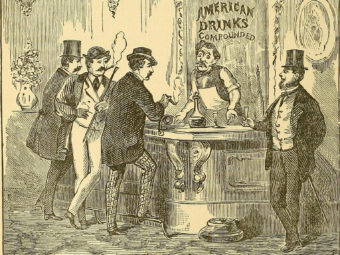
An illustration from The Innocents Abroad by Mark Twain, published 1897. Between the 1860s and 1920, when Prohibition went into effect, American bartending came into its own. via Flickr
An illustration from The Innocents Abroad by Mark Twain, published 1897. Between the 1860s and 1920, when Prohibition went into effect, American bartending came into its own.
via Flickr

Summertime is the perfect time to indulge in a refreshing cocktail on a balmy night. But before you reach for that minty mojito or sweet sangria, consider stepping out of your modern-day comfort zone and going back to the drinks of 100 years ago.

“Some of the best cocktails that we think about today — the martini, the daiquiri, the Manhattan — those all came out between the 1860s and Prohibition,” says Derek Brown, an award-winning mixologist who has studied the history of alcohol in America.

Historians have dubbed that time span the Golden Age of Cocktails, an era when bartenders got pretty inventive. Brown tells NPR’s Audie Cornish that these bar staples were originally simpler — but perhaps, better tasting— than the versions modern-day cocktail lovers are familiar with.

Take, for instance, the daiquiri.

“Most people expect to get a daiquiri when they’re going through a drive-through window in New Orleans … and it’s going to be full of grain alcohol and red coloring and things like that,” Brown says. In other words, it’s got a bad rap. But the original daiquiri, he says, “is really something so simple — it is rum, it’s lime and it’s sugar.”

"For 6 persons:" The original daiquiri recipe, as scribbled by Jennings Cox. Courtesy of the Cuban Heritage Collection, University of Miami Libraries
“For 6 persons:” The original daiquiri recipe, as scribbled by Jennings Cox.
Courtesy of the Cuban Heritage Collection, University of Miami Libraries

American engineer Jennings Cox is credited with inventing the daiquiri while working in Cuba in the late 1890s. The story goes that he played around with Bacardi rum to get the perfect flavor, then named the drink after the small town where he worked. The original sheet of paper where he scribbled down the recipe now resides at the University of Miami library.

“Now there were plenty of people drinking rum then, and using lime and cane sugar. But it was his particular formula that became specifically the daiquiri,” Brown says.

The daiquiri stayed in Cuba until U.S. Navy Admiral Lucius Johnson discovered it. Enthralled with the cocktail, the admiral introduced it to Washington, D.C.’s Army and Navy Club in 1909. It spread like wildfire from there, eventually becoming a favorite of Ernest Hemingway and John F. Kennedy.

Another cocktail of the era, the martini, would probably be unrecognizable to barflies who order it today.

“Today you could walk into a bar and you could order a martini and you might just get warm vodka with a bunch of olives in it,” he says. “[This] masks the real character of the martini. The original martini at its invention was gin, vermouth and orange bitters.”

Bartenders — then and now — would sometimes refer to martinis made according to the original recipe as a “silver bullet” or a “crisp cocktail,” Brown says, because of its incredibly clean and fresh flavor.

The origins of the Manhattan — a cocktail species closely related to the martini — are a bit hazy.

In his book Imbibe!, liquor historian David Wondrich writes that the cocktail was probably invented at the Manhattan Club, a social organization for Democrats in New York.

Another story points to more elite origins: It suggests Lady Randolph Churchill gave birth not only to Sir Winston, but also to this cocktail — she is said to have ordered a combination of rye and vermouth for a toast during a visit to the Manhattan Club.

While we don’t know all the details, we do know that the Golden Age of Cocktails was a time when Americans learned to love mixed drinks.

The first bartenders guide was penned in 1862 by Jerry Thomas, who is considered the father of American mixology. “It really just marks this start of this incredibly creative period in making great cocktails,” Brown says.

Thomas is famous for making bartending an entertainment. His signature drink was the Blue Blazer, a cocktail he’d light on fire and pass back and forth between two glasses to create a blazing arch. (That description reminded us of this “highlight” from the Tom Cruise cinematic oeuvre.) Oh, and he’d do it all while wearing two white rats perched on his shoulders.

This sort of theatrical presentation — and the new savory blends — helped build enthusiasm for alcohol. But it was also blamed for encouraging the kind of rampant overdrinking that inspired women’s suffragists to denounce the societal ills of alcohol, and eventually led to Prohibition in 1920, Brown says.

This spring, the National Archives in Washington, D.C., kicked off Spirited Republic: Alcohol in American History, an exhibit that explores how Americans have both enjoyed — and denounced — getting tippled throughout history.

As chief spirits adviser for the archives, Brown organized a number of boozy but educational public seminars to go along with the exhibit, including a discussion of the Golden Age of Cocktails, where guests got to sample the original drinks.

If you want to mix up the historic versions of these cocktails at home, the recipes are below.


The Daiquiri

2 ounces of rum

3/4 ounce of lime juice

1/2 to 3/4 ounce of simple syrup

Shake the ingredients with ice and strain into a chilled cocktail glass.

Dry Martini

1 1/2 ounces of dry gin

1 1/2 ounces of dry vermouth

A dash of orange bitters

Lemon Peel

Stir liquors and bitters in a mixing glass with ice until very cold. Strain into a chilled cocktail glass. Squeeze the oils from lemon peel in and discard the peel.

Manhattan

2 ounces of rye whiskey

1 ounce of sweet vermouth

A dash of aromatic bitters

1 cherry

Stir liquors and bitters in a mixing glass with ice. Strain into a chilled cocktail glass. Garnish with the cherry.

Copyright 2015 NPR. To see more, visit http://www.npr.org/.
Read Original Article – Published JULY 29, 2015 4:33 PM ET


2 Gene Studies Suggest First Migrants To Americas A Complex Mix

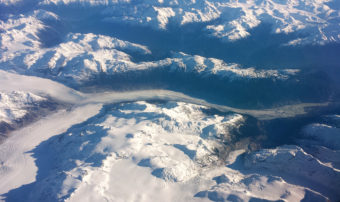
The area around the confluence of the Silverthrone and Klinaklini Glaciers in southwestern British Columbia provides a glimpse into how the terrain traveled by Native Americans in Pleistocene times may have appeared. David J. Meltzer/Science
The area around the confluence of the Silverthrone and Klinaklini Glaciers in southwestern British Columbia provides a glimpse into how the terrain traveled by Native Americans in Pleistocene times may have appeared.
David J. Meltzer/Science

The first people to set foot in the Americas apparently came from Siberia during the last ice age.

That’s the conventional wisdom.

But now there’s evidence from two different studies published this week that the first Americans may have migrated from different places at different times — and earlier than people thought.

The human race has walked or paddled or sailed until it covered the globe. Scientists can trace those migrations from the stuff these people left behind: tools, dwellings or burial grounds.

Geneticists can now trace these patterns of travel, too — by examining the genes of living people and comparing them to each other, as well as to genes extracted from ancient bones. Rasmus Nielsen of the University of California, Berkeley and a large, international team of scientists have done just that for native people of the Americas. And they think they’ve figured out how the very first people got here.

“They came in a single migration wave into the Americas,” Nielsen says — “people who diverged from people originally in Siberia and East Asia about 23,000 years ago.”

Now, that confirms the standard view that people first got here across a frozen “land bridge” between Siberia and Alaska, albeit a few thousand years earlier than many had assumed.

But there’s long been a lingering puzzle: Some ancient skulls found in the Americas look rather like Europeans, or maybe Polynesians. Did another group come from somewhere else?

Writing in this week’s issue of the journal Science, Nielsen says no. Genetically, no Native Americans match up with Europeans or Polynesians, in terms of these markers of ancient migration. Instead, he says, there was just one major, founding wave of people moving into the continent; any diversification of Native American groups must have evolved on its own after the first bunch of people got here.

“Diversification of modern Native Americans happened in the Americas,” Nielsen says — “not because people came from all over the world into the Americas.”

But there’s often a twist when you’re teasing apart the threads of ancient history with genetic tweezers. David Reich, a geneticist at Harvard Medical School, says his research — published Tuesday in the journal Nature — suggests a more complicated story.

When Reich studied groups of indigenous people in South America, he found that some of them had a peculiar genetic fingerprint. He searched the world for other copies of that fingerprint and found it far away — in modern Australasia.

“What we found,” says Reich, “was that Native American people from Amazonia — from present-day Brazil — are more closely related to some populations in Asia than are other Native Americans, for example from Mexico, or from western South America and many parts of North America.”

The Amazonians’ modern relatives — the Australasians — are native Australians, and people of New Guinea and the Andaman Islands.

Reich says what may have happened is this: Members of a now-extinct population of people in what’s now Southeast Asia — Reich calls them Population Y — crossed the land bridge as well, either before or after the first wave of people made it to the Americas. This splinter group from Population Y kept going, and some members got all the way to Brazil. Meanwhile, those who stayed behind in Asia populated what is now Australasia. But the two groups still are linked genetically.

Says Reich: “We now have the possibility of there being two different streams of ancestry penetrating south of the ice sheets, so that’s a very exciting new observation.”

That observation adds yet another branch — or root — to the American family tree.

Copyright 2015 NPR. To see more, visit http://www.npr.org/.
Read Original Article – Published JULY 21, 2015 3:45 PM ET

12 Lost American Slangisms From The 1800s

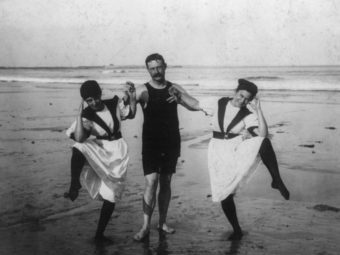
Bathers at the beach, 1897. Library of Congress
Bathers at the beach, 1897.
Library of Congress

Phrases phase in and out of everyday usage. Especially in the global hodgepodge that is American English. Sometimes, however, there are phrases forgotten that perhaps should be sayings salvaged.

Informal words and expressions that popped up in popular parlance, especially in the 19th century, says Lynne Murphy — an American linguist who teaches at the University of Sussex in England — are “going to stay fairly local, and so there can be a lot of variation not just between countries, but between cities, between social classes, et cetera.”

Murphy, who also oversees the language-watching blog Separated by a Common Language, says: “English has a rich variety of means for making new words — and then a lot of slang is just giving new meaning to old words.”

Here are an even dozen, pretty much forgotten slanglike words or sayings from the 19th century, rediscovered while delving in the archives — and with added guidance from James Maitman’s 1891 American Slang Dictionary:

1) Too high for his nut — beyond someone’s reach. “That clay-bank hog wants the same pay as a Senator; he’s getting too high for his nut,” according to a grammar-corrected version of the Oakland, Calif., Tribune on Jan. 12, 1885.

2) Bottom fact — an undisputed fact. “Notwithstanding all the calculations of the political economists, the great bottom fact is that one man’s honest, steady work, rightly applied, especially if aided by machinery and improved modes of conveyance and distribution, suffices to supply the actual needs of a dozen burdensome loafers,” according to the Brooklyn Daily Eagle of Jan. 31, 1871.

3) To be Chicagoed — to be beaten soundly, as in a baseball shutout. “Political corruption … if the clergy only keep to that topic, Lincoln will be Chicagoed!” from the Plymouth, Ind., Weekly Democrat of June 7, 1860.

4) See the elephant — to see all the sights of a town, especially the edgier aspects. “A young Sioux Indian from Haskell Institute … said he was going to Chicago to hunt buffalo. He was told there was no game of that kind there, but that if he wanted to see the elephant he was on the right track,” the Lawrence, Kan., Daily Journal reported on Sept. 2, 1891. Also sometimes used by members of the military to describe going to war.

5) How came you so — inebriated. Describing an illustration, a reporter in the Gettysburg, Pa., People’s Press of May 22, 1835, wrote: “A gentleman a little ‘how came you so’ with his hat on the back of his head, is staggering about in the presence of Miss Fanny, who appears to be quite shocked.”

6) Lally-cooler — a real success. “That north show window of Shute & Haskell’s is a ‘lally-cooler,’ ” the Jan. 4, 1890, Salina, Kan., Republican noted.

7) Shinning around — moving about quickly. “It is shinning around corners to avoid meeting creditors that is sapping the energies of this generation,” opined the Dallas, Texas, Daily Herald on Oct. 31, 1877.

8) Shoddyocracy — people who get rich selling shoddy merchandise or services. “A lady of the shoddyocracy of Des Moines found, on returning from a walk, some call cards on her table,” observed the Harrisburg, Pa., Telegraph of June 30, 1870.

9) Some pumpkins — a big deal. “If there was any kind of trading,” noted the Grant County Herald in Wisconsin on July 17, 1847, “in which Simon B. … flattered himself he was decidedly ‘some pumpkins,’ it was a horse-trade.”

10) Like Thompson’s colt — doing something unnecessarily, like jumping a fence when the rails have been removed. “Thompson’s colt,” a reporter in the Saint Paul, Minn., Globe of Nov. 20, 1882, wrote, “was such an infernal idiot, that he swam across the river to get a drink.”

11) Tell a thumper construct a clever lie. “When anyone told a thumper more palpably outrageous than usual, it was sufficiently understood …” Reminiscences of the Turf by William Day, 1891.

12) Wake snakesget into mischief. “So I went on a regular wake snakes sort of a spree, and I went here and there turnin’, twistin’ and doublin’ about until I didn’t know where or who I was,” a man testified in court as to why he was intoxicated, according to the New Orleans, La., Times Picayune of Aug. 15, 1842.

We asked Lynne Murphy to comment on a few items in the list above. Lally-cooler, she says, is “a sort of nonsensical compound … though maybe it’s less nonsensical than it seems.” See the elephant is “an expression based in a fable” — the Blind Men and the Elephant. And to be Chicagoed is “a verbing of a place name. In the last case, I’m not findng any verbed place names in Britain, but in the same era, there was definitely verbing of personal names here, for example boycott.”

She adds: “I’m sure we could find nonsensical-looking words — it was Lewis Carroll’s time after all — and verb phrases of the verb-the-animal type, but I’m not sure about ones with fable origins.”

In that pursuit, researchers may be buffaloed.


Follow me @NPRHistoryDept; lead me by writing lweeks@npr.org

Copyright 2015 NPR. To see more, visit http://www.npr.org/.
Read Original Article – Published JULY 21, 201511:13 AM ET

After 54 Years, The U.S. And Cuba Formally Restore Ties

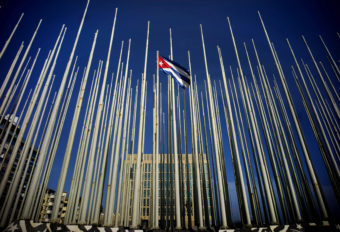
The Cuban flag is raised over their new embassy in Washington, on Monday. Cuba's blue, red and white-starred flag was hoisted Monday at the country's embassy in Washington in a symbolic move signaling the start of a new, post-Cold War era in U.S.-Cuba relations. Andrew Harnik/AP
The Cuban flag is raised over their new embassy in Washington, on Monday. Cuba’s blue, red and white-starred flag was hoisted Monday at the country’s embassy in Washington in a symbolic move signaling the start of a new, post-Cold War era in U.S.-Cuba relations.
Andrew Harnik/AP

After 54 years of animosity, the United States and Cuba have formally restored diplomatic ties.

That means that the U.S. opened an embassy in Havana and Cuba opened an embassy in Washington, D.C., Monday morning.

In truth, both countries had for years already been running robust interest sections in both capitals. Today, however, both of those missions were upgraded.

During a ceremony full of pomp and circumstance, Cuban Foreign Minister Bruno Rodriguez raised the Cuban flag at the embassy in Washington.

The last time the Cuban flag flew in that location was in 1961, before the U.S. broke ties with the communist island.

The streets surrounding the embassy were filled with media and onlookers, this morning. As the Cuban flag went up, shouts of protests could be heard: “Cuba si! Castro No!” Yes to Cuba, No to Castro.

In response, others shouted: “Viva Fidel! Viva! Viva Raúl! Viva” Long live, Fidel. Long live, Raúl.

In a speech after the ceremony, Rodriguez reminded everyone that while the reopening of embassies normalizes diplomatic relations, there are still many thorny issues left to be worked out.

“The historic events we are living today will only make sense with the removal of the economic, commercial and financial blockade, which causes so much deprivation and damage to our people, the return of occupied territory in Guantanamo, and respect for the sovereignty of Cuba,” Rodriguez said.

In Miami, home to the largest Cuban exile community in the United States, a few protesters gathered to denounce the opening of embassies. Demonstrators accused President Obama of being a “coward.”

A Cuban flag flies among empty flag polls that obscure the then U.S. Interests Section. That building has again become the U.S. Embassy in Havana. Ramon Espinosa/AP
A Cuban flag flies among empty flag polls that obscure the then U.S. Interests Section. That building has again become the U.S. Embassy in Havana.
Ramon Espinosa/AP

Secretary John Kerry will travel to Havana to raise the American flag at the U.S. embassy there later in the summer.

Conrad Tribble, the deputy chief of mission at the U.S. Embassy in Havana, tweeted shortly after midnight that he had phoned the State Department.

“Just made first phone call to State Dept. Ops Center from United States Embassy Havana ever,” he tweeted. “It didn’t exist in Jan 1961.”

If you remember, this process kicked off in December, when President Obama and Cuban President Raúl Castro announced their intention to normalize relations. Since then, the U.S. has eased some travel and economic restrictions and removed Cuba from a list of state sponsors of terrorism.

NPR’s Carrie Kahn is in Havana for the occasion. She filed a piece for Morning Edition that takes a look at the history of the old U.S. Embassy in Havana:

Copyright 2015 NPR. To see more, visit http://www.npr.org/.
Read Original Article – Published JULY 20, 2015 7:41 AM ET

Japan’s Mitsubishi Apologizes For Using U.S. POWs As Forced Labor In WWII

In this 1942 file photo provided by the U.S. Marine Corps, Japanese soldiers stand guard over American prisoners of war just before the start of the Bataan Death March following the Japanese occupation of the Philippines. Some of those who survived the death march were later forced to work for Japanese industry.

Japan’s Mitsubishi corporation is making a big apology. It’s not for any recall or defect in its products, which include automobiles, but for its use of American prisoners of war as forced labor during World War II.

James Murphy, 94, traveled from his home in Santa Maria, Calif., to the Simon Wiesenthal Center in Los Angeles, where a ceremony was held and Hikaru Kimura, a senior Mitsubishi executive, made the apology in person.

James Murphy, World War II veteran and prisoner of war, was photographed at his home in Santa Maria, Calif., on Thursday. Murphy received an apology from a senior Mitsubishi executive for being forced to work in the company's mines during the war. Michael A. Mariant/AP
James Murphy, World War II veteran and prisoner of war, was photographed at his home in Santa Maria, Calif., on Thursday. Murphy received an apology from a senior Mitsubishi executive for being forced to work in the company’s mines during the war.
Michael A. Mariant/AP

“Being one of the few surviving workers of that time,” Murphy said in a statement, “I find it to be my duty and responsibility to accept Mr. Kimura’s apology.”

Murphy spent a year of forced labor, from 1944 to ’45, at a copper mine owned by the company in Japan. He told the Associated Press this week that the experience was a complete horror, “slavery in every way.”

But in his statement, Murphy took a tone of optimism. “Hopefully,” he said, “the acceptance of this sincere apology will bring some closure and relief to the age-old problems confronting the surviving former Prisoners of War and to their family members.”

NPR’s Sam Sanders says Murphy was the only former prisoner of war made to work for the Japanese conglomerate who was able to make the trip.

Although the Japanese government has already apologized to prisoners of war for their brutal treatment during the war, this is the first time that a Japanese company has done so.

“As far as I know, this is a piece of history,” Rabbi Abraham Cooper, an associate dean at the center, was quoted by the AP as saying. “It’s the first time a major Japanese company has ever made such a gesture. We hope this will spur other companies to join in and do the same.”

According to the AP: “Some 12,000 American prisoners were shipped to Japan and forced to work at more than 50 sites to support imperial Japan’s war effort, and about 10% died, according to Kinue Tokudome, director of the US-Japan Dialogue on POWs, who has spearheaded the lobbying effort for companies to apologize.”

The move comes at a time when the Japanese government appears to be trying to put the country’s wartime atrocities behind it as part of a larger push to restore its ability to project military power abroad — something that had been prohibited by its postwar constitution.

Earlier this week, Prime Minister Shinzo Abe won a crucial vote in Parliament on legislation to give the army and navy limited powers to fight in foreign conflicts for the first time since World War II.

The New York Times writes: “The vote was the culmination of months of contentious debate in a society that has long embraced pacifism to atone for wartime aggression. It was a significant victory for Mr. Abe, a conservative politician who has devoted his career to moving Japan beyond guilt over its militarist past and toward his vision of a “normal country” with a larger role in global affairs.”

Abe has made multiple visits to Tokyo’s Yasukuni shrine, which honors Japan’s dead from World War II, including war criminals. His government has also sought to downplay or deny the wartime use of so-called “comfort women” in military brothels that impressed mainly Asian girls and women into prostitution.

In a Times opinion piece written last year, Mindy Kotler, the director of Asia Policy Point, a non-profit research center, wrote: “Mr. Abe’s administration denies that imperial Japan ran a system of human trafficking and coerced prostitution, implying that comfort women were simply camp-following prostitutes.”

Copyright 2015 NPR. To see more, visit http://www.npr.org/.
Read Original Article – Published JULY 19, 2015 3:02 PM ET

Grand Jury Testimony In Cold War-Era Rosenberg Case Released

Harry McCabe (from left), deputy U.S. marshal; Julius Rosenberg and his wife, Ethel; Anthony H. Pavone, deputy U.S. marshal, in New York on March 8, 1951. AP
Harry McCabe (from left), deputy U.S. marshal; Julius Rosenberg and his wife, Ethel; Anthony H. Pavone, deputy U.S. marshal, in New York on March 8, 1951.
AP

Here’s what we know: Julius and Ethel Rosenberg were executed in 1953 for selling U.S. nuclear secrets to the Soviet Union after one of the most sensational Cold War-era espionage trials. They were convicted in 1951 owing, largely, to the testimony of David Greenglass, Ethel Rosenberg’s brother.

Here’s what we don’t know: How credible Greenglass’ testimony was in court.

Greenglass himself spent nearly a decade in prison for his role in the conspiracy. The Army sergeant stole nuclear intelligence from Los Alamos, N.M., and said he passed it on to the Rosenbergs. At the trial, he said Ethel Rosenberg typed his notes that were then given to the Russians.

But decades later, Greenglass, who died in 2014, told New York Times reporter Sam Roberts he had lied to protect his wife, Ruth Greenglass, and suggested it was she who had typed up the notes. Ruth Greenglass died in 2008.

Wednesday the National Security Archives released Greenglass’ grand jury testimony, lending weight to his account to Roberts.

In the testimony from Aug. 7, 1950, Greenglass is asked whether Ethel Rosenberg asked him to stay in the Army so he could continue providing information from Los Alamos. His reply: “I said before, and say it again, honestly, this is a fact: I never spoke to my sister about this at all.”

But at trial, a year later, he put Ethel at the center of the conspiracy. The documents released Wednesday show it was Ruth who played a far more pivotal role.

The testimony, which was sealed for more than six decades, was released upon the order of Judge Alvin Hellerstein, who cited its historical significance.

The Rosenbergs maintained their innocence until their execution by electric chair.

Copyright 2015 NPR. To see more, visit http://www.npr.org/.
Read Original Article – Published JULY 15, 2015 7:20 PM ET
Site notifications
Update notification options
Subscribe to notifications