History

On 40th anniversary, Southeast’s smallest city remains defiant

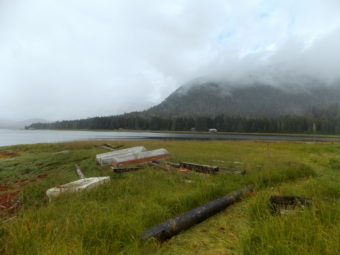
The view over to Kupreanof from Sharon Sprague’s house on Sasby Island. (Photo by Joe Sykes/KFSK)

Most people in Petersburg don’t give much thought to the handful of houses which sit on the other shore of the Wrangell Narrows.

But to the people who live there it’s a place they are proud to call home. It’s name is Kupreanof and with just 24 residents it’s Southeast’s smallest, and Alaska’s second smallest, city. And this week it turns 40. It’s a community still proud of their little piece of Alaskan independence and unified against their older brother across the water.
When Sharon Sprague and her husband Dick moved to Sasby Island, in the middle of the Wrangell Narrows in 1975, they had to build a life from scratch.

“We started with nothing. There was no electricity, there was no water here. Nothing,” Sprague said.

Sharon Sprague picks vegetables in her garden on Sasby Island. (Photo by Joe Sykes/KFSK)

Since then they’ve created what some might call a homestead. They have their own hydroelectric power system, chickens run around in the garden, and plump fruit hangs off trees ripe for picking.

They came here to get away and live out on their own. And together with a group of other isolation inclined individuals they helped found the city of Kupreanof, the smallest city in Southeast Alaska.

It sits on the shore of Kupreanof island just next to the Sprague’s house and on the opposite side of the narrows from Petersburg.

It began when residents who lived on the island decided they were sick of Petersburg and so organized themselves into an independent city. And the Spragues went with them.

And Sharon Sprague says Petersburg and Kupreanof are separate for a good reason.

“The two communities are so opposite,” she told me.

That opposition still simmers and boiled over in 2013 when Kupreanof fought the establishment of the Borough of Petersburg. They lost that battle meaning they had to pay more money into Petersburg’s coffers but retained their status as a city.

At a recent council meeting, jokes at Petersburg’s expense flew over breakfast of watermelon slices, sausages and eggs.

“Has the assembly over there every provided you with breakfast?” Kupreanof Mayor Tom Reinarts quipped as he offered me my share of their Saturday morning spread. In a city so small the mayor is not just the mayor.

“I’m also the police chief and the fire chief,” he said.

Everyone has to play a hand in Kupreanof.

Butch Anderson’s been living here for about eight years. He turned up to the council meeting one day just to see what was going on.

“There was an extra seat open. So they voted. I got one vote,” he said. “I got in by a landslide, one vote was all it took.”

He likes it here because he can kind of do what he wants.

“I’m a hermit. I live alone and enjoy life. I don’t like heat. In my house, it will get down to 25 inside. Then I’ll go light the fire,” he said.

They’re idiosyncratic. They keep to themselves and because of that sometimes it’s hard to remember just how many people actually live here.

“Our official population is 24, I think,” Tom Reinarts said.

“I thought it was 25. I read 25,” Butch Anderson jumped in.

“Maybe 25, I concede,” Reinarts replied.

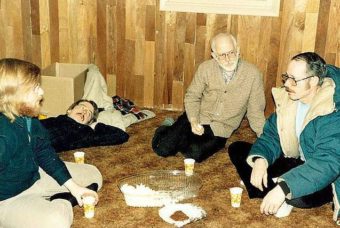
Kupreanof Mayor, Tom Reinarts, heads up a meeting of the Kupreanof City Council. (Photo by Joe Sykes/KFSK)

Either way, their six-member council makes up about a quarter of their population. And while they say they’ve not always seen eye to eye, they do have a common bête noire: The Borough of Petersburg.

“We’re like Petersburg’s red-headed step-child. They’re like ‘we want you guys to follow our rules. So we can tell you how to live your life over here, ” Anderson said.

So now it’s their 40th anniversary and they’re determined to show Petersburg they’re here, they’ve been here for a long time and they are here to stay.

“I think we need to make a big splash for our friends across the bay in Petersburg East,” Reinarts announced at the meeting.

He says he calls them Petersburg East because people in Petersburg often refer to Kupreanof by its original name, Petersburg West.

They’re proud to be Kupreanof and they know with so few people it will always be a struggle to survive. But Sharon Sprague, standing on her dock looking out over both communities has the answer.

“If you’ve got a group of people and they have one goal and they all feel the same and they’re a unit, they have strength,” she said.

I ask her what she thinks that goal should be:

“To keep it as it is,” she says. “This is a jewel.”

And it’s a jewel that will always be a bugbear to Petersburg.

“They hate us, they hate us. We’re a thorn in their side. They just wish we’d go away. But we’re not going to,” Sprague tells me with a glimmer in her eye.

They’re not going anywhere and if it was up to Sharon Sprague they’d be a thorn in Petersburg’s side for another 40 years to come.

Vatican team travels to Bethel to trace history of Yup’ik masks

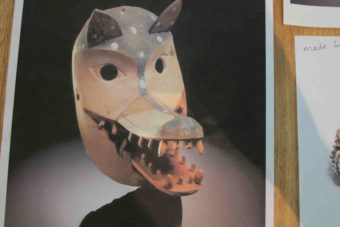
The Vatican officials are seeking to connect with people of Western Alaska through the masks. (Photo by Ben Matheson / KYUK)

A team from the Vatican was in Bethel last week trying to trace the origins of several traditional Yup’ik masks they received nearly a century ago. Museum experts are going through the Vatican’s vast collection and trying to find the people who can explain the art.

There is next to no documentation for the seven masks besides a note that says “from Holy Cross.” The Yukon village was the location of a Jesuit orphanage and mission.
Nicola Mapelli, curator for the Ethnographic Section of the Vatican museum and colleague Katherine Aigner held meetings in Bethel Tuesday at the Cultural Center. They say they contacted people in Holy Cross who believe the masks are from further south. That brought the team to the Lower Kuskokwim to attempt to track down the history of the masks.

The wooden masks are light in tone with orange and blue coloration. They depict animal forms like salmon and birds with expressive faces. The trail from Alaska to the Vatican begins in 1924 when Pope Pius XI wanted to hold an international exhibition of works from far reaches of the earth where his missionaries were based.

The Pope asked for objects from around the world to show the daily and spiritual lives of the people. The Vatican team emphasizes that the masks were gifts, but for the masks, they’re not sure of their origins. Regional experts thought the masks could be from the Goodnews Bay area although there was no formal Catholic mission there at the time.

When the Vatican team traveled to Goodnews Bay, Wednesday, they say one person identified a mask as the style from the area and a carver remembered his grandfather and father making similar masks.

However, there is still no definitive word on the masks’ provenience and they say their detective work will continue. They want to show photos and have conversations with people in the YK Delta and hope that they can learn the story of how the masks got to the Vatican.

The team brought images of the masks that were given to the Pope in 1924. (Photo by Ben Matheson / KYUK)

Of the 100,000 items sent to the Vatican last century, 60,000 were returned and 40,000 stayed to form the core of a collection. The items have not been on display for 40 years, as the museum closed due to preservation concerns.

They’re now reaching out across the world to connect with the communities and bring the items back into public view. They recently did a large exhibit of indigenous Australian art and are hoping to someday do an exhibit on the Americas.

Bethel’s John McIntyre, originally from Eek, is an accomplished mask carver and dancer and has had his work displayed at the Smithsonian. He met with the Vatican team and was eager to lay the groundwork for bringing the masks back to Alaska for an exhibit.

“We need to start looking at bringing back all these artifacts that have been brought out of the region. It’s very important for us to keep our culture and tradition alive. And with the artifacts, we can explain to the younger generation before that information is lost,” said McIntrye.

The team expressed interest in someday showing the masks in Southwest Alaska. The international logistics and funding challenges, however, make it a very slow process.

A team from the Vatican brought images of masks to Alaska as they attempt to trace the history of the masks. (Photo by Ben Matheson / KYUK)

Missionaries were among the first Europeans to live among the Yup’ik people, and not without a troubled history. There are stories of missionaries repressing traditional beliefs and the Yup’ik language.

The team says the objects now are an opportunity for the Vatican to reconnect in a positive way with the indigenous people of Alaska.

Next the representatives from the Vatican will travel to Barrow with more photos of objects from Northern Alaska, including ivory carvings.

Note: Vatican officials did not have permission to be quoted for this online story or to share their high-quality digital photo of the masks.

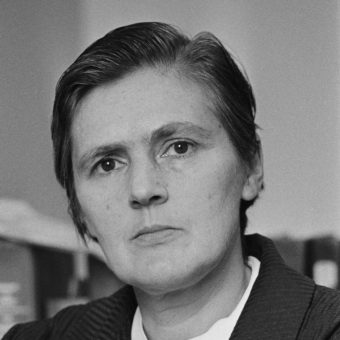
Frances Kelsey, FDA Officer Who Blocked Thalidomide, Dies At 101

Dr. Frances O. Kelsey of the U.S. FDA, who is credited with keeping the birth-deforming drug, Thalidomide, off the U.S. market, is shown in an Aug. 1962 photo. Kelsey died on Friday at age 101. AP
Dr. Frances O. Kelsey of the U.S. FDA, who is credited with keeping the birth-deforming drug, Thalidomide, off the U.S. market, is shown in an Aug. 1962 photo. Kelsey died on Friday at age 101.
AP

Dr. Frances Oldham Kelsey, whose tireless efforts uncovered a link between the drug thalidomide and severe birth defects, has died at age 101.

In 1960, Kelsey was the new medical officer at the Food and Drug Administration when an application for FDA approval of the sedative Kevadon, the trade name of thalidomide, manufactured by drug company William S. Merrell Company of Cincinnati.

Thalidomide had already been sold to pregnant women in Europe and elsewhere as an anti-nausea drug to treat morning sickness, and Merrell wanted a license to do the same in the U.S.

As The New York Times reports, Kelsey asked for more information.

“Thus began a fateful test of wills. Merrell responded. Dr. Kelsey wanted more. Merrell complained to Dr. Kelsey’s bosses, calling her a petty bureaucrat. She persisted. On it went. But by late 1961, the terrible evidence was pouring in.” Thalidomide “was causing thousands of babies in Europe, Britain, Canada and the Middle East to be born with flipperlike arms and legs and other defects.”

As The Washington Post adds, “[the] tragedy was largely averted in the United States, with much credit due to Kelsey. … For a critical 19-month period, she fastidiously blocked its approval while drug company officials maligned her as a bureaucratic nitpicker.”

The Post, in a front-page article published in 1962 described Kelsey as a “heroine” whose “skepticism and stubbornness … prevented what could have been an appalling American tragedy.”

Kelsey, a physician and pharmacologist, died on Aug. 7. Her daughter confirmed her death to The Washington Post, but did not cite a cause.

Copyright 2015 NPR. To see more, visit http://www.npr.org/.
Read Original Article – Published AUGUST 08, 2015 1:20 PM ET

Kodiak’s Alutiiq Museum Releases Book About Karluk Archaelogical Site

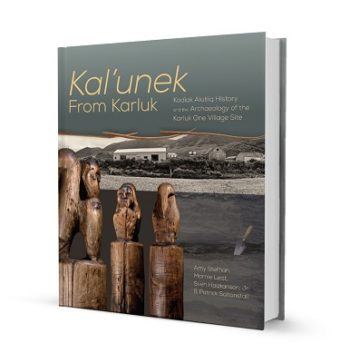
The Alutiiq Museum recently published a book called “Kal’unek” with the University of Alaska Press. The nearly 400-page volume focuses on archeological discoveries near the community of Karluk and delves into the site’s lasting effects on those involved.

The museum’s director of research and publication, Amy Steffian, says the site at the mouth of the Karluk River — Karluk One — opened to excavation in 1983 when few people knew about Kodiak Island’s Alutiiq history.

The Alutiiq Museum's newest publication,  “Kal’unek”. The book focuses on archeological discoveries near the community of Karluk. (Image courtesy of the Alutiiq Museum)
The Alutiiq Museum’s newest publication, “Kal’unek”. The book focuses on archeological discoveries near the community of Karluk. (Image courtesy of the Alutiiq Museum)

“Many people would not even claim their Native heritage because there was so much disenfranchisement and disrespect, and there was this sense that the prehistoric culture … was impoverished,” Steffian says. “[It was thought] that these were poor people who suffered and who didn’t have a vibrant artistic life, and certainly when we set out to study this site, it became pretty clear that that was false.”

Steffian says it became extremely exciting to the Alutiiq community to see the objects coming out of the ground and to have access to them. She says the book is really about two different stories.

“It’s the story of the site and its contents and it provides an ethnography; it talks about how people lived [hundreds of years ago] … but it also tells how this kind of anthropological, archaeological study, when done in partnership with the community, when done with support and involvement, can be a very powerful experience,” she says.

Steffian says that the museum worked on “Kal’unek”with the help of many contributors, from researchers to people who had excavated the site. She says they’ve built a picture about Alutiiq life using a variety of resources, from oral history to Russian texts. Many of the artifacts are especially well-preserved.

The museum’s director, April Laktonen Counceller, says the freshwater that leaked into the site helped prevent oxygen from touching the artifacts until excavators could unearth them.

Counceller says she was involved in the project through the Kodiak Alutiiq New Words Council, which draws on the knowledge of Alutiiq elders. She says the members who had helped create words for modern technology turned their attention to ancient objects.

“By creating words for items where the words were once lost, we were able to kinda put our mark back on that prehistory and say, ‘This is our prehistory,’” she says. “Our people have long been discussed by outside archeologists and anthropologists. For the elders, it was really important to claim ownership over the past by giving back new words to those old items.”

She says they didn’t always invent new words or combine existing ones. For instance, they use applied the modern word for “knife” to an ancient one.

“That helps show the cultural continuity,” explains Counceller. “That we don’t need to come up with a completely unrelated word. We can use an existing word so that people can leverage the language they already have.”

Counceller says there are many more words listed in the book. Steffian says “Kal’unek” is a thorough study of Alutiiq culture and that “the goal was to make it a joint project where everyone was involved and people of all heritages and interests had access to the material.”


Governor meets with Kuskokwim tribes on ‘land into trust’

Gov. Bill Walker on April 18. 2015. (Photo by Jeremy Hsieh/KTOO)

Gov. Bill Walker was in Akiachak and Tuluksak Tuesday to discuss a lawsuit involving tribal lands into trust, according to officials in Akiachak. Walker’s office tried to keep a low profile on his first post-election visit to Southwest Alaska amid high interest in a case that could reshape jurisdiction on Alaska Native lands.

Walker arrived in Akiachak around 10 a.m. and spent a couple of hours meeting with tribal officials and community members before flying to Tuluksak.

Phillip Peter is chairman of the Akiakchak Indian Reorganization Act (IRA) council, which opposes any further delays.

“Akiachak already won the case. I said to them we’re not going to drop this issue, it’s already been approved by the court,” said Peter.

The Walker was traveling Wednesday on the North Slope where he was talking with other tribes about trust lands and was unavailable for comment. Spokeswoman Katie Marquette says Walker is reaching out to tribes like those in Southwest Alaska.

“… To talk to them about lands into trust issues, he has additional meetings across with other tribes in villages across the state to continue to talk about land into trust issues,” said Marquette.

The Department of the Interior announced new rules last year to allow Alaska tribes to put land into trust. Alaska Native leaders say the change, after years of litigation, brings them one step closer to self-determination.

Trust status for tribal land protects it from taxation and alienation – the taking or sale of land — and gives tribes greater jurisdiction. Under the new rules, tribes could put lands they own into trust, including land they’d purchased, received through an inheritance, or lands transferred to tribes by Native Corporations.

The state has fought the issue over the years. Walker inherited the 2013 lawsuit from the Parnell administration. Most recently, Walker asked earlier this year, for a six-month delay in the case. The state is not talking about its plans now, but Akiachak officials say Walker wants another six months.

Cori Mills, an assistant attorney general with the Department of Law, says the first six-month extension ended in July, the state then received a 30-day extension and now faces a deadline of Aug. 24.

“That’s the deadline in place now. Whether the state makes a different decision or wants to withdraw the appeal, that’s yet to be seen and will be determined by Aug. 24 in whatever is filed by that time,” said Mills.

The state can also ask for more time.

After the meeting, described as a first for the community, Akiachak’s Phillip Peter is hopeful that Walker seems willing to work with them.

“The governor is willing to work with the tribes about the land into trust issues. I was saying to the governor that we’re going to go forward and work with the state of Alaska on this land into trust issue,” said Peter.

Akiachak and Tuluksak were plaintiffs in earlier litigation to allow trust lands.

How Percy Shelley Stirred His Politics Into His Teacup

Joseph Severn's portrait of Percy Bysshe Shelley. The radical 19th century poet practiced the politics of the plate. For Shelley and other liberals of his day, keeping sugar out of tea was a political statement against slavery. Joseph Severn/Wikimedia
Joseph Severn’s portrait of Percy Bysshe Shelley. The radical 19th century poet practiced the politics of the plate. For Shelley and other liberals of his day, keeping sugar out of tea was a political statement against slavery.
Joseph Severn/Wikimedia

Born 223 years ago on Aug. 4, the great Romantic poet Percy Bysshe Shelley is celebrated for such works as his sublime odes to the skylark and West Wind. But he was also a radical thinker — and his revolutionary politics stormed in his teacup.

Slender of build and Spartan in habit, the tall, fair-haired poet had no taste for rich foods or wine. A vegetarian who shuddered at animal slaughter — though there were lapses into muttonchops and bacon — Shelley was an indifferent eater. He would absently spoon congealed food down his throat while his bright blue eyes devoured Aeschylus or Plutarch, whose essays on vegetarianism he translated.

But the one beverage to which he was addicted was tea.

His appetite for tea was limitless. Presumably, Shelley would have loved to load his cup with sugar — he had a strong sweet tooth. Except that in his lifetime, sugar came to epitomize the evils of slavery. In the liberal circles Shelley moved in, eating sugar was about as acceptable as displaying tusks of ivory in one’s living room is today.

In 1791, the year before Shelley was born, the abolitionist William Fox published his anti-sugar pamphlet, which called for a boycott of sugar grown by slaves working in inhuman conditions in the British-governed West Indies. “In every pound of sugar used, we may be considered as consuming two ounces of human flesh,” wrote Fox. So powerful was his appeal that close to 400,000 Britons gave up sugar.

The sugar boycott squarely affected that most beloved of English rituals: afternoon tea. As The Salt has reported, sugar was an integral reason why tea became an engrained habit of the British in the 1700s. But with the sugar boycott, offering or not offering sugar with tea became a highly political act.

Soon, grocers stopped selling West Indies sugar and began to sell “East Indies sugar” from India. Those who bought this sugar were careful to broadcast their virtue by serving it in bowls imprinted with the words “not made by slave labor,” in much the same way that coffee today is advertised as fair-trade, or eggs as free-range.

Leading the boycott were the Romantic poets Coleridge and Shelley’s early hero, Robert Southey, who described tea as a “blood-sweeten’d beverage” produced under the “mangling scourge” of the trader’s whip. Shelley used these very words in his first long poem, Queen Mab, to evoke plantation slaves toiling “to the sound of the flesh-mangling scourge” to produce “all-polluting luxury and wealth.”

Both Shelley and his second wife, Mary, abstained from sugar and drank green tea instead. According to Mary Shelley’s biographer Miranda Seymour, the lonely and misunderstood monster in Mary’s 1818 masterpiece, Frankenstein, is based on the African slaves she saw being worked at the quays in Bristol, a major slave port at the time. Mary’s father, William Godwin — a radical socialist philosopher at the forefront of the antislavery movement, and Shelley’s mentor — enjoyed a strong smoky green tea known as Gunpowder.

Still, even Shelley’s high-minded avoidance of sugar had its limits. This, after all, was a man who liked to lick honey straight from the honeycomb. As his friend, Thomas Jefferson Hogg, wrote, Shelley “would greedily eat cakes, gingerbread, and sugar.” And at Oxford, at least, Shelley took his tea with sugar.

For the most part, though, the poet seems to have maneuvered around the need for the sweet stuff in his cup by drinking only the best, most expensive green tea. Though barely a step ahead of the debt collector, he insisted on having the finest tea shipped to Italy when he and Mary moved there for the last four years of his life. It was, Mary explained, a necessity, as “Townley tea” — a common brand — “was tried and found wanting.”

What else would one expect of Shelley? He was, after all, born an aristocrat. His radical politics caused his estrangement from his wealthy family, but they did not strip him of his taste for good tea. Indeed, the man who got kicked out of Oxford for writing a pamphlet on “The Necessity of Atheism” liked to joke that he was actually a “théist” — by which he meant, a devotee of tea.

That devotion never wavered. Though doctors of the age cautioned against excessive drinking of stimulants like tea and coffee, Shelley — in his usual rebel manner — sneered at their counsel. A couple of years before his death, he wrote:

“The liquor doctors rail at—and which I
Will quaff in spite of them—and when we die
We’ll toss up who died first of drinking tea,
And cry out,—’Heads or tails?’ where’er we be.”

Afternoon tea didn’t kill Shelley — an afternoon storm did. A month before his 30th birthday, Shelley drowned off the coast of Italy.


Nina Martyris is a freelance journalist based in Knoxville, Tenn.

Copyright 2015 NPR. To see more, visit http://www.npr.org/.
Read Original Article – Published AUGUST 04, 2015 3:43 PM ET
Site notifications
Update notification options
Subscribe to notifications