History

Human skull discovered in dirt pile delivered to Haines raptor center

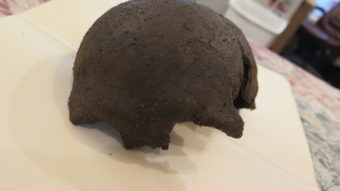
Part of a human skull was found in a dirt pile at the American Bald Eagle Foundation on Monday. (Photo courtesy Cheryl McRoberts)

A human skull was found in a pile of dirt last week in Haines. Employees at the American Bald Eagle Foundation were working on improving accommodations for raptors residing there when the skull was unearthed.

Chloe Goodson, the raptor curator at the Eagle Foundation, got quite the surprise while working outside on the property.

“We were shoveling away, there were just three of us — myself, another staff member and an intern — and suddenly we struck something that wasn’t quite breaking apart and we were sort of wondering ‘what is this object?’ One person said ‘Is this a coconut?’ another person said, ‘Is it like a clay pot or something? This is really weird.’ One of the interns said she could see traces of where blood vessels were so we were thinking ‘What kind of animal was this at some point?’ So, we turned it around and turned it around then we came face to face with a human skull. You could see the top of the ridges for the eyes and part of the bridge of the nose was still there between the eyes.”

Goodson says the dirt pile was delivered from a site at 6.5-mile Haines Highway. They were working to convert two sheds into aviaries for the raptors.

“Everyone was pretty much just in shock — eyes wide, jaws dropped. This doesn’t happen to real people, this is something that you’d only see in a movie or something,” Goodson said.

She says they stood there in utter astonishment for a moment before alerting foundation director Cheryl McRoberts and calling the police.

Interim Police Chief Robert Griffiths says the police are working with local tribal organizations.

“We have a human skull that was found that’s an ancient artifact so we’re coordinating the excavation of that site in cooperation with both of our tribes in town,” the chief said.

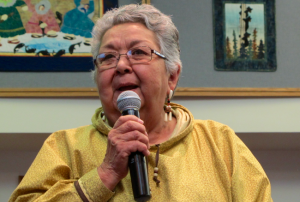
Haines police responded and initiated an investigation Monday afternoon. Griffiths says local anthropologist Anastasia Wiley examined the artifact and determined the skull belonged to a female Native American at least 40 years of age and likely dates to before the 1700s.
Griffiths says that the State Medical Examiner’s Office is looking at photographs of the skull. When the origin and age of the skull is determined, it will be returned to ancestors in the area for a traditional burial.

“If it’s truly an antiquity, and we believe it is based on our limited knowledge of it, then the medical examiner will simply turn it back over to us to release to the family and in this case the family would be the descendants, which, in this case, would be the local Native organizations,” he said.

When police arrived they found another small piece of bone in the pile. Goodson says watching the anthropologist examine the skull and make her observations was fascinating.

“She just came to the conclusion of older, possibly female, Native American before the 1700s and she just went into all of the explanation for that and it was just really impressive.”

Goodson says she volunteered to help go through the dirt pile with Wiley and other volunteers this weekend.
“When I took the job as raptor curator, I never thought I would dig up human remains, so that was pretty interesting.”

The site at 6.5-mile will also be excavated to see if there are other remains in the area.
Wiley was unavailable for an interview.

Village council organization elects first-ever female traditional chief

Bea Kristovich is the first woman Traditional Chief of AVCP. (Photo by Anna Rose MacArthur / KYUK)

In a historical election Bea Kristovich is the first woman to ever be elected Traditional Chief of the Association of Village Council Presidents.

“I think I’m still in shock,” she responded when asked about her new position.

On the second day of the 51st  AVCP Annual Convention association delegates elected Kristovich as 2nd Traditional Chief of AVCP.

“Women were always left out over the years,” Kristovich said. “The men were the leaders. But over the years, there’s been more women getting more active, going into active roles as leaders from the villages. And they’re still silent. But I think being the first one, it will show the other younger generation that they can do it.”

Kristovich has been active in working on Native and education issues for more than 40 years. She was also part of the effort to see the Alaska Native Claims Settlement Act passed.

The Traditional Chief acts as a figurehead — opening meetings, saying prayers and offering traditional knowledge. But Kristovich, who belongs to the Native Village of Napaimute, wants to do more than that. In her new position, Kristovich said she wants to encourage leaders to speak openly. To do that, they will have to challenge their cultural upbringing.

“We weren’t raised that way to be open or talk about people or argue or stuff like that” Kristovich explained.

She also says she wants older leaders to retire so younger leaders can step forward to learn about tribal issues.

“I want them to be united,” Kristovich continued. “You know, [there are] 56 villages, and they’re still separated by Yukon, Kuskokwim and our area, and I think if we were all united, we’d be so strong. We could stick together and fight for issues that are very important for our people and our villages. It would work.”

Women’s traditional chin tattoos are making a comeback in Alaska


More and more Inuit women are getting face tattoos.

The traditional practice dates back centuries but was banned by 19th and 20th-century missionaries. Now it’s coming back. Though the techniques and customs were nearly lost, a new generation is using tattoos to reclaim what it means to be a Native woman in the 21st century.
In the backroom of a small Anchorage tattoo parlor, Maya Sialuk Jacobsen uses a thin needle to pull an inky thread through the skin on her friend’s wrist.

“I use the exit hole as the entrance for the next stitch,” Jacobsen explained, bent over her work as a small crowd observed.

The friend is Holly Mititquq Nordlum, organizer of a weeklong series of tattoo-related events called Tupik-Mi. Compared to the sting of a tattoo gun, the stitches hardly register, and Norldum looks unfazed, greeting and bantering with observers cycling in and out of the cramped room.

“It’s loose,” Nordlum said, nodding at the flesh on her arm. “I put on a few pounds so she’d have something to work with.”

“Her skin is so much better than my husband’s skin,” Jacobsen laughed. “She has really lovely skin to tattoo.”

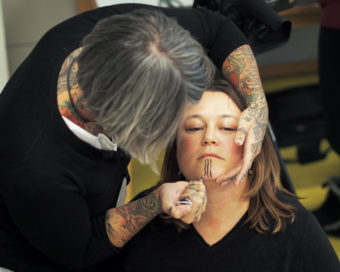
Maya Sialuk Jacobsen of Greenland gives a henna tattoo to a friend’s chin during an event at the Anchorage Museum, part of the Polar Lab’s Tupik-Mi series on traditional tattoos. (Photo by Zachariah Hughes/KSKA)

Jacobsen is one of the few Inuit women who knows how to give tattoos through traditional methods like sewing and poking in dabs of dye. She’s candid about the fact that the equipment has changed. Instead of whale sinew, she uses cotton thread; rather than coloring with soot, she uses tattoo ink. But much like rifle hunting compared to harpooning, she sees her modern tools simply as superior means towards traditional ends: inscribing the skin with meaningful marks.

Jacobsen has spent years cobbling together a body of knowledge about what the practice meant before Danish colonization in her native Greenland almost three centuries ago.

“There is no short answer,” Jacobsen says, adding, “it’s also a very Western, academic way of thinking.”

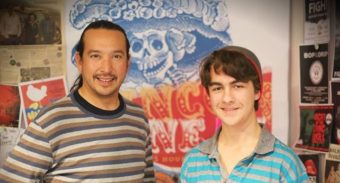
Jacobsen’s son Benjamin came with her from Greenland, and shows off self-administered henna designs made of different traditional patterns, but reconfigured. (Photo by Zachariah Hughes/ KSKA)

Outsiders have looked at Inuit tattoos as having legible meanings embedded within stable rituals, like clear markers signifying marriage or adulthood. But not only did those cultural foreigners import concepts of their own–like marriage–but also a sense of fixity to a practice Jacobsen says was much more fluid and interpretive. “I can’t tell you a triangle means an iceberg,” she explained dryly. That’s partly because the historical record is unreliable, but also because symbols were not nearly so firm.”

You can’t understand tattooing, she believes, without understanding the lives of Inuit women.

While working as a tattoo artist in Europe, Jacobsen was diagnosed with fibromyalgia, which made it difficult to wield the heavy, vibrating drill that is the trade’s standard instrument. So she started poking, and from there stitching. But as she tried learning more about how Inuit women had traditionally been marked, the few historical accounts all came from European adventurers and missionaries.

“I assure you, they did not really know what tattooing was,” Jacobsen says with a wry smile.

But then came the mummies. A group of 15th century Inuit women discovered during 1972 at the Qilakitsoq (“little sky”) grave-site in Greenland, preserved tattoos and all. Jacobsen found a book about them, studied the designs, and realized the marks on their foreheads, cheeks, and chins were similar to the tight stitches she’d learned as a girl. It was her first primary source.

“I have, like, literature, and then I have, what I call ‘from the horse’s mouth,’” Jacobsen says, “and that is the mummies.”

Tupik-Mi, Jacobson and Norldum’s project, is part of an effort within the Urban Interventions series in the Anchorage Museum’s Polar Lab.

“Tupik means tattoo,” explained Nordlum, who is Inupiaq, “and then ‘mi’ is a shortened version of muit, which means ‘people.’ In Kotzebue, we say ‘Qikiqtaġrumuit’ which means, ‘We’re the people from Kotzebue.’”

Nordlum was introduced to Jacobsen over Facebook after she couldn’t find anyone to give her a traditional tattoo in Alaska. A friendship blossomed, and they arranged the first in what they hope will be yearly Tupik-Mi events.

In addition to a lecture and live tattooing demonstration, the women also hosted a light explanation of traditional tattoos for high schoolers before letting them apply tube after tube of henna to their appendages.

Nordlum squeezed a tight formation of dots and lines onto the back of an 11th grader’s wrist.

“She’s making my initials with the Inuit designs,” says Ben Hunter-Francis.

The West High junior says he has plenty of time to decide whether or not he’ll get a tattoo. But if he does, he’d like it to be attached to his Yup’ik roots in the Lower-Yukon community of Marshall.

“Just to make my heritage proud, and make my family proud,” Hunter-Francis says, “that I’m connected with my heritage in some way.”

Traditionally, tattooing was the province of women. They were the ones who wore them, and exclusively the ones to administer them. But as Nordlum finished Hunter-Francis’s wrist, she explained that the practice isn’t bound in place by history.

“In modern culture, men getting tattoos is not a rarity. We are contemporary people working in modern times, so although it was a rarity traditionally, now it isn’t,” Nordlum says, not letting up her hold on Hunter-Francis’s arm.

“Culture is not a set thing, it is a living breathing thing that changes as time goes, and we’re just adapting … like skin.”

Holly Mititquq Nordlum shows off her partially complete tattoo during a live demonstration at Anchorage’s Above The Rest studio. Each horizontal line is 40 individual stitch marks through the first layer of skin. Before starting the stitches, Jacobsen poked the basic design of three bird feet rising from the lines. Nordlum’s Inupiaq name, Mititquq, means ‘a place where birds land,’ and she celebrates big life goals with bird feet tattoos, like the two on her opposite wrist, done with a tattoo gun. (Photo by Zachariah Hughes/ KSKA)

If plans go ahead, Tupik-Mi will expand next year to train a handful of Alaskans in traditional tattooing methods. By the third year, the hope is to hold workshops in Canada and Greenland, growing tattooing capacity across the high north.

“The idea,” Nordlum explains, “is for Iñupiaq, Inuit, Yup’ik women to feel proud of who they are. To feel strong. To create a sisterhood. To belong to something bigger than yourself, so that you’re safe and you’re supported by all these other women.”

Nordlum was a few days away from getting lines tattooed on her chin, one of the most visible and common styles across a wide array of indigenous Arctic communities. She says more women in Alaska are opting for chin tattoos, to the point where she brushed off the suggestion it was a bold decision to get one

“I don’t feel very brave here because there’s so many of us,” Nordlum says.

Permanence is part of why tattoos carry so much weight, and Nordlum sees the resurgence in women’s chin tattoos as putting forward a permanent, proud Native identity for all to see.

Jacobsen had her own chin lines laid down by her partner just two months ago. Soon after the process began, she felt a visit from her late mother.

“My mind was just wrapped around all of these thousands of fore-mothers I must have had that had tattoos,” Jacobsen says, her words growing softer. “My heart was beating so hard, and I cried, and I was shaking.”

Four thin lines that would have normally taken a few minutes took hours. “It was definitely very, very emotional,” she says.

Jacobsen is sharing that intimate experience with Nordlum, dot-by-dot, as she pokes a tattoo into her friend’s chin.

LGBT rights in Alaska

P R I D E

LGBT Rights in Alaska: Past, Present, Future

Layout and Design: Lakeidra Chavis
Content: Lakeidra Chavis
Editing: Jennifer Canfield and Jeremy Hsieh

A lifetime of fighting: A history of Alaska LGBT rights

Alaskans voted in 1998 to define marriage in the state constitution as only between a man and a woman. Now that the U.S. Supreme Court has invalidated that definition, Alaska and the entire country has marriage equality.

To some it may seem like things are changing fast, but Alaska’s fight for gay rights began half a lifetime ago.


Gov. Bill Walker on April 18. 2015. (Photo by Jeremy Hsieh/KTOO)

Q&A: Gov. Walker discusses LGBT rights

Walker has not given a direct answer when questioned about his position on LGBT rights. He’s only stated that he believes marriage is between a man and a woman. When questioned further in this interview about his stance on LGBT rights, he still did not provide a direct answer.

Rachel Pettijohn says she was discriminated against by two Juneau employers. The State of Alaska has no law protecting discrimination based on sexual identity or gender orientation. (Photo by Lakeidra Chavis/KTOO)

Despite marriage equality ruling, LGBTQ Alaskans can still be discriminated against

“They didn’t fire me,” says Rachel Pettijohn, “they just cut down my hours to where I wasn’t getting any hours.” 

Rainbow flags fly in front of San Francisco City Hall in 2013 after the U.S. Supreme Court cleared the way for same-sex marriage in California. Noah Berger/AP

LGBT discrimination claims still not valid in Alaska

“Just imagine if you couldn’t call the fire department because you were LGBT. If you are LGBT you should be able to call any state agency and get the same service,” says attorney Caitlin Shortell. She represented the same-sex couples that sued the state for the right to marry. “This is an injustice that needs to be corrected.”


Politicians and activists weigh in

Jesse Kiehl, aide to Sen. Dennis Egan, interacts with a visitor to the senator's office, Feb, 10, 2014. (Photo by Skip Gray/Gavel Alaska)

Juneau Assemblyman Jesse Kiehl on LGBT protections in Juneau.

Gov. Bill Walker discusses a tax credit veto with the press, July 1, 2015. (Photo by Jeremy Hsieh/KTOO)

Gov. Walker on handling LGBT rights during his tenure.

Activist and researcher Melissa Green. (Photo courtesy of Melissa Green)

Activist and Researcher Melissa Green.


Documents

This list includes the official files from bills that have included sexual orientation or gender identity in drafts of legislation dating back to 1975. The grid also includes links to significant court cases and video focusing on LGBT rights.

9/11 Remembered

A silent moment of the prayer before the raising of the American flag at Riverside Rotary Park. (Photo by Matt Miller/KTOO)
A moment of prayer before the raising of the American flag to half mast at Riverside Rotary Park. (Photo by Matt Miller/KTOO)
Juneau residents get to know first responders and service members during a short break in the obseverance. (Photo by Matt Miller/KTOO)
Juneau residents get to know first responders and service members during a short break in the observance. (Photo by Matt Miller/KTOO)

Juneau residents paused for a few minutes on Friday morning to remember those who lost their lives on Sept. 11, 2001 in New York, Washington D.C., and Pennsylvania. The 9/11 observance was held at Riverside Rotary Park in the Mendenhall Valley.

In remarks during the observance, George Riefenstein, retired special teams captain for Capital City Fire/Rescue, said they wanted to remember the 2,973 people who died on September 11. He also said they wanted to honor 1,400 additional people — rescue workers who have since died because of health issues related toxin exposure at the World Trade Center site.

“The healing goes on, as does as the commitment to serve with integrity and compassion that honors the memory of the fallen,” Reifenstein said. “We will never forget their sacrifice.”

“We all saw through the horror of that day what it means to be human. That, our connection to one another is as close as the manifestation of kindness and selflessness within the human spirit. By celebrating those unique qualities, we triumph over intimidation and we are guided forward with the knowledge that we will prevail.”

Abigail Zahasky sings the National Anthem (Photo by Matt Miller/KTOO)
Abigail Zahasky sings The Star-Spangled Banner. (Photo by Matt Miller/KTOO)
Scott Marnon of the City of Juneau Pipe Band (Photo by Matt Miller/KTOO)
(Photo by Matt Miller/KTOO)
Click to enlarge photo of program (Photo by Matt Miller/KTOO)
Juneau residents remember first responders whose names have been engraved in bricks at Riverside Rotary Park. (Photo by Matt Miller/KTOO)
Juneau Police and Capital City Fire/Rescue were among those attending the 9/11 observance. (Photo by Matt Miller/KTOO)

Veterans Used In Secret Experiments Sue Military For Answers

Historic images from the Naval Research Laboratory depict results of a test subject who was exposed to mustard gas. Naval Research Laboratory
Historic images from the Naval Research Laboratory depict results of a test subject who was exposed to mustard gas.
Naval Research Laboratory

American service members used in chemical and biological testing have some questions: What exactly were they exposed to? And how is it affecting their health?

Tens of thousands of troops were used in testing conducted by the U.S. military between 1922 and 1975. As one Army scientist explained, the military wanted to learn how to induce symptoms such as “fear, panic, hysteria, and hallucinations” in enemy soldiers. Recruitment was done on a volunteer basis, but the details of the testing and associated risks were often withheld from those who signed up.

Many of the veterans who served as test subjects have since died. But today, those who are still alive are part of a class action lawsuit against the Army. If they’re successful, the Army will have to explain to anyone who was used in testing exactly what substances they were given and any known risks. The Army would also have to provide those veterans with health care for any illnesses that result, in whole or in part, from the testing.

The law firm representing the veterans estimates at least 70,000 troops were used in the testing, including World War II veterans exposed to mustard gas, whom NPR reported on earlier this summer.

Bill Blazinski has chronic lymphocytic leukemia, which he thinks may have been caused by the military tests. He was 20 years old and had just graduated from boot camp when he volunteered in 1968.

“There would be a guaranteed three-day pass every weekend unless you had a test,” he says. “There would be no kitchen police duties, no guard duties. And it sounded like a pretty good duty.”

What sounded more like a vacation than military duty quickly changed, he says. In one test, doctors said they would inject him with an agent and its antidote back to back.

“We were placed in individual padded cells. And you know the nurse left and I’m looking at this padded wall and I knew it was solid but all of a sudden started fluttering like a flag does up on a flag pole,” he recalls.

To learn about what substances made him hallucinate, in 2006, Blazinski requested the original test documents under the Freedom of Information Act. It showed two antidotes for nerve agent poisoning with dangerous known side effects.

Researchers kept information about which agents they were administering from test subjects to avoid influencing the test results. A lawyer representing the veterans, Ben Patterson of the law firm Morrison and Foerster, says that’s a problem.

“They don’t know what they were exposed to. You know, some of these substances were only referred to by code names,” Patterson says.

Code names such as CAR 302668. That’s one of the agents, records show, that researchers injected into Frank Rochelle in 1968.

During one test, Rochelle remembers that the freckles on his arms and legs appeared to be moving. Thinking bugs had crawled under his skin, he tried using a razor blade from his shaving kit to cut them out. After that test, he says he hallucinated for 40 hours.

“There were animals coming out of the walls,” he says. “I saw a huge rabbit and he was solid white with red eyes.”

In 1975, the Army’s chief of medical research admitted to Congress that he didn’t have the funding to monitor test subjects’ health after they went through the experiments. Since then, the military says it has ended all chemical and biological testing.

Test subjects like Rochelle say that’s not enough.

“We were assured that everything that went on inside the clinic, we were going to be under 100 percent observation; they were going to do nothing to harm us,” he says. “And also we were sure that we would be taken care of afterwards if anything happened. Instead we were left to hang out to dry.”

The Department of Justice is representing the Army in the case and declined to comment for this story. In June, an appeals court ruled in favor of the veterans. On Friday, the Army filed for a rehearing.

Copyright 2015 NPR. To see more, visit http://www.npr.org/.
Read Original Article – Published SEPTEMBER 05, 2015 5:07 PM ET
Site notifications
Update notification options
Subscribe to notifications