History

American Women Who Were Anti-Suffragettes

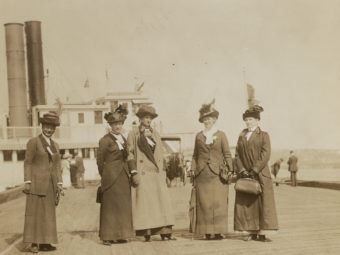
A group of anti-suffrage leaders who organized a barge excursion up the Hudson River for a Decoration Day picnic in New York, 1913 (from left): Mrs. George Phillips, Mrs. K.B. Lapham, Miss Burnham, Mrs. Everett P. Wheeler, Mrs. John A. Church. Library of Congress
A group of anti-suffrage leaders who organized a barge excursion up the Hudson River for a Decoration Day picnic in New York, 1913 (from left): Mrs. George Phillips, Mrs. K.B. Lapham, Miss Burnham, Mrs. Everett P. Wheeler, Mrs. John A. Church.
Library of Congress

With the new movie about the British suffrage movement, Suffragette, scheduled to be released this week, recollections of protest and debate concerning a woman’s right to vote in the U.S. are inevitable.

As the 19th century ended and the 20th began, the American wave of women pushing for access to the ballot box gathered momentum. But it wasn’t until the 19th Amendment to the Constitution was ratified in 1920 that voting rights were guaranteed for all women.

Hard as it is to imagine today, there were certain women — mostly forgotten — during that period of duress who did not believe that women deserved the right to vote. Some called these naysayers “anti-suffragettes” or “anti-suffragists.” Some called them “remonstrants” or “governmentalists.” Some called them just plain “antis.”

Who were these women who actively spoke out against a woman’s right to vote?

Privileged Class

The female leaders of the U.S. anti-suffrage campaign “were generally women of wealth, privilege, social status and even political power,” NPR learns from Corrine McConnaughy, who teaches political science at George Washington University and is author of the 2013 The Woman Suffrage Movement in America: A Reassessment. “In short, they were women who were doing, comparatively, quite well under the existing system, with incentives to hang onto a system that privileged them.”

Anti-suffrage leaders in the North, she says, “were generally urban, often the daughters and-or wives of well-to-do men of business, banking or politics. They were also quite likely to be involved in philanthropic or ‘reform’ work that hewed to traditional gender norms.”

Southern anti-suffrage leaders, she says, “were generally planter class, and so their resistance was also tied more explicitly to worries about disruption of the racial order.”

Anti-suffragists everywhere were concerned with societal disruptions. “What women anti-suffragists produced to appeal to ‘ordinary’ women more broadly,” McConnaughy adds, “was a logic of suffrage as a threat to femininity … to the protection of the value of domestic life — most notably to the vocation of motherhood, and to a loss of the privileges of womanhood.”

Community Activists

To attempt to understand the type of person who rallied against her own­­ rights, it might be beneficial to remember some of the opponents — and revisit their reasoning.

  • Mrs. William Force Scott. When the opposing sides squared off at the Woman’s University Club in New York City in the spring of 1909, the New York Times reported the story on April 24 under the headline: “SUFFRAGETTES MEET THE ANTIS IN DEBATE.” Speaking for the anti-suffragists, Mrs. Scott — referred to only by her married name in the Times — explained to the crowd that an “inherent right to vote” does not exist and that it was all a matter of expediency. “If women should vote,” Mrs. Scott told the gathering, “they must join one of the existing political parties or form a new party of their own — a Woman’s Party — and that would be women against men, and more dangerous than labor against capital.”
  • Josephine Jewell Dodge. For a while, she was the president of the National Association Opposed to Woman Suffrage. According to a biography compiled by her alma mater, Vassar College, she was the daughter of Marshall Jewell, the U.S. minister to Russia and then the U.S. postmaster general in the 1870s. In 1875, she married Arthur Dodge, who was from a prominent New York family. “Mrs. Dodge was both an outspoken anti-suffragist and a central actor in the reform campaign that worked toward the establishment of child care programs — ‘day nurseries’ — for the children of poor and working-class women who worked because of financial necessity,” McConnaughy says. “Her message really was about the damage to the reform potential of women that she believed woman suffrage would bring — through women’s integration into the ‘corrupt’ world of party politics.”
  • Kate Douglas Wiggin. An internationally known author of children’s books, she told a group of anti-suffragists in Washington in April of 1912 that she would have “woman strong enough to keep just a trifle in the background, for the limelight never makes anything grow.” The Western Sentinel of Winston-Salem, N.C., reported that she believed “it was more difficult to be an inspiring woman than a good citizen and an honest voter.”

Women in the upper echelons of society “saw ‘status’ as a result of their particular gender experience,” McConnaughy says. “They were particularly capable of reform work or philanthropy exactly because of their upper-class version of womanhood. And they had an interest in continuing their gendered influence.”

Serving The State

Author Kate Douglas Wiggin, for example, founded the Free Kindergarten system in California and was the first vice president of the Kindergarten Association in New York, according to the Louisville, Ky., Courier-Journal on March 2, 1913.

Also featured in the story about high-profile anti-suffragists who were involved in civic and charity work were Josephine Jewell Dodge; Annie Nathan Meyer, one of the founders of Barnard College; Anna C. Maxwell, superintendent of the Presbyterian Hospital Training School for Nurses; and Eleanor G. Hewitt, who was active at Cooper Union, which offered free education classes.

Women “should serve the state in every way possible without jeopardizing the home by entrance into active politics,” Dodge told the Courier-Journal.

The opportunity for all American women to participate in “active politics” did come, a few years later. “We know further,” Corrine McConnaughy adds, “that the right to vote did not quickly translate into actual voting on the part of many women. A gender gap in voting — with women much less likely to vote than men — endured for decades after women’s enfranchisement.”


Follow me @NPRHistoryDept; lead me by writing lweeks@npr.org

Copyright 2015 NPR. To see more, visit http://www.npr.org/.
Read Original Article – Published OCTOBER 22, 201511:03 AM ET

Seabirds recolonize Attu Island amid toxic WWII battlefield remnants

Personal from The US Fish and Wildlife Service research boat R/V Tiglax visit the World War II memorial constructed by the Japanese government honoring American and Japanese soldiers on Engineer Hill on Attu Island on Wednesday, June 3, 2015. (Photo by Bob Hallinen/Alaska Dispatch News)

It’s been seven decades since U.S. soldiers recaptured Attu Island from Japanese forces, setting off one of the bloodiest battles of World War II.

Once they recovered the most remote island in the Aleutian Chain, American forces transformed it, briefly, into a strategic hub. But that decades-old infrastructure has been crumbling under influence of harsh winds, weather and time.

Now, Attu is scheduled for what may be the first of many stages of cleanup — but it’s unlikely the military will ever be able to turn back the clock to a time before conflict.
Long before the war, Attu was home to a small village. It was also a haven for birds.

“These common eiders, they just make this cooing — rrr, rrr. On a day like this, it carries across the water,” said Jeff Williams, assistant manager for the Alaska Maritime National Wildlife Refuge, standing on the shore of Attu’s Casco Cove in early June. The sun shone brightly, with only the barest breeze pushing its way through tangles of beach grass.

Attu has been a refuge for wildlife since 1913. President Theodore Roosevelt set it aside, along with a handful of other islands that were important to seabirds and marine mammals. But refuge status didn’t stop the military from using those lands during World War II.

There are now more than 20 former defense sites located within the Alaska Maritime National Wildlife Refuge. Attu is the most remote — nearly 1,500 air miles from Anchorage — and one of the most deeply affected. Besides collapsed Quonset huts and spent shells, the tundra is covered with rusting tank farms, decaying fuel barrels and miles of pipeline.

This summer, Williams and a few volunteers for the U.S. Fish and Wildlife Service stopped to check on one of the worst areas — a field of above-ground storage tanks near an area called Navy Cove.

“I mean, you can see the valve right there, just coming out,” Williams said, pointing to a viscous puddle of black liquid that had oozed from one tank. “It’s a direct source.”

Biologist Jeff Williams checks the eggs in an Aleutian Canada goose nest on Attu Island. (Photo by Bob Hallinen/Alaska Dispatch News)

The bodies of at least a half-dozen birds dotted the puddle; their decaying wings jutting out at odd angles — “almost like the La Brea tar pits.”

“It’s not as thick — only a few inches thick. But it’s just enough,” Williams said. He gestured to-ward the edge of the puddle. “See a carcass right over here?”

Over the years, investigators for the Fish and Wildlife Service have found the remains of many more birds trapped in this puddle. It’s the most obvious example of a much broader problem, as infrastructure built to support the Attu Naval Station and the Attu Army Air Base disintegrates.

Both facilities closed in the years following World War II. The naval station came back into use in 1959 amid rising hostility between the United States and the Soviet Union. Within a decade, it had closed again, though, and the military returned all but a sliver of its 82,400-acre reservation to the wildlife refuge. (The remaining 1,800 acres were kept for the U.S. Coast Guard, which continuously maintained a navigational station on Attu until 2010.)

Fish and Wildlife and federal contractors have conducted multiple site studies and reviewed as-built blueprints over the years, but they’ve never determined just how many gallons of petroleum products are still here. There have been some attempts to remove them: Williams said the Navy tried to decommission some of the fuel tanks they installed when the base finally shut down.

“They burned a lot of them. There are pictures of guys with flamethrowers going right up to the tank. It’s really remarkable to see flamethrowers going on gunk like this, just igniting it and black flames flying up,” Williams said. “You know, I think we’ve changed some since then.”

Abandoned tanks on Attu Island are inventoried as the US Fish and Wildlife Service research boat R/V Tiglax stops at the western most of the Aleutian Islands on Wednesday, June 3, 2015. (Photo by Bob Hallinen/Alaska Dispatch News)

When the Army Corps of Engineers arrives on Attu in summer 2016, their operations will look much different. The agency has hired Bristol Environmental Remediation Services, LLC — a subsidiary of the Bristol Bay Native Corporation — to remove old storage containers and polluted soil from two sites, including the leaky tank farm.

“We are also aware of a pallet-sized pile of old lead batteries,” said Army Corps project manager Andy Sorum. “And we’re going to target not only the remains of those batteries, but the contaminated soil around it.”

The Army Corps received an extra burst of funding from Congress for this work. The price tag is $10 million; at least 40 percent of that covers a season’s worth of logistical expenses. “There’s nothing easy about getting heavy equipment to Attu and removing the volume of potentially contaminated material that we’re dealing with here,” Sorum said. He expects to deploy a mix of barges and aircraft, since Attu’s runways are still operable.

Sorum also hopes to clean up other sections of the island down the road, working with federal site managers and the Alaska Department of Environmental Conservation on details.

But there are limits to what the Corps can do. Ken Andraschko oversees environmental restoration at old defense sites for the Army Corps of Engineers in Alaska. He said his teams will focus on chemical hazards; munitions and explosives expended during the war are beyond the scope of their program as outlined by Congress.

“Anything that’s actually in a battlefield, anything that was released as part of the battlefield would be ineligible, because that’s defined as an Act of War,” Andraschko said. “And under our program, that is exclusively forbidden for us to go address.”

A cormorant comes in for a landing near a rookery. (Photo by Bob Hallinen/Alaska Dispatch News)

The battlefield was confined to the easternmost corner of Attu, but it casts a long shadow. American forces invaded by sea and slowly charged inland, through fog and frigid rains. Cut off from reinforcements, many Japanese soldiers decided it was more honorable to perish in battle — or by suicide — than to surrender. About 2,900 men are believed to have died over the course of 18 days.

Now, the battlefield is a national landmark and part of a national monument to World War II in the Pacific Theater. “It’s not like your typical Civil War battlefield or your European battlefield where everything’s manicured,” said historian John Cloe. “These things are in a real wild state.”

Cloe knows that firsthand. After retiring from a long career as a reservist and Air Force historian, Cloe is now a guide for a California-based company called Valor Tours. He’s been leading small groups of World War II buffs on sailing trips to Attu since 2013.

When it comes to cleaning up the island, Cloe is strongly in favor. “Go to a Civil War battlefield — you don’t see a lot of junk lying around, do you?” he asked. “It’s unsightly, all this twisted metal lying around. It has very little historical relevance. Somebody needs to look at it and make sure, though.”

It’s still being debated, but that twisted metal may stay put. The federal agencies responsible for managing Attu Island aren’t as concerned about debris, so long as it doesn’t leach chemicals or harm wildlife.

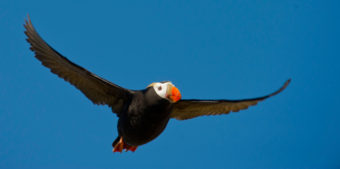
A tufted puffin returns to its nest as the US Fish and Wildlife Service research boat R/V Tiglax stops at Attu Island the western most of the Aleutian Islands on Thursday, June 4, 2015. (Photo by Bob Hallinen/Alaska Dispatch News)

The wreckage wasn’t enough to keep Aleutian cackling geese at bay. This summer, their high-pitched honks rang out from the shoreline all the way up to Attu’s mountain passes. The entire species was nearly extinct before the Fish and Wildlife Service launched a huge effort to bring the cackling goose back into its old nesting grounds on the refuge.

“We didn’t bring these birds to Attu,” said Billy Pepper, captain of Fish and Wildlife’s research vessel. “All we did was remove the fox from here — and all of a sudden we come here one year and hear the [honking] just like you’re hearing right now. It’s like, wow. Now they’re everywhere. It just goes to show you what a little bit of work can do.”

Pepper sailed to the island in June to drop off researchers who wanted to study the island’s birds. As they went about their work, the captain jumped on a four-wheeler and set off down old military roads with a few other Fish and Wildlife employees. They arrived at a small interpretive site the agency installed for the 70th anniversary of the Battle of Attu.

There are a few signs explaining the significance of the Aleutian Campaign during World War II and the bravery shown by Army Private Joseph Martinez, who died leading an assault on a rocky hillside pocked with enemy foxholes.

Pepper sat on a small bench looking out at Engineer Hill, where the final fight took place.

“If you can try to let yourself run with the thought of what that would have been like for a 19-year-old kid, it’d be a lot,” Pepper said, shaking his head. “But they did it. And now it’s kind of gone full circle. It’s back to birds. A little interpretive site here, but it’s mostly birds.”


Petersburg library, newspaper recognized for archiving 100 years of history

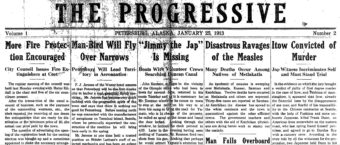
The (Petersburg) Progressive, Jan. 25, 1913
The Progressive was an earlier iteration of the Petersburg Pilot newspaper.

The Alaska State Historical Records Advisory Board has recognized The Petersburg Public Library with a certificate of excellence for partnering with the Petersburg Pilot to digitize and archive the weekly newspaper going back 100 years.
The Petersburg Public Library has hundreds of old papers from decades ago. Some are still at the old library in storage and some are in the new library’s small local history room. And for a decade the library’s director, Tara Alcock, wanted to archive those papers into some kind of searchable database. The problem was that the technology just wasn’t there.

“You would literally have to type in the newspaper,” she said.

The publisher of the Petersburg Pilot, Ron Loesch, gave the library permission to digitize and share the newspaper’s weekly issues since 1974. Loesch says the paper is a historical record of what happened in the community and preserving it is important. Also, he says, the new database makes things more efficient for both the public and the Pilot.

“We get a lot of requests for archival information and we do not have the staff to search that, so being able to send people to the library archives to retrieve various articles saves us a tremendous amount of time,” Loesch said. “On a few occasions, particularly when attorneys wanted particular information, we would charge $20 an hour to search the archives, and now the archives are available through the library for free.”

As for the future of the hard copies of the old papers, the library is working on an off-site solution to storing them because as Alcock says, they are rarely used anymore.

The Russians are coming? Sitka waits

Alaska Day on Castle Hill, Sitka
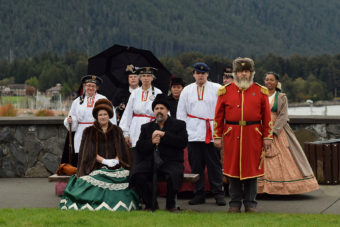
Sitkans in period dress wait to play their role in the transfer ceremony atop Castle Hill in Sitka, Oct. 18, 2014. (Creative Commons photo by John Pennell/U.S. Army)

A huge performance ensemble from Moscow is traveling to Sitka this week for the Alaska Day Festival — or not.

The offer to send 68 artists, support personnel, and camera crew to Sitka came about only three weeks ago, along with diplomatic communication to the local historical society.

But are the Russians really coming?

“It’s one of those things where you go, is this too good to be true?”

Hal Spackman is the director of the Sitka Historical Society. For less than a month he’s been engaged in an extensive — and somewhat bizarre — email exchange with a Russian event promoter named Alex Chupilkin.

First it was 85 people coming, then 55, now 68. Cossacks — some possibly on horseback, with plans to re-enact a battle with Alaska Natives — Bolshoi dancers, acrobats, bands, and children’s choirs.

Spackman thought at first it might be a hoax. But his attitude began to change when he got more reasonable emails from the promoter.

“And a phone call on my cell phone from the deputy consul general from Russia, that he is coming on Friday, and that he is aware that they are coming, too.”

So that’s where things stand. Sitka may have 68 Russians in town over the next few days for the Alaska Day Festival. Spackman has referred them to local hotels to find rooms, and taken one additional precaution.

“The Historical Society is bringing down two Russian speakers who are involved in the travel industry, to be here just in case they come.”

But no venue has been booked, except the Performing Arts Center on Thursday evening. Spackman would like to do more, but is reluctant to tie up too much of the town’s limited performance venues for something that remains a bit of a question mark.

“So we’re prepared, but we can’t prepare as much as we’d like.”

One big question is: Why? Tension is high now between the U.S. and Russia, as Russia has increased its military presence in Syria. The U.S. military is also active there — especially in the airspace — and the risk of inadvertent conflict is high.

Is now the right time to send 68 Russians to a small-town celebration of its Russian and Native heritage?

Spackman is aware that international diplomacy is in play.

“And there’s all this speculation that goes on: Why would they spend that kind of money to come here? Because they haven’t asked for a dime. Is it just a big PR stunt? What’s the idea? Do they do it with the idea that the U.S. has to look bad in not inviting them?” he said. “Whatever it is, I’m hoping that it’s in good nature and good spirit because, quite frankly, Sitka and all of Alaska hold a very soft spot for Russians. I think they view it in the way we might view Valley Forge or Plymouth Rock. It’s an exciting and interesting period to them.”

So Spackman is optimistic that Sitka can rise above international tension, and make the singers, dancers, children’s choir, military bands, cossacks — without horses — absolutely welcome, if they make it. He’s looking forward to seeing them in the parade, but he says there won’t be room for them all to participate in the transfer ceremony on Castle Hill.

Basically, we know as much as he does.

“It’s a great mystery, but it will be a wonderful surprise if it happens,” Spackman said.

‘Assimilation’ playwright flips the script on Native history


Assimilation Playwright Jack Dalton and actor Tendal Mann. (Photo by Annie Bartholomew/KTOO)
“Assimilation” playwright Jack Dalton and actor Tendal Mann. (Photo by Annie Bartholomew/KTOO)

In a dystopian future, Western civilization has crumbled and indigenous people are in control. That’s the premise of Jack Dalton’s play “Assimilation,” now touring Alaska. It flips the history of boarding schools with whites violently assimilated into Native culture.

A tyrannical character know as Elder pinches a student by the ear and leads him to his desk.

“With each time that you choose to speak your dirty language, your punishment will increase,” she tells him. 

In the course of the play, the boys are beaten, verbally abused and stripped of their identity.

Whites are forced to assimilate into Yup’ik culture. It’s horrific treatment but it also really happened, which playwright Jack Dalton says is the point.

“Being Yu’pik myself, I have had a lot of conversations with people who ask ‘Why are Native people still having problems?’” Dalton said. “And my answer is usually well, when you look at all the traumas that’s happened over several generations, you can imagine it’s really hard to heal from those traumas.”

Assimilation premiered in Anchorage in 2010 with 12 sold-out performances. And this past spring, it was selected for a staged readings at Emory University.

Dalton said he didn’t do any historical research on Alaska Native boarding schools. He drew inspiration from the stories his family told him about their own experiences.

“So I was actually worried that maybe I was too close to the subject and I might be making it harsher than it really was but my dramaturge, Michael Evenden from Emory University, went and did the research and said you only cover about 25 percent of what happened. There’s so much more,” Dalton said.

In the play, a boys screams out in pain as Elder strikes him with a stick.

“I do not care how good your Yup’ik is!” she lectures.

Louise Leonard, the actress who plays Elder, attended one of the boarding schools when she was kid and remembers being punished for speaking her Native language of Cup’ik.

“I am so glad that this is going to be on because we never really talked about those days,” Leonard said.

Dalton cast Leonard after meeting her at a state fair.

He says, traditionally, not talking about the “bad things” was a survival mechanism.

But it’s one that can be dangerous. Each performance of Assimilation is followed by a community discussion.

However, Dalton said he has wondered if some of the material could be offensive–particularly the racial slurs targeted toward whites.

“Every single person I talked to said, ‘How could I possibly be offended by what’s in the play when you realize that every one of those things and every one of those slurs is something that’s happened to Native people and other minorities?’”

By flipping the roles, Dalton says he hopes Natives won’t feel triggered by the violence. And non-Natives can empathize with what happened.

Assimilation’s Kickstarter recently raised over $15,000 to pay the actors and cover touring costs. The play premieres in Juneau on Friday at The University of Alaska Southeast’s Egan Library. The performance is free and starts at 7 p.m.

Editor’s note: the location of the premiere performance has been corrected. 

On Orders From Mao, Researchers Set Off On Nobel-Winning Drug Work


The Nobel Prize in medicine was awarded Monday to three scientists for their work on parasitic diseases.

William C. Campbell and Satoshi Omura were recognized for discovering a compound that effectively kills roundworm parasites. A Chinese scientist, Dr. Youyou Tu, won for her work in isolating a powerful drug in the 1970s to fight malaria.

Pharmacologist Youyou Tu was one of hundreds of Chinese researchers developing anti-malarial drugs in the 1970s. Jin Liwang/AP
Pharmacologist Youyou Tu was one of hundreds of Chinese researchers developing anti-malarial drugs in the 1970s.
Jin Liwang/AP

For Tu, it all started in the 1960s, when Americans and North Vietnamese fighters were hurting — not just from jungle warfare with each other but also from a common enemy: drug-resistant malaria.

Scientists on both sides of the line scurried to develop a new drug that would keep troops malaria-free. American military scientists toiled in the laboratories of Walter Reed Army Institute of Research. Meanwhile, Mao Zedong ordered hundreds of Chinese scientists to develop a new drug. Tu led a team of researchers working on what was called “Project 523.”

The research would eventually result in artemisinin, an extremely effective anti-malarial medication that has been credited with halving the number of malaria deaths worldwide. In addition to the Nobel Prize, Tu earlier this year won the Alpert Foundation Prize from Harvard and in 2011 the Lasker Prize for Clinical Medical Research.

In aiming to develop a new drug, her group combed the literature on traditional Chinese medicine, looking for plants that might hold promising ingredients for a malaria cure. Artemisia annua, also known as “sweet wormwood” or “qinghao,” had been given as a tea to malaria patients for centuries, cited as an anti-fever medicine as early as the second century B.C., and as an anti-malarial by alchemist Ge Hong in the fourth century. When Tu’s team brought it to the lab, they found that it killed the malaria parasites in mice. They eventually isolated the active ingredient — a chemical now known as artemisinin.

A fourth-century tea recipe involving the plant, the doctor wrote in the journal Nature Medicine, “gave me the idea that the heating involved in the conventional extraction step we had used might have destroyed the active components, and that extraction at a lower temperature might be necessary to preserve antimalarial activity.”

The centuries-old manuscripts were right. By late 1971, they had isolated “a nontoxic, neutral extract that was 100 percent effective” against malaria in infected mice and monkeys. Tu wrote that she and her colleagues tested the new drug on themselves before starting human trials.

“This was during the Cultural Revolution, when Chinese scientists and other intellectuals were sent off to the countryside to do hard labor and be publicly humiliated,” says Keith Arnold, who was researching malaria on the U.S. side at the time and would later work with the Chinese researchers. Back then, he says, they “often worked overnight and in the basement of buildings. And they were in fact harassed and treated very badly, until the word came down that these scientists were protected by Mao.”

Arnold, the first Western scientist to write about artemisinin, learned about the secret national project when he met some of the scientists on a trip to China in the late 1970s. He says he looked at the data “and noticed that this was incredible. We had no compound comparable to this that would kill the parasite as quickly as this.”

Despite comparative studies that showed that it far outshone the U.S. drug mefloquine, mutual distrust between East and West kept artemisinin off the international market.

“It was delayed far too long,” Arnold says.

Just as Tu’s work on artemisinin is being showered with recognition, malaria parasites in South East Asia have started to show resistance. Scientists are now searching for the next breakthrough drug. The world’s deadliest animal remains the mosquito.

Copyright 2015 NPR. To see more, visit http://www.npr.org/.
Read Original Article – Published OCTOBER 05, 2015 5:17 PM ET
Site notifications
Update notification options
Subscribe to notifications