History

Tlingit elders write boarding school history for future generations

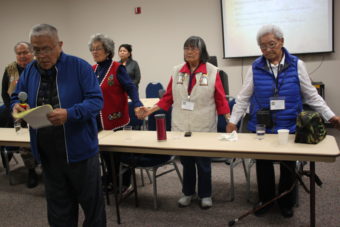
Tlingit elder Della Cheney talks during a panel discussion on boarding schools at the "Sharing Our Knowledge; A Conference of Tlingit Tribes & Clans." In the 1920s and 1930s, Cheney's parents attended Sheldon Jackson School in Sitka. (Photo by Lisa Phu/KTOO)
Tlingit elder Della Cheney talks during a panel discussion on boarding schools at the “Sharing Our Knowledge; A Conference of Tlingit Tribes & Clans.” In the 1920s and 1930s, Cheney’s parents attended Sheldon Jackson School in Sitka. (Photo by Lisa Phu/KTOO)

By talking about boarding school experiences, Tlingit elders in Juneau are turning painful memories into sources of healing – healing for themselves and generations still living with the consequences.

The nonprofit arm of the local urban Native corporation is using those stories to create a K-12 curriculum that will focus on the impacts of colonization on the Tlingit people.

Della Cheney and other elders have been meeting once a month at Goldbelt Heritage Foundation since August.

“We’re helping to write down the story of how boarding schools are affecting us and our families today, so that our children and grandchildren will know the history and realize the changes our families, our people faced,” said Cheney, who’s originally from Kake. She was part of panel of Tlingit elders during the recent clan conference in Juneau.

From the late 1800s to the mid-1900s, the federal government split up families and forced Native children into boarding schools to assimilate. Many were also raised in orphanages.

“That time is still walking with us today,” Cheney said. “The people who were raised with no love or affection in a very hostile environment also raised their children without much nurturing or affection. So today we see some of our families suffering from abuse.”

Cheney said both her parents attended Sheldon Jackson School in Sitka. Her mother was only 10 when she was brought there in 1923.

“It just breaks my heart to think that I was raised in such a loving family and to know that my mother and father weren’t,” Cheney said.

But those who went to boarding schools persevered, Cheney said. In Kake, they fought to make the village a first class city in 1951, allowing the community to operate its own school system.

Emma Shorty is from Teslin, Yukon. She was 4 years old when she was taken away from her home in 1937 to go to residential school in Carcross.

“We were never allowed to go anywhere,” Shorty said. “We had to stay in one yard. They put a fence around the school. They used to lock the fence and when we went to bed, they would lock our doors and there were no bathrooms to go to, so we got into trouble for wetting our beds.”

Shorty said she was molested at the school.

“I learned to forgive. I wasn’t always kind. Residential school just about killed my spirit. Today I forgive them,” Short said.

She fought hard to have her first daughter go to public school, even though she was turned away again and again for being Tlingit.

Tlingit elder John Martin said boarding schools "was a form of prison." (Photo by Lisa Phu/KTOO)
Tlingit elder John Martin said boarding schools “was a form of prison.” (Photo by Lisa Phu/KTOO)

John Martin went to boarding school in Eklutna and then to the St. Pius X Mission in Skagway, “but instead of Christianity, there were some ugly things that went on.” Martin said he would not speak about it.

Martin said many of the elders are still hurt.

“By putting us in boarding schools, it was a form of prison,” Martin said. “They disrupted our learning process of the language. They actually took a way of life from us when our elders were teaching us how to gather food.”

Martin said telling the stories from that time and identifying the hurt is the beginning of healing.

Developing the new Goldbelt Heritage curriculum is a multi-year process. Besides boarding schools, it will also share the history of the Douglas Indian Village burning and the Douglas Indian cemetery relocation.

The curriculum will be used during summer academic programs at Goldbelt Heritage and will be available for the Juneau School District.

It’s the beginning of the end for historic Gastineau Apartments

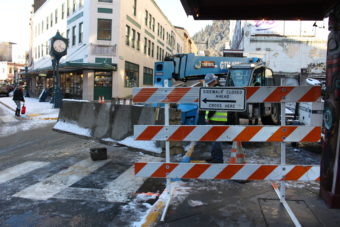
Juneau’s Gunakadeit Park will soon be torn down. The park will serve as the staging area for the larger demolition of the Gastineau Apartments. Rorie Watt, the city’s engineering director, said the contractors should have the park dissembled within a couple of weeks.
“They’re going to be moving pieces of art and the decorative fence, and setting up barriers and traffic control signs,” Watt said.

The decorative metal pieces would be salvaged, but the city hasn’t identified a use for them yet.

The flow of traffic isn’t expected to be interrupted until after the holiday season. That’s when some of the riskier demolition will take place, and the front facing wall of the Gastineau Apartments will be torn down.

CBC Construction was given the notice to proceed after a Nov. 10 Juneau Assembly meeting.

The Gastineau Apartments burned in November 2012. The city and owners James Barrett and Camilla Barrett have been in a long dispute over the maintenance of the building. The Barretts were served numerous times over the years with notices to clean up or secure the site.

The project is supposed to be completed by the end of April.

Travel in time with the handwritten letter

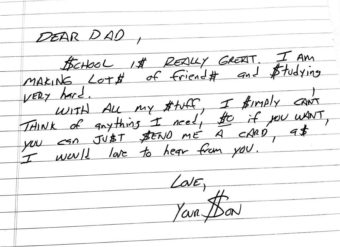
Hand-written letters like this one are read and shown on a screen. (Image courtesy of Letters Aloud)
Handwritten letters like this one are read and shown on a screen. (Image courtesy of Letters Aloud)

Seattle-based Letters Aloud will perform Tuesday night at the Juneau Arts and Culture Center. The group of reality theater actors formed in 2013 with the mission of connecting modern audiences to an endangered form of communication — the handwritten letter.

Tuesday night’s show is themed “fame.” On a Juneau Afternoon, Letters Aloud actor Todd Beadle read an unusual appeal from a young Sidney Poitier.

Dear President Roosevelt,

My name is Sidney Poitier and I am here in the United States in New York City. I am from the Bahamas. I would like to go back to the Bahamas but I don’t have the money. I would like to borrow from you $100. I will send it back to you when I get to the Bahamas. I miss my mother and father and I miss my brothers and sisters and I miss my home in the Caribbean. I cannot seem to get myself organized properly here in America, especially in the cold weather, and I am therefore asking you as an American citizen if you will loan me $100 to get back home. I will send it back to you and I would certainly appreciate it very much.

Your fellow American,
Sidney Poitier

Paul Morgan Stetler founded Letter Aloud.

Letters from Marilyn Monroe, Elvis Presley and Andy Warhol will also be read and accompanied by a slideshow. Curator Paul Morgan Stetler says the project gives listeners unique insight into the lives of heroes and celebrities of the past.
“It’s like a time travel to a certain degree — you feel like you’re really connecting to these people in a way that you wouldn’t normally have access to.” Stetler said.

The live performance begins 7 p.m. Tuesday at the JACC.

Tsimshian language revival focus of new group

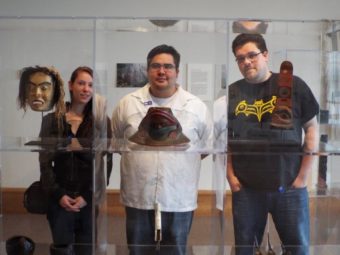
Haayk Foundation co-founders, from left, Kandi McGilton, Gavin Hudson and David R. Boxley visit the Museum of Northern British Columbia in Prince Rupert, British Columbia. (Photo courtesy of David Boxley)

Three young Metlakatla residents have started a new nonprofit organization with the goal of strengthening their Tsimshian culture. The first task is helping to create a larger pool of fluent speakers of the Tsimshian language, starting with themselves.

In an old black and white photo taken on Annette Island in the late 1800s, more than two dozen Tsimshian men are lined up in two rows, ready to pull a tree stump out of the ground using only ropes and muscle.

Those were Metlakatla’s founders, recently arrived from British Columbia, and that was one of many stumps they pulled by hand to clear the land for their new community.

“That’s an inspiring image for us because it didn’t matter if they were rich or poor, it didn’t matter what their clan was. The only thing that mattered was setting aside their differences to pull together to create something that no one person can create on their own,” said Gavin Hudson, one of three co-founders of the Haayk Foundation.

Hudson said if his ancestors were able to pull thousands of stumps out of the ground without the aid of modern machinery, he believes their new nonprofit can revive the dying Tsimshian language, a first step toward revitalizing the culture.

“Sm’algyax is the language of the Tsimshian people. It’s going away. It’s fading away before our very eyes,” Hudson said. “It seems that with language loss comes identity loss. We fill that void with drugs and alcohol and abuse of all sorts — self-hatred, self-loathing. So, our silver bullet idea is to save our language in order to strengthen the spirit of our people.”

That’s where they got the name for their nonprofit — haayk means spirit. The three cofounders — David R. Boxley, Kandi McGilton and Hudson — are aiming high but in less than a year, the Haayk Foundation has made some progress.

They organized an online fundraising effort selling T-shirts to raise money for materials and classes, and they held a “coming out” culture and history event during the community’s annual Founders Day, which commemorates the founding of Metlakatla.

They’re bringing in a teacher in December to conduct a series of free language workshops. David R. Boxley is also one of the group’s founders; his father, David A. Boxley, will serve as the teacher. The elder Boxley is a master carver who kicked off a cultural revival in Metlakatla in the 80s; he hosted the first potlatch in that community to honor his grandparents and raised his first big totem pole.

Boxley said that cultural revival focused on the arts – carving, singing, dancing, weaving and regalia.

“As far as I’m concerned, and I think we all feel that way, this is the next step,” he said of the Foundation’s efforts. “We have to take what our parents’ generation has done and not try to replicate anything but build off that upward movement.”

The decline of Native languages started with government-run schools during the first half of the 20th century. Native students were punished for speaking their language and were told to only use English. Now, though, Boxley said,

“It’s no one else’s fault anymore if it goes. Nobody’s stopping us anymore. Nobody is saying it’s wrong,” the younger Boxley said. “The things that caused us to be in this mess don’t exist anymore.”

Except for a lingering sense of shame and trauma passed down through the generations. But, Boxley said, learning the language, reclaiming that heritage, is a way to heal.

“The pride one feels in knowing who they are is invaluable,” he said. “It prevents you from doing things that harm your body or your family when you’re proud of who you are, when you know where you come from, when you have a connection to something beyond keeping up with the Kardashians.”

The three Haayk Foundation co-founders, want to work with other Native organizations and community members, which Hudson said is the only way to achieve their challenging goal. In fact, their Founders Day event was called “Pulling Together.”

During that event, they gave everyone who attended a print of a painting by Chris Hopkins, based on that old photograph of Metlakatla’s founding fathers pulling a stump out of the ground. The painting also is called “Pulling Together.”

Hudson said Lt. Gov. Byron Mallott, who is Tlingit, attended the Founders’ Day event and also received a print. Mallott had it framed and gave it to Gov. Bill Walker.
Hudson said, “Gov. Walker, I’ve read over and over again in Alaska news that he’s choosing to find inspiration in the same place that we found inspiration, and that is in the pioneers who settled Annette Island.”

Because pulling together is the only way to solve a really big problem, whether it’s clearing a thousand stumps or saving a dying language.

Totem pole returns to Southeast after 84 year journey

A Tlingit totem pole has returned to Prince of Wales Island after a more than 5,000-mile odyssey to Hollywood, Honolulu and back home.

If this story was a Hollywood thriller, Steve Langdon would be the detective in a trenchcoat and fedora. In reality, Langdon is an anthropologist noted for his work with the Tlingit people. But, the story does have some mystery and big-name actors. Langdon’s first hint that something was amiss came from a visit to Ketchikan’s Tongass Historical Museum.

Vincent Price with Tuxican totem pole, circa 1950. (Image courtesy of Ketchikan Museum)

“One time I was just going through photos,” Langdon said. “There was just a notebook and I was turning the pages in the notebook and I turned the page and the picture was, standing there was Vincent Price by this big tall totem pole and there was cactus around it and my mind said ‘Hmmm, how did that happen?”

At the bottom of the picture, it said “Pole from Tuxican”. Langdon was familiar with Tuxican, a now-unoccupied Tlingit village north of present day Klawock. He compared the pole to his collection of pictures from Tuxican and it was a clear match, but he wasn’t sure how it got to a famous actor’s backyard or where it ended up.

Meanwhile, a friend was working on tracking down a different pole stolen near Glacier Bay and was looking through the diary from white homesteaders in the area. “And he found reference to this actor, John Barrymore, coming up there and I think he said in their diary it said he had a pole on his boat.”

It wasn’t until looking at Barrymore’s family travel album that Langdon knew for sure Barrymore had taken the Tuxican pole during a 1931 Alaska trip aboard his 120-foot yacht.

“There is a picture that shows his crew ashore with their ropes around the pole.” Langdon said. “You can clearly see the pole; you can see the crewmen in their little white sailor hats.”

Barrymore’s crew cut the pole in three pieces for transport. When Langdon first saw the pole in person at the Honolulu Museum of Art, he saw what other modifications Barrymore made.

“He put a kind of a metal beam up the back of it so it was kind of carved out, the back part of it. Then he ran a hose or some kind of waterline to the top of the pole and he turned it into a fountain. For a period of time, it was a fountain in his garden in Hollywood,” Langdon said.

“We had never hidden the fact that we had the totem pole, but we are not a huge museum,” Director of Communications at the museum, Lesa Griffith said. “In fact it had been on view here at the museum in the 1980s after we had received it as a donation.”

The totem pole was a donated in 1981 by Vincent Price’s ex-wife, Mary, after their divorce and the museum valued it at $90,000. The Prices had bought the pole from Barrymore’s estate for $1,500 and also displayed it in their garden to aid in what she described as a happy luncheon atmosphere.

However, the pole has a much deeper significance to the Tlingit people. The mortuary pole held the ashes and bones of a high ranking clan member until Barrymore’s wife discovered them, and where they ended up is another mystery.

“It became clear that this was a sacred object of cultural patrimony. Our director immediately decided yes the totem pole should be returned to Alaska.”

In 2013, the museum began the long process to repatriate the pole under the Native American Graves Protection and Repatriation Act. In October of this year, before it was packed for shipment, Klawock tribal member and master carver Jonathan Rowan flew to Hawaii where he saw the pole in person for the first time and performed a ceremony.

“Repatriation is a new thing for the peoples. Everybody’s probably got their own ideas on how things should be done. When you get down to it we were just welcoming it home.

Steve Langdon said, “It’s just really important to the people of Klawock to have these things come back. These are beings. The pole has a name and has a spirit so in that sense it is a returned being to them.”

The mortuary pole is the second item from Tuxican recently returned to Klawock. In 2012, The National Museum of the American Indian shipped 80 planks of a 40-foot wide painting on a traditional clan house, which was taken around the same time as the pole.

Carver Jon Rowan hopes to one day recreate the storied pole and have it displayed in Klawock.

73 years ago Friday, the USS Juneau sank during WWII

U.S.S Juneau memorial service
Juneau Mayor Greg Fisk addresses a wind-blown and rain-soaked crowd during an observance Friday at the USS Juneau memorial on the downtown waterfront. (Photo by Matt Miller/KTOO)
U.S.S Juneau memorial
The memorial tells the story of the first U.S. Navy ship named after Alaska’s capital city and its sinking during the naval battle of Guadalcanal. Of the 697 crew aboard the ship, over 100 may have survived the sinking. But most of the initial survivors later succumbed to exposure and sharks as they waited eight days for rescue. Only 10 sailors survived the ordeal. (Photo by Matt Miller/KTOO)

Juneau residents, service members and veterans paused for a few moments on Friday to remember the sailors who perished when the USS Juneau sank during the naval battle of Guadalcanal 73 years ago. A short service was held in the blowing wind and sideways rain at the USS Juneau memorial on the waterfront.

Mayor Greg Fisk read a proclamation declaring Nov. 13, 2015, as USS Juneau Remembrance Day.

Lt. Cmdr. Rich Halbig of the U.S. Navy briefly recounted the World War II battle that led to the vessel’s sinking.

All five brothers from the Sullivan family in Waterloo, Iowa, served on board the Juneau and died during the sinking. Their grief-stricken parents made speaking appearances at war plants and shipyards around the country during the war.

Jane Lindsey of Juneau-Douglas City Museum announced that they will be putting on display the silver set that was used on board the Juneau. The silver set, including a punch bowl and ladle, was typically used in an officers wardroom while entertaining dignitaries. Lindsey says Juneau community members may have raised funds for that silver set, which was kept on shore for safekeeping before the ship entered combat.

Lindsey credits the Mendenhall Valley Flying Lions for helping acquire the silver set on a 10-year loan. She hopes to put it on display at the museum on Feb. 14, the 74th anniversary of the USS Juneau’s commissioning.

The city museum already has artifacts related to the first USS Juneau, CL-52, and the third USS Juneau, LPD-10, an amphibious transport dock that was recently decommissioned.

U.S.S Juneau memorial
The five Sullivan brothers weren’t the only set of brothers who perished during the sinking of the USS Juneau, but they were certainly the most famous. After their deaths, most service branches implemented a policy of allowing service exemptions for sole survivors of a family. (Photo by Matt Miller/KTOO)
Site notifications
Update notification options
Subscribe to notifications