History

Less Arctic sea ice helps archaeologists find sunken whaling ships

Abandonment of the whalers in the Arctic Ocean, September 1871, including the George, Gayhead, and Concordia. Scanned from the original Harper’s Weekly 1871. (Image courtesy of Robert Schwemmer Maritime Library)

The battered remnants of two whaling ships from the 1800s were discovered in the Chukchi Sea this fall. National Oceanic and Atmospheric Administration archaeologists say they can thank an increasingly ice-free Arctic for the find as it’s improved their access to potential shipwreck sites.

The ships are believed to have sunk in 1871 when 33 ships were trapped by sea ice in an unusual stranding event. The whaling captains had counted on a wind shift from the east to push the ice back out, as was the seasonal norm, but the favorable wind never came.

The ships were destroyed, leaving more than 1,200 whalers stranded. Miraculously, all survived. They were rescued by ships moored farther south in Icy Cape. But the loss of property was a major low for the Yankee whaling industry.

A team of archaeologists from NOAA’s Maritime Heritage Program had an inkling that a 30-mile stretch of coastline near Wainwright could be fruitful searching grounds for remnants of the 1871 stranding event. Previous searches had found traces of gear salvaged by local people, plus washed-up ship debris on shore.

“Earlier research by a number of scholars suggested that some of the ships that were crushed and sunk might still be on the seabed,” said Brad Barr, a NOAA archaeologist and co-director of the project.

The team used modern sonar technology to outline the flattened hulls of the two wrecks. Anchors, fasteners, ballast and brink-lined pots used for rendering whale blubber into oil were also found.

“Until now, no one had found definitive proof of any of the lost fleet beneath the water,” Barr said. “This exploration provides an opportunity to write the last chapter of this important story of American maritime heritage.”

At the time of the stranding in September 1871, the captains of the 33 whaling ships convened to weigh their options for saving the 1,219 officers, crew and even families from an icy fate. The nearby mooring of seven ships 80 miles to the south was a godsend.

But in order to make room for the survivors, the seven ships in Icy Cape had to jettison their cargoes of whale oil, bone and whaling gear. Barr calculates the loss to the New Bedford whaling fleet was over $33 million in 2015 dollars. All seven rescue ships sailed safely out of the Arctic to different destinations including Honolulu, San Francisco and New Bedford.

New York Public Library Makes 180,000 High-Res Images Available Online

"Ferry and river men. Vicksburg, Mississippi," a 1936 photo by Walker Evans, is one of many images in the NYPL's collection from the Farm Security Administration's Depression-era photography projects. Walker Evans/New York Public Library
“Ferry and river men. Vicksburg, Mississippi,” a 1936 photo by Walker Evans, is one of many images in the NYPL’s collection from the Farm Security Administration’s Depression-era photography projects.
Walker Evans/New York Public Library

Forget journeys into the stacks or stints at a library scanner: For more and more of the New York Public Library’s collections, access is just a click away.

On Wednesday, the library released more than 180,000 of its public-domain items — including maps, posters, manuscripts, sheet music, drawings, photographs, letters, ancient texts — as high-resolution downloads, available to the public without restriction.

A lithograph of New Orleans, by the artist Henry Lewis and the lithographer Arnz and Co., is among the more than 180,000 public domain items now available for high-resolution download from the New York Public Library. Henry Lewis/New York Public Library
A lithograph of New Orleans, by the artist Henry Lewis and the lithographer Arnz and Co., is among the more than 180,000 public domain items now available for high-resolution download from the New York Public Library.
Henry Lewis/New York Public Library

It’s the latest push by NYPL Labs, the library’s Internet-oriented tech and outreach team, to make the library’s holdings more accessible to the public.

Before the release, many of the items were available to view for free through the library’s Digital Collections site, and some could be downloaded at lower resolutions. But in most cases, for a high-resolution image, users would have to make a request and pay a processing fee, a library spokeswoman says.

Now, in addition to the availability of high-res downloads, it’s simpler to identify which of the items in the library’s digital collections are in the public domain. The library also has made it easier for programmers to access and analyze those files in bulk.

“These changes are intended to facilitate sharing, research and reuse by scholars, artists, educators, technologists, publishers, and Internet users of all kinds,” the library says in a statement.

“All subsequently digitized public domain collections will be made available in the same way, joining a growing repository of open materials.”

If it’s hard to conceptualize what 180,000 items looks like, NYPL Labs also released a visualization of all the materials, sorted by date, genre, collection or even color.

This photo from the Billy Rose Theatre Collection — labeled simply "Macbeth, by William Shakespeare, photo file 'A' " — is among the NYPL's restriction-free downloads. New York Public Library
This photo from the Billy Rose Theatre Collection — labeled simply “Macbeth, by William Shakespeare, photo file ‘A’ ” — is among the NYPL’s restriction-free downloads.
New York Public Library
An early-20th century photo by Edwin Levick, "Uncle Sam, host. Immigrants being served a free meal at Ellis Island," is part of the NYPL's photography collection. Edwin Levick/New York Public Library
An early-20th century photo by Edwin Levick, “Uncle Sam, host. Immigrants being served a free meal at Ellis Island,” is part of the NYPL’s photography collection.
Edwin Levick/New York Public Library

The documents include literary manuscripts, Farm Security Administration photographs, sheet music, papers from Founding Fathers, WPA-era art by African-American artists, the 16th-century Handscrolls of the Tales of Genji, illuminated manuscripts from the Medieval Ages and the Renaissance, maps and atlases, and stereoscopic views, the library says.

The materials can all be viewed and downloaded through the Digital Collections site.

In addition to making public-domain files available for free, the library is actively encouraging people to come up with creative uses for the items. A “remix residency” will offer funding, work space and promotion to people with novel ideas for reusing the library’s public domain materials.

In need of inspiration?

NYPL Labs’ designers came up with a few projects to get you started — a game based on public-domain mansion floor plans, a comparison of 1911 street photos with 2015 Google Street View images and a trip planner based on a guide to where black visitors would be welcomed in the 1930s-1960s.

Copyright 2016 NPR. To see more, visit http://www.npr.org/.
Read Original Article – January 6, 2016 12:52 PM ET

South Korea And Japan Reach Landmark Deal Over Comfort Women

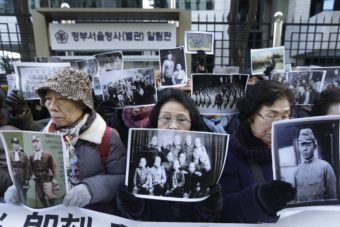
Relatives of Korean women forced into Japanese-run brothels during World War II demonstrate outside the foreign ministry in Seoul, South Korea, on Monday. The two countries announced a deal that included an apology from the Japanese prime minister and a fund to support the 46 surviving Korean women. Ahn Young-joon/AP
Relatives of Korean women forced into Japanese-run brothels during World War II demonstrate outside the foreign ministry in Seoul, South Korea, on Monday. The two countries announced a deal that included an apology from the Japanese prime minister and a fund to support the 46 surviving Korean women.
Ahn Young-joon/AP

The issue of so-called comfort women — tens of thousands of Korean women and girls forced by the Japanese into sexual slavery before and during World War II — has long strained relations between South Korea and Japan. On Monday, the two countries announced a deal that South Korean Foreign Minister Yun Byung-se characterized as “final and irreversible,” according to the AP. It could mark the beginning of improved relations between the two countries, both strong allies of the United States.

The deal included an apology from Japanese Prime Minister Shinzo Abe and a billion yen (roughly $8.3 million) fund to support the 46 surviving Korean women.

The fact that monetary compensation is coming from government coffers is potentially significant. In 1995, Japan established the Asian Women’s Fund, funded through private donations, which gave monetary assistance to former sex slaves. The fact that Tokyo had resisted direct compensation to the victims prompted former comfort women and activists to criticize Japan for what they saw as an avoidance of official responsibility.

Some of the surviving women spoke out against the agreement. “The agreement does not reflect the views of former comfort women,” said Lee Yong-soo, 88, during a news conference, according to The New York Times. “I will ignore it completely.”

Improved ties between South Korea and Japan has been a U.S. priority. More than 75,000 U.S. troops are stationed in the two countries, and the Obama administration is looking to its two Asian allies to counter a rising China and a nuclear-armed North Korea.

Copyright 2015 NPR. To see more, visit http://www.npr.org/.
Read Original Article – December 28, 2015 12:35 PM ET

Meadowlark Lemon, Star Of The Harlem Globetrotters, Dies

Meadowlark Lemon talks with Miami Marlins manager Don Mattingly in St. Louis on Dec. 5. The legendary Harlem Globetrotter died at his home in Scottsdale, Ariz., on Sunday. He was 83. Bill Greenblatt/UPI
Meadowlark Lemon talks with Miami Marlins manager Don Mattingly in St. Louis on Dec. 5. The legendary Harlem Globetrotter died at his home in Scottsdale, Ariz., on Sunday. He was 83.
Bill Greenblatt/UPI

Meadowlark Lemon, a star with the Harlem Globetrotters for nearly a quarter century, died on Sunday at the age of 83. He had dreamed of playing for the Globetrotters when he was growing up in the Jim Crow South and joined the team in 1954 after serving in the Army. He went on to arguably become its preeminent player, earning the moniker “the clown prince of basketball.”

Created in the 1920s, the Globetrotters provided one of the few opportunities for African-American men who wanted to play professional basketball. Wilt Chamberlain, one of the greatest basketball players of all time, spent one year with the team before joining the NBA in 1959.

Lemon, who was known as "the clown prince of basketball," offers a pretzel to a referee during a game at New York's Madison Square Garden on Feb. 18, 1978. Suzanne Vlamis/AP
Lemon, who was known as “the clown prince of basketball,” offers a pretzel to a referee during a game at New York’s Madison Square Garden on Feb. 18, 1978.
Suzanne Vlamis/AP

“Meadowlark was the most sensational, awesome, incredible basketball player I’ve ever seen,” Chamberlain said in a television interview shortly before his death in 1999, according to the New York Times. “People would say it would be Dr. J or even Jordan. For me, it would be Meadowlark Lemon.”

Lemon was an elite athlete. He thrilled audiences with his long hook shots and ballhandling skills. But he and the Globetrotters emphasized their comedic side as well. Lemon would throw buckets of confetti on unsuspecting referees and fake injuries, among other gags.

Lemon left the Globetrotters in 1978 over a contract dispute and subsequently formed his own traveling teams, including Meadowlark Lemon’s Bucketeers and Meadowlark Lemon’s Harlem All-Stars. His likeness also appeared on the cartoon series Scooby Doo.

After his retirement, he became a Christian minister and along with his wife founded Meadowlark Lemon Ministries in 1994.

Copyright 2015 NPR. To see more, visit http://www.npr.org/.
Read Original Article – December 28, 2015 9:58 AM ET

France Makes Wartime Vichy Government Archive Available To The Public

German Chancellor Adolf Hitler shakes hands with Head of State of Vichy France Marshall Philippe Pétain in occupied France on Oct. 24, 1940. AP
German Chancellor Adolf Hitler shakes hands with Head of State of Vichy France Marshall Philippe Pétain in occupied France on Oct. 24, 1940.
AP

The French government is making available for the first time more than 200,000 documents on the Vichy government, which collaborated with the Nazis during World War II.

The documents, which were previously only partially accessible to researchers, will make “information such as the activities of the special police, who hunted resistants, communists and Jews accessible to the public, as long as they have been cleared by defence and security chiefs,” French radio station RFI reported. These archives also “show the extra-legal prosecution of members of the French Resistance, as well as proceedings against French Jews,” says the Associated Press.

“France has a painful relationship with this portion of its past, when the government helped the Nazis deport 76,000 Jews during the war,” Agence France-Presse reports.

The New York Times reported that the release of these documents may help Vichy, the small town where the collaborating government was based, come to terms with this dark period of French history. “While the city of 25,000 may remain a symbol, it may no longer be a scapegoat,” the Times says. Here’s more:

“Thierry Wirth, a Vichy historian and author, said [the documents’ release] would provide a true picture of France’s ‘collective involvement.’

” ‘The Vichy regime was situated here, in the free zone, but the records clearly show that the greatest numbers of collaborationists were, in fact, in the occupied zone, including Paris,’ Mr. Wirth said. ‘Moreover, the region in which we are situated, the Auvergne, had France’s largest force of Resistance fighters …’ “

Delving into the past may well be painful. Before the documents were widely available, historian Jean-Marc Bélière said that he had seen people leave these archives in tears “because they’d found out the details of an arrest, an execution, a betrayal, for example. Some came with the idea that their grandfather had been in the resistance but discovered that was not exactly true.” Bélière was quoted in Le Figaro in 2010 — and RFI translated the quote today.

Copyright 2015 NPR. To see more, visit http://www.npr.org/.
Read Original Article – December 28, 2015 1:40 PM ET

With understanding comes forgiveness: Turning ‘Yuuyaraq’ into film

(Video still courtesy Lisle Hebert)

Juneau filmmaker Lisle Hebert is making a film based on Harold Napoleon’s essay “Yuuyaraq: The Way of the Human Being.” Napoleon gave Hebert his blessing to do the adaptation, but he says it’ll be a challenge to translate the message to film.

The beginning of Lisle Hebert’s film “Yuuyaraq” is a re-enactment depicting life on the Yukon-Kuskokwim Delta before Western contact. The narration stays true to Harold Napoleon’s original words.

Juneau filmmaker Lisle Hebert (Photo by Lisa Phu/KTOO)

“It’s verbatim because his writing is so poetic, and so I couldn’t do better than that,” Hebert said.

The re-enactment conveys what the Yup’ik word Yuuyaraq means.

“Their spiritual beliefs, the way they viewed the world, everything had a spirit. Everything was in harmony and it was kind of like a code of living,” Hebert said.

Napoleon wrote Yuuyaraq in 1988 when he was in prison for the death of his son. He says he was so drunk, he blacked out and doesn’t remember it. Without any memory of what happened, he couldn’t defend himself and so he pled no contest to second degree murder. He never went to trial and no matter how it happened, he blames himself.

He started writing to figure out why he and so many people he knew struggled with alcohol abuse.

Napoleon is Yup’ik Eskimo from Hooper Bay.

“I had been baffled for many years about why we knew so very little about our own history and why there was so much shame about our own culture,” Napoleon said.

Napoleon is 66. He said he grew up in a very confusing world, being neither fully Yup’ik nor white and Christian. There was suffering in the missing pieces of his village’s history.

“There was also a lot of disconnect between parents and children and that disconnect was not just personal, it was also cultural,” Napoleon said.

“As children, we were not abandoned literally, but we somehow ended up in nowhere land.”

Napoleon experienced abuse as a child and drank as an adult. While in prison, he read a lot about trauma and post-traumatic stress disorder in Vietnam War veterans.

“Having never been to war and never experienced war or witnessed war, I found it odd that I would have the same symptoms as Vietnam veterans. And not only me but all the other people in my village had the same symptoms,” Napoleon said.

After more research, Napoleon learned about the flu epidemic of 1918. In Yuuyaraq, he calls it the “Great Death” and wrote that it spread like wildfire, killing 6 of every 10 people and wiping out Alaskan villages. “It gave birth to a generation of orphans,” he wrote.

Harold Napoleon wrote "Yuuyaraq: The Way of the Human Being" in 1988. (Video still courtesy Lisle Hebert)
Harold Napoleon wrote “Yuuyaraq: The Way of the Human Being” in 1988. (Video still courtesy Lisle Hebert)

Up until then, Napoleon said Yup’ik people had resisted Christianity and white influence.

“But after ‘The Great Death,’ there was mass conversion and people began to abandon, in a sense, their own culture and in abandoning their culture, they abandoned themselves. There was also born in them a sense of shame and guilt because what they were being taught is that the way they had lived their lives had caused them to die in such great numbers,” Napoleon said.

He said the trauma, shame and violence he and others in his village experienced traces back to that time. And it still reverberates today.

Writing Yuuyaraq, Napoleon said, helped him to understand his village and his family, the past and the present.

“With understanding there came forgiveness. I had found a trail of truth through our experiences as Native people,” he said.

Napoleon said Alaska Native cultures are going through a reawakening and he hopes Lisle Hebert’s film adaptation of Yuuyaraq will contribute to it.

“If the young people become interested in their own stories, in their own history, then I think it will have done a good job,” Napoleon said.

As a young man, Hebert said he spent time in Hollywood and used to be egotistical about filmmaking, but Yuuyaraq is about something else.

“I’m hoping that people will be moved by it and have more compassion and also realize what (Alaska Natives) have been through, and try to look at people like people,” Hebert said.

For Hebert, Yuuyaraq is a meaningful film, and that has given meaning to his own life.

Lisle Hebert plans to finish the film in June. An Indiegogo campaign is currently underway to help him do that. You can also attend a community potluck and “fun-raiser” on Wednesday, Dec. 16 at St. Ann’s Parish Hall from 5 to 8 p.m.
Site notifications
Update notification options
Subscribe to notifications