Camp construction at Fort Richardson, 1942. (Photo courtesy of Dr. Morgan Blanchard, Northern Land Use Research Alaska)
New historical evidence is shedding light on the internment of Japanese people in Alaska during World War II.
A small ceremony held recently at Joint-Base Elmendorf-Richardson was one of the first of its kind, according to officials present.
The ceremony fell on the official Day of Remembrance held nationwide, and is part of an expanding effort to recognize the experiences of Southeast Alaska’s Japanese community during the war years.
Alice Tanaka Hikido was 9 years old on the night in 1941 when FBI agents took her father from their home in Juneau.
“He turned to us and quietly said, ‘I may not be home for a while,’ and the next moment he was gone, into the December darkness, taken by the men who had put confusion and fear in our hearts,” Hikido recalled during prepared remarks. “Little did we know at that time that he would not be home for a very long while.”
Her father was one of 17 men brought to the Army’s Fort Richardson in Anchorage for several months before they were sent to an internment camp in New Mexico. Hikido and the rest of her family stayed in Juneau until April 1942. Then they were deported to a camp in Idaho. The family was part of the 110,000-120,000 people of Japanese ancestry on the West Coast detained for years during World War II.
“And about 200 came from Alaska,” said Hikido.
She spoke to a room of a few dozen people as part of the Day of Remembrance held every year on Feb. 19, the anniversary of Executive Order 9066, which was the basis for forcibly removing Japanese-Americans from their communities to government camps.
Colonel Timothy Wulff is the deputy installation commander for Joint-Base Elmendorf-Richardson. He says this is the first such event of its kind held at the base.
“Something like this should never happen again,” Wulff told the audience during opening remarks.
The event’s uniqueness comes from the fact that it took place inside a building sitting on the site of the little-known internment camp that was only recently evidenced.
Doctor Morgan Blanchard is an archeologist and uncovered a rare map showing where the camp was built. He pointed out the window of the Army Reserve Building, looking south toward a parking lot.
A schematic of the internment camp layout. (Image courtesy of Dr. Morgan Blanchard, Northern Land Use Research Alaska)
“Just 5 feet from where we’re standing is where the north fence of this camp was. And there were two strands of barbed wire fence that ran through there. The area was cleared so it could be lit with electric lights, and there were guard towers on each of the corners,” Blanchard said. “We have no photos of the guard towers, but we assume that they were armed.”
Blanchard had made a point of noting design several times during his presentation and in a brief interview.
“It’s important because it’s an architecture of containment,” Blanchard said. “There is no other structure like it. It’s a prison. It’s a structure that tells us that people were held here against their will.”
Blanchard authored a report after an archeological investigation into the site. They found a lot of material, but none of it conclusively tied to the camp. While there is plenty of evidence corroborating the designs laid out in the 1943 map he discovered, none of the hastily constructed buildings or structures remained.
While Japanese men were brought to Fort Richardson in December 1941, it wasn’t until February 1942 that construction of the camp started. And even then, it wasn’t much: 16-by-16 arctic tents on top of wooden platforms with latrines and walkways. By the time it was done on June 1942, the 17 men had been moved. The camp has long been known about, but physical evidence substantiating its story has been sparse.
Camp construction at Fort Richardson, 1942. (Photo courtesy of Dr. Morgan Blanchard, Northern Land Use Research Alaska)
The ceremony was held the same day as a screening of the documentary ‘The Empty Chair,’ which tells the story of this captivity from the perspective of the Japanese community in Southeast Alaska.
Before Hikido and her family were deported from Juneau, the high school arranged an early graduation for her brother John.
“Later the next month, in May, when the actual graduation took place, an empty chair was placed with the rest of the graduating students to honor John, and to acknowledge his absence, and the absence of the total Japanese community from Juneau,” Hikido said, emotion creeping into her voice.
In the last 20 years, more people have begun sharing their experiences in the internment camps, according to Hikido. And she sees those stories as deeply relevant to the present.
“When people get fearful we tend to lose our sense of what’s right and wrong,” Hikido said during an interview after the event.
“We need to always be strong enough to stand up (to) any kind of injustice.”
The ceremony was organized by the Alaska Chapter of the Japanese-American Citizens League, which is asking the Army to let them use the area as an “interpretive site,” permanently commemorating all that took place.
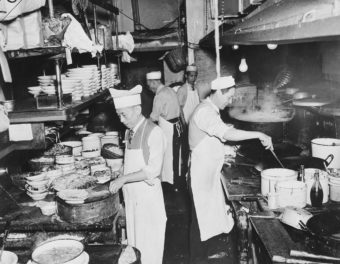
Chefs at work in the kitchen of a restaurant in New York’s Chinatown, circa 1940. For many Chinese, opening up restaurants became a way to bypass U.S. immigration laws designed to keep them out of the country. Weegee(Arthur Fellig)/International Center of Photography/Getty Images
Americans craving kung pao chicken or a good lo mein for dinner have plenty of options: The U.S. is home to more than 40,000 Chinese restaurants.
One could think of this proliferation as a promise fulfilled — America as the great melting pot and land of opportunity for immigrants. Ironically, the legal forces that made this Chinese culinary profusion possible, beginning in the early 20th century, were born of altogether different sentiments: racism and xenophobia.
Anti-Chinese sentiment was rampant in America in the early 20th century — and had been since the latter half of the 19th century, when as many as 300,000 Chinese miners, farmers, railroad and factory workers came to the U.S. Many non-Chinese workers felt threatened by these laborers, who often worked for lower wages.
Amid mounting social tensions, the U.S. passed immigration laws that explicitly barred Chinese laborers from immigrating or becoming U.S. citizens, and made it extremely difficult for even legal residents to re-enter the U.S. after a visit home to China.
The interior of a Chinese restaurant in San Francisco, circa 1880. The Miriam and Ira D. Wallach Division of Art, Prints and Photographs: Photography Collection,The New York Public Library
But, as MIT legal historian Heather Lee tells it, there was an important exception to these laws: Some Chinese business owners in the U.S. could get special merchant visas that allowed them to travel to China, and bring back employees. Only a few types of businesses qualified for this status. In 1915, a federal court added restaurants to that list. Voila! A restaurant boom was born.
“The number of Chinese restaurants in the U.S. doubles from 1910 to 1920, and doubles again from 1920 to 1930,” says Lee, referring to research done by economist Susan Carter. In New York City alone, Lee found that the number of Chinese eateries quadrupled between 1910 and 1920.
Lee was digging through old immigration records in 2011, as part of her doctoral dissertation, when she discovered evidence that this legal change had fueled a rise in restaurants. She found a flood of applications from Chinese immigrants after 1915 seeking merchant status to start up restaurant businesses, along with applications from others brought over to work in these establishments.
Prior to the restaurant loophole, Lee says, most Chinese immigrants in America worked in laundries — they were excluded from better-paying options. But by 1930, they were more likely to be toiling in eating establishments. “The scale of it increases astronomically,” she says.
The menu for a Chinese restaurant in New York City, 1904. At the turn of the 20th century, the cheapness of Chinese food and late hours observed by Chinese restaurants were a draw – especially for bohemians, whose patronage lent these establishments a certain cachet. Rare Book Division, The New York Public Library
Many Chinese immigrants to the U.S. were men who had come alone: They were here to earn money to support families back home, not to settle down permanently. Once in the U.S., however, it was all but impossible for them to travel back to visit loved ones in China. After 1915, the visas that came with working in a restaurant became bridges to families and friends back in China, Lee says.
“It was really important for [these men] to be able to move back and forth, to get married and retire someday. That was the idea. These special visas were critically important,” Lee says.
Even so, getting a special merchant visa was far from easy, Lee explains. Only the major investors in a restaurant qualified — and it had to be a “high grade,” fancy eatery. These investors had to manage their restaurants full time for at least a year. During that time, they couldn’t do any menial work: no cooking, waiting tables or ringing up the cash register, she says.
Lee says Chinese immigrants found ingenious ways to get around these hurdles: They would pool their money to start luxury “chop suey palaces,” then each investor would take turns running the joint for a year or 18 months. Once they’d earned merchant status, the investors would use it to bring their relatives over to work in the restaurant.
Lee explains how it worked: “Your cousin, your uncle has helped you over and is giving you a job. He’s supposed to show you the ropes. Then you move up the hierarchy until you earn the money to be a partner in your own restaurant.”
Lee’s research focused on New York City (she’s writing a book about the rise of restaurants there in the 19th and early 20th centuries). But she says the immigration dynamics were similar in other urban centers with large Chinese communities, like Chicago and San Francisco.
A view of New York City’s Chinatown in the 1930s. Between 1910 and 1920, the number of Chinese restaurants in New York quadrupled, and it more than doubled between 1920 and 1930, according to legal historian Heather Lee. Keystone-France/Gamma-Keystone via Getty Images
In order to make these schemes work, Chinese restaurateurs also had to loop in the white vendors they worked with: Lee says Chinese immigrants had to have two white witnesses support their visa applications. In practice, she says, this turned into a quid pro quo situation: A small group of white vendors would secure the restaurants’ business, and in exchange, they’d vouch for the investors. “I found the same six vendors’ names over and over again” on old immigration documents, she says.
“It’s quite a different story than [the usual explanation] about why Chinese were opening restaurants during that period,” Lee tells me.
That standard explanation points to a confluence of cultural forces. For one thing, as historian Yong Chen notes in Chop Suey, USA, Chinese food’s cheapness made it an affordable luxury and helped democratize the dining out experience.
The late hours observed by Chinese restaurants were also a draw — especially to bohemians, whose patronage lent these establishments a certain cachet. By 1910, “going out for chop suey made middle-class Americans feel pleasantly naughty,” write Lisa Stoffer and Michael Lesy in Repast, their history of dining out during that era.
Cultural historians also tell of the rise of “slumming parties” — groups of well-heeled suburbanites and out-of-towners in New York who’d pay for tours of Chinatown, where the supposed “depravity” of the place was the main attraction. And some point to New York Jews who shook off the old country and embraced Chinese food as a sign of their own modernity.
All of these factors played a role, Lee says, but they’re not the whole story. “While going to Chinese restaurants did play into an emerging worldview, what’s really under-recognized is the primary motivation for the Chinese,” Lee tells us.
That motivation was the same then as what still drives many immigrants in America today: to save, get ahead and send money to family back home.
Copyright 2016 NPR. To see more, visit http://www.npr.org/.
Read original article –February 22, 2016 2:27 PM ET
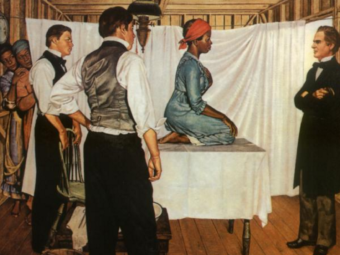
Illustration of Dr. J. Marion Sims with Anarcha by Robert Thom. Courtesy of Southern Illinois University School of Medicine, Pearson Museum. Pearson Museum, Southern Illinois University School of Medicine
There are three statues in the United States honoring Dr. James Marion Sims, a 19th-century physician dubbed the father of modern gynecology. Invisible in his shadow are the enslaved women whom he experimented on. Today, they are unknown and unnamed except for three: Anarcha, Lucy, and Betsey. This week, we grapple with their story and the troubling history of medical experimentation on African Americans.
The Hidden Brain Podcast is hosted by Shankar Vedantam and produced by Kara McGuirk-Alison, Maggie Penman and Max Nesterak. To subscribe to our newsletter, click here. You can also follow us on Twitter @hiddenbrain,@karamcguirk,@maggiepenmanand@maxnesterak, and listen for Hidden Brain stories every week on your local public radio station.
Copyright 2016 NPR. To see more, visit http://www.npr.org/.
Read original article – February 21, 2016 9:53 AM ET
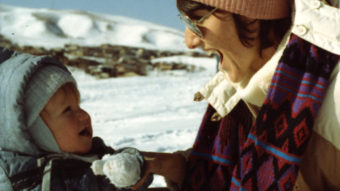
Sue Klebold plays in the snow with a young Dylan. “He’s like an invisible child that I carry in my arms everywhere I go, always,” she says. Courtesy of Sue Klebold
On April 20, 1999, when Sue Klebold heard about a shooting incident at Columbine High School, her thoughts immediately turned to her 17-year-old son, Dylan, who was a senior there.
“In the very beginning, I didn’t know what to think,” Sue tells Fresh Air’s Terry Gross. “I was aware that there was a shooting incident occurring at the school. I didn’t know if Dylan was in danger, if someone was trying to shoot him, if he was doing something.”
Gradually the truth emerged: Dylan and his friend, 18-year-old Eric Harris, had gone on a shooting rampage at the school, murdering 13 people and injuring 24 others before killing themselves.
For a long time, Sue was in denial about her son’s role in the massacre. She told herself that Dylan had been brainwashed or coerced into the plan — or that he hadn’t really shot anyone. But then she saw the “Basement Tapes,” a set of videos Dylan and Harris had made in which they brandished guns and bragged about the destruction they were planning, and her understanding of Dylan’s role in the rampage changed.
“Seeing those tapes was one of the most shocking, dramatically traumatic things that happened in the aftermath of this, because I had been living with such a different construct to try to cope with what I believed to be true,” she says.
In her new memoir, A Mother’s Reckoning, Sue describes the guilt, despair, shame and confusion that have plagued her in the 17 years since the Columbine massacre. She hopes that her book will honor the memories of the people her son killed, and perhaps help other parents whose children may be struggling with mental health issues. (All of the author revenues from the book, minus expenses, will be donated to research and charitable foundations focusing on mental health issues).
As for Dylan, Sue says she wishes she had listened to him more carefully in the years preceding the shooting. She wonders what questions she could have asked that might have encouraged her son to open up about whatever he was feeling. She adds that despite everything, she has never stopped loving him. “I will love him until I breathe my last breath,” she says. “He’s like an invisible child that I carry in my arms everywhere I go, always.”
Interview Highlights
On realizing that one of the “Basement Tapes” had been filmed in her house
When I saw that one of those scenes was actually shot in our home one night, and it was a night when Eric had spent the night, it was jaw-dropping. All I can tell you is I gasped out loud and I said, “That’s his room!” It was just a complete shock that something could happen like that in my own home — that I didn’t know the two of them had weapons and that Eric had brought weapons to our house.
We went back and thought about that evening, and we remembered when Eric spent the night and he had brought a big duffel bag in and we had just assumed it was, I don’t know, perhaps a video camera or a computer — we weren’t in the habit of asking guests what they were bringing over — and we had to sort of put these pieces together of what the boys had been doing that night, and it was a complete shock.
On how she believed Dylan to be posturing in the Basement Tapes
What I saw in those Basement Tapes, what appeared to me to be occurring, was that he was posturing, that he was putting on some kind of a performance to prove not only to Eric but possibly to himself that he was this tough, hateful human being, who was kind of revving himself up to do this. So that was the sense I got from those tapes, and I think one of the things that was most frightening to me when I saw those tapes, was the thought that if and when these become available to the public, how the public couldn’t possibly believe that the other child that I knew existed and was so different from the one on the tape. I knew that trying to illustrate that would be impossible, if they had seen this image of this hate-filled person.
On why she advocated for the destruction of the Basement Tapes
I advocated for their destruction because there is a great deal of research to show that making these available to the public is dangerous — that vulnerable kids will look at these and copy these and use what happened at Columbine as a benchmark for other events such as this. So there is certainly a lot of documentation to support that making them public is a very poor and very risky idea.
I had an additional reason as well as that … I knew that if people believed that someone who was going to do something as heinous as Dylan did, acted openly as Dylan did in that tape, they would develop a false sense of security to be able to say, “My loved one doesn’t act like that, therefore I am safe. My loved one is not at risk.” And I think for me, that was one of the most dangerous things about these tapes is to realize, this was not his [affectation] on a daily level, this was the two of them acting, doing theater, doing a performance, in front of a videotape, and it would be very deceptive to release that kind of information and have people expect to see behavior like that when someone was very disturbed, because that is not the truth.
On if she considered whether the Dylan in the tapes was the real Dylan
His writings tell a different story. His writings show that he was someone who was very focused on love, he was very focused on a sense of conscience, he had a secret crush on an unidentified female at his school, and his writings do not reveal the level of irrational anger that the tapes revealed. And also, the fact that I had known him, of course, all of his life and known him to be a gentle and a loving person, so from everything I have been able to learn about this, from every piece of evidence I can find, it was the behavior on the tapes that was the aberration, and it was something that he was doing, in many ways, I believe, to prepare himself to do what he was about to do.
On Dylan’s suicidal thoughts
When I refer to Dylan’s suicidal thoughts and his behavior, I want to make it very clear that I am not trying to discount the fact that he also committed murder. I perfectly am aware, always, every minute, of the lives that he took and the lives that he ruined, but murder-suicide, which is what this event was, is one manifestation of suicide. It is what can happen with a suicide. It is generally now believed more and more to be motivated by the same things that motivate a suicide rather than a homicide.
So I have done a lot of research on suicide and tried to understand Dylan’s thinking. Yes, in his writings, a full two years before he died, he is talking about being in agony, being in pain, about his thoughts, wanting to end them. He writes about wishing he had a gun. He even wrote about cutting himself at one point. So, yes, I believe that he was experiencing persistent suicidal thoughts and depression at least two years before this event grew and grew and escalated into this terrible tragedy.
On whether she blames herself for Dylan taking his own life and murdering others
I, like many survivors of loss, when someone takes their own life, do think those thoughts. I felt for a very long time that it must’ve been something I did, and I went back to ridiculous detail into our past, and I remember at one point sobbing because when Dylan turned 3 I had only put sprinkles on his birthday cake, but when his brother turned 3, I had decorated the cake with icing, thinking, “It must’ve been something like that, where he didn’t feel equally loved.” I know that sounds ridiculous — that is the kind of work that you do in your head when something like this happens.
So I examined and I questioned and I blamed, and to this day I do it still — occasionally I fall back and think, “If I had done this, if I had not done this.” But over time, with all the research I was doing into behaviors and losses due to suicide, I really began to see that these things were things within Dylan’s brain and his thinking, and that I might’ve in some way inadvertently contributed to his perception of something at a given moment, but I did not believe and still don’t believe that I caused this or caused him to have this perception of himself and his worldview.
On what she wishes she could’ve done differently as a parent
I wish that I had had the ability to delve deeper and ask the kinds of questions that would’ve encouraged him to open up more to me. I had parented my kids, in many ways, the way I had been parented, which means you listen to your kids’ problems and you try to fix them. … I think what I needed to do with Dylan more was to just shut up and listen, to try to get him to say to me what he was feeling and thinking about something, rather than to automatically jumping to a way to make him not feel that way or to fix the way he felt.
On people destroying the crosses for Dylan and Eric in a memorial of the victims
I can’t presume to even know what [the families] were experiencing and what the level of their grief was. I completely understood their need to express what they were feeling, and that their feelings were such that they could not tolerate having those memorializations there. I feel certain that I would’ve felt the same way.
But like everything after a murder-suicide event, the feelings are so complicated that you feel so many things at once. There was a part of me that felt responsible and empathetic … and there was a part of me, as a mother, that was very hurt by this expression of hatred for my son. But this is all part of why the experience was something I wanted to write about, because there are all kinds of feelings that we have, and I can understand the need to express that kind of rage, but I hope also that people will understand my need to love the child that I lost. …
What I use as my guide is that I want to educate people. I want people to know that even family members of people who do horrible, heinous things are still human beings, and that perhaps by meeting me and seeing that I am not a crazed person, that maybe it will broaden their understanding and they will have a little bit more compassion for someone else.
Copyright 2016 Fresh Air. To see more, visit Fresh Air.
Read original article – February 16, 2016 12:32 PM ET
A screen capture from Alaska Airlines’ website. Amid criticism, the phrase “Meet our Eskimo” was changed to “Meet the Eskimo.”
When Alaska Airlines unveiled a new look for their airplanes and website, many Alaska Natives took offense to a phrase in their marketing campaign.
Alaska Airlines’ website prominently featured the familiar face of a smiling Alaska Native elder and included the phrase “Meet our Eskimo.” It’s sparked a controversy and a new conversation about what “Eskimo” means to Alaska Natives.
The phrase was quickly changed to “Meet the Eskimo,” but some Alaska Natives say that doesn’t go far enough.
“I would rather be called ‘Inupiaq’ because that’s what I am and my children are Yup’ik,” said Blossom Twitchell from Kotzebue. “I want them to be able to connect to their culture and people won’t group us in as little people that live in igloos and give little Eskimo kisses all the time. We are so much more than that. We have culture and traditions that have been passed down for generations and I don’t believe the word Eskimo does our heritage justice.”
After the Alaska Airlines redesign incident, Twitchell decided to take it a step further by starting a petition asking the Bureau of Indian Affairs to stop identifying people’s ethnicity as “Eskimo” in federal paperwork. The petition had 75 supporters as of Saturday evening.
Much like the familiar face on the tail of the Alaska Airlines planes, no one seems to have a definitive answer on where the word Eskimo came from. An article by University of Alaska Fairbanks linguist Lawrence Kaplan said the word meant “eater of raw meat” and might have been given to the Inupiaq people by Western explorers. The article also says the Canadian version of the word could have come from an Ojibwa word meaning “netter of snowshoes.”
The word isn’t used much in Canada where it’s considered offensive by many Inuit in the country. But Alaska Natives say they have been using the word for a while.
“In my first memories, we used Eskimo when referring to ourselves or each other,” said Nels Alexie, a Yup’ik elder from Bethel. “Then along the way we started using the word Yup’ik to describe ourselves.”
Like many Yup’ik interviewed for this story, Alexie is accustomed to the term and has no firm position about whether it’s appropriate or not.
Other Yup’ik elders, however, don’t like the term.
“If we stop using the names other people give us, they will understand,” said Theresa John, an associate professor of indigenous studies at University of Alaska Fairbanks. “Our ancestors were proud to be Yup’ik and were strengthened by their way of life. They wanted us, their descendants, to keep our tradition alive. Not to act like it’s not there, but to understand it and to live it.”
John also added noted that “Eskimo” isn’t part of the Yup’ik language, or any Native language in Alaska, originally.
Tiffany Zulkosky from Anchorage, and the former mayor of Bethel, sent a letter to Alaska Airlines expressing her disappointment about their website statements and invited them to participate in the racial equity summit sponsored by the First Alaskans Institute.
Alaska Airlines CEO Brad Tilden
In a statement, Alaska Airlines CEO Brad Tilden apologized on behalf of the company for the “insensitive reference.” The airline stated it is looking forward to working with the Alaska Native community to ensure their actions reflect their respect for all Alaska Natives and Alaskans.
Loose-leaf green tea of the modern variety. Archaeologists have discovered ancient tea in the tomb of a Chinese emperor who died in 141 B.C. It’s the oldest known physical evidence of tea. But scientists aren’t sure if the emperor was drinking tea as we know it or using it as medicine. iStockphoto
Tea is often referred to one of the world’s oldest beverages. But just how old is it?
A Chinese document from 59 B.C. refers to a drink that might be tea, but scholars cannot be certain. Now, a new analysis proves that plant remains found in tombs 2,100 years old – about 100 years before that document – definitely are tea, the oldest physical evidence for the drink. And the buried tea was high-quality stuff, fit for an emperor.
That’s no surprise, because one of the tombs, the Han Yangling Mausoleum in Xi’an in western China, was built for the Jing Emperor Liu Qi, who died in 141 B.C. The other tomb is the slightly younger Gurgyam Cemetery (maybe A.D. 200) in Ngari district, western Tibet. In both, archeologists found remains of millets, rice and a kind of spinach. They also found tiny leaf buds that bore an uncanny resemblance to the finest tea.
The 2,100-year-old tea leaves were found in the tomb of the Jing Emperor Liu Qi, who died in 141 B.C. His portrait hangs in the Han Yangling museum in Xianyang, China. Brücke-Osteuropa/Wikimedia Commons
While those buds did look like tea, there was a chance they could be some other plant. To confirm their suspicions, the researchers compared the chemistry of the leaves with modern samples of tea. The ancient leaves contained unmistakable traces of caffeine, present in tea and also in a few other plants. The clincher was equally unmistakable traces of theanine, a chemical found only in plants of the tea family, with especially high levels in tea itself. Crystals found on the surface of the leaves also matched crystals on modern tea leaves.
Tea does not grow in the area of the tombs, so the evidence shows not only that it was present and valued enough to be buried with important people, but also that it was being imported to Xi’an at least 141 years B.C., and westwards into Tibet by the second century.
Gurgyam Cemetery also yielded woven silk cloth, metal bowls and a gold mask, further supporting the idea that luxury goods were already moving along early tracks of the Silk Road 2,000 years ago. It was Emperor Jing’s son, Emperor Wu, who really promoted the development of trade along what became the Silk Road.
Dorian Fuller, professor of archaeobotany at University College, London, and a member of the research team, says he’s pleased that modern science is able to provide details of ancient Chinese culture.
“The identification of the tea found in the emperor’s tomb complex gives us a rare glimpse into very ancient traditions which shed light on the origins of one of the world’s favorite beverages,” he tells us.
Other scholars wonder whether the emperor was drinking tea as we know it, despite the apparent high-quality buds.
James Benn, professor of Buddhism and East Asian religions at McMaster University in Canada and author of the recent book Tea in China: A Religious and Cultural History, agrees that tea was consumed “in some form” 2,100 years ago.
“But,” he adds, “I’m not convinced that this is a discovery of ‘tea drinking’ as it was later understood. It could have been used along with other ingredients in a medicinal soup, for example.”
The remains from Gurgyam Cemetery in Tibet may support this view. They contained barley and other plants mixed with the tea. As the researchers write in the online Nature journal Scientific Reports, this offers the intriguing possibility that the plants “were consumed in a form similar to traditionally prepared butter tea, in which tea is mixed with salt, tsampa (roasted barley flour) and/or ginger in the cold mountain areas of central Asia.”
No matter how it was being used, this research pushes back the verified history of tea in China and Tibet. Tradition says that tea came to Tibet as part of the Chinese princess Wencheng’s dowry on her betrothal to the Tibetan Songtsen Gambo, around 640 A.D. The tea found in Gurgyam Cemetery is some 450 years older than that.
Tea Tuesdaysis an occasional series exploring the science, history, culture and economics of this ancient brewed beverage.
Jeremy Cherfas is a biologist and science journalist based in Rome.
Copyright 2016 NPR. To see more, visit http://www.npr.org/.
Read original article – January 26, 2016 2:14 PM ET