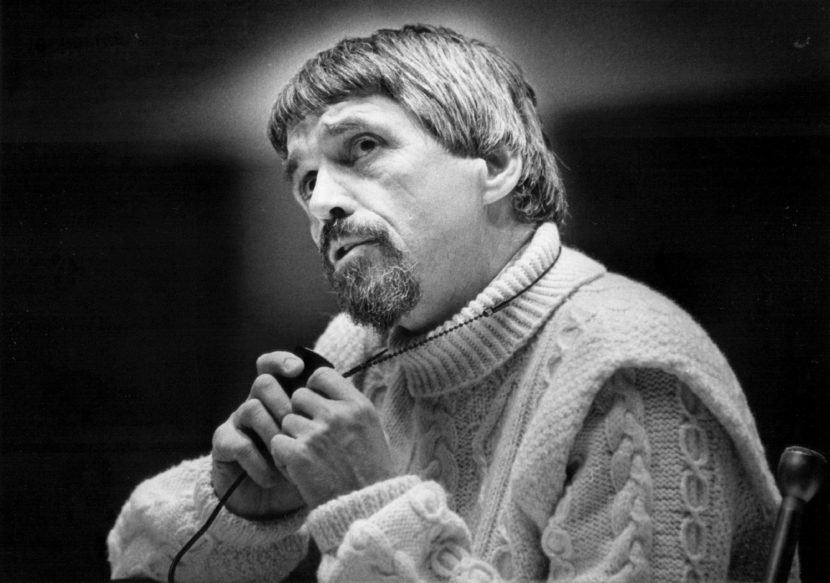
Daniel Berrigan speaks in Colorado in 1974. Jodi Cobb/Denver Post via Getty Images
The Rev. Daniel Berrigan, a Jesuit priest who became emblematic of the movement opposing U.S. involvement in Vietnam after an audacious act of civil disobedience, died on Saturday.
The Jesuit magazine, America, reports that he died at age 94 at the Murray-Weigel Jesuit Community in the Bronx, New York.
Berrigan was an acclaimed poet but he came to national prominence when he and eight others stole hundreds of draft records from the Selective Service Offices in Catonsville, Maryland.
They walked outside and set the documents on fire using homemade napalm.
Berrigan was taken to jail. During his trial, the burnt documents were trotted into court.
“They introduced those in evidence as though they were important,” Berrigan said in the documentary Investigation of a Flame. “And they were nothing. I mean we had burned papers instead of children. That was our crime.”
The New York Times reports that Berrigan was convicted of destroying government property and he was sentenced to three years in prison. He tried to evade authorities but was eventually caught.
The Times adds:
“[His brother] Philip Berrigan had been the main force behind Catonsville, but it was mostly Daniel who mined the incident and its aftermath for literary meaning — a process already underway when the F.B.I. caught up with him on Block Island, off the Rhode Island coast, on Aug. 11, 1970. There was ‘The Trial of the Catonsville Nine,’ a one-act play in free verse drawn directly from the court transcripts, and ‘Prison Poems,’ written during his incarceration in Danbury.
“In ‘My Father,’ he wrote:
I sit here in the prison ward
nervously dickering with my ulcer
a half-tamed animal
raising hell in its living space
In recent years, America Magazine reports, Berrigan continued his anti-war activism. He protested the wars in Afghanistan and Iraq.
Copyright 2016 NPR. To see more, visit http://www.npr.org/.
Solar Impulse 2 pilots Bertrand Piccard (right) and Andre Borschberg celebrate after Piccard landed their solar-powered plane at Moffett Field in Mountain View, Calif., on Saturday. Noah Berger/AP
Experimental solar-powered plane Solar Impulse 2 has landed in Mountain View, Calif., after a three-day flight across the Pacific.
“Good morning, California!” the plane’s visibly emotional pilot Bertrand Piccard told a cheering crowd at Moffett Airfield, where he landed at 11:44 p.m. local time. He’s soon handed an extra large bottle of champagne.
The Solar Impulse team is attempting to fly around the world using only the power of the sun.
As we reported, Piccard took off from Hawaii early Thursday after a nine-month delay for repairs. The previous leg, a five-day long trip from Japan to Hawaii, broke a world record for the longest duration nonstop solo flight. But it also fried the plane’s batteries.
The journey across the Pacific was the ninth leg in their journey, which started in Abu Dhabi. The team hopes to eventually end there.
It’s meant to send a message about clean energy, the team says in a statement:
“By attempting the first solar flight around the world, pushing back the boundaries of the possible, going into the unknown, and taking on a project deemed impossible by industry experts, Bertrand Piccard and [alternating pilot] André Borschberg want to support concrete actions for sustainability and show that the world can be run on clean technologies.”
Copyright 2016 NPR. To see more, visit http://www.npr.org/.
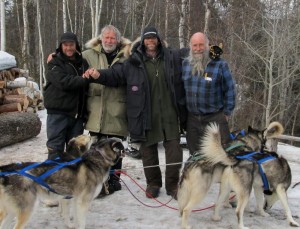
Expedition members celebrate their success upon arrival in Eagle. (Photo courtesy of InAmundsensFootsteps.com)
An international team of explorers returned recently from a grueling 700-mile dogsled journey from the Arctic Ocean to Eagle, Alaska. They were the first to retrace the route that legendary explorer Roald Amundsen took in 1905 after his historic transit of the Northwest Passage.
Winds were howling Feb. 28 when the three explorers set down on Herschel Island, just off the coast of Yukon Territory about 50 miles east of the U.S.-Canada border. A breathless videographer announced their arrival after they flew in from Inuvik, Northwest Territories.
“Here they are, Tim Oakley, Wayne Hall, Graham Burke, out here on Herschel Island,” they said.
Oakley, Burke and Hall had already been on the trail for eight days. And after a day’s rest on the island, they set out for the return trip to Eagle on the route Norwegian explorer Roald Amundsen took in 1905 after he’d navigated the Northwest Passage – the first known transit of the icy route along Canada’s northern coast. Amundsen went to Eagle because it was the closest telegraph station – and, Oakley said, he wanted to get to get the word out about his historic voyage.
“He wanted to tell the world that he’d done it,” said Oakley. “So he made a 700-mile sledding journey from Herschel Island to Eagle.”
Oakley was born in Canada and grew up in the U.K., and he’s a fellow with the Royal Geographical Society. He says the society supported the expedition in part as a learning opportunity for students in Alaska, Canada, Norway and the U.K., who were able to monitor his journey through a blog he posted to the project website titled “In Amundsen’s Footsteps.”
“The educational program is to highlight the fragility of the Arctic regions, and climatically, what is happening up there,” Oakley said.
Oakley said this wasn’t a scientific expedition, but rather a journey that might offer a snapshot of changes underway in the region. For example, he says Amundsen traveled over the frozen Yukon River when he set out in October 1905 – which might not be possible today.
“Last year, the river didn’t freeze up at Eagle ’til about mid-December,” said Oakley.
Oakley said the warming climate probably led to the early breakup and overflow of the Firth River in far northern Yukon Territory. The flood-soaked the three mushers and their dogs on the second day of their journey, and they spent a miserable 48 hours waiting for winds to die down.
“I think for all of us, the Firth was the most difficult part of the whole expedition,” Oakley said. “It was extreme.”
Burke said Hall’s outdoorsman savvy helped the team survive the ordeal.
“I don’t know that we would’ve gotten through without Wayne’s skills,” said Burke.
Oakley said his team had been trying to maintain the same timeframe as Amundsen’s expedition. But he says they picked up the pace near the end of the journey as they were approaching Eagle.
“The weather started to get warmer and warmer, and the snow conditions were starting to get difficult,” Oakley said. “And running dogs in hot weather is not particularly desirable.”
Oakley and Burke said the huskies Hall raised at his home in Eagle deserve most of the credit for the successful expedition. And Oakley said they also appreciate the support from others who run or race dogs.
“I think the heroes of this, as Graham’s pointed out, are the dogs,” said Oakley. “They are exceptional dogs. And I think we were very lucky that we had a lot of mushers from the Yukon Quest and from the Iditarod who were following us.”
Burke, who’s worked with dogs in his native New Zealand, said the team’s respect for animals shows another difference between the two expeditions.
“Back in Amundsen’s day, the dogs were an expendable commodity, if you like,” Burke said.
He says all 22 huskies returned home safely. And one even gained a few pounds out on the trail.
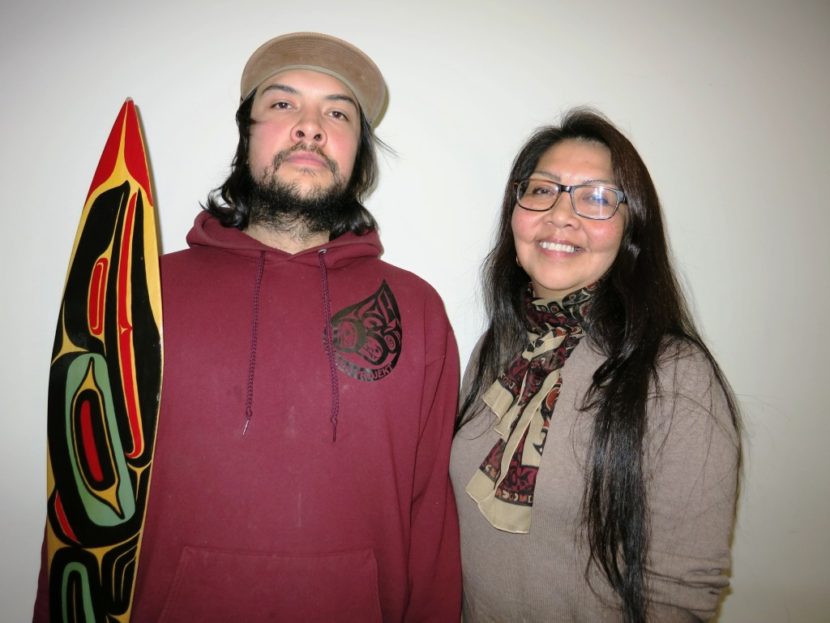
Ted Hart and Harriet Brouillette. (Photo by Emily Files/StoryCorps)
Harriet Brouillette’s family history is wrought with identity struggles. In a StoryCorps interview from the Haines and Juneau Public Libraries, Brouillette told her son, Ted Hart, about her and her family’s experiences growing up Tlingit.
Brouillette says her mother attended boarding school at The Wrangell Institute. There, she was punished for speaking her language.
“She had experiences like being locked in a closet for speaking her language. She was hit with a ruler and had her mouth washed out. But she was pretty stubborn and determined to learn and hold on to Tlingit,” Brouillette said. “You had to be pretty determined to hold on to your language because the educational system was pretty determined to scrub it out of you.”
But when Brouillette was growing up, her mother and father didn’t want their children to learn the language. Brouillette says she doesn’t know why her mother strived to hold on to the language herself but didn’t pass it on to her children.
“I know that she learned a lot of shame in her language and her culture. And she told me one time when we were born, she hoped we didn’t look Native.”
Brouillette says she didn’t understand at the time. Why would she not want her children to look Native when that’s what they are? That caused Brouillette to feel the opposite.
“So when you were born, I was very happy you were brown and had dark hair,” Brouillette recounted to Hart. “And I made a point of telling her, ‘Look at my child, I want him to look like this. I want him to be brown, I want him to have dark hair. I want him to know who he is. I want him to know he’s a Raven Frog.’ If that’s the only thing I taught you, it was gonna be to be proud of who you were.”
Brouillette says she has ‘large aspirations’ for Hart and his brother. She says she’s proud of Hart’s kindness, honesty and pride in his culture.
“You’re proud of who you are. You’re proud of the color of your skin, you’re proud of your history and your ancestry. What more could I ask for? So my aspiration for you is that as you grow older, you continue to share the love of your culture with not only your children but everyone else’s children. … Culture-bearer is what I hope for your future.”
Hart adds that people should research the Tlingit culture to discover its wisdom for themselves.
“There’s just ancient, ancient knowledge in there about nature and the way things work. And I think that’s really important in this day and age, with the way things are going with the climate and things of that nature.”
This StoryCorps interview was recorded by the Haines and Juneau Public Libraries and produced by KHNS’s Emily Files. Listen to the interview here. StoryCorps is a national nonprofit whose mission is to provide Americans of all backgrounds and beliefs with the opportunity to record, share and preserve the stories of our lives. More information at storycorps.org.
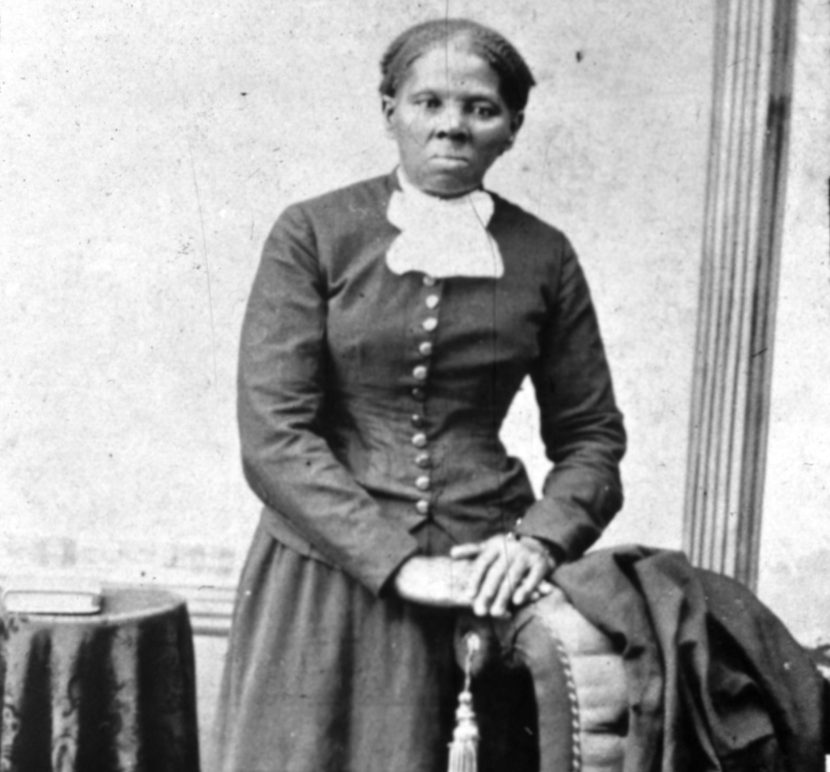
American abolitionist leader Harriet Tubman (1820-1913), who escaped slavery by marrying a free man and led many other slaves to safety using the abolitionist network known as the underground railway. MPI/Getty Images
Treasury Secretary Jacob Lew is expected to announce that he has decided to put abolitionist leader Harriet Tubman on a new $20 bill, according to a spokesman for the Treasury Department.
The decision caps a public campaign asking for the change and months of deliberation by the Treasury to either replace Alexander Hamilton on the $10 bill or Andrew Jackson on the $20 bill.
As we reported, an unofficial contest by the activist group Women on 20s gave the nod to Tubman to take Jackson’s place on the $20 bill. The campaign then sent a petition to President Obama.
As we reported:
“We’ll note that Tubman’s appearance on the $20 bill would have a special historical resonance: That’s the same amount she eventually received from the U.S. government as her monthly pension for her service as a nurse, scout, cook and spy during the Civil War, as well as for her status as the widow of a veteran.”
Jackson, it’s also worth noting, was a slaveholder.
The Treasury had previously said it would roll out a brand new $10 bill in 2020 and that it would feature a woman. But the popularity of the broadway show “Hamilton” might well have put a stop to that plan.
The New York Times reports that Hamilton will remain on the front of the $10 bill, but images of women will be put on the back of the bill. The $10 is still expected to be introduced by 2020. The Wall Street Journal reports that it’s not clear when the new $20 bill will be introduced.
Lin-Manuel Miranda, the creator of “Hamilton,” personally lobbied Lew and after a meeting last month, he tweeted that the Treasury secretary had told him “you’re going to be very happy.”
In an interview with Charlie rose in March, Lew also previewed his decision saying, “Alexander Hamilton is one of my heroes. He’s not leaving our money.”
Hamilton was the country’s first secretary of the treasury.
Copyright 2016 NPR. To see more, visit http://www.npr.org/.
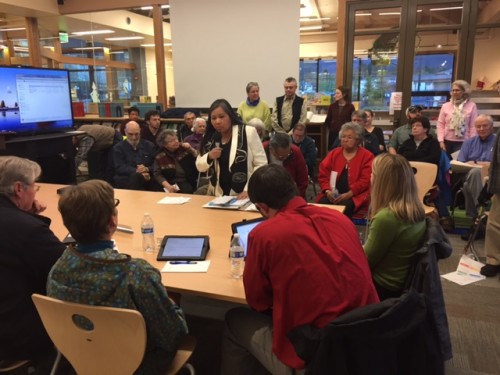
The Planning Commission listens to citizen testimony about land use. Paulette Moreno of the Alaska Native Sisterhood urged the commission to include Tlingit elders in the process. (Photo by Emily Kwong/KCAW)
The Planning Commission is revising the land use section of Sitka’s Comprehensive Plan. And they’re inviting the public to weigh in. By devoting one meeting a month to land use, the commission hopes to get policies up to speed with modern practices. But at recent meeting, it was the past – not the future – that took center stage.
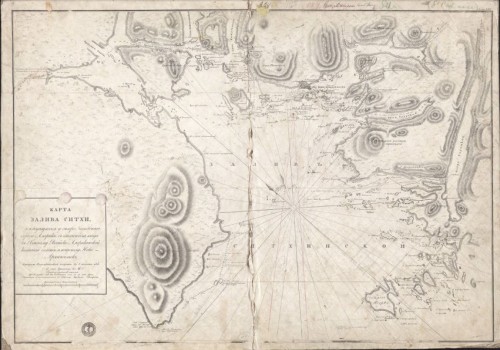
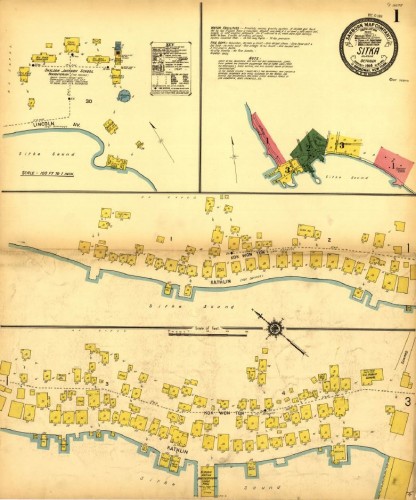
At the top of the meeting, the Planning and Community Development Commission presented a series of maps – drawn up by Russian and American settlers in the 1800s.
In tiny ink boxes, you can see the footprint of Sitka’s earliest homes and business. One set of maps, from the Sanborn Map and Publishing Company, were created for fire insurance purposes.
A 1826 map of Sitka Sound, drawn up by Russian settlers. You can make out Bjorka Island in the bottom right corner. (Map courtesy of the Sitka Planning Commission)A 1914 fire insurance map of Sitka, published by the Sanborn Map and Publishing Company. The map provides a snapshot of urban development in WWI-era Sitka. (Courtesy of the Sitka Planning Commission)
The presentation was intended to acquaint the 50 or so Sitkans in the audience with the early history of land use. But for some, it also touched a nerve.
Paulette Moreno is the president of the Alaska Native Sisterhood (ANS). Picking up the microphone shortly after the presentation, she said, “Out of respect for the Tlingit people and the land on which you are speaking on – Sheet’ka Kwaan – at every moment, at every time, you are a guest here.”
She then drew attention to one particular chapter of the plan, last updated in 2007. “We’re referred to as ‘Ethnic Diversity and Native Issues.’” Moreno paused. “Words are very important. I don’t consider myself or the people that walk amongst me or even any of our neighbors as ‘issues.’”
Moreno was not alone in challenging the commission to tread with sensitivity as they revise the comprehensive plan. Flanking her on both sides were tribal leaders and citizens. They took up the entire first row. They talked about how Alaskan Natives have been ostracized – both physically and politically – from the development process time and again.
Joy Wood is an officer with ANS. “A lot of the Natives just clam up as soon as soon as they see a white person with a piece of paper. I’m a notary public and there are some Natives that no matter how hard they try, I cannot get them to sign their names on paper. Because they are traumatized.
Scott Saline said some of that trauma is more recent. He criticized a past Planning Commission for the failing to install adequate drainage on Kaagwaantaan Street, thus damaging a clan house.
Saline lives on nearby Katlian Street, where the Tlingit set up a village segregated from the Russian side of town. “The property that I’ve owned in Indian Village – once I’ve studied how I’ve been able to buy that – I’m ashamed that I have that,” Saline told the commission. “I have learned how that paperwork and good faith has been taken advantage of. That is the culture of resistance, where what the grandfather struggles to forget the grandson fights to remember.
Culture. History. Trauma. These aren’t words you’d expect to hear at a land use meeting, but they illustrate how complex and fraught the conversation is around land use in Sitka.
During a break in the public testimony, I asked Maegan Bosak, planning and community development director, whether this surprised her.
KCAW: Did you ever see yourselves as accountable for addressing trauma and providing healing? Those are very different orders than creating a land use plan.
Bosak: Yes, very different from planning but I think in the end it’s a part of our community. And that’s what we’re charged with doing. We feel honored to be able to provide that service.
And in many ways, Bosak says, candid public testimony is exactly what the Planning Commission wants. “These meetings will not just be held at the library. We plan to have one at the senior center. We plan to have one at ANB (Alaska Native Brotherhood) hall. We plan to go around town to really highlight different groups and make sure that their voices are a part of this plan,” Bosak said.
In the zoning code of the 1970s, housing lots were 4,000 square feet. Now, they’re 8,000 square feet, which a handful of participants, like Michelle Putz, criticized as too big and too expensive. Putz said, “I really want to see us working toward smaller lots and more options to develop small housing on existing lots to make housing more affordable, so that all of us can live here.”
With conversation flowing, the meeting was also as staging ground for various groups and individuals to pitch development ideas. That included creating agricultural zones — particularly in land deemed unsafe for housing — building a new lost-cost trailer court or higher density properties, and adapting roads to be safer for walkers and bicyclists.
There’s a lot that’s possible in Sitka, but the challenges posed by precedent – by history – are there too. Nancy Yaw Davis complimented the commission trying to reconcile the two. “Part of what you’re working toward is a fuller awareness and validation of what really matters. Place names can help with that,” Yaw Davis said. “So as you move into neighborhoods, return to the history. Each of those lots. Each section of Sitka.”
The Planning and Zoning Commission hopes to finalize the revised comprehensive plan by the spring of 2017 and is dedicating the first Tuesday meeting of every month to that project.
Close
Update notification options
Subscribe to notifications
Subscribe
Get notifications about news related to the topics you care about. You can unsubscribe anytime.

9(MDEwMjQ0ODM1MDEzNDk4MTEzNjU3NTRhYg004))

9(MDEwMjQ0ODM1MDEzNDk4MTEzNjU3NTRhYg004))
9(MDEwMjQ0ODM1MDEzNDk4MTEzNjU3NTRhYg004))